Stress and Strain
Surface interactions between continuous media are best described in terms of mechanical stress and strain. These fundamental quantities characterize how forces are distributed through materials and how materials deform in response.
Mechanical Stress
Stress (σ, sigma) is defined as force per unit area:
σ = f/Awhere:
- σ = stress
- f = force
- A = area over which force is distributed
Physical Meaning
Stress measures how intensely a force is distributed over a region. The same total force produces different effects depending on the area:
Example 1: High heels on a floor A woman weighing less than a man can apply more stress to a floor if she wears narrower heels because her weight is distributed over a smaller area.
Example 2: Sharp versus dull objects Sharp objects can penetrate hard barriers more easily than dull objects with the same force because stress is concentrated over a smaller area.
Types of Stress
Stresses can be oriented perpendicular to a surface, tangential (parallel) to a surface, or a combination of both.
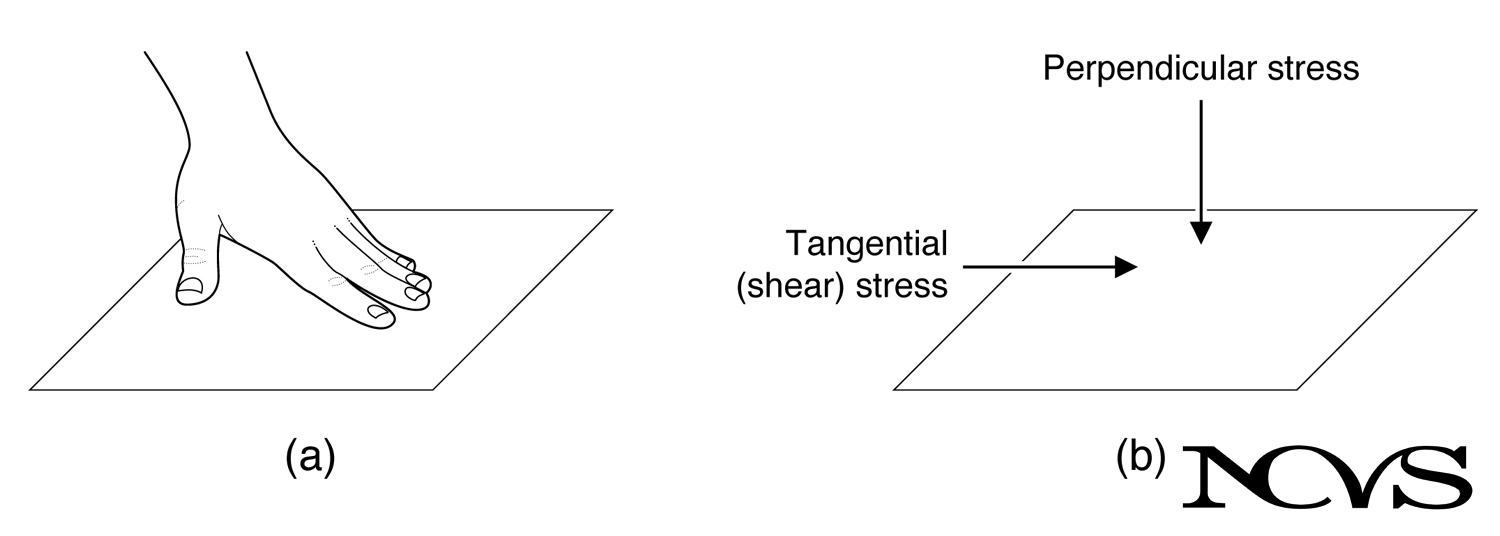 Figure 2.2: (a) Hand pushing top of a table at an angle; (b) The corresponding normal (perpendicular) stress and tangential (shear) stress.
Perpendicular Stresses
Stresses acting perpendicular (normal) to a surface:
Tensile Stress:
- Points away from the surface
- Tends to pull material apart
- Example: Stress in a rope supporting a weight
Compressional Stress:
- Points toward the surface
- Tends to push material together
- Example: Stress in a column supporting a building
Pressure:
- The magnitude of a compressional stress
- Commonly used quantity in voice science
- Will be discussed further in Chapter 3
Tangential Stresses
Shear Stress:
- All tangential stresses are called shear stresses
- Act parallel to the surface
- Tend to cause sliding of adjacent layers
Examples:
- Wind resistance along the side of a car (shear stress)
- Wind resistance against the front bumper (pressure)
- Stress in a connecting rod that flexes (shear stress)
- Stress in a straight connecting rod under tension (tensile stress)
Combined Stresses
In real situations, stresses are typically combinations:
- A hand pushing a table at an angle (Figure 2.2a) produces both perpendicular and tangential components (Figure 2.2b)
- Vocal fold tissue during vibration experiences tension, compression, and shear simultaneously
Strain
When stress is applied to any surface of a continuous medium, a deformation results, unless the medium is infinitely stiff.
Strain (ε, epsilon) measures normalized elongation:
ε = (L - L₀)/L₀where:
- ε = strain
- L = stressed (deformed) length
- L₀ = unstressed (rest) length
Key Properties of Strain
Dimensionless Quantity:
- Strain is a ratio of lengths
- Has no units
- Often expressed as percentage
Examples:
- Strain of 0.2 = 20% elongation over rest length
- Strain of -0.1 = 10% contraction over rest length
- Strain of 0 = no deformation
Sign Convention:
- Positive strain: Elongation (material lengthens)
- Negative strain: Contraction (material shortens)
Coupled Deformations
A deformation in one dimension typically results in opposite deformation in another dimension:
Examples:
- Elongating a rubber band contracts its thickness
- Active contraction of a muscle along its length increases its cross-section
- Stretching vocal fold tissue longitudinally reduces its thickness
This coupling occurs because materials resist volume change. When elongated in one direction, they contract in perpendicular directions to approximately preserve volume.
Volumetric Deformation
Expansion and Compression
If deformation is applied uniformly over the body to change its entire volume:
Expansion:
- Increase in volume
- In acoustic terms: rarefaction
- Example: Air expanding as pressure decreases
Compression:
- Decrease in volume
- In acoustic terms: condensation
- Example: Air compressing as pressure increases
Volumetric Strain:
ε_vol = ΔV/V₀where:
- ΔV = change in volume
- V₀ = original volume
Incompressibility
Sometimes volume is completely conserved during deformation—the medium is incompressible:
Characteristics:
- Volume remains constant
- Elongation in one direction requires contraction in another
- Strain in different directions must sum appropriately
Examples:
- Liquids are nearly incompressible
- Solids are nearly incompressible
- Biological soft tissues are approximately incompressible
Important Note: Incompressibility is an idealization. Some small volume change always occurs with any deformation, but it serves as a reasonable approximation for many biological materials, particularly soft tissues of the human body.
Stress-Strain Relationships
The relationship between stress and strain defines material behavior:
Linear Elastic:
- Stress proportional to strain
- Hooke’s law applies
- Example: Steel at small deformations
Nonlinear Elastic:
- Stress not proportional to strain
- Material still returns to original shape when stress removed
- Example: Rubber, biological tissues
Viscoelastic:
- Time-dependent relationship
- Both elastic and viscous components
- Example: Most biological tissues
Plastic:
- Permanent deformation remains after stress removal
- Material does not return to original shape
- Example: Clay, metals beyond yield point
Practical Examples
Example 1: Vocal Fold Tissue
During phonation, vocal fold tissue experiences:
Tensile stress:
- Longitudinal stretching from muscle contraction
- Determines vocal fold length and tension
Compressional stress:
- From collision with opposite fold
- From aerodynamic pressure
Shear stress:
- Between tissue layers with different velocities
- During mucosal wave propagation
Strain:
- Can reach 30-40% during vibration
- Nonlinear response (tissue stiffens with increasing strain)
- Viscoelastic behavior (time-dependent)
Example 2: Hand Clapping
The stinging sensation after prolonged clapping results from:
Impact stress:
- Large force distributed over hand area
- Compressional stress perpendicular to palm
- Repeated application causes cumulative effect
Tissue response:
- Skin and subcutaneous tissue deform
- Viscoelastic properties mean some energy dissipates as heat
- Repeated stress can cause inflammation
This analogy helps understand vocal fold collision during phonation.
Multi-Dimensional Stress and Strain
Stress Tensor
In three dimensions, stress at a point is not a simple scalar or vector—it’s a tensor:
- Nine components (three normal, six shear)
- Describes stress on all faces of an infinitesimal cube
- Only six components are independent (symmetry)
Components:
- σ_xx, σ_yy, σ_zz: Normal stresses
- σ_xy, σ_xz, σ_yz: Shear stresses (with symmetric counterparts)
Strain Tensor
Similarly, strain is a tensor in three dimensions:
- Describes deformation in all directions
- Includes elongation/contraction and angular distortion
- Related to displacement gradients
Why This Matters
For simple cases (one-dimensional elongation), stress and strain are scalars. For complex biological tissues:
- Multiple stress components act simultaneously
- Deformation occurs in all directions
- Tensor description is necessary for accurate analysis
- Computer models use tensor formulations
Summary
Stress and strain are fundamental quantities in continuum mechanics:
Stress:
- Force per unit area
- Can be tensile, compressional (pressure), or shear
- Measured in Pascals (Pa) or kilopascals (kPa)
Strain:
- Normalized deformation
- Dimensionless (often expressed as percentage)
- Can be elongation, contraction, or volumetric change
Key Relationships:
- Deformation in one dimension typically produces opposite deformation in perpendicular directions
- Biological tissues are approximately incompressible
- Three-dimensional stress and strain are tensor quantities
For vocal fold tissue:
- Multiple stress types act simultaneously during vibration
- Strains can be large (30-40%)
- Relationship between stress and strain is nonlinear and time-dependent
- Understanding these quantities is essential for analyzing phonation mechanics
Key Takeaways
- ✅ Stress is force per unit area, measuring intensity of force distribution
- ✅ Three types of stress: tensile (pulling), compressional (pressure), and shear (tangential)
- ✅ Strain is normalized deformation, dimensionless, often expressed as percentage
- ✅ Deformation in one direction typically produces opposite deformation in perpendicular directions
- ✅ Biological tissues are approximately incompressible (volume preserved)
- ✅ Vocal fold tissue experiences multiple stress types simultaneously during phonation
Related Topics
Further Reading
- Fung, Y. C. (1981). Biomechanics: Mechanical properties of living tissues. New York: Springer-Verlag.
- Perlman, A. L., Titze, I. R., & Cooper, D. S. (1984). Elasticity of canine vocal fold tissue. Journal of Speech and Hearing Research, 27, 212-219.