One-Dimensional Stress-Strain Relations in Vocal Fold Tissue
Several investigations have been conducted to determine the force-elongation (or stress-strain) relationships for various layers of vocal fold tissue. Understanding these relationships is essential for predicting how tissue will respond during phonation and how different layers interact to control pitch and register.
Data Sources and Animal Models
Human Versus Animal Data
Some data come from human cadavers, but most measurements have been collected from animals, particularly canine larynges.
Assumptions about animal models:
- Canine larynx approximates human larynx in overall size
- However, morphology of lamina propria differs significantly
- Vocal ligament is virtually nonexistent in dogs
- Canine thyroarytenoid muscle bears closer resemblance to human
Implications:
- Results must be interpreted cautiously
- Human tissue data preferable when available
- Animal models provide valuable comparative information
Experimental Conditions
Tissue was kept alive during testing:
- Oxygen and nutrients supplied in tissue bath
- Temperature maintained at physiological levels
- Hydration preserved
- Measurements taken within hours of excision
Thyroarytenoid Muscle Tissue
Experimental Protocol
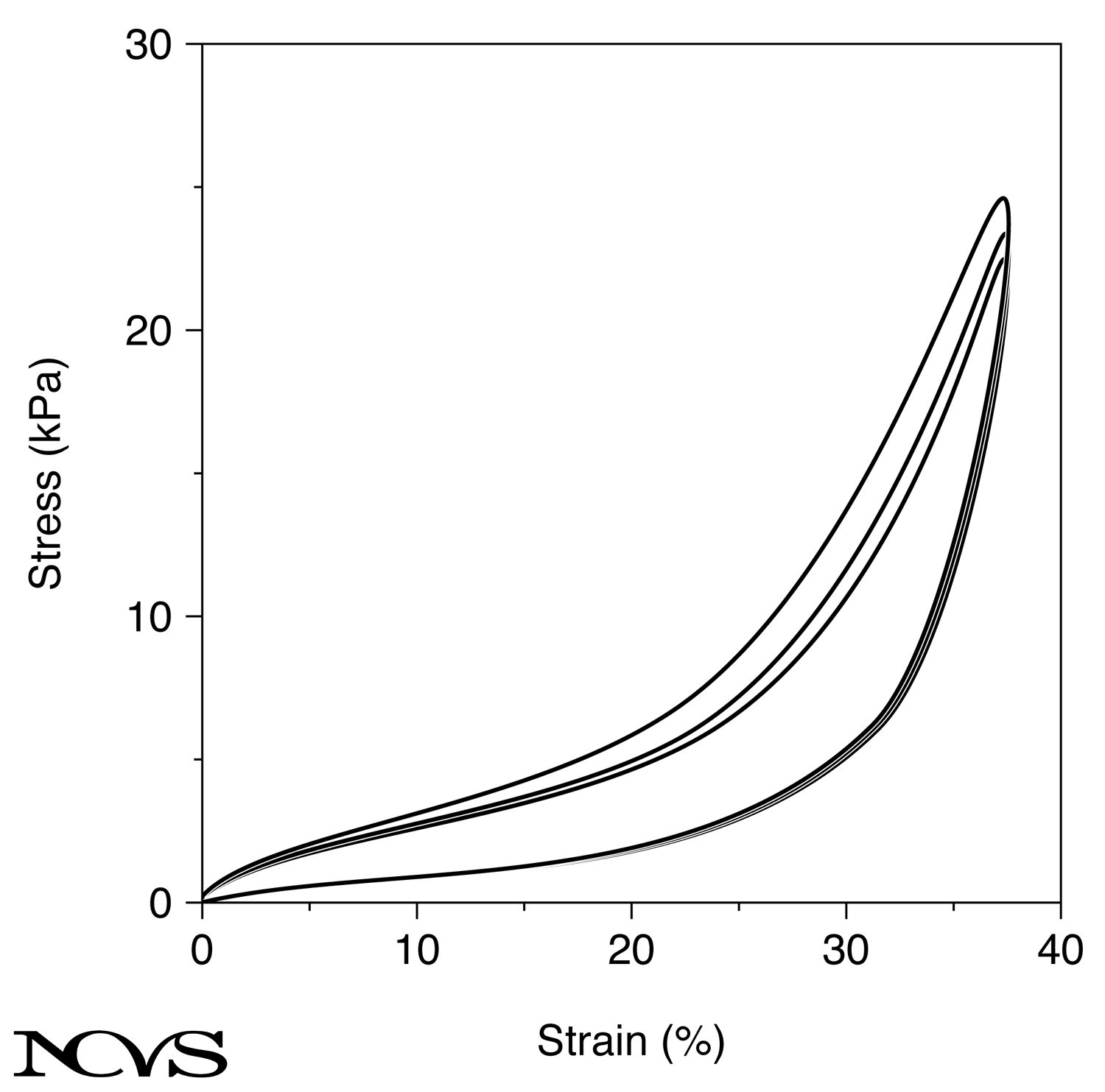 Figure 2.7: Stress-strain curves for canine thyroarytenoid muscle tissue obtained by cyclic stretch-release at 1.0 Hz.
Canine thyroarytenoid muscle in relaxed (inactive) state was tested using cyclic stretch-release:
- Rate: 1.0 Hz (one cycle per second)
- Direction: Longitudinal (along muscle fiber length)
- Cycles: Three repetitions
- Comparable to: Slow pitch change in conversational speech or song
Key Observations
1. Hysteresis: The “Banana Shape”
The stress-strain curve forms a distinctive banana shape:
- Top three curves: Stretch (loading) phase
- Bottom three curves: Release (unloading) phase
- Different paths: Stretch and release follow separate trajectories
Physical meaning:
- Tissue relaxes during cyclic process
- Unlike elastic spring (equal resistance loading/unloading)
- Thyroarytenoid muscle does not retain internal resistance
- Stress has “leaked out” during deformation
At 30% strain:
- Stress during stretch: ~10 kPa
- Stress during release: ~5 kPa
- Stress has relaxed to approximately half its loading value
Mechanism:
- Molecular bonds break in muscle and connective tissue fibers
- Broken bonds require “new grip” to return to normal
- Energy dissipated as heat (not recovered)
2. Settling Behavior
Early cycles differ from later cycles:
- First elongation: Most resistance
- Second elongation: Less resistance
- Third elongation: Even less resistance
- After 3-4 cycles: Behavior becomes repeatable
Interpretation:
- Tissue “settles” to stable process
- Initial testing disrupts some structural organization
- Subsequent cycles represent more stable mechanical state
3. Nonlinearity
The stress-strain relationship is highly nonlinear:
At 30% strain:
- Additional 5% elongation (to 35%)
- Loading: Doubles total stress
- Unloading: Triples total stress
General pattern:
- Small strains: Relatively low stiffness
- Large strains: Progressively increasing stiffness
- Tissue becomes much stiffer when already stretched
Analogy: Consumer economics example: If second pound of apples costs more than first, and third more than second, the price-quantity relationship is nonlinear. This is common in many natural and economic systems.
Mathematical Characterization
For nonlinear materials, multiple numbers are needed to quantify stress-strain relationship:
- Series of Young’s moduli at different strain levels
- Or coefficients of mathematical function fitting the curve
- Or parameters of exponential/polynomial expressions
Vocal Fold Cover Tissue
Composition
Cover tissue consists of:
- Epithelium
- Superficial layer of lamina propria
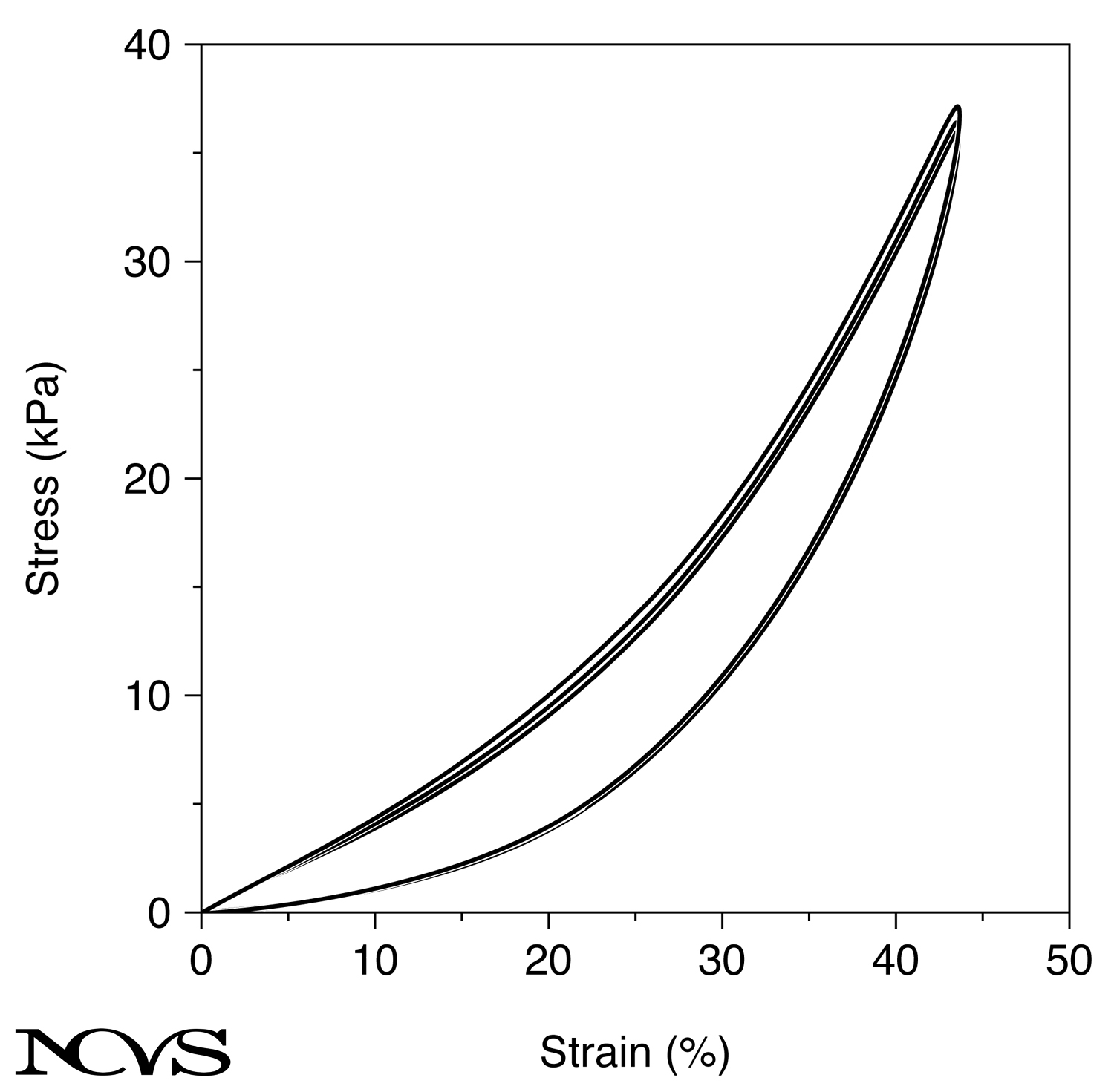 Figure 2.8: Stress-strain curve for canine vocal fold cover tissue obtained by cyclic stretch-release at 1.0 Hz.
Comparison to Muscle
The cover tissue curve (Figure 2.8) differs from muscle:
More linear:
- Curve closer to straight line
- Less curvature than muscle tissue
- More predictable stiffness
Faster settling:
- Requires somewhat less time to reach stable behavior
- Fewer cycles needed for repeatability
Still shows hysteresis:
- Difference between stretch and release remains
- Cover tissue also relaxes stress quickly over time
- Energy dissipation still occurs
Physical interpretation:
- Less complex internal structure than muscle
- Fewer molecular bonds to break and reform
- But still viscoelastic with stress relaxation
Stress Relaxation Over Time
Experimental Setup
Thyroarytenoid muscle was:
- Elongated quickly to specific strain level
- Held at constant length
- Stress recorded as function of time
- Normalized to maximum stress (value 1.0)
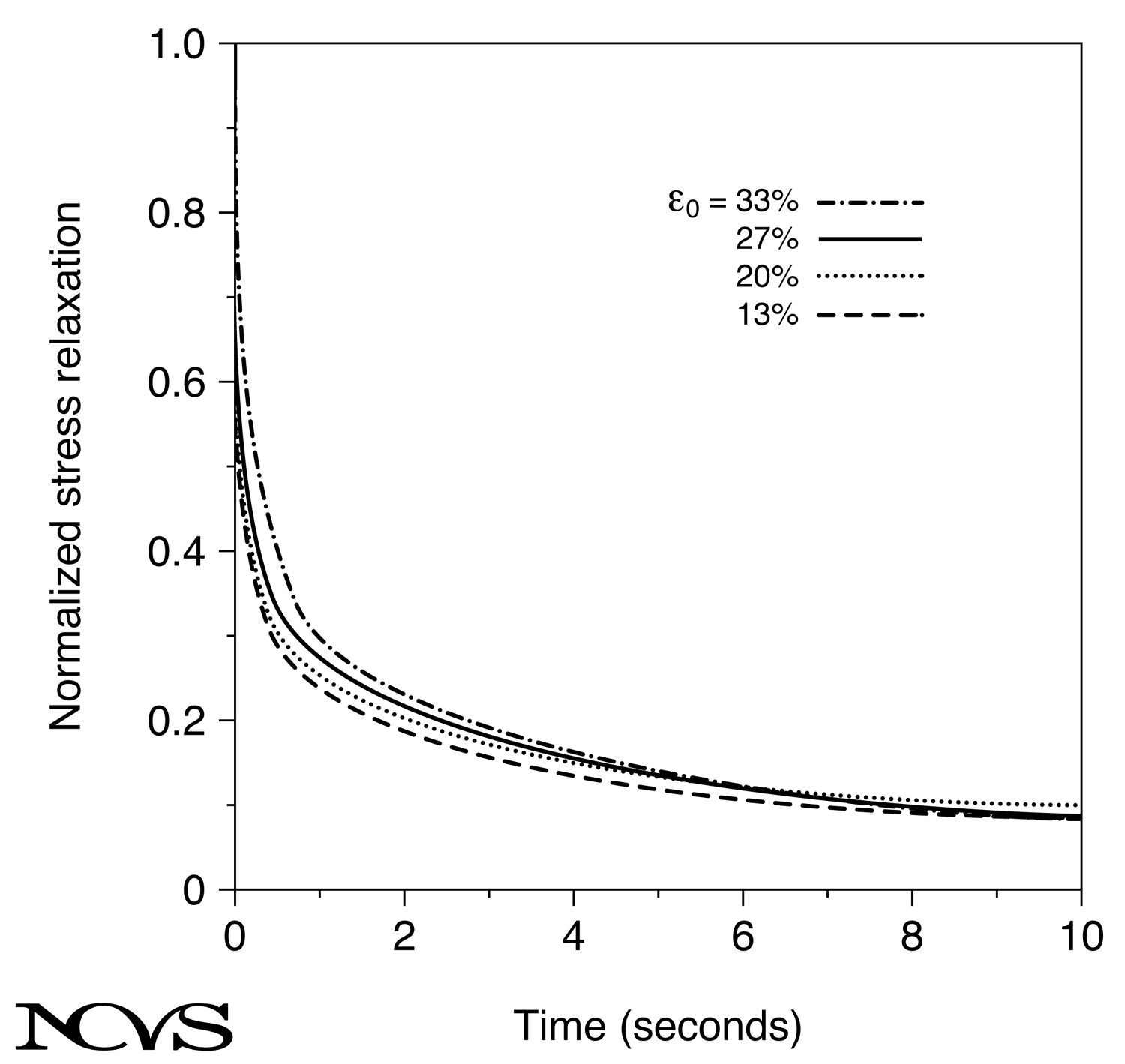 Figure 2.9: Normalized stress-relaxation curve for thyroarytenoid muscle at four different strain levels (13%, 20%, 27%, 33%).
Results
Quick initial drop:
- First second: Rapid stress decrease
- Most dramatic relaxation occurs immediately
Continued relaxation:
- Each subsequent second: Further stress decrease
- But in successively smaller amounts
- Exponential decay pattern
Long-term behavior:
- If held indefinitely at this length
- Tissue would ultimately release all stress
- Would reorganize (microscopically) to assume new rest length
Independence from Strain Magnitude
Remarkable finding:
- Normalized relaxation curve nearly independent of elongation size
- Similar pattern for 13%, 20%, 27%, and 33% strain
- Suggests fundamental relaxation mechanism operates similarly across strain levels
Implication:
- Single relaxation time constant may characterize tissue
- Simplifies mathematical modeling
- But absolute stress levels differ (higher initial stress at higher strain)
Comparative Tissue Properties
Hypothetical Human Data
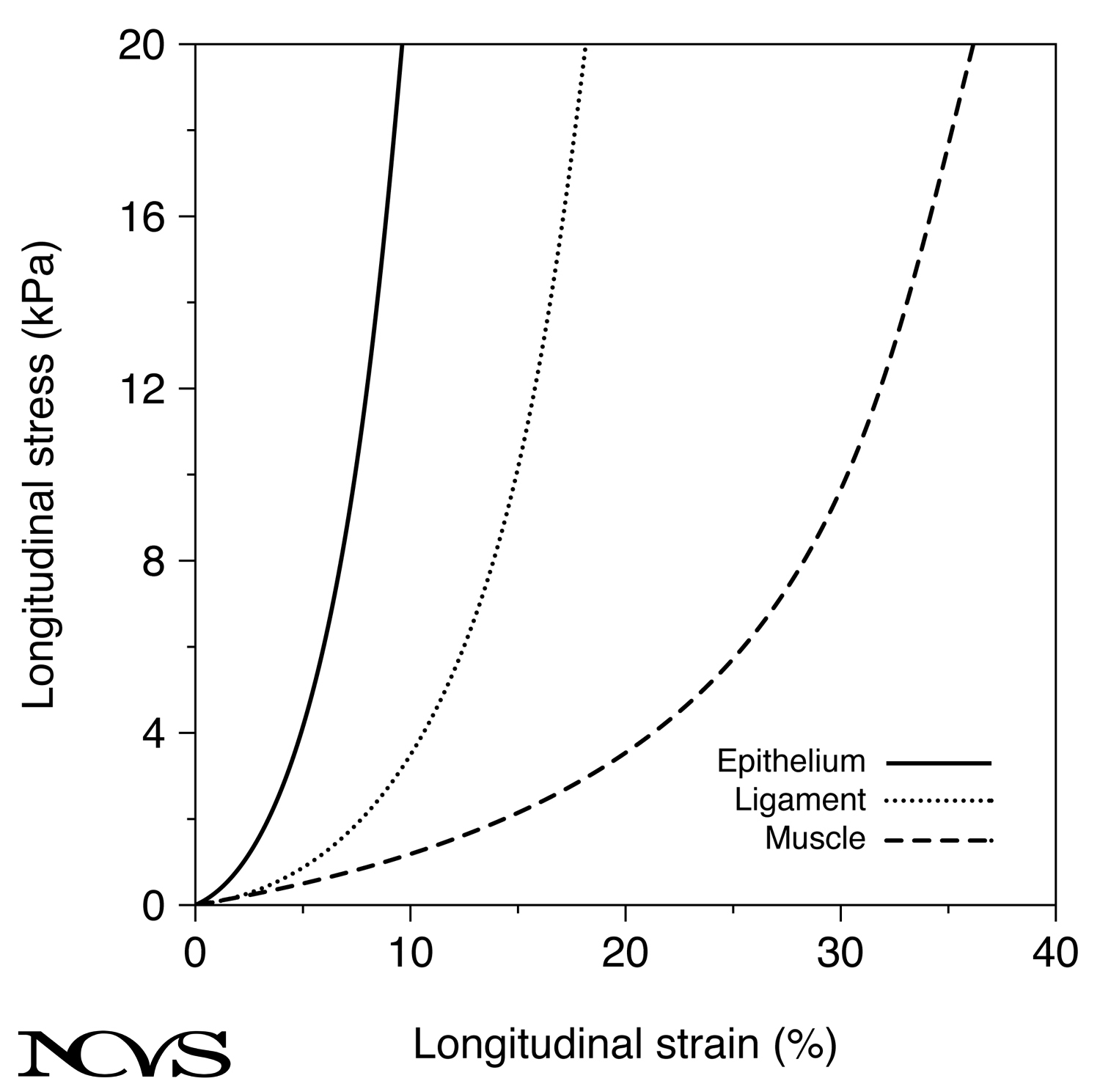 Figure 2.10: Hypothetical stress-strain curves for human vocal fold tissues based on limited data.
Based on limited data from human tissues, Figure 2.10 suggests:
For equal longitudinal strain applied to vocal folds:
Greatest stress developed: Epithelium
- Stiffest tissue layer
- Most resistance to elongation
- Protective outer covering
Intermediate stress: Ligament (intermediate/deep lamina propria)
- Moderate stiffness
- Contains elastin and collagen fibers
- Structural support
Least stress: Thyroarytenoid muscle (relaxed state)
- Most compliant when inactive
- But can increase stress actively through contraction
Active Muscle Contraction
Critical qualification:
- These curves show passive (relaxed) muscle properties
- Thyroarytenoid muscle can be tensed by internal contraction
- Active contraction tends to reduce vocal fold length
- Can balance stress in ligament and epithelium
Hypothesis:
- Balancing (relative stiffening) of body with respect to cover is major factor in:
- Pitch control
- Register control
- Voice quality adjustments
This body-cover balance will be discussed in depth in Chapters 8 and 10.
Strain Creep
Alternative to Stress Relaxation
If constant stress (rather than constant strain) applied:
- Tissue would continue increasing in length
- Called strain creep
- Complement of stress relaxation
Behavior:
- Tissue would plastically deform
- Like taffy or chewing gum
- Progressive elongation under sustained load
- May not fully recover original length
Implications for Phonation
Passive Properties
These passive stress-strain relationships affect:
Fundamental frequency:
- Stiffer tissue → higher F0
- More compliant tissue → lower F0
Phonation threshold:
- Tissue stiffness affects ease of oscillation
- Optimal stiffness exists for efficient phonation
Amplitude of vibration:
- Compliant tissue → larger amplitude potential
- Stiff tissue → smaller amplitude
Layer Interactions
The different properties of layers enable:
Register control:
- Adjusting relative stiffness of body and cover
- Creating transitions between chest and head voice
Fine pitch control:
- Small adjustments in muscle activation
- Modifying stress balance between layers
Voice quality:
- Layer coupling affects harmonic structure
- Stiffness ratios influence spectral content
Summary
Experimental investigation of vocal fold tissue reveals complex viscoelastic behavior:
Nonlinear Elasticity:
- Tissues become progressively stiffer with elongation
- Stress-strain curves show upward curvature
- Cannot be characterized by single elastic modulus
Hysteresis:
- Loading and unloading follow different paths
- Energy dissipated during each cycle
- Indicates viscous component
Stress Relaxation:
- Rapid initial decrease in stress
- Exponential decay with time
- Nearly independent of strain magnitude
Layer Differences:
- Epithelium stiffest
- Ligament intermediate
- Muscle (passive) most compliant
- Balance affects vocal function
Settling Behavior:
- Initial cycles differ from subsequent
- Tissue requires conditioning to stable state
These properties have profound implications for:
- Voice production efficiency
- Control of pitch and loudness
- Register transitions
- Voice quality
- Pathological changes
- Therapeutic interventions
Understanding tissue viscoelasticity provides essential foundation for analyzing vocal fold vibration and developing effective treatments for voice disorders.
Key Takeaways
- ✅ Vocal fold tissues exhibit nonlinear stress-strain relationships, stiffening progressively with elongation
- ✅ Hysteresis between loading and unloading indicates energy dissipation and viscoelastic behavior
- ✅ Stress relaxation occurs rapidly initially, then gradually over time with exponential decay
- ✅ Different tissue layers have different stiffness: epithelium > ligament > passive muscle
- ✅ Cyclic testing shows settling behavior before reaching repeatable mechanical state
- ✅ Active muscle contraction can balance stress among layers for pitch and register control
Related Topics
Further Reading
- Alipour-Haghighi, F., & Titze, I. R. (1985). Viscoelastic modeling of canine vocalis muscle in relaxation. Journal of the Acoustical Society of America, 78, 1939-1943.
- Alipour-Haghighi, F., & Titze, I. R. (1991). Elastic models of vocal fold tissues. Journal of the Acoustical Society of America, 90, 1326-1331.
- Hirano, M., Kurita, S., & Matsuo, K. (1980). Laryngeal tissue reaction to stress. In V. Lawrence & B. Weinberg (Eds.), Transcripts of the Ninth Symposium on Care of the Professional Voice. New York: Voice Foundation.