The Body-Cover Model of F₀ Control
The cover model successfully predicts F₀ behavior for soft phonation and falsetto register, where only the superficial tissue layers vibrate. However, at moderate to loud intensities and in modal register, a significant portion of the thyroarytenoid muscle (the vocal fold body) participates in vibration. This involvement fundamentally changes the mechanics of F₀ control and explains observations that the cover model cannot predict.
Limitations of the Cover Model
The cover model fails to account for several observed phenomena:
Positive TA-F₀ Correlation
- EMG studies show TA activity positively correlated with F₀ in speech
- Cover model predicts negative correlation (TA shortens folds, should lower F₀)
- Contradiction suggests body participation changes mechanics
- Active muscle tissue has properties distinct from passive connective tissue
Modal Register Characteristics
- Larger amplitude vibrations recruit deeper tissue
- Muscle stiffness can exceed cover stiffness when contracted
- Internal muscle forces affect overall vocal fold tension
- Complex stress distribution across layers
Intensity Effects
- Louder phonation increases vibrational amplitude
- Greater depth of tissue involved in vibration
- Body-cover coupling becomes significant
- Simple string model inadequate
Active Tissue in Vibration
The key conceptual advance is recognizing that muscle tissue behaves fundamentally differently from connective tissue:
Passive Tissue Properties
- Stress increases with elongation (follows stress-strain curve)
- No internal force generation
- Behavior purely mechanical
- Predictable from material properties
Active Tissue Properties
- Can generate internal stress through contraction
- Contracted muscle is stiffer than relaxed muscle
- Stiffness can increase without length change
- Depends on neural activation level
The TA Muscle Paradox
When TA contracts:
Effect on Length:
- Tends to shorten vocal folds
- Opposes CT elongation
- Cover becomes slacker
Effect on Body Stiffness:
- Muscle tissue becomes stiffer
- Active stress generated internally
- Body becomes less compliant
Net Effect on F₀:
- Depends on whether body or cover dominates vibration
- If cover dominates: F₀ decreases (cover slackened)
- If body dominates: F₀ increases (body stiffened)
Depth Ratio: The Critical Parameter
The parameter that determines which tissue layer dominates is the depth ratio:
Depth ratio = da/d
where:
- da = depth of thyroarytenoid muscle tissue in vibration
- d = total depth of all tissue in vibration
Low Depth Ratio (da/d < 0.3)
- Cover dominates vibration
- Behavior similar to cover model
- TA contraction lowers F₀
- Typical of soft voice and falsetto
High Depth Ratio (da/d > 0.5)
- Body significantly involved
- Active muscle stiffness important
- TA contraction can raise F₀
- Typical of modal register and loud voice
Quantitative Body-Cover Model
The fundamental frequency equation for the body-cover model is:
F₀ = (1/2Lm) × √(σp/ρ) × √(1 + (da/d) × (σam/σp) × aTA)
where:
- F₀ = fundamental frequency
- Lm = membranous vocal fold length
- σp = effective passive stress of all combined tissues in vibration
- ρ = tissue density (1,040 kg/m³)
- da/d = depth ratio (fraction of vibrating tissue that is muscle)
- σam = maximum active stress the TA muscle can produce
- aTA = normalized thyroarytenoid muscle activity (0 to 1)
Interpretation of Terms
First Factor: (1/2Lm) × √(σp/ρ)
- Identical to cover model
- Represents contribution from passive tissues
- Baseline frequency when TA inactive
Second Factor: √(1 + (da/d) × (σam/σp) × aTA)
- Represents active muscle contribution
- Increases with TA activity when da/d is substantial
- Approaches 1 when da/d is small (reduces to cover model)
- Can produce significant F₀ increase when da/d large
Passive Stress (σp)
The passive stress represents the condition when TA muscle is totally inactive:
Components:
- Stress in cover layers (epithelium, SLP)
- Stress in vocal ligament
- Passive stress in relaxed TA muscle
- All contributions from CT elongation alone
When aTA = 0:
- Equation reduces to cover model
- Only passive tissue contributes
- CT alone controls F₀
Active Stress (σam)
The maximum active stress represents peak muscle contractile capability:
Characteristics:
- Force per unit area muscle can generate
- Depends on muscle fiber type and health
- Typically ranges 100-300 kPa for skeletal muscle
- Varies with training and age
Register Implications
The body-cover model explains register differences:
Modal (Chest) Register
- da/d typically 0.4-0.6
- Body significantly involved
- TA activity contributes positively to F₀
- Both CT and TA can raise pitch
- Richer harmonic spectrum
Falsetto Register
- da/d typically 0.1-0.3
- Minimal body involvement
- TA activity minimal or counterproductive
- CT dominates F₀ control
- Simpler spectrum, fewer harmonics
Transition Zone
- da/d changes during register shift
- Balance between body and cover contributions
- Technique involves managing depth ratio
- Smooth transitions require coordination
The Vocal Ligament’s Critical Role
In humans, the vocal ligament profoundly affects the body-cover model:
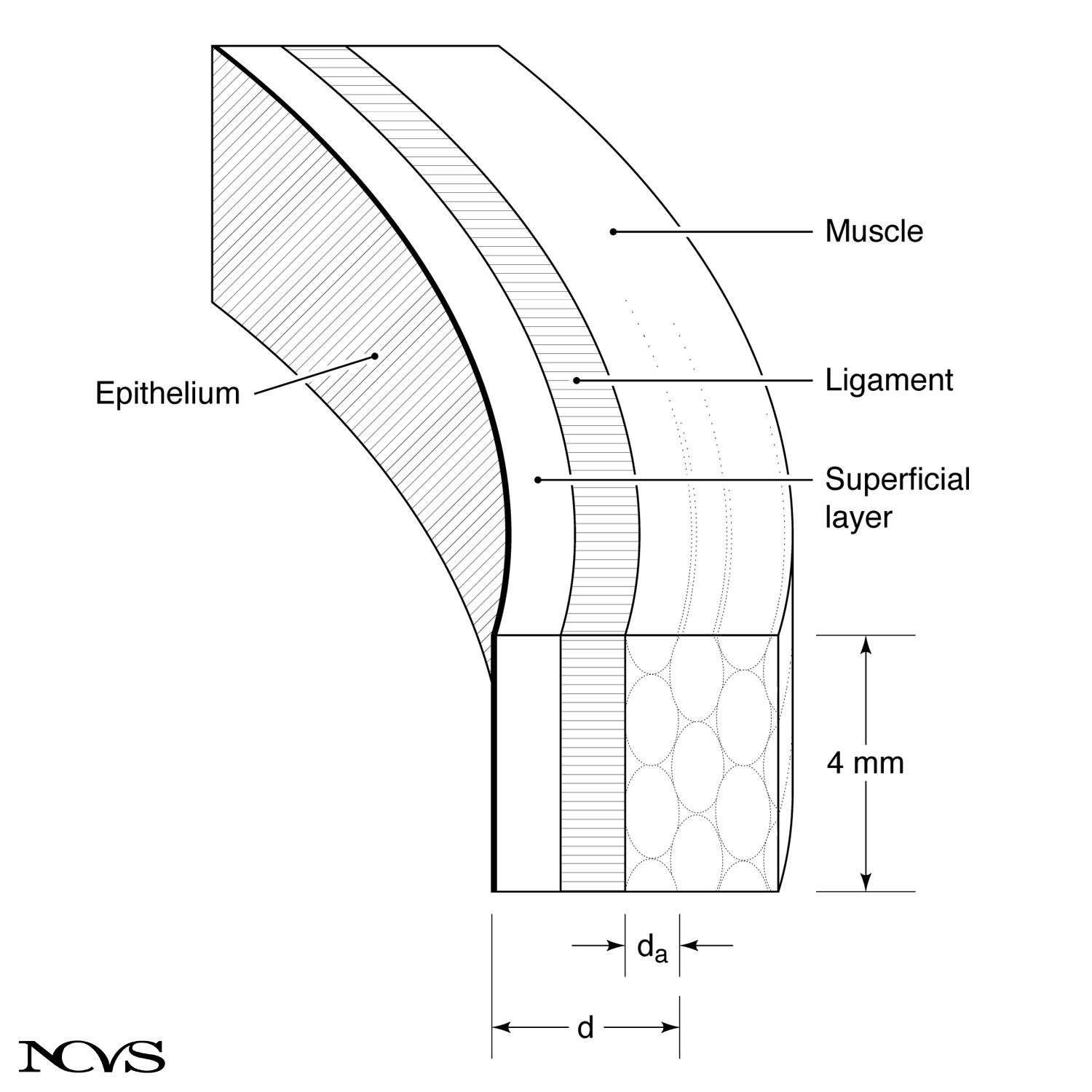 Figure 8.8: Schematic of tissue layers of human vocal folds.
Low to Intermediate F₀
- Muscular portion of body provides primary stress
- Mucosa and ligament both remain relatively lax
- Large amplitude mucosal wave possible
- Modal register characteristics
High F₀
- Vocal ligament absorbs most passive stress
- Mucosa remains lax despite high tension
- Surface wave velocity stays low
- Efficient energy transfer maintained
Canine Comparison
- Lack of vocal ligament limits strategy options
- Cannot achieve high F₀ with loose mucosa
- Epithelium must bear stress at high pitch
- Fundamental limitation on pitch range
Individual Variation
Significant individual differences exist in body-cover behavior:
Anatomical Factors
- Vocal fold thickness affects depth ratio
- Ligament development varies
- Muscle fiber composition differs
- Individual biomechanical properties
Training Effects
- Vocalists learn to modulate da/d
- Register control involves depth ratio management
- Efficiency improves with practice
- Individual strategies emerge
Clinical Implications
- Some voices naturally favor body involvement
- Others more naturally produce cover-dominated phonation
- Training must respect individual biomechanics
- Pathology can disrupt normal body-cover balance
Summary
The body-cover model extends fundamental frequency analysis to conditions where the thyroarytenoid muscle participates significantly in vibration. The key insight is that contracted muscle tissue generates active stress that increases effective stiffness, allowing TA activity to contribute positively to F₀ despite shortening the vocal folds. The depth ratio (da/d) determines whether body or cover dominates mechanical behavior, explaining register differences and the variety of control strategies available to vocalists.
Understanding that F₀ control involves not just passive tissue elongation but also active muscle contraction patterns provides a more complete picture of vocal mechanics. The human vocal ligament enables sophisticated control strategies unavailable to species lacking this structure, contributing to the extended pitch range and flexibility characteristic of human voice.
Key Takeaways
- ✅ Body-cover model accounts for thyroarytenoid muscle participation in vibration
- ✅ Active muscle contraction increases stiffness independent of length changes
- ✅ Depth ratio (da/d) determines whether body or cover dominates F₀ control
- ✅ TA activity can increase F₀ when depth ratio is high (modal register)
- ✅ TA activity decreases F₀ when depth ratio is low (falsetto register)
- ✅ Vocal ligament enables complex control strategies in humans
- ✅ Register differences reflect changes in which tissue layers participate
- ✅ Individual anatomical variation affects optimal control strategies
Related Topics
- Active Tissue in Vibration
- Effect of Lung Pressure on F₀
- Muscle Activation Plot for the Body-Cover Model
- The Cover Model of F₀ Control
Further Reading
- Titze, I. R., Jiang, J. J., & Druker, D. G. (1988). Preliminaries to the body-cover theory of pitch control. Journal of Voice, 1, 314-319.
- Hirano, M. (1974). Morphological structure of the vocal cord as a vibrator and its variations. Folia Phoniatrica, 26, 89-94.
- Titze, I. R. (1989). On the relation between subglottal pressure and fundamental frequency in phonation. Journal of the Acoustical Society of America, 85, 901-906.