Analogies with Vibrating Strings and Ribbons
Understanding how the vocal fold cover vibrates requires drawing parallels to simpler mechanical systems whose behavior is well-characterized. Vibrating strings and ribbons provide useful analogies, though the vocal fold cover exhibits important differences that must be acknowledged.
Vocal Fold Cross-Sectional Anatomy
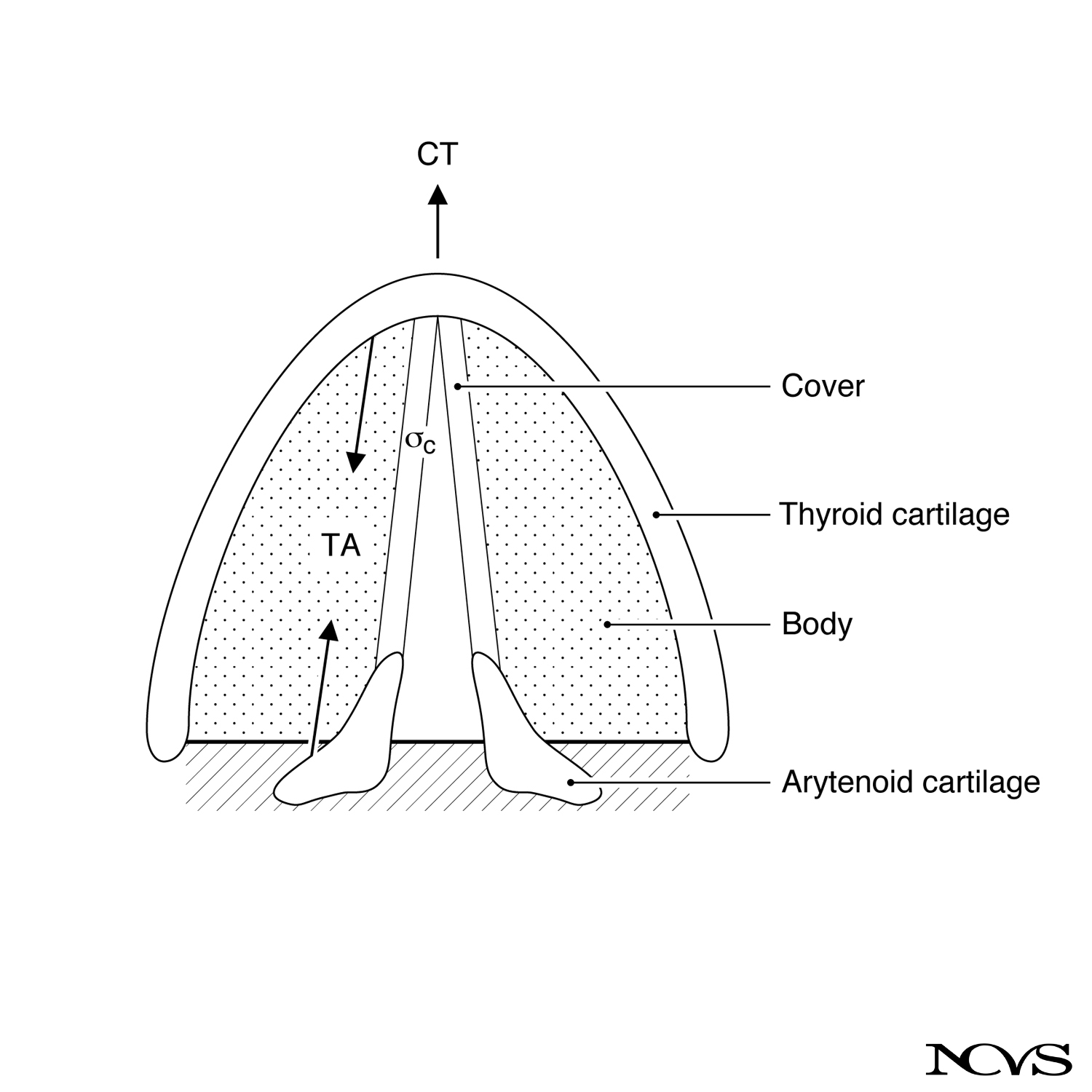 Figure 8.4: Horizontal section through the vocal folds and the thyroid and arytenoid cartilages. Arrows indicate tissue stresses.
The cross-sectional view reveals the structural arrangement relevant to stress distribution:
Anatomical Components
- Body: Thyroarytenoid muscle (stippled in figure)
- Cover: Epithelium and superficial lamina propria (unstippled)
- Posterior attachment: Vocal process of arytenoid cartilage
- Anterior attachment: Inner surface of thyroid cartilage
Stress Application Mechanisms
Cricothyroid (CT) Contraction
- Applies stress to thyroid cartilage
- Affects both body and cover
- External stress application
- Distributed across tissue layers
Thyroarytenoid (TA) Contraction
- Creates internal stress in body
- Muscle generates active force
- May affect cover indirectly
- Stress transmission depends on tissue coupling
The Critical Variable: σc
The quantity of primary interest is σc, the longitudinal stress in the vocal fold cover. This stress determines the restoring force available for vibration and, consequently, the fundamental frequency.
The Vibrating String Model
An ideal vibrating string provides the simplest useful model for the tensed vocal fold cover.
String Equation
For a string under tension with fixed endpoints:
F₀ = (1/2Lm) × √(σc/ρ)
where:
- F₀ = fundamental frequency of vibration
- Lm = membranous length (between attachment points)
- σc = longitudinal stress in the string
- ρ = material density (1,040 kg/m³ for vocal fold tissue)
Key Assumptions
- String is thin relative to length
- Vibration amplitude small relative to length
- Material is homogeneous
- Bending stiffness negligible compared to tension
- Only longitudinal stress matters
Applicability to Vocal Folds
The string model works reasonably well when:
- Vocal folds are highly tensed (high F₀)
- Configuration is thin (falsetto)
- Cover is primary vibrating structure
- Body remains relatively stationary
The Vibrating Ribbon Model
A more sophisticated analogy treats the cover as a vibrating ribbon with vertical structure.
Ribbon Characteristics
- Has both horizontal and vertical dimensions
- Upper and lower portions can move independently
- Phase differences create convergent-divergent patterns
- More accurately represents mucosal wave
Two-String Approximation
For simplified analysis, consider the ribbon as two parallel strings:
Upper String
- Corresponds to superior vocal fold surface
- Contacts airflow directly
- Responds to aerodynamic forces
- Leads the vibratory motion
Lower String
- Corresponds to inferior vocal fold surface
- Connects to transition zone toward ligament
- Follows upper surface with phase delay
- Creates vertical phase difference
Coupling Between Strings
The upper and lower portions are coupled through:
- Elastic forces: Tissue tries to maintain coherence
- Viscous forces: Damping between layers
- Aerodynamic forces: Pressure differences
Despite coupling complexity, fundamental frequency is still approximated by:
F₀ = (1/2Lm) × √(σc/ρ)
The coupling affects amplitude patterns and phase relationships but has secondary effect on frequency.
Minimal Lateral Coupling Assumption
A key simplification in the cover model is neglecting lateral coupling to the body:
Justification
- In soft phonation, body relatively stationary
- Cover vibrates primarily in isolation
- Lateral forces small compared to longitudinal tension
- Approximation valid for falsetto and soft voice
When Assumption Fails
- At higher intensities, body begins vibrating
- Coupling forces become significant
- Body-cover model becomes necessary
- Simple string analogy breaks down
The Critical Role of Nonlinear Stress-Strain Behavior
A profound insight emerges from comparing linear and nonlinear materials:
Linear Material Behavior
For a hypothetical linear material:
- Stress increases proportionally with strain: σ = E × ε
- Elongation increases both stress and length proportionally
- From string equation: F₀ ∝ √σ / L ∝ √(E × ε) / L
- If ε ∝ ΔL/L, then √σ increases slower than L
- Result: F₀ decreases with elongation
The Rubber Band Experiment
A rubber band demonstrates this principle:
Try This: Stretch a rubber band and pluck it at different tensions. At small elongations, increasing length actually lowers the pitch. Only at substantial elongations does pitch begin rising.
This occurs because rubber has nonlinear stress-strain behavior but is relatively soft at small strains.
Required Nonlinearity for F₀ Increase
For F₀ to increase with elongation:
√(σc) must increase faster than Lm
This requires:
σc must increase faster than Lm²
The stress-strain curve must be sufficiently steep that stress increases faster than the square of elongation. Only strongly nonlinear materials satisfy this requirement.
Tissue Components Providing Nonlinearity
Different layers of the vocal fold cover contribute to nonlinear mechanical behavior:
Superficial Lamina Propria (SLP)
Composition: Loosely arranged elastin fibers in gel-like matrix
Stress-Strain Characteristics:
- Very compliant at small strains (< 10%)
- Gradual stiffening with elongation
- Moderate nonlinearity
- Contributes primarily at low to moderate F₀
Function:
- Allows large-amplitude vibration at low pitch
- Provides some restoring force
- Maintains mucosal wave properties
- Relatively uniform stress with depth
Epithelium
Composition: Stratified squamous epithelium (~50 μm thick)
Stress-Strain Characteristics:
- Minimal stress at small strains (< 20%)
- Very sharp stress increase above 20% strain
- Extremely nonlinear behavior
- Can dominate at high elongations
Function:
- Protects underlying tissue
- Provides high-frequency restoring force
- Becomes load-bearing at high F₀
- Limits maximum elongation
Vocal Ligament (Humans)
Composition: Dense collagen and elastin fiber network (intermediate and deep lamina propria)
Stress-Strain Characteristics:
- Substantial stress at moderate to high strains
- Strongly nonlinear behavior
- Provides stress absorption without mucosa stiffening
- Critical for human vocal capability
Function:
- Bears longitudinal stress at high F₀
- Allows superficial layer to remain loose
- Enables mucosal wave even when highly tensed
- Key evolutionary development for human voice
Effective Depth of Vibration
The depth of tissue participating in vibration profoundly affects behavior:
Shallow Cover (Thin Configuration)
- Primarily epithelium involved
- Epithelial stress dominates
- Very high F₀ achievable
- Typical of high falsetto
- Limited amplitude capability
Deep Cover (Thick Configuration)
- Includes substantial SLP thickness
- SLP mechanical properties dominate
- Lower maximum F₀
- Typical of modal register at low pitch
- Larger amplitude possible
Intermediate Configuration
- Mixed contribution from layers
- Transition between stress-bearing components
- Most common in typical phonation
- Balance between F₀ range and amplitude
Species Differences in Cover Structure
Comparing human and canine vocal folds reveals functional significance of anatomy:
Canine Vocal Folds
- Lack well-developed vocal ligament
- Epithelium must provide nonlinearity for high F₀
- SLP relatively thick and uniform
- Maximum F₀ typically ~220 Hz in experiments
- High-F₀ production requires epithelial tension
Human Vocal Folds
- Possess distinct vocal ligament
- Can maintain mucosal wave at high F₀
- Ligament absorbs stress while mucosa loose
- Maximum F₀ exceeds 1,000 Hz (soprano high notes)
- Evolutionary adaptation for speech and song
Implications for F₀ Control
The string/ribbon analogy provides several practical insights:
Tension Dominates Frequency
- Similar to tuning a violin or guitar
- Stress (tension per unit area) is key variable
- Small tension changes produce noticeable pitch changes
- Musicians and vocalists use similar concepts
Length Has Complex Effect
- Longer strings → lower pitch (if tension constant)
- But elongation increases tension
- Net effect depends on stress-strain curve steepness
- Training helps vocalists optimize this relationship
Depth Modulation
- “Thinning” the vocal folds raises pitch
- Can be voluntary (register adjustment) or automatic (amplitude effect)
- Effective depth changes stress distribution
- Advanced technique involves depth control
Summary
The vocal fold cover behaves approximately like a tensed string or ribbon when vibrational amplitudes are small. The fundamental frequency depends primarily on the square root of the stress-to-density ratio, divided by the length. However, unlike ideal strings, the vocal fold cover exhibits strongly nonlinear stress-strain behavior essential for F₀ to increase with elongation. Different tissue components (epithelium, superficial lamina propria, vocal ligament) contribute nonlinearity at different elongation ranges, and the effective depth of vibration significantly affects which components dominate stress-bearing. The human vocal ligament represents a key evolutionary development enabling high-frequency phonation while maintaining mucosal wave properties.
Key Takeaways
- ✅ The cover model treats vocal folds as tensed strings or ribbons under longitudinal stress
- ✅ Fundamental frequency follows F₀ = (1/2Lm) × √(σc/ρ) approximately
- ✅ Two-string model accounts for vertical phase difference in mucosal wave
- ✅ Nonlinear stress-strain behavior is essential for F₀ to increase with elongation
- ✅ Stress must increase faster than length squared for pitch to rise with elongation
- ✅ Epithelium provides extreme nonlinearity at high strains (> 20%)
- ✅ Human vocal ligament enables high F₀ while maintaining loose mucosa
- ✅ Effective depth of vibration determines which tissue components dominate stress
- ✅ Species differences (human vs. canine) reflect vocal ligament importance
Related Topics
- Mechanics of Vocal Fold Elongation
- Quantitative F₀ Analysis for the Cover Model
- Vocal Fold Stiffness and Mass
Further Reading
- Titze, I. R. (1988). The physics of small-amplitude oscillation of the vocal folds. Journal of the Acoustical Society of America, 83, 1536-1552.
- Hirano, M. (1974). Morphological structure of the vocal cord as a vibrator and its variations. Folia Phoniatrica, 26, 89-94.
- Story, B. H., & Titze, I. R. (1995). Voice simulation with a body-cover model of the vocal folds. Journal of the Acoustical Society of America, 97, 1249-1260.