Muscle Strength
In singing, the average F₀ over an entire song can be an octave higher than an individual’s average speaking F₀. This demands sustained or intense laryngeal muscle contraction, and an individual’s ability to meet these demands significantly influences appropriate voice classification.
Tessitura and Muscle Demands
Sustained Muscle Activity
The operatic tenor sometimes encounters a tessitura (an average pitch level of a song or piece of a song) that demands his F₀ to reside predominantly in the upper octave of a two-octave range. Contract of laryngeal muscles extends over long periods of time. This places particular demands on:
- Cricothyroid muscle: For sustained pitch elevation
- Thyroarytenoid muscle: For maintaining appropriate vocal fold configuration
- Interarytenoid muscles: For prolonged glottal closure
- Respiratory muscles: For maintaining adequate subglottal pressure
Clinical Note: A tessiturogram (Thurmer, 1988) has been proposed as a plot of the distribution of all the notes of a song. This visualization tool helps match vocal capabilities to repertoire demands.
Burst Activity
In contrast to sustained high tessitura, other vocal literature contains only an occasional high note, but a dramatic one, which requires a brief moment of intense muscle contraction. This demands:
- Rapid cricothyroid activation for quick pitch changes
- Strong thyroarytenoid contraction for powerful sound
- Precise coordination of respiratory and laryngeal systems
- Quick recovery from maximum exertion
The Sprinter versus Marathoner Analogy
Vocal Sprinters
Consider an analogy with two types of runners. Sprinters are able to produce short bursts of extreme muscle activity, but they tire rapidly. Applied to vocalists:
Characteristics:
- Excel at dramatic climactic high notes
- Capable of intense, brief muscle contractions
- Tire quickly with extended high tessitura
- May struggle with sustained coloratura passages
Potential Implications:
- Bothered by extended high tessitura
- Well-suited for dramatic roles with occasional peak notes
- May need to avoid repertoire requiring sustained upper-range singing
- Could benefit from endurance training protocols
Vocal Marathoners
Long-distance runners are able to maintain moderate levels of muscle activity for long periods of time. Their vocal counterparts:
Characteristics:
- Naturally placed in the high part of their F₀ range
- Maintain moderate muscle activity sustainably
- Find it difficult to produce a climactic high note
- Excel at sustained coloratura or high tessitura
Potential Implications:
- Well-suited for lyric or coloratura roles
- May struggle with dramatic climactic moments
- Could benefit from power training protocols
- Naturally comfortable in upper register
Speculative Note: It is tempting to speculate that these phenomena relate to muscle-fiber typing and general metabolic activity, but there is as yet no direct evidence to support this speculation.
Classification on the Basis of Speaking F₀
Classification based on speaking fundamental frequency alone may be hazardous because it does not involve the full range of laryngeal muscle contraction. Klingholz (1990) has suggested a scheme that involves the entire Voice Range Profile (VRP), to be discussed in detail in Chapter 9.
The Voice Range Profile Approach
As shown in Figure 7.4, the Voice Range Profile maps out the range of intensity over the range of F₀. An ideal classification is one in which the vocalist performs most often near the center of the Voice Range Profile, where:
- Phonation is stable
- Changes in intensity can occur equally in all directions
- Changes in F₀ can occur equally in all directions
- Vocal effort remains balanced
- Long-term vocal health is maintained
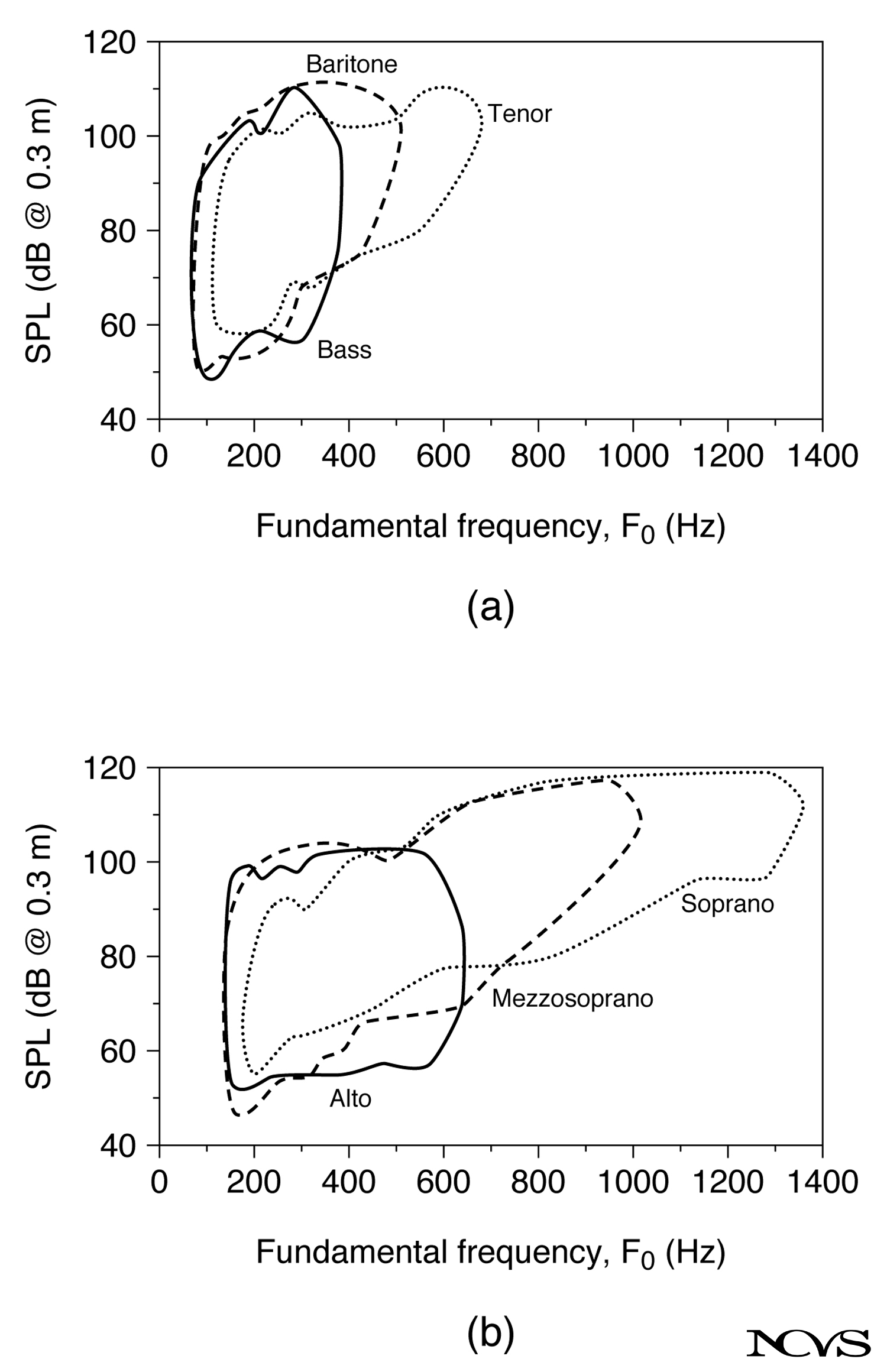 Figure 7.4: Voice Range Profile for six voice classes: (a) male and (b) female. After Klingholz (1990).
Relaxation versus Tension Paradox
Speaking versus Singing Modes
Sometimes an ideal speaking voice functions less ideally in a singing mode, even with adequate training. It is noticeably free and relaxed, perhaps too relaxed. A corollary is that excellent singers sometimes have unpleasant speaking voices, suggesting that prolonged usage at a high state of muscle contraction (frequent high notes) may cause difficulty with low notes, at least temporarily.
Pedagogical Consideration: It is possible that the achievement of optimally relaxed conditions in the larynx is not based on the same principles as achievement of optimally tensed conditions.
Implications for Classification
The relaxation-tension paradox suggests:
- Individuals with naturally relaxed laryngeal musculature may excel at speech but struggle with sustained singing demands
- Those adapted to high muscle tonus may sing powerfully but sound strained in conversational speech
- Classification should consider both relaxed and tensed phonation capabilities
- Training may need to address the full spectrum from minimal to maximal muscle activation
Metabolic and Fiber-Type Considerations
Potential Muscle Fiber Differences
Although direct evidence is lacking, muscle physiology suggests potential differences in laryngeal muscle composition:
Type I (Slow-Twitch) Fibers:
- Fatigue-resistant
- Suited for sustained activity
- Lower power output
- Associated with endurance activities
Type II (Fast-Twitch) Fibers:
- Rapid, powerful contractions
- Fatigue quickly
- Higher power output
- Associated with sprint activities
Type IIa (Intermediate):
- Balance of power and endurance
- Moderately fatigue-resistant
- Adaptable through training
Training Implications
If muscle fiber composition influences vocal capabilities:
- Assessment of natural endurance versus power capabilities could guide classification
- Training protocols might target specific fiber-type development
- Repertoire selection could match physiological predispositions
- Cross-training approaches might develop underutilized fiber types
Summary
Laryngeal muscle strength and endurance represent critical secondary factors in voice classification. The distinction between vocal sprinters (excelling at powerful, brief exertions) and vocal marathoners (maintaining moderate activity sustainably) provides a useful framework for understanding individual differences in vocal capability. Voice Range Profile analysis offers a more comprehensive assessment than speaking F₀ alone, capturing the full spectrum of pitch and intensity capabilities. The paradoxical relationship between optimal relaxation and optimal tension suggests that speaking and singing modes may require different muscular strategies. While speculation about muscle fiber typing remains unconfirmed, the analogy with athletic performance provides valuable insights for classification and training approaches.
Key Takeaways
- ✅ Singing tessitura can demand F₀ an octave above speaking pitch, requiring sustained muscle contraction
- ✅ Vocal sprinters excel at dramatic climactic notes but tire quickly with extended high tessitura
- ✅ Vocal marathoners maintain moderate activity sustainably but may struggle with powerful peak notes
- ✅ Classification based on speaking F₀ alone is hazardous because it doesn’t test the full range of muscle capability
- ✅ Voice Range Profile (VRP) assessment provides comprehensive data on pitch and intensity capabilities
- ✅ Ideal classification places the vocalist near the center of their VRP for maximum flexibility
- ✅ The relaxation-tension paradox suggests that optimal speaking and singing modes may require different strategies
- ✅ Muscle fiber-type differences may underlie individual variations in strength versus endurance, though direct evidence is lacking
Related Topics
Further Reading
- Klingholz, F. (1990). Acoustic recognition of voice disorders: A comparative study of running speech versus sustained vowels. Journal of the Acoustical Society of America, 87(5), 2218-2224.
- Thurmer, S. (1988). The tessiturogram. Journal of Voice, 2(4), 327-329.
- Coleman, R. F. (1987). Performance demands and the performer’s vocal capabilities. Journal of Voice, 1(3), 209-216.
- Gramming, P. (1988). The phonetogram: An experimental and clinical study. Malmo, Sweden: Lidbergs Blankett AB.