Vocal Tract Length
Voice classification concerns not only average fundamental frequency but also voice quality. The size of the vocal tract significantly influences resonance characteristics, leading to perceived differences between “dark voices” and “bright voices,” even when their F₀ ranges overlap. Understanding the relationship between vocal tract length and formant frequencies proves essential for comprehensive voice classification.
The Role of Resonance in Voice Quality
In musical instruments, the size of the resonator has as much influence on the range and character of the instrument as the sound source itself. Usually, some sort of match is created between source frequencies and resonance frequencies. This principle applies equally to the human voice, where the vocal tract acts as an acoustic resonator that shapes the output spectrum.
Acoustic Principle: An inverse relationship exists between formant frequencies and vocal tract length. For a given larynx, the voice would be perceived darker (lower) if the vocal tract were longer.
The vocalist has some control over effective vocal tract length by either lowering or raising the larynx, allowing for flexibility in style and mood. This manipulation contributes to variations in voice quality independent of fundamental frequency changes.
Long-Time Average Spectral Analysis
Cleveland’s Autoclassification Scheme
Although formants vary substantially from vowel to vowel as one speaks or sings an extended passage, the average distribution approaches a constant if the passage is long enough and contains the entire scope of vowels. Cleveland (1977, 1978) has proposed an autoclassification scheme based on long-time average spectral (LTAS) peaks.
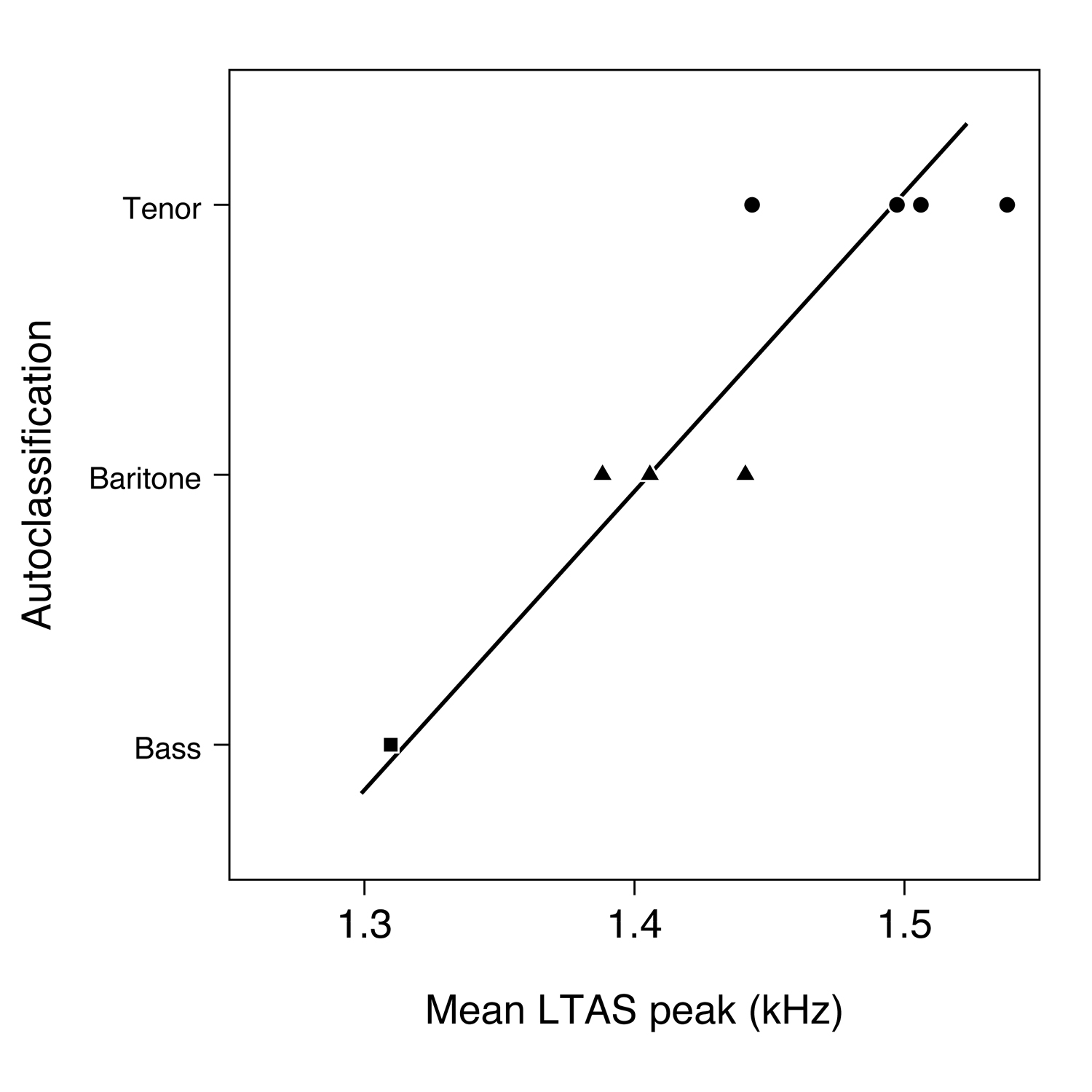 Figure 7.3: Voice classification on the basis of long-time average spectral peaks. Data points are for eight different subjects. From Cleveland (1978).
LTAS Findings for Male Singers
Cleveland’s study revealed clear trends in LTAS peaks across voice classifications:
| Voice Class | Mean LTAS Peak | Number of Subjects |
|---|---|---|
| Bass | ~1.3 kHz | 1 |
| Baritone | ~1.4 kHz | 3 |
| Tenor | ~1.5 kHz | 4 |
Because acoustic theory predicts an inverse length relation for formants, the approximate 15% difference in formant peaks between bass and tenor voices corresponds to a 15% difference in their vocal tract lengths.
Application to Female Voices
A similar autoclassification approach would be appropriate for female voices, though Cleveland’s original study focused on male singers. The method is attractive because:
- Long-time average spectra can be obtained with standard acoustic equipment
- The measurement procedure raises no subject safety concerns
- The analysis provides objective, quantifiable data for classification
Gender Differences in Vocal Tract Proportions
Proportional Growth in Females
For females, one would expect the vocal tract to grow in proportion to the vocal folds. A single size principle would then govern all anatomical differences. A combination of shorter vocal folds and a shorter vocal tract would certainly increase the likelihood of a higher classification.
Disproportionate Growth in Males
The difficulty arises when a vocalist’s laryngeal anatomy grows disproportionately with respect to the rest of the anatomy, as it does in males during puberty. Interesting hybrid classifications may then occur:
- Long necks + Short vocal folds → Pitched high but sound dark
- Long vocal folds + Short necks → Pitched low but sound bright
Some operatic subclassifications (e.g., lyric baritone, heldentenor) may have resulted, in part, from such hybrid cases, though definitive data are not available.
Vocal Tract Manipulation
Larynx Positioning
Vocalists can modify their effective vocal tract length through laryngeal positioning:
- Lowering the larynx: Increases vocal tract length, producing darker, lower-resonance timbre
- Raising the larynx: Decreases vocal tract length, producing brighter, higher-resonance timbre
These adjustments allow performers to:
- Modify voice quality for different styles or musical periods
- Create character voices in theatrical performance
- Compensate for anatomical proportions that do not match desired classification
- Adapt to different acoustic environments
Lip Rounding and Other Adjustments
Additional articulatory adjustments can further modify effective vocal tract length:
- Lip rounding: Extends the vocal tract anteriorly
- Lip spreading: Shortens the effective length
- Tongue position: Alters the cross-sectional area and effective length
Clinical and Pedagogical Implications
Classification Challenges
When vocal tract length does not scale proportionally with vocal fold length, classification becomes more complex. Voice teachers must consider:
- Whether to classify based on comfortable fundamental frequency range
- Whether to emphasize natural resonance characteristics
- How to develop vocal techniques that optimize both pitch and quality
- Whether hybrid classifications better serve the student’s long-term development
Training Considerations
Understanding vocal tract contributions to voice quality guides pedagogical decisions:
- Students with naturally longer vocal tracts may need to work on brightening techniques
- Those with shorter vocal tracts may benefit from darkening strategies
- Matching repertoire to natural resonance characteristics reduces vocal strain
- Developing voluntary control of vocal tract length increases versatility
Summary
Vocal tract length serves as a critical secondary factor in voice classification, influencing voice quality through its effect on formant frequencies. While vocal fold length primarily determines fundamental frequency, vocal tract length shapes the resonance characteristics that distinguish dark from bright voices. Long-time average spectral analysis provides an objective method for quantifying these resonance differences. The disproportionate growth of laryngeal and supralaryngeal structures in males creates potential mismatches between pitch and quality classifications, leading to hybrid vocal types. Voluntary control of vocal tract length through laryngeal positioning and articulatory adjustments allows vocalists to modify their timbre and adapt their natural classification.
Key Takeaways
- ✅ Vocal tract length inversely affects formant frequencies, influencing perceived voice quality (dark vs. bright)
- ✅ Long-time average spectral (LTAS) analysis provides objective classification data
- ✅ A 15% difference in formant peaks corresponds to approximately 15% difference in vocal tract length
- ✅ Female vocal tracts typically grow proportionally to vocal folds, while males show disproportionate laryngeal growth
- ✅ Hybrid classifications occur when vocal fold length and vocal tract length scale differently
- ✅ Vocalists can voluntarily modify effective vocal tract length through laryngeal positioning and articulation
- ✅ Operatic subclassifications may reflect anatomical variations in the vocal fold-to-vocal tract length ratio
- ✅ Vocal tract considerations complement fundamental frequency measurements for comprehensive classification
Related Topics
Further Reading
- Cleveland, T. (1977). Acoustic properties of voice timbre types and their influence on voice classification. Journal of the Acoustical Society of America, 61, 1622-1629.
- Cleveland, T. (1978). Estimating voice classification from speech sound measures. In T. Lawrence (Ed.), Transcripts of the seventh symposium: Care of the professional voice, Part 1 (p. 100). New York: Voice Foundation.
- Wendler, J., Doherty, E. T., & Hollien, H. (1980). Voice classification by means of long-time speech-spectra. Folia Phoniatrica (Basel), 32, 51-60.