Fundamental Frequency and Vocal Fold Length
The relationship between vocal fold length and fundamental frequency provides the most direct physiological correlate of voice classification. Understanding this relationship requires examining the vocal folds as vibrating structures whose frequency depends on length, tension, and tissue properties.
The Vibrating String Model
Assume the vocal folds to be the equivalent of a pair of piano or violin strings: uniform, thin, under constant tension, fixed anteriorly and posteriorly, and free to move otherwise. Although none of these ideal string conditions is perfectly met by the vocal folds, some are approximated because tissue fibers behave like a bundle of strings. Under these assumptions, F₀ can be estimated by the well-known formula for vibrating strings:
F₀ = (1/2L) √(σ/ρ)Where:
- F₀: Fundamental frequency (Hz)
- L: Length of the vocal folds (m)
- σ: Longitudinal stress in vocal fold tissue (Pa)
- ρ: Tissue density (kg/m³)
Based on this formula:
- F₀ is inversely proportional to vocal fold length
- F₀ is directly proportional to the square root of tissue stress
- Tissue density is essentially constant under all conditions and does not play a role in F₀ regulation
Predicting F₀ from Length Differences
If we attempt to predict differences in F₀ based on vocal fold length only, we must assume common stress in laryngeal tissues, whether the larynx be male or female, child or adult. This is probably not the case, even when there is complete relaxation of the laryngeal musculature. The relaxed, intrinsic stress depends on the structural properties of the vocal fold tissue layers, which may differ with age, sex, prolonged use, disease, or numerous other factors.
Nevertheless, if we make the bold assumption of equality of tissue stress in the relaxed state, the fundamental frequency can be scaled according to the following inverse proportion:
F₀₂/F₀₁ = L₁/L₂Where subscripts 1 and 2 denote two lengths and two fundamental frequencies to be compared. Thus, a 5:1 ratio between infant and adult F₀ would imply a 1:5 ratio between their effective vocal fold lengths.
Effective Vocal Fold Length
Membranous versus Cartilaginous Portions
It is important to identify what is meant by effective vocal fold length. Not all the tissue between the arytenoid cartilages and the anterior commissure of the folds vibrates during normal phonation. The vocal fold length is divided into:
- Cartilaginous portion: The posterior section overlying the vocal processes of the arytenoid cartilages
- Membranous portion: Extending from the vocal processes to the anterior commissure
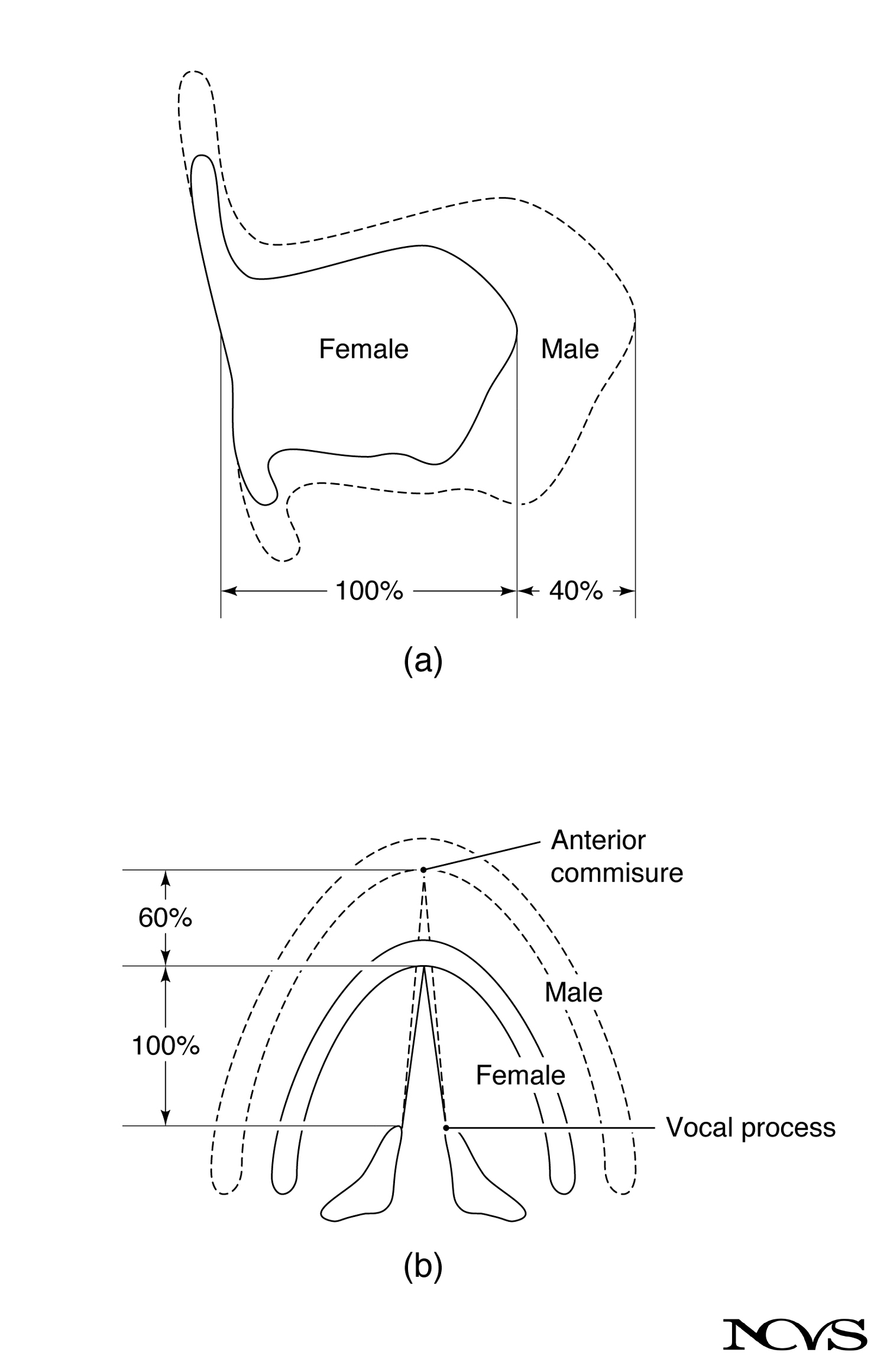 Figure 7.2b: Dimensions for membranous length shown in percentages on the left side of the figure. In the male larynx, the membranous length is 60% longer than in the female.
The membranous length constitutes the primary vibrating portion during phonation. In the male larynx, this membranous length is 60% longer than in the female, which clearly explains the primary gender difference in F₀ (Kahane, 1978; Hirano, Kurita, & Nakashima, 1983; Titze, 1988).
Empirical Relationship: The 1700 Hz-mm Constant
Figure 7.7 shows the long-term average speaking fundamental frequency as a function of membranous length, derived as a composite of data from Kent (1976) and Hirano et al. (1980). Age is indicated as a parameter at some data points. The relationship can be modeled by a hyperbola:
F₀ = 1700/LₘWhere:
- F₀: Fundamental frequency (Hz)
- Lₘ: Membranous vocal fold length (mm)
- 1700: Empirical constant (Hz-mm)
This model represents Equation 7.1 with all parameters except length replaced by an empirical constant.
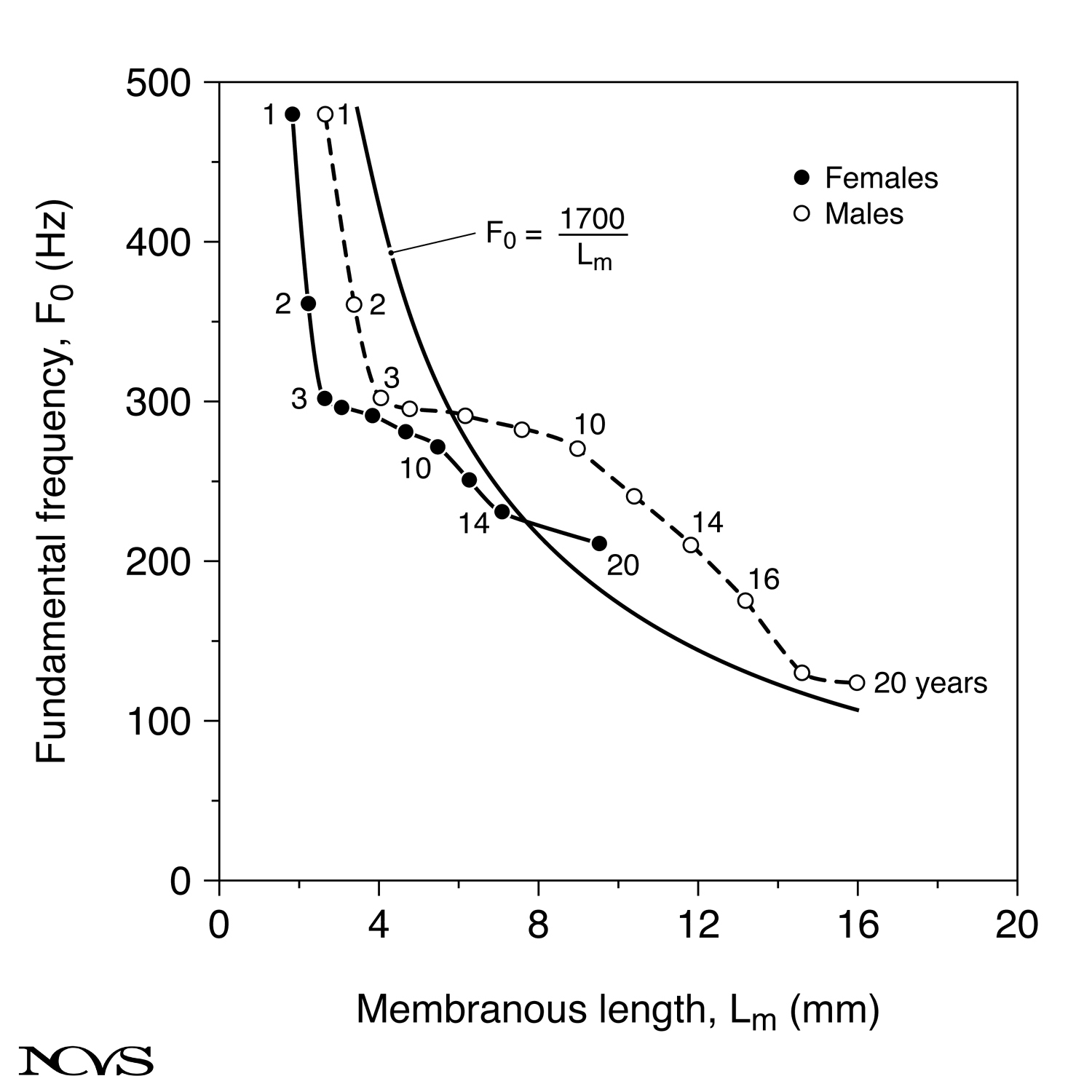 Figure 7.7: Fundamental frequency as a function of membranous length of the vocal fold, with age as a parameter. The hyperbola F₀ = 1700/Lₘ serves as a model, though deviations occur at ages 3-10.
Developmental Deviations
Major deviations from the model occur at ages 3 to 10. The fundamental frequency drops less in this age range than predicted by length alone. Several factors may explain this phenomenon:
-
Tissue Development: Development of the vocal ligament and thyroarytenoid muscle begins at ages 3-4 (Hirano et al., 1981). This could stiffen the tissue on average, counteracting the drop in F₀ due to increasing length.
-
Dimensional Changes: Compensating changes in vocal fold tissue layer dimensions may occur during this developmental period.
-
Tissue Elasticity Changes: Alterations in tissue elastic properties could affect the stress-to-density ratio.
-
Hypertense Musculature: Children might maintain a hypertense laryngeal musculature during speech production in these years (though this is considered less likely).
More controlled data with increased subject numbers are needed to fully explain these developmental patterns.
Gender Differences in Vocal Fold Length
The 60% difference in membranous vocal fold length between males and females accounts for the primary gender difference in fundamental frequency:
- Adult female: Approximately 10 mm membranous length → ~200 Hz F₀
- Adult male: Approximately 16 mm membranous length → ~125 Hz F₀
This ratio (16/10 = 1.6) predicts an F₀ ratio of 10/16 ≈ 0.625, which corresponds to approximately:
- 200 Hz × 0.625 = 125 Hz
This calculation matches observed average male fundamental frequencies, confirming that membranous vocal fold length serves as the critical determinant of gender-related voice classification.
Summary
The inverse relationship between vocal fold length and fundamental frequency provides a robust physiological basis for voice classification. While the vibrating string model offers theoretical grounding, empirical data confirm that membranous vocal fold length—not cartilaginous length or overall body size—determines fundamental frequency. The 60% gender difference in membranous length fully accounts for the approximate octave difference in average speaking F₀ between males and females. Developmental data reveal that this relationship holds remarkably well across the lifespan, with some interesting deviations during early childhood that may reflect tissue maturation processes.
Key Takeaways
- ✅ Vocal folds can be modeled as vibrating strings where F₀ = (1/2L)√(σ/ρ)
- ✅ Fundamental frequency is inversely proportional to vocal fold length
- ✅ Membranous vocal fold length, not total length, determines the effective vibrating portion
- ✅ The empirical relationship F₀ = 1700/Lₘ accurately predicts fundamental frequency from membranous length
- ✅ Male membranous vocal fold length is 60% longer than female length, explaining the primary F₀ difference
- ✅ Tissue stress and density remain relatively constant, making length the dominant variable
- ✅ Developmental deviations at ages 3-10 may reflect vocal ligament and muscle maturation
- ✅ A 5:1 ratio between infant and adult F₀ corresponds to a 1:5 ratio in vocal fold lengths
Related Topics
- Classification Based on Size
- Vocal Tract Length
- Childhood Development
- Adolescence
- Morphology of Vocal Fold Soft Tissue
Further Reading
- Titze, I. (1988). Physiologic and acoustic differences between male and female voices. Journal of the Acoustical Society of America, 85(4), 1699-1707.
- Hirano, M., Kurita, S., & Nakashima, T. (1983). Growth, development and aging of human vocal folds. In D. Bless and J. Abbs (Eds.), Vocal fold physiology: Contemporary research and clinical issues (pp. 22-43). San Diego: College-Hill Press.
- Kahane, J. (1978). A morphological study of the human prepubertal and pubertal larynx. American Journal of Anatomy, 151, 11-20.
- Benade, A. H. (1976). Fundamentals of musical acoustics. New York: Oxford University Press.
- Kent, R. D. (1976). Anatomical and neuromuscular maturation of the speech mechanism: Evidence from acoustic studies. American Journal of Anatomy, 151, 11-20.