Classification Based on Size
The single most important acoustic variable for voice classification is fundamental frequency (F₀), which demonstrates an inverse relationship with the size of sound-producing structures. This chapter explores how physical development and anatomical dimensions determine vocal characteristics across the lifespan and between individuals.
The Role of Fundamental Frequency
Fundamental frequency serves as the primary acoustic correlate of voice classification because it directly reflects the vibratory characteristics of the vocal folds. In broad terms, F₀ of any sound-producing device is inversely related to its size—a principle that applies to musical instruments and biological sound sources alike. This relationship has been confirmed experimentally across developmental stages:
- Infant cries: approximately 500 Hz
- Children’s speech: 250-400 Hz range
- Adult female speech: around 200 Hz average
- Adult male speech: around 125 Hz average
Physical development, particularly growth, plays a large role in determining F₀. The approximate 3:1 linear growth factor observed from infancy to adulthood corresponds to the dramatic decrease in fundamental frequency across this developmental period.
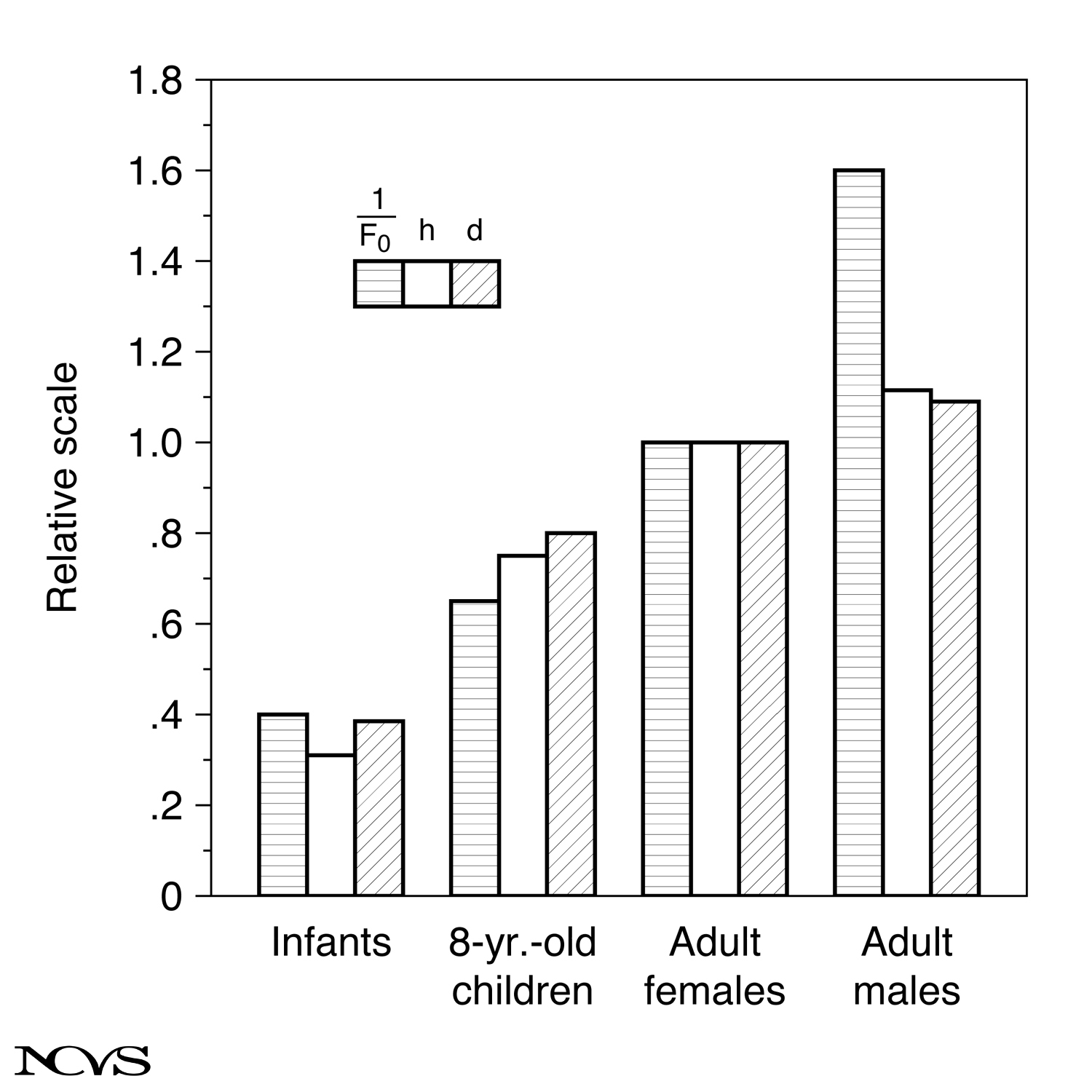 Figure 7.1: Comparison of body height h, equivalent cubic dimension d, and 1/F₀ for infants, eight-year-old children, and adults. All measures are normalized to the adult female. The quantity 1/F₀ correlates grossly with size measures, except for adult males, which show disproportionate laryngeal growth.
Body Size Relationships
Overall Body Dimensions
Weight and height represent the most intuitive size measures to correlate with F₀. Table 7.1 shows average mass (M in kg) and average height (h) versus F₀ for several growth stages. The table also includes an equivalent cubic dimension (d), calculated as the cube root of the mass/density ratio.
| Stage | Average Mass | Equivalent Dimension (d) | Average Height | F₀ |
|---|---|---|---|---|
| Infant | 3.5 kg | 0.15 m | 0.5 m | 500 Hz |
| 8-year-old | 32.0 kg | 0.31 m | 1.2 m | 300 Hz |
| Adult female | 59.0 kg | 0.38 m | 1.6 m | 200 Hz |
| Adult male | 73.0 kg | 0.41 m | 1.8 m | 125 Hz |
The h/d ratio provides a slenderness ratio that indicates differences in body shape:
- Adults: approximately 4.3
- Eight-year-olds: approximately 3.9
- Infants: approximately 3.3
An infant is not simply a scaled-down version of an adult, primarily because of disproportionate head size. This observation becomes crucial when considering voice classification principles.
Limitations of External Frame Size
While classification by basic body size holds up reasonably well for growth and maturation in children and adult females, it proves less reliable among adults of the same sex. The often-espoused belief that sopranos and tenors are short while altos and basses are tall may be supportable on very broad statistical terms, but predictions for a given individual must be based on more localized size criteria.
A quick reflection on speakers and singers reveals that measurements based on external frame size are not the most reliable indicators of average F₀. For meaningful voice classification, examining dimensions closer to the voice source—particularly laryngeal size—becomes essential.
Laryngeal Dimensions
Even among laryngeal dimensions (length, height, and width), not all play equally important roles in determining fundamental frequency. Figure 7.2 demonstrates that length and height for the average male larynx are approximately 40% greater than for the average female larynx (Kahane, 1978). This 40% difference comes close to, but does not entirely account for, the male-female difference in F₀.
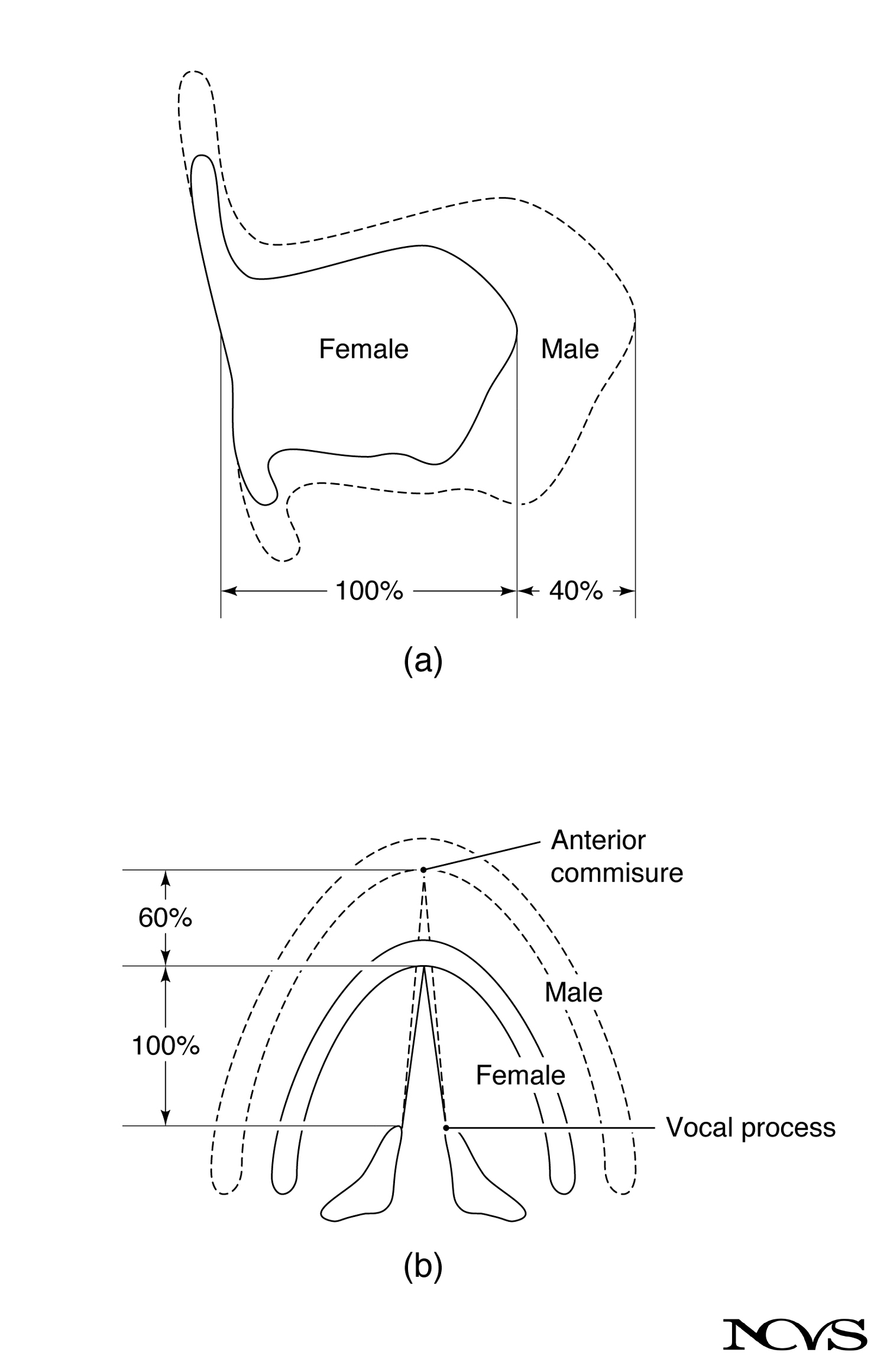 Figure 7.2: Comparison of laryngeal dimensions for the male versus the female larynx: (a) thyroid cartilage and (b) membranous vocal fold length (left-side dimensions). After Kahane (1978).
A critical laryngeal dimension, however, can account for the entire gender difference in fundamental frequency: the membranous vocal fold length. In the male larynx, the membranous length is 60% longer than in the female, which clearly explains the primary gender difference in F₀ (Kahane, 1978; Hirano, Kurita, & Nakashima, 1983; Titze, 1988).
Summary
Size-based classification of voices relies primarily on the inverse relationship between vocal fold length and fundamental frequency. While overall body size provides useful correlations during growth and development, localized anatomical measures—particularly membranous vocal fold length—offer more accurate predictors of fundamental frequency in adults. The disproportionate growth of laryngeal structures, especially in males during puberty, creates gender differences in F₀ that exceed what would be predicted from overall body dimensions alone.
Understanding these size relationships provides the foundation for voice classification, but additional factors including vocal tract length, muscle properties, and social influences must also be considered for comprehensive classification schemes.
Key Takeaways
- ✅ Fundamental frequency (F₀) serves as the single most important acoustic variable for voice classification
- ✅ F₀ is inversely related to size, with larger vocal structures producing lower fundamental frequencies
- ✅ Body size correlates well with F₀ during developmental growth but proves less reliable for adult classification
- ✅ Membranous vocal fold length is the critical dimension that accounts for gender differences in fundamental frequency
- ✅ Male vocal folds are approximately 60% longer than female vocal folds, explaining the primary F₀ difference between genders
- ✅ External frame size measurements (height, weight) are not reliable indicators of F₀ among adults
- ✅ Laryngeal dimensions must be examined for accurate prediction of fundamental frequency in mature voices
Related Topics
Further Reading
- Kahane, J. (1978). A morphological study of the human prepubertal and pubertal larynx. American Journal of Anatomy, 151, 11-20.
- Hirano, M., Kurita, S., & Nakashima, T. (1983). Growth, development and aging of human vocal folds. In D. Bless and J. Abbs (Eds.), Vocal fold physiology: Contemporary research and clinical issues (pp. 22-43). San Diego: College-Hill Press.
- Titze, I. (1988). Physiologic and acoustic differences between male and female voices. Journal of the Acoustical Society of America, 85(4), 1699-1707.
- Kent, R. D. (1976). Anatomical and neuromuscular maturation of the speech mechanism: Evidence from acoustic studies. American Journal of Anatomy, 151, 11-20.