Adolescence
The most obvious vocal change in adolescence occurs during puberty, especially in males. The male hormone testosterone is responsible for the disproportionate growth of the larynx, along with other sexual characteristics. This period presents unique challenges for voice classification and requires careful management to navigate successfully.
Pubertal Laryngeal Growth
The Adam’s Apple
The disproportionate growth of the male larynx is primarily in the membranous vocal fold length, resulting in a protruding Adam’s apple. Figure 7.8 shows typical neck profiles of a male and a female with comparable body fat.
Figure 7.8: Neck profiles for (a) male and (b) female. Note protrusion of thyroid cartilage in the male.
The female shows no protrusion of the thyroid cartilage, while the male profile clearly displays the laryngeal prominence created by the increased thyroid cartilage angle and overall laryngeal growth.
Fundamental Frequency Changes
As seen in Figure 7.7, a significant downturn in the F₀ curve occurs for males between the years of 10 to 18. For a given individual, this downturn is more abrupt (usually within one to two years), but the data in the figure are averages over a number of individuals.
Individual versus population patterns:
- Individual: Dramatic drop within 1-2 years
- Population average: Smoothed curve due to variable timing of puberty
- Typical drop: Approximately one octave (from ~250 Hz to ~125 Hz)
Since the growth spurt occurs at different ages for different individuals, the population curve is smoothed out. This is also the case in Figure 7.6, which would display an abrupt jump in membranous length (Lₘ) for any individual male.
Vocal Fold Thickness Changes
Aside from an increase in vocal fold length, there is also an increase in the bulk of the thyroarytenoid muscle in the male pubertal larynx. The vocal fold thickens as shown in Figure 7.9.
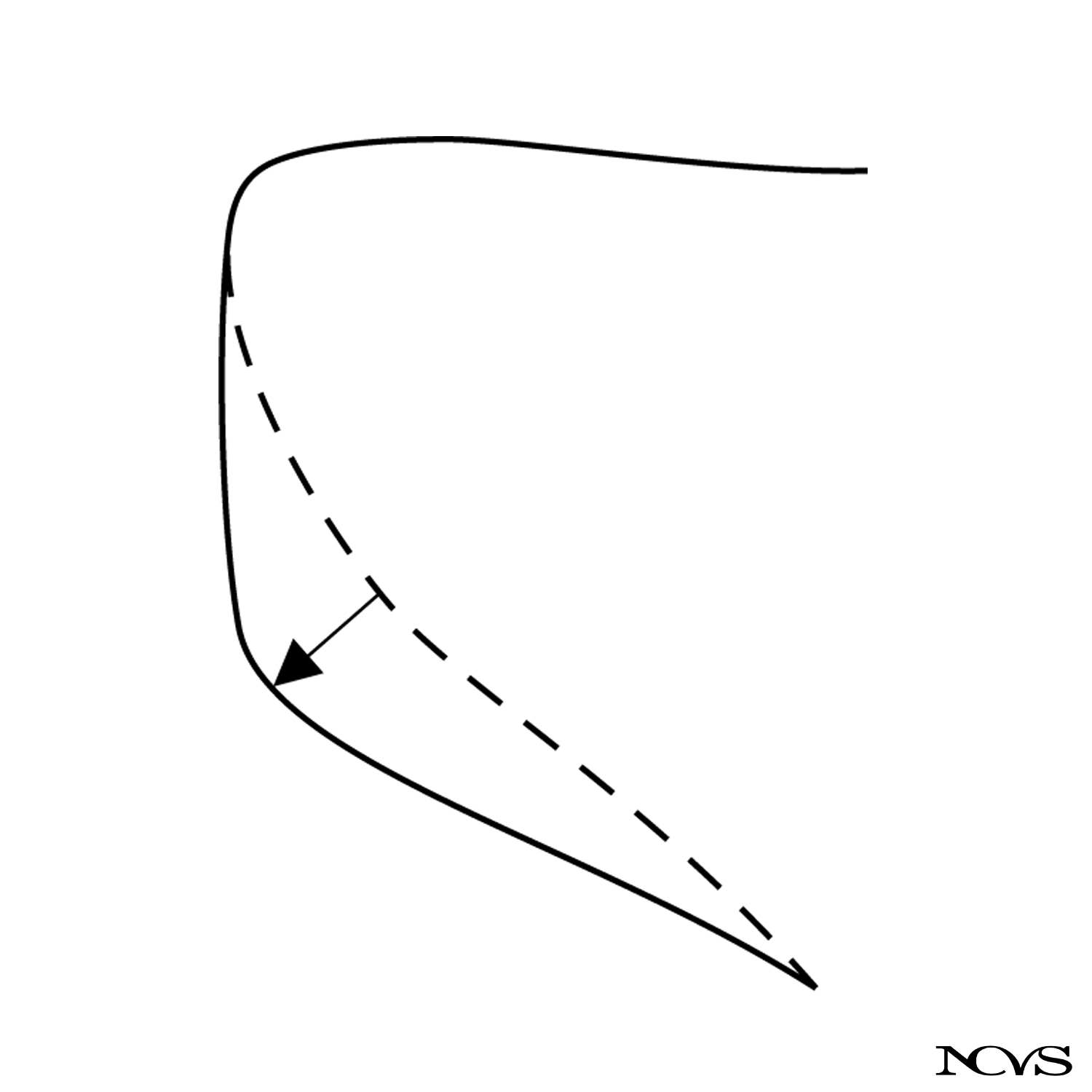 Figure 7.9: Pubertal development of the vocal fold (in coronal section) for the male larynx. The medial surface bulges out to make the glottis more rectangular.
Important distinction: There has been speculation about the effect of vocal fold thickness on F₀. Thickness does increase the overall mass of the vocal folds, but that has no obvious consequence on F₀, as the string model equation shows. As the cross section of tissue in vibration is enlarged, the stress (σ) remains the same; stiffness is added in proportion to mass.
Theoretical Note: There is thus no theoretical ground for assuming that thicker vocal folds have a lower fundamental frequency simply due to thickness itself.
Acoustic Consequence of Enlarged Thyroarytenoid Muscle
Register Change and Voice Quality
What, then, is the acoustic consequence of the enlarged thyroarytenoid muscle? It produces a register change, a change in vocal quality. As the bottom of the vocal fold bulges out, the glottis becomes more rectangular than wedge-shaped (convergent).
During vibration:
- Glottal closure can be obtained over a greater portion of the vocal fold
- Closure occurs over a greater portion of the vibratory cycle
- More of the entire body of the vocal fold is set into vibration
- Greater overall amplitude of vibration results
The result: A voice of richer timbre, which we call chest voice or modal voice (see Chapter 10).
Register Control Difficulties
During the growth spurt, adolescent boys find it difficult to control register. They often flip back and forth between their child voice and their new adult voice. This is understandable because modes of vibration are dependent on the shape of the vocal folds.
Why register control is difficult:
- Vocal folds are becoming thicker and more rectangular
- Different muscle patterns are needed to control new modes of vibration
- The process is essentially trial-and-error
- Rapid anatomical changes prevent stable muscle memory
- Hormonal influences may affect muscle function
Classification Challenges During Adolescence
The Moving Target Problem
Classification of voices in the adolescent years is fraught with difficulty, primarily because changes can occur so rapidly. In school choral groups, for example:
Example: The director may have a boy soprano at the beginning of the year, an alto by Christmas, and a tenor by graduation.
Even beyond the major growth spurt, development continues up to about age 20.
Recommendation for Timing
It is probably not wise to talk much about specific voice classification until age 20. Before then:
- Use descriptive terms rather than formal classifications
- Allow for frequent reassessment
- Focus on healthy technique rather than category placement
- Prepare students for continued changes
- Avoid locking singers into inappropriate roles
Managing the Transition
Voice teachers and choral directors should:
For the student:
- Explain the normalcy of voice changes
- Reduce performance pressure during unstable periods
- Encourage experimentation with different registers
- Develop patient, supportive attitudes toward voice breaks
For repertoire:
- Choose music that accommodates changing ranges
- Avoid extreme tessituras during transition
- Allow optional octave transpositions
- Provide alternative part assignments as needed
For technique:
- Emphasize breath support throughout the range
- Develop smooth register transitions
- Strengthen emerging adult production
- Maintain lighter mechanism for higher notes
Gender Differences in Adolescent Development
Female Changes
Female adolescent vocal changes are more gradual and proportional:
- Vocal fold growth continues at 0.4 mm/year
- Less dramatic F₀ change (approximately 2-3 semitones)
- More predictable timeline
- Less register instability
- Easier to maintain choral participation
Male Changes
Male adolescent vocal changes are dramatic and disproportionate:
- Accelerated vocal fold growth (well beyond 0.7 mm/year during spurt)
- Dramatic F₀ drop (approximately 12 semitones)
- Variable and unpredictable timing
- Significant register instability
- Often requires temporary break from singing
Emotional and Social Dimensions
Psychological Impact
The voice change, particularly for males, carries psychological significance:
Potential challenges:
- Embarrassment about voice breaks in public
- Loss of soprano/alto identity in choirs
- Uncertainty about new vocal capabilities
- Self-consciousness during the transition period
Supportive approaches:
- Normalize the experience through education
- Create safe environments for vocal exploration
- Celebrate the emergence of adult voice
- Provide same-sex vocal role models
Choral Participation
Schools and community programs should:
- Offer flexible voicing (SAB, SATB with optional parts)
- Create changing voice ensembles
- Avoid excluding students during voice change
- Provide alternative musical participation (instruments, composition)
Summary
Adolescence, particularly puberty, represents the most dramatic critical period for vocal change. Male voices undergo disproportionate laryngeal growth driven by testosterone, with membranous vocal fold length increasing approximately 60% and fundamental frequency dropping about one octave. The thyroarytenoid muscle enlarges, creating a more rectangular glottal shape that produces richer chest voice quality. However, this rapid transformation creates register control difficulties as adolescents struggle to manage new vibratory modes. Classification during this period proves extremely challenging due to rapid, unpredictable changes occurring at different ages for different individuals. Voice professionals should avoid formal classification until approximately age 20, focusing instead on healthy technique and psychological support through this critical transition.
Key Takeaways
- ✅ Puberty causes dramatic male laryngeal growth driven by testosterone, creating the Adam’s apple
- ✅ Male fundamental frequency typically drops approximately one octave during puberty
- ✅ Membranous vocal fold length increases approximately 60% in males during adolescence
- ✅ Thyroarytenoid muscle enlargement creates a rectangular glottal shape and richer chest voice quality
- ✅ Vocal fold thickness increase adds mass proportionally to stiffness, not directly lowering F₀
- ✅ Register control becomes unstable as new vocal fold shapes require different muscle patterns
- ✅ Female changes are more gradual and proportional, with less dramatic F₀ shifts
- ✅ Formal voice classification should wait until approximately age 20 after development stabilizes
Related Topics
- Critical Periods of Vocal Change
- Childhood
- Fundamental Frequency and Vocal Fold Length
- Maturity and Advanced Age
Further Reading
- Kahane, J. (1978). A morphological study of the human prepubertal and pubertal larynx. American Journal of Anatomy, 151, 11-20.
- Kahane, J. (1982). Growth of the human prepubertal and pubertal larynx. Journal of Speech and Hearing Research, 25, 446-455.
- Hirano, M., Kurita, S., & Nakashima, T. (1983). Growth, development and aging of human vocal folds. In D. Bless and J. Abbs (Eds.), Vocal fold physiology: Contemporary research and clinical issues (pp. 22-43). San Diego: College-Hill Press.