Childhood
An important aspect of vocal development is the changing morphology of vocal fold tissues during childhood. For voice classification, increases in vocal fold length are key considerations, along with the development of the vocal ligament and thyroarytenoid muscle.
Vocal Fold Growth Patterns
Membranous and Cartilaginous Length
Figure 7.6 shows measurements of the membranous length (Lₘ) and the cartilaginous length (Lc) as a function of age taken from cadavers (Kahane, 1978; Hirano et al., 1981).
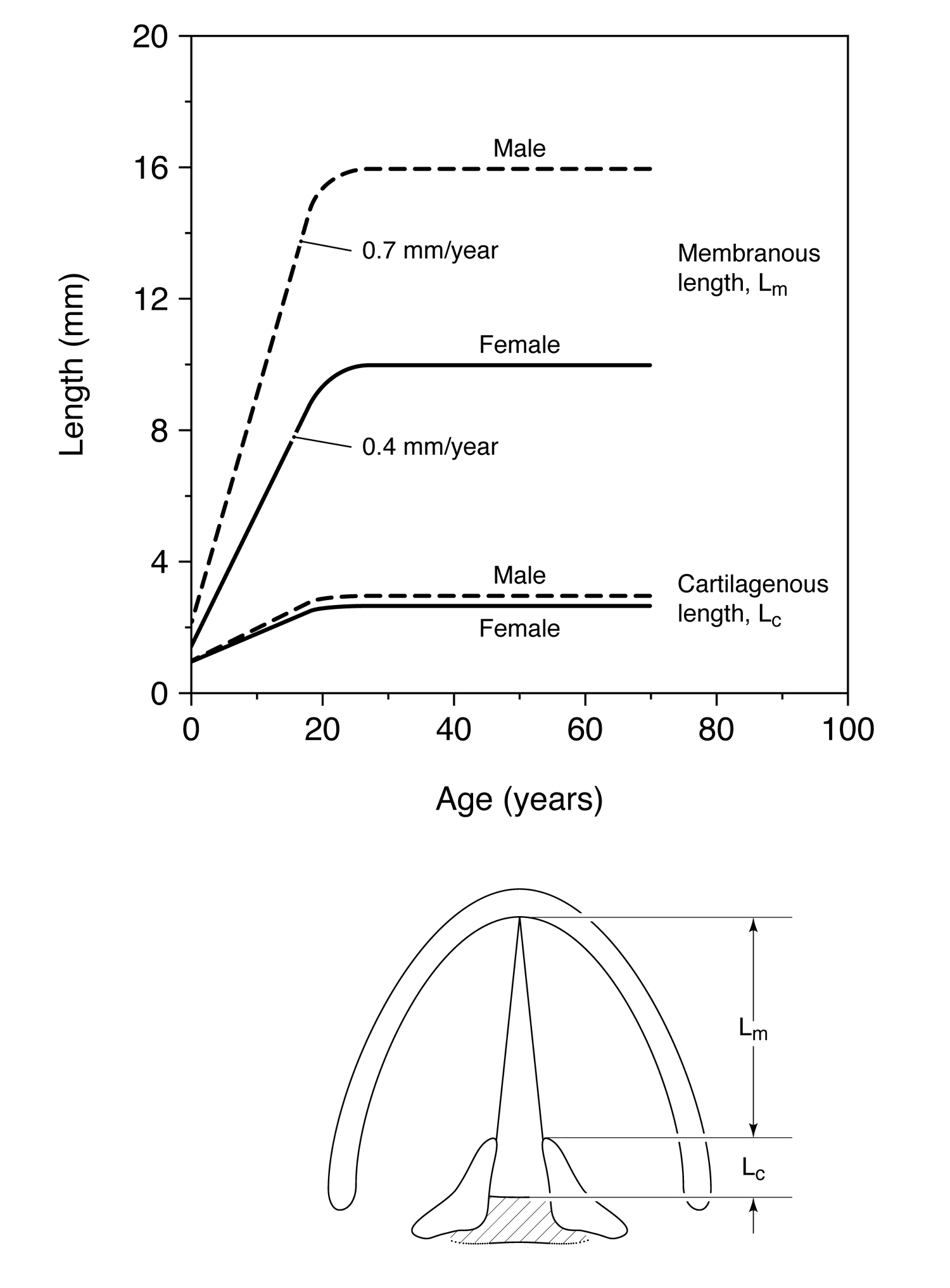 Figure 7.6: The membranous length of the vocal fold as a function of age for 48 male cadavers. Growth rate is 0.4 mm/year for females and 0.7 mm/year for males. From Hirano et al. (1989).
Key findings:
- Growth rate for females: 0.4 mm per year
- Growth rate for males: 0.7 mm per year
- Maximum adult length: approximately 16 mm for males, 10 mm for females
- Infant length: approximately 2 mm
- Cartilaginous length (Lc): Does not display as large a gender difference as membranous length
Note: The cadaveric state is preferred for this comparison rather than an in vivo state because it provides the highest probability of a common stress in the tissue.
Tissue Development Timeline
Development of crucial vocal fold structures follows a specific timeline:
- Birth to age 3: Relatively undifferentiated tissue structure
- Ages 3-4: Development of the vocal ligament and thyroarytenoid muscle begins
- Ages 4-10: Continued tissue differentiation and organization
- Approaching puberty: Accelerating gender divergence in growth patterns
The development of the vocal ligament and thyroarytenoid muscle beginning at ages 3-4 represents a critical milestone. This tissue maturation could stiffen the vocal folds on average, counteracting the expected drop in F₀ due to increasing length.
Fundamental Frequency Development
The F₀-Length Relationship
Figure 7.7 shows the long-term average speaking fundamental frequency as a function of membranous length. This figure is derived as a composite of data from Kent (1976) and Hirano et al. (1980), with age indicated as a parameter at some data points.
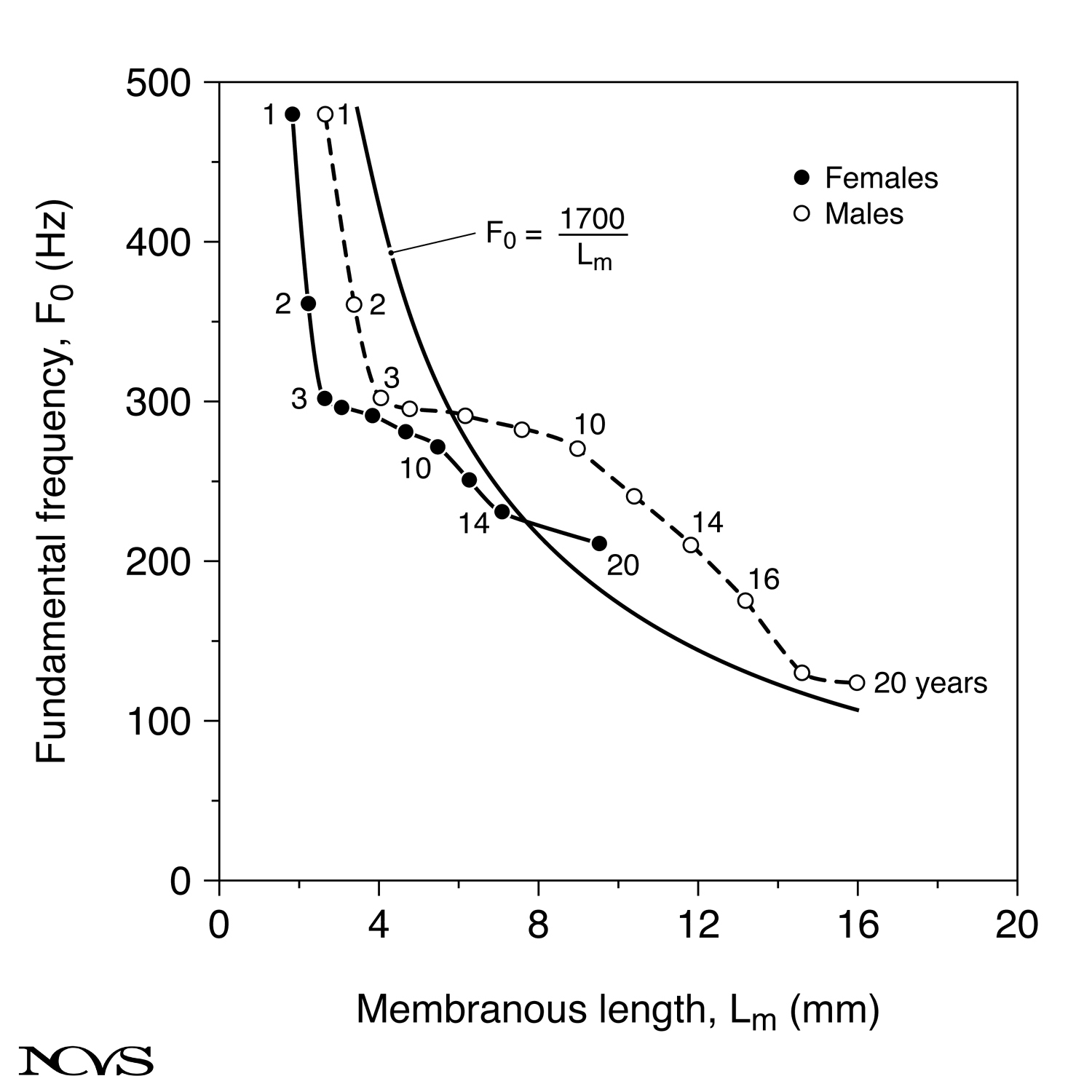 Figure 7.7: Fundamental frequency as a function of membranous length of the vocal fold, with age as a parameter. The hyperbola F₀ = 1700/Lₘ serves as a model.
The relationship can be modeled by a hyperbola:
F₀ = 1700/LₘWhere:
- F₀ is fundamental frequency in Hz
- Lₘ is membranous vocal fold length in mm
- 1700 is an empirical constant (Hz-mm)
Developmental Deviations at Ages 3-10
Major deviations from the model occur at ages 3 to 10. The fundamental frequency drops less in this age range than would be predicted by length increase alone. Several factors may explain this phenomenon:
-
Tissue Stiffening: Development of the vocal ligament and thyroarytenoid muscle beginning at ages 3-4 could stiffen the tissue, counteracting the F₀ drop from increasing length
-
Dimensional Compensation: Compensating dimensional changes in the vocal fold tissue layers may occur
-
Elasticity Changes: Alterations in tissue elasticity could affect the overall stress-to-density ratio
-
Hypertense Musculature: Children might maintain hypertense laryngeal musculature during speech (though this is considered less likely)
Research Need: More data under controlled conditions with an increased number of subjects are needed to shed light on this topic.
Aerodynamic Characteristics
Loudness Production in Children
An interesting question arises: How are children able to produce sounds as loud as adults with much smaller vocal folds and lungs?
Partial answer from F₀: A higher F₀ guarantees higher intensity, all else being equal. Vocal intensity increases about 8-9 dB per octave increase in F₀ (as will be shown in Chapter 9). At 300 Hz speaking F₀, children are about an octave higher than the male-female adult average of 150 Hz.
Non-Scaled Vocalizations
However, children’s vocalizations are not simply scaled-down versions of adult vocalizations. According to Stathopoulos and Sapienza (1991), children aged four to eight years produce time-varying (oscillatory) airflows similar to those of adults when asked to phonate soft, comfortable, or loud.
Implications: With membranous vocal fold lengths less than half the adult value, this is possible only if either:
- Lung pressure is significantly greater in children, or
- Amplitude of vibration is significantly greater in children
Lung Pressure and Volume Excursion
Stathopoulos and Sapienza measured lung pressure and found:
- 50-60% greater lung pressure in children compared to adults
- Greater lung volume excursion relative to vital capacity in children
Interpretation: Children attempt to match the vocal loudness of adults by working harder. They compromise the length of their vocal utterances to achieve equality in loudness. This explains why children take more frequent breaths during speech.
Implications for Pitch-Loudness Independence
If amplitude of vibration is also disproportionately large in children (which has yet to be proven), it would be understandable why children have a difficult time making pitch and loudness independent of each other.
As will be shown in Chapter 8, the amplitude-to-length ratio determines the amount of F₀ increase that can be expected with rising lung pressure. With a high amplitude-to-length ratio, children would find it difficult to sing a crescendo at constant pitch—they would have a tendency to go sharp when lung pressure is increased, a phenomenon that has been observed.
Clinical and Pedagogical Considerations
Appropriate Expectations
Understanding childhood vocal development helps establish appropriate expectations:
- Vocal Range: Children naturally have higher fundamental frequencies and smaller ranges
- Loudness Control: Children work harder aerodynamically to match adult loudness
- Breath Management: More frequent breathing is normal and necessary
- Pitch Control: Difficulty maintaining constant pitch during crescendo is developmentally normal
- Quality: Voice quality reflects immature tissue structure
Training Considerations
Voice training for children should:
- Respect natural limitations of smaller vocal folds and lungs
- Avoid pushing for adult-like loudness or range
- Develop healthy breath management appropriate to child anatomy
- Recognize that pitch-loudness independence develops gradually
- Allow for frequent vocal rest and hydration
When to Begin Classification
Given the rapid changes and developmental uncertainties:
- Avoid formal classification before age 10
- Use descriptive terms rather than adult voice categories
- Reassess frequently as growth occurs
- Focus on healthy production rather than placement in categories
- Wait until age 20 for definitive adult classification
Summary
Childhood vocal development is characterized by steady vocal fold growth at different rates for males (0.7 mm/year) and females (0.4 mm/year), with important tissue development beginning at ages 3-4. The relationship between fundamental frequency and membranous vocal fold length follows the empirical formula F₀ = 1700/Lₘ, though deviations occur at ages 3-10, possibly due to vocal ligament and thyroarytenoid muscle development. Children produce adult-like loudness by working harder aerodynamically, using 50-60% greater lung pressure and greater lung volume excursion relative to vital capacity. This results in more frequent breathing and difficulty maintaining pitch-loudness independence. Understanding these developmental patterns helps establish appropriate expectations and avoid premature formal voice classification.
Key Takeaways
- ✅ Membranous vocal fold length grows at 0.4 mm/year for females and 0.7 mm/year for males during childhood
- ✅ Vocal ligament and thyroarytenoid muscle development begins at ages 3-4, potentially affecting F₀-length relationships
- ✅ The empirical relationship F₀ = 1700/Lₘ models fundamental frequency from vocal fold length
- ✅ Deviations from the model occur at ages 3-10, possibly due to tissue maturation processes
- ✅ Children produce adult-like loudness using 50-60% greater lung pressure than adults
- ✅ Higher lung pressure relative to smaller vocal folds may create difficulty with pitch-loudness independence
- ✅ More frequent breathing during speech is normal and necessary for children
- ✅ Formal voice classification should be avoided before age 10, with definitive classification waiting until age 20
Related Topics
- Critical Periods of Vocal Change
- Fundamental Frequency and Vocal Fold Length
- Adolescence
- Morphology of Vocal Fold Soft Tissue
Further Reading
- Hirano, M., Kurita, S., & Nakashima, T. (1981). The structure of the vocal fold. In K. N. Stevens and M. Hirano (Eds.), Vocal Fold Physiology. University of Tokyo Press.
- Kahane, J. (1978). A morphological study of the human prepubertal and pubertal larynx. American Journal of Anatomy, 151, 11-20.
- Kent, R. D. (1976). Anatomical and neuromuscular maturation of the speech mechanism: Evidence from acoustic studies. American Journal of Anatomy, 151, 11-20.
- Stathopoulos, E.T. & Sapienza, C. M. (1991, October). Comparison of child and adult mechanisms for varying vocal intensity. ASHA, p. 216.