Rules for Modifying Vowels
Understanding how specific articulatory maneuvers affect formant frequencies allows systematic and predictable vowel modification. These rules provide practical guidance for singers, actors, and voice clinicians.
Rule 1: Vocal Tract Length
All formant frequencies decrease uniformly as the length of the vocal tract increases.
Physical Basis
This rule agrees with intuition: larger objects resonate sound at lower frequencies. We use long organ pipes, long strings, large drums, and big loudspeakers to produce low notes.
Mechanisms for Changing Vocal Tract Length
Larynx Lowering:
-
Increases pharyngeal length
-
Approximately 10% length increase possible
-
Produces comparable percentage shift in formant frequencies
-
Darkens vowel quality
-
Used in “covered” singing technique
Larynx Raising:
-
Decreases pharyngeal length
-
Brightens vowel quality
-
Less effective than lowering (limited range)
-
Associated with “pressed” or “tight” voice quality
Lip Protrusion:
-
Extends vocal tract beyond teeth
-
Approximately 10% length increase possible
-
Similar acoustic effect to larynx lowering
-
More visible and easier to control than larynx height
Lip Retraction:
-
Effectively shortens vocal tract
-
Raises all formants
-
Associated with spreading, smiling configuration
Quantitative Effects
For a 17.5 cm vocal tract (average male):
10% lengthening (to 19.25 cm):
-
F₁: 500 Hz → 455 Hz (-45 Hz, -9%)
-
F₂: 1500 Hz → 1364 Hz (-136 Hz, -9%)
-
F₃: 2500 Hz → 2273 Hz (-227 Hz, -9%)
-
All formants reduced by approximately 10%
10% shortening (to 15.75 cm):
-
F₁: 500 Hz → 556 Hz (+56 Hz, +11%)
-
F₂: 1500 Hz → 1667 Hz (+167 Hz, +11%)
-
F₃: 2500 Hz → 2778 Hz (+278 Hz, +11%)
-
All formants increased by approximately 11%
Practical Exercise
Try this experiment:
-
Phonate an [a] vowel at comfortable pitch
-
Gradually lower your larynx (attempt to yawn)
-
Note the darkening quality (move toward [ɔ])
-
Now extend your lips forward during [a]
-
Similar darkening should occur
Rule 2: Lip Rounding and Spreading
All formant frequencies decrease uniformly with lip rounding and increase with lip spreading.
Physical Basis
Lip rounding is similar to partially covering the mouth. In both cases, the effective tube length increases acoustically, which lowers all formant frequencies.
Lip Rounding Effects
Mechanism:
-
Creates small opening at lips
-
Builds up pressure behind lips
-
Acoustic zero-crossing extends beyond physical mouth
-
Increases effective acoustic length
Typical effects (5 mm protrusion with rounding):
-
All formants: -50 to -100 Hz per mm of extension
-
Total shift: -250 to -500 Hz for substantial rounding
Perceptual effects:
-
Darker, warmer tone quality
-
Reduced brightness
-
Associated with [u], [o], [ɔ] vowels
Lip Spreading Effects
Mechanism:
-
Creates larger opening
-
Reduces pressure buildup
-
Acoustic zero-crossing occurs inside physical mouth
-
Decreases effective acoustic length
Typical effects:
-
All formants: +50 to +100 Hz
-
Brighter, more forward tone quality
-
Associated with [i], [e], [æ] vowels
Covered vs. Open Singing
The contrast between “open” and “covered” singing by professionals involves lip configuration combined with larynx height adjustments:
Covered sound:
-
Lip rounding
-
Larynx lowering (or neutral)
-
Lower formants overall
-
Darker tone quality
Open sound:
-
Lips neutral to spread
-
Larynx higher (or neutral)
-
Higher formants overall
-
Brighter tone quality
Practical Exercise
-
Phonate [a] with spread lips
-
Gradually round lips while maintaining [a]
-
Notice transition toward [ɔ] or [o]
-
Alternate between spread and rounded
-
Observe the consistent darkening with rounding
Rule 3: Jaw Lowering
F₁ can be raised substantially by lowering the jaw.
Physical Basis
Jaw lowering:
-
Increases mouth opening
-
Reduces constriction at mouth
-
Shortens effective acoustic length for F₁
-
Decreases acoustic impedance at lips
Application to Singing
This is particularly important in female singing at high pitches (Sundberg, 1977):
High soprano singing:
-
F₀ may exceed typical F₁ for vowel
-
Sopranos tend to align F₁ with F₀
-
Accomplished by jaw lowering
-
Maximizes output power
-
May sacrifice vowel identity for intensity
Example:
-
Soprano singing A5 (880 Hz)
-
Normal [i]: F₁ ≈ 300 Hz (poor alignment)
-
Modified [i]: F₁ raised to ~880 Hz (good alignment)
-
Accomplished by jaw lowering
-
Vowel sounds more like [e] or [ɛ]
Trade-offs
Benefits:
-
Increased acoustic output power
-
Better formant-harmonic alignment
-
Easier phonation at high pitches
Costs:
-
Reduced vowel intelligibility
-
Less precise articulation
-
May affect smoothness of tone quality
Voice teachers and singers must determine the optimal balance through trial and error based on:
-
Performance context (opera house vs. recital hall)
-
Repertoire requirements
-
Individual vocal characteristics
-
Desired aesthetic
Practical Exercise
-
Sing or speak [i] at comfortable pitch
-
Gradually lower jaw while maintaining [i]
-
Notice F₁ rising (brightness increasing)
-
Vowel moves toward [e] then [ɛ]
-
Observe power increase with better resonance
Rule 4: Pharyngeal Constriction
A pharyngeal constriction raises F₁ and lowers F₂, creating spectral compacting.
Physical Basis
When the pharynx narrows (back of tongue raised):
-
Pharynx acts as smaller cavity
-
Mouth acts as larger cavity
-
F₁ pressure patterns show shortened acoustic length
-
F₂ pressure patterns show lengthened acoustic length
Acoustic Effects
For [a] vowel (pharyngeal constriction):
-
F₁: Raised from 500 Hz to ~700-900 Hz
-
F₂: Lowered from 1500 Hz to ~1000-1300 Hz
-
Net result: Compact spectrum (energy concentrated)
Perceptual quality:
-
Focused sound
-
Concentrated energy
-
Dark, back quality
-
May sound “throaty” if excessive
Applications
Positive uses:
-
Creating [a], [ɑ], [ɔ] vowels
-
Achieving darker tone quality
-
Balancing forward/back resonance
Caution:
-
Excessive constriction may cause tension
-
Can limit dynamic range
-
May create harsh or pressed quality
Rule 5: Oral Constriction
A mouth constriction lowers F₁ and raises F₂, creating spectral diffusion.
Physical Basis
When the mouth narrows (front of tongue raised):
-
Mouth acts as smaller cavity
-
Pharynx acts as larger cavity
-
F₁ pressure patterns show lengthened acoustic length
-
F₂ pressure patterns show shortened acoustic length
Acoustic Effects
For [i] vowel (oral constriction):
-
F₁: Lowered from 500 Hz to ~250-350 Hz
-
F₂: Raised from 1500 Hz to ~2200-2500 Hz
-
Net result: Diffuse spectrum (energy spread across frequencies)
Perceptual quality:
-
Bright, forward sound
-
Energy distributed high and low
-
Clear, penetrating quality
Applications
Positive uses:
-
Creating [i], [e], [ɛ] vowels
-
Achieving brighter tone quality
-
Increasing speech intelligibility
In singing:
-
May need modification at high pitches
-
Can create excessive brightness
-
Balance with pharyngeal adjustments
Constructing the F₁-F₂ Chart from Memory
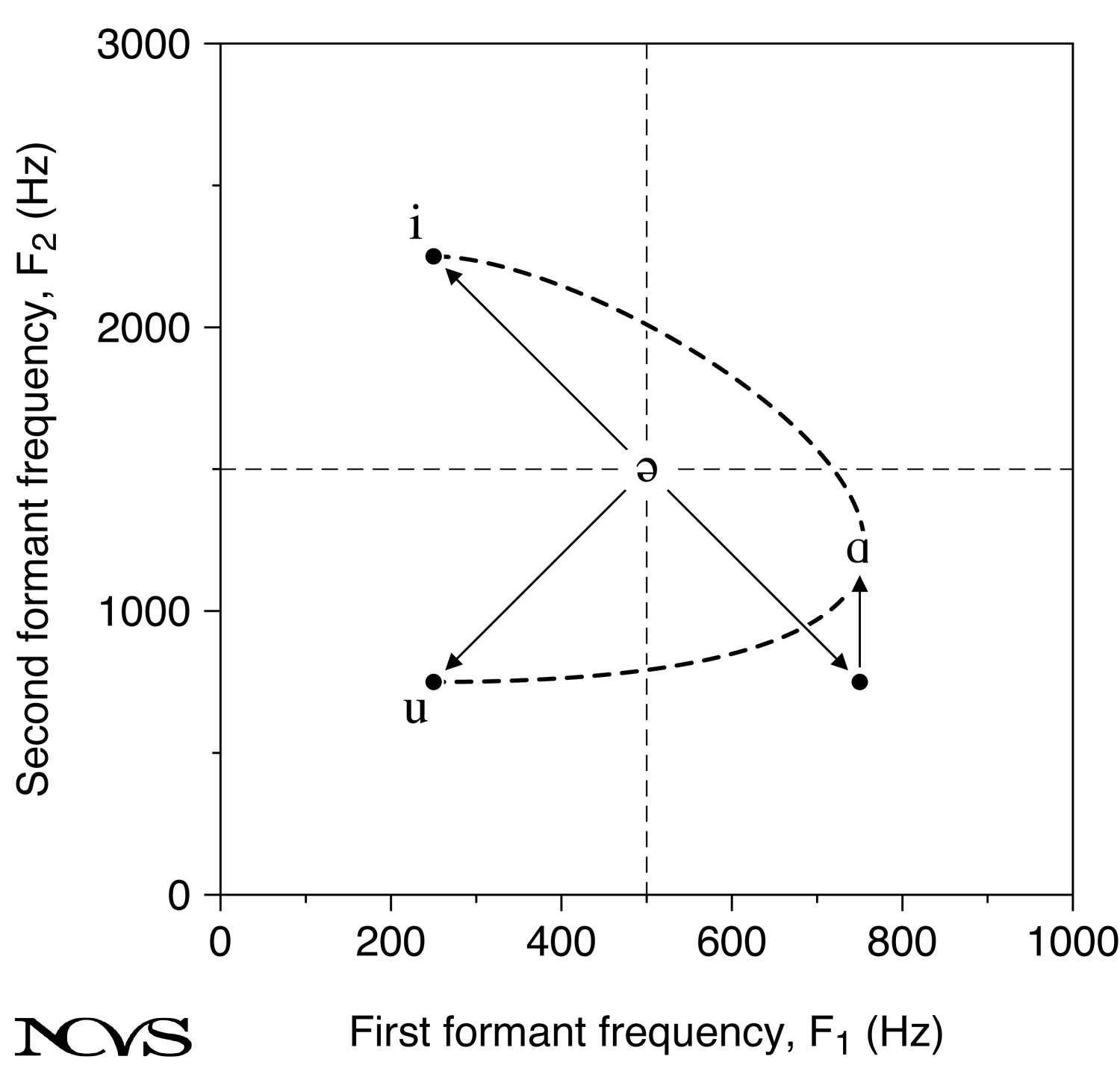
Figure 6.24: Constructing the F₁-F₂ vowel chart from a few simple rules.
These rules allow systematic construction of the vowel space:
-
Draw square (0-1000 Hz F₁; 0-3000 Hz F₂)
-
Place [ə] at center (500 Hz, 1500 Hz)
-
[i] upper left: Oral constriction (F₁ ↓, F₂ ↑)
-
[a] lower right: Pharyngeal constriction (F₁ ↑, F₂ ↓)
-
[u] lower left: Lip rounding (both ↓)
-
Connect corners: Form horseshoe
Practical Application Strategies
For Teachers
-
Start with neutral: Establish [ə] as reference point
-
Isolate variables: Change one parameter at a time
-
Use visual feedback: Real-time spectral display helpful
-
Develop awareness: Help students sense acoustic effects
-
Apply systematically: Use rules consistently
For Clinicians
-
Assess baseline: Measure formants in comfortable speech
-
Identify problems: Determine if formants are appropriate
-
Target modifications: Apply specific rules to shift formants
-
Document changes: Measure before and after
-
Establish new patterns: Stabilize improved configurations
For Performers
-
Understand your instrument: Know your typical formant values
-
Experiment systematically: Try each modification strategy
-
Balance goals: Consider power, quality, intelligibility
-
Develop consistency: Make modifications automatic
-
Adapt to context: Modify based on venue and repertoire
Summary
Five main rules guide vowel modification: (1) Vocal tract lengthening lowers all formants uniformly; (2) Lip rounding lowers all formants uniformly while lip spreading raises them; (3) Jaw lowering primarily raises F₁; (4) Pharyngeal constriction raises F₁ and lowers F₂; (5) Oral constriction lowers F₁ and raises F₂. These rules provide systematic guidance for achieving specific acoustic goals through articulatory changes. Understanding and applying these rules allows voice professionals to make informed decisions about vocal technique and to predict acoustic outcomes of articulatory adjustments.
Key Takeaways
-
✅ Vocal tract lengthening (larynx lowering, lip protrusion) lowers all formants uniformly
-
✅ Lip rounding lowers all formants; lip spreading raises all formants
-
✅ Jaw lowering primarily raises F₁, important for high-pitched singing
-
✅ Pharyngeal constriction raises F₁ and lowers F₂ (spectral compacting)
-
✅ Oral constriction lowers F₁ and raises F₂ (spectral diffusion)
-
✅ These rules allow systematic vowel modification for specific acoustic goals
Related Topics
Further Reading
-
Sundberg, J. (1977). The acoustics of the singing voice. Scientific American, 236, 82-91.
-
Miller, D. G., & Schutte, H. K. (1990). Feedback from spectrum analysis applied to the singing voice. Journal of Voice, 4(4), 329-334.
-
Titze, I. R. (2000). Principles of voice production (2nd ed.). National Center for Voice and Speech.