Sound Propagation in Tubes
When an acoustic wave propagates in a tube, certain boundary effects must be considered that do not occur in free-space propagation. The vocal tract acts as an acoustic tube, and understanding wave behavior in tubes is essential for comprehending vowel formation and vocal tract resonance.
Boundary Conditions in Tubes
In Chapter 5, one-dimensional plane waves propagating in open space were described with no confinement of the wave in the plane perpendicular to the direction of propagation. When an acoustic wave propagates in a tube, the tube walls impose important constraints on the wave.
The air particle velocity must go to zero at the tube wall. Otherwise, the air would not be in “direct contact” with the tube. Air particle velocity is usually at its maximum at the center of the tube and decreases gradually toward the wall. This creates a velocity profile across the tube’s cross section.
Redefining Acoustic Impedance
A free-space acoustic impedance, defined in Chapter 5 as the ratio of pressure to particle velocity, would not be constant over the cross section of the tube. To avoid multiple definitions of wave impedance over this cross section, acoustic impedance (and reflection coefficients) must be reexamined on the basis of an average air particle velocity.
If the average particle velocity across the tube is multiplied by the cross-sectional area, an average flow in the tube is obtained. This average flow is conserved when the tube suddenly expands or contracts. (Flow cannot be created or destroyed, unless there are holes or side branches at a junction.)
The ratio of acoustic pressure p to acoustic airflow u becomes a new definition for the acoustic impedance of the tube:
Z = p/uIf there are no reflections in the tube (the wave travels in one direction only), this pressure-flow ratio has the simple form:
Z = pc/Awhere p is the air density, c is the sound velocity, and A is the cross-sectional area of the tube. Relating this formula to the free-space wave impedance pc described in Chapter 5, the tube impedance is the free-space impedance divided by the area of the tube. It has dimensions of kg s⁻¹ m⁻⁴.
Factors Affecting Wave Propagation
There are now three factors that can alter the propagation of waves:
- Change in sound velocity - Alters the wave speed and wavelength
- Change in air density - Affects the characteristic impedance
- Change in cross-sectional area - Most important for the vocal tract
Any of these factors will cause a reflection. In the vocal tract, area changes are by far the most significant factor, as air density and sound velocity remain relatively constant throughout the airway.
Vocal Tract as a Series of Tubes
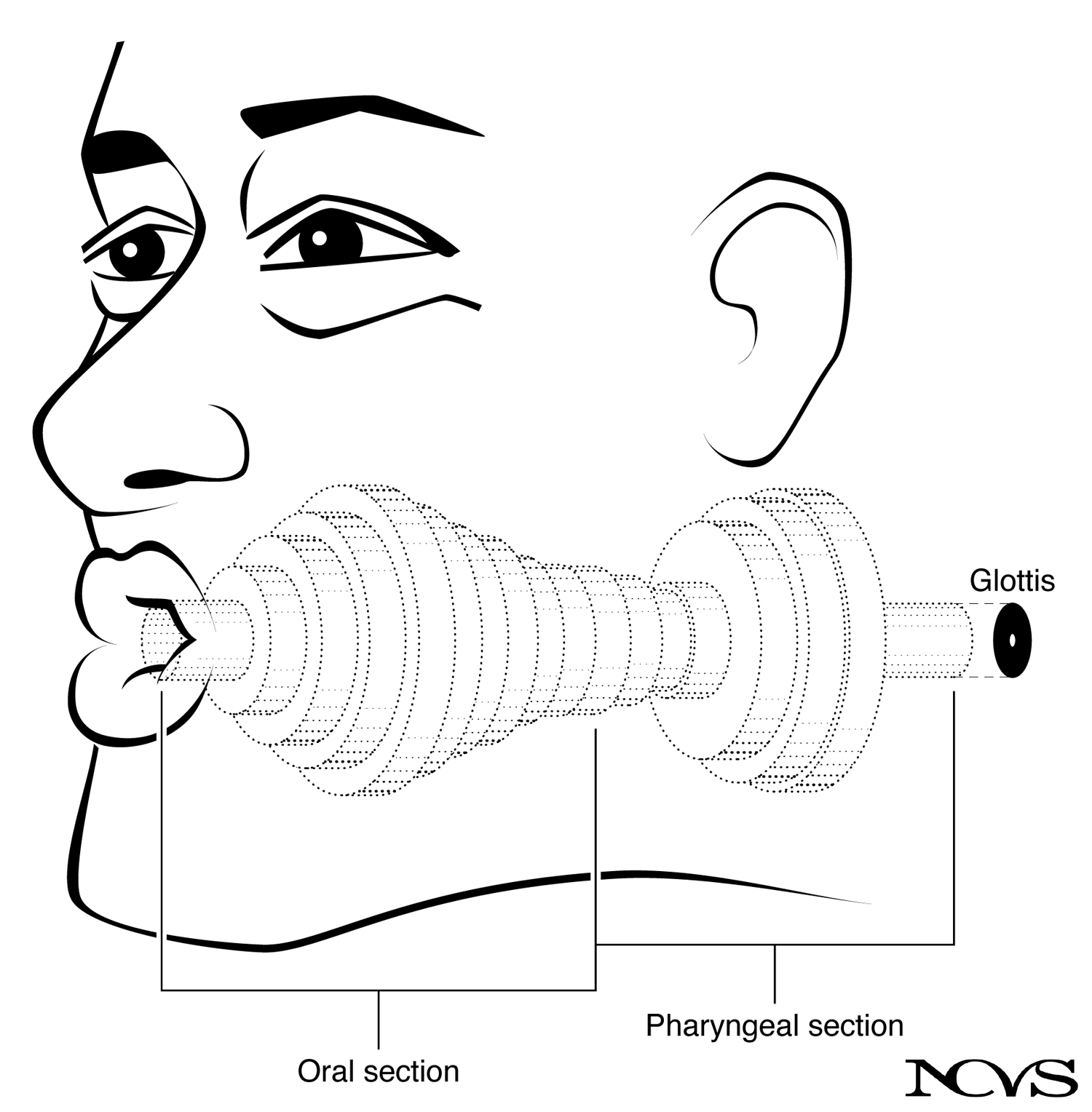 Figure 6.1: Cylindrical-tube approximation of the vocal tract for a simulated /u/ vowel, showing pharyngeal and oral sections.
The vocal tract can be approximated by a series of cylindrical tubes with varying diameters. Cylinders are used for ease of computation of wave propagation. They are arranged in series (abutted against one another) to accommodate area changes in the vocal tract. With these cylindrical tubes, any complicated vocal tract shape can be modeled.
Practical Implications
This tube-based model of the vocal tract allows us to:
- Calculate formant frequencies for different vocal tract shapes
- Predict how articulatory changes affect acoustic output
- Understand why certain vocal tract configurations produce specific vowel qualities
- Design vocal training strategies based on acoustic principles
Summary
Sound propagation in tubes differs fundamentally from free-space propagation due to boundary conditions at the tube walls. The key concept is that acoustic impedance must be redefined as the ratio of pressure to volume flow rather than pressure to particle velocity. This new definition allows us to analyze the vocal tract as a series of connected tubes with different cross-sectional areas.
The most important factor affecting wave propagation in the vocal tract is the change in cross-sectional area along its length. These area changes create reflections that set up standing waves, which in turn create the resonance frequencies (formants) that characterize different vowels.
Key Takeaways
- ✅ Air particle velocity must be zero at tube walls, creating a velocity profile across the tube
- ✅ Acoustic impedance in tubes is defined as the ratio of pressure to volume flow (Z = p/u)
- ✅ For a uniform tube with no reflections, impedance is Z = pc/A, inversely proportional to area
- ✅ Three factors can alter wave propagation: sound velocity, air density, and cross-sectional area
- ✅ In the vocal tract, area changes are the primary factor causing wave reflections
- ✅ The vocal tract can be modeled as a series of cylindrical tubes with varying diameters
Related Topics
- Acoustic Impedance and Reflection
- Quarter-Wave Resonance
- Formant Bandwidth
- Acoustic Wave Propagation
Further Reading
- Fant, G. (1960). Acoustic theory of speech production. The Hague: Mouton.
- Morse, P. (1976). Vibration and sound. New York: American Institute of Physics.
- Titze, I. R. (2000). Principles of voice production (2nd ed.). National Center for Voice and Speech.