Formant Bandwidth
Energy loss in a tube is frequency-dependent and determines the sharpness of formant peaks. The concept of formant bandwidth quantifies how energy dissipation affects the selectivity of vocal tract resonances.
Energy Loss Mechanisms
The theoretical formant frequencies derived for ideal tubes assume 100 percent reflection and no energy loss anywhere in the tube. In reality, several mechanisms dissipate acoustic energy:
- Radiation from the open end: Energy transmitted into free space
- Loss through the glottis: Energy absorbed into the lungs
- Wall vibration: Energy transferred to vibrating tissue
- Air friction: Energy lost to viscous friction between air particles
With the addition of these energy losses, the tube becomes less selective in its response to frequencies. The standing-wave patterns are both less constructive and less destructive.
From Line Spectra to Continuous Spectra
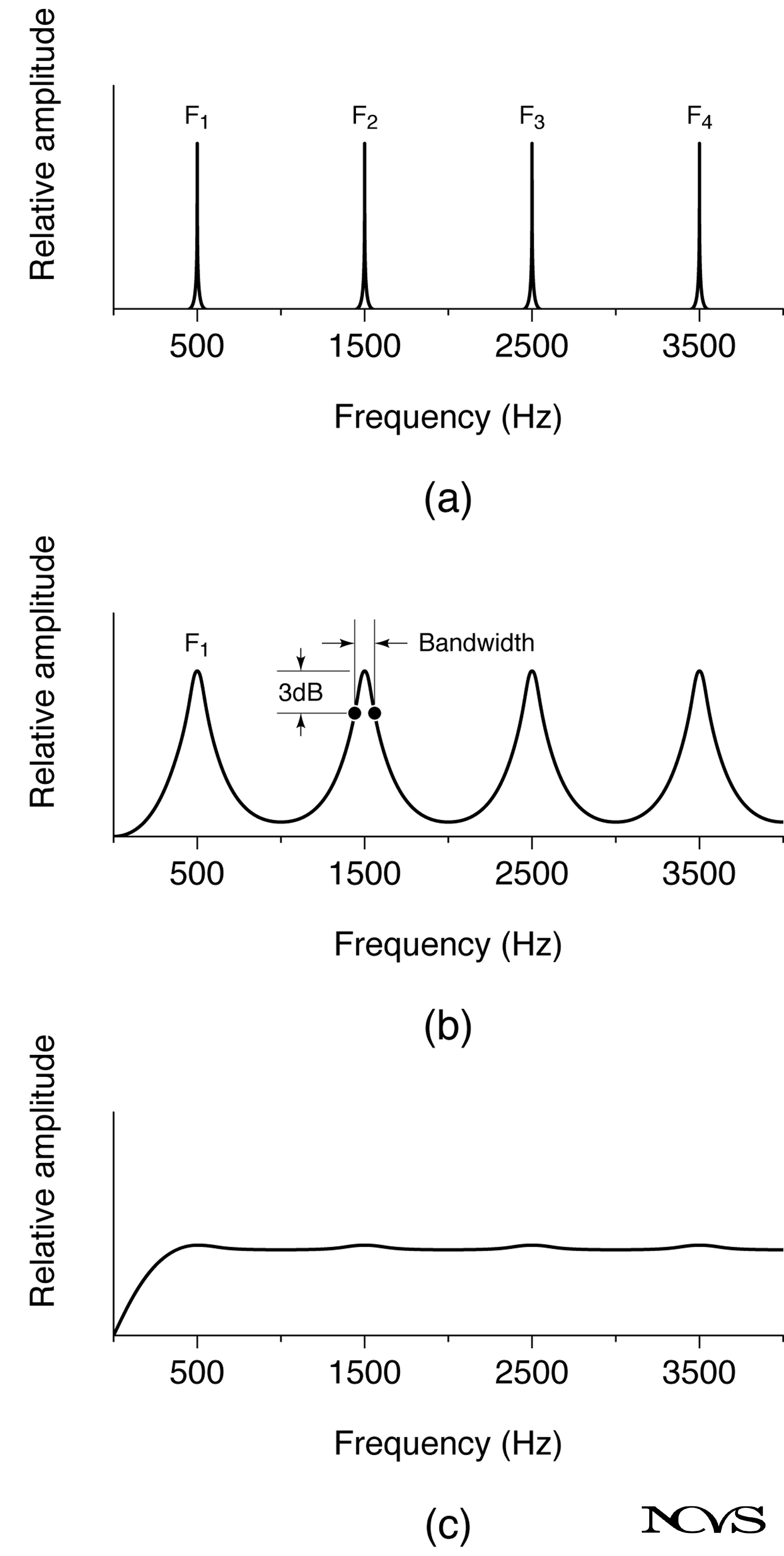 Figure 6.6: Frequency spectra of a closed-open tube: (a) line spectrum for nearly zero energy loss, (b) spectrum when more realistic energy losses are included, and (c) nearly flat spectrum resulting from excessive energy loss.
Ideal Case (No Loss)
A spectrum of formant frequencies with zero energy loss is a line spectrum. Sharp lines occur at precise frequencies only (500 Hz, 1,500 Hz, 2,500 Hz, etc. for a 17.5 cm tube). These lines are evenly spaced at 1,000 Hz intervals for a uniform tube.
Line spectra are abstractions that do not exist in the real world. They are based on the assumption of 100 percent reflection and no energy loss.
Realistic Case (Moderate Loss)
More realistically, with acoustic energy radiated from the open end and lost through the glottis and walls, hills and valleys replace sharp lines. The peaks are at the same locations as the sharp lines, but now the tube can support frequencies in the valleys as well.
Extreme Case (Excessive Loss)
In the limit, as reflections in the tube become very weak with excessive energy loss (or as the “open” and “closed” boundaries are removed), the tube transmits sound equally at all frequencies. The spectrum approaches a straight horizontal line, and the standing wave patterns diminish and ultimately disappear.
Defining Formant Bandwidth
A formant bandwidth quantifies the broadening of a resonance resulting from energy loss. The bandwidth is defined using the half-power points (also called 3 dB points):
Formant Bandwidth = The difference in frequency between the two points on the resonance curve where the response is 3 dB lower than at the peak.
Mathematical Relationship
At the half-power points, the power is reduced by a factor of two relative to the peak:
10 log₁₀(2) ≈ 3.0 dBThe bandwidth encompasses the frequency range where the formant provides significant acoustic amplification.
Frequency-Dependent Energy Loss
Energy loss in the vocal tract is generally frequency-dependent, particularly radiation from the open end.
Radiation Efficiency
At the open end, the tube radiates acoustic energy into free space more effectively at high frequencies than at low frequencies. Radiated power from a simple acoustic source is proportional to the square of the frequency (Morse, 1976).
For every octave increase (doubling) of frequency, the acoustic power radiated from the open end increases by a factor of four, or 6 dB (10 log₁₀ 4 ≈ 6).
Effect on Reflection Coefficient
As more energy “leaks” out of the tube at higher frequencies, the reflection coefficient at the open end gradually decreases in magnitude:
- Low frequencies: r ≈ -1.0 (nearly perfect reflection)
- Mid frequencies: r ≈ -0.9 to -0.8
- High frequencies: r < -0.8 (more energy escapes)
What leaks out of the tube at the top is what the listener hears. Thus, what is a loss from the tube’s point of view is a gain for the listener’s point of view.
Perceptual Significance
The formant bandwidth affects the perceived quality of the voice:
Narrow Bandwidths
- Indicate low energy loss
- Create sharp, selective resonances
- Tend to have a “metallic” sound
- Associated with efficient vocal tract resonance
- May sound more “ringing” or “focused”
Broad Bandwidths
- Indicate high energy loss
- Create less selective resonances
- Tend to have a “muffled” sound
- Associated with damped resonances
- May sound less clear or defined
Typical Bandwidth Values
For the human vocal tract, typical formant bandwidths are:
- F₁: 50-100 Hz
- F₂: 70-150 Hz
- F₃: 100-200 Hz
- F₄: 120-250 Hz
Higher formants generally have greater bandwidths due to increased radiation efficiency at higher frequencies.
Clinical and Pedagogical Applications
Understanding formant bandwidth helps explain:
- Voice quality variations: Why some voices sound clearer or more resonant than others
- Vocal tract efficiency: How well the vocal tract transfers energy from the glottis to the listener
- Acoustic coupling: The degree to which the vocal tract loads the glottal source
- Spectral clarity: Why formants may be more or less distinct in different voices
Summary
Formant bandwidth quantifies the broadening of resonance peaks due to energy loss in the vocal tract. It is defined as the frequency difference between the 3 dB down points on either side of the formant peak. Energy loss occurs through radiation, wall vibration, and air friction, with radiation losses being frequency-dependent (increasing at higher frequencies). Narrow bandwidths produce a metallic sound quality, while broad bandwidths produce a muffled quality. Understanding bandwidth is essential for interpreting spectral analysis and understanding voice quality variations.
Key Takeaways
- ✅ Formant bandwidth is defined as the frequency range between 3 dB down points on a resonance peak
- ✅ Energy loss occurs through radiation, glottal transmission, wall vibration, and air friction
- ✅ Radiated power increases by 6 dB per octave, making high frequencies lose more energy
- ✅ Greater energy loss produces broader formant bandwidths and less selective filtering
- ✅ Narrow bandwidths create metallic sound quality; broad bandwidths create muffled quality
- ✅ Higher formants typically have greater bandwidths due to more efficient radiation
Related Topics
Further Reading
- Fant, G. (1960). Acoustic theory of speech production. The Hague: Mouton.
- Morse, P. (1976). Vibration and sound. New York: American Institute of Physics.
- Stevens, K. N. (1998). Acoustic phonetics. MIT Press.