Quarter-Wave Resonance
Resonance in a tube is the constructive interference of waves experiencing multiple reflections. It is the essence of vocal tract acoustics. The human vocal tract, like the tube of a wind or brass instrument, resonates at certain special frequencies produced by the sound source. These frequencies depend on the shape of the vocal tract and determine many speech sounds (phonemes) from which syllables and words are made.
The Quarter-Wave Tube Configuration
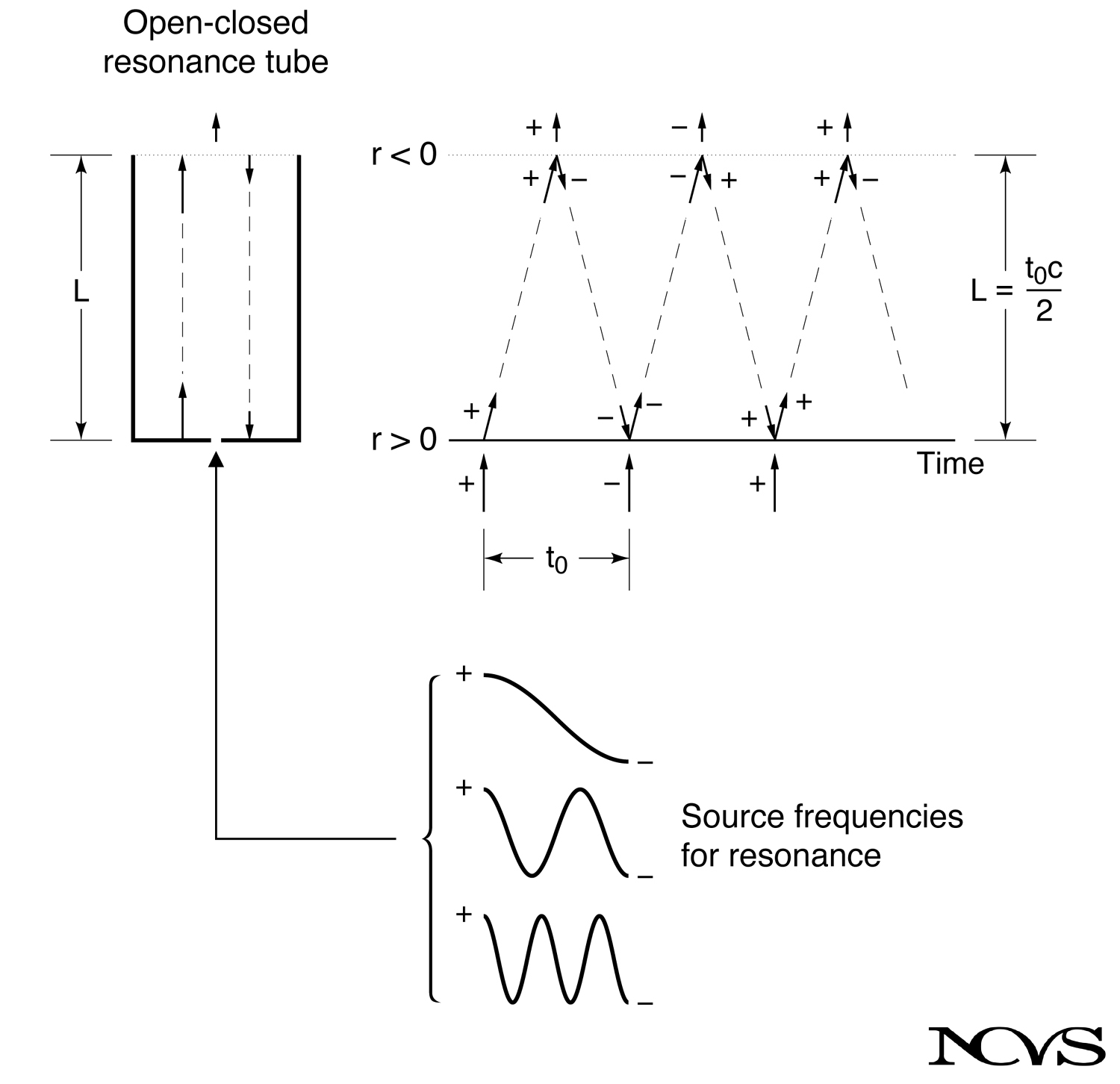 Figure 6.3: Resonance in an open-closed (quarter-wave) tube. A reflection diagram is shown to the right, and source frequencies for resonance are shown underneath.
Consider a tube of length L, closed at one end and open at the other. This tube is called a quarter-wave resonator for reasons that will become evident. The tube is shown in a vertical position, with the open end on top. A small hole at the bottom makes the “closed end” not quite closed, but approximately so.
This hole, which is used to supply acoustic energy to the tube, is a representation of the glottis in the human airway. It could also represent the gap between a brass player’s lips. For any vibrating source, this hole (or slit) will open and close periodically according to the criteria of oscillation described in Chapter 4.
Space-Time Reflection Diagram
A wave reflection diagram is shown to the right of the tube. Time is on the horizontal axis, and space is on the vertical axis. Instead of “freezing” one variable and showing pressure versus either space or time, we have essentially created a three-dimensional representation by showing both space and time and letting the magnitude of a pressure peak be the length of an arrow. Polarity of the wavefront is also indicated at the side of the arrow.
Wave Propagation Sequence
Assume that a sinusoidal flow is introduced through the hole. This can be any frequency component of a complex source waveform. The initial peak of the sinusoids is chosen with a plus sign (for the sake of discussion), indicating that the polarity of the initial pressure disturbance at the hole is a compression.
The sequence of events is:
- Upward propagation: The positive pressure disturbance propagates the length of the tube toward the open end
- First reflection (r < 0): At the open end (expansion to infinite area), the compression inverts to create a rarefaction of nearly the same magnitude
- Downward propagation: The rarefaction travels back down the tube
- Second reflection (r > 0): At the bottom (nearly closed), the rarefaction reflects with the same polarity, remaining a rarefaction
- Second upward trip: The rarefaction travels to the top and inverts again to become a compression
- Cycle completion: After the second round trip, the pressure pattern is identical to the initial one
Standing Wave Formation
A standing wave is created in this process. Note that:
- The pressure magnitude is always doubled at the bottom (either doubly positive or doubly negative as the alternating plus and minus signs indicate)
- The pressure magnitude always remains near zero at the top (because incident and reflected waves tend to cancel each other)
This standing wave would persist indefinitely in the tube, even for a single pressure disturbance introduced at the hole, were it not for the fact that some energy is lost in propagation and reflection. The small amount of acoustic energy leaving at the top of the tube and at the bottom hole attenuates the reflected waves.
Resonance Condition
The standing-wave pattern can be reinforced by periodic source inputs, provided the period T of the injected flows has a simple relationship to the transit time of the wave. If we define t₀ to be the transit time for one round trip of the wave, resonance occurs when:
t₀ = T/2
or  t₀ = 3T/2
or  t₀ = 5T/2
or  t₀ = nT/2  (where n is any positive odd integer)
The transit time may be expressed as the total distance (two tube lengths) divided by the speed of sound c:
t₀ = 2L/cFor resonance, then:
2L/c = nT/2where n is any positive odd integer. Because the period T is the inverse of the frequency F of the source, this can be rewritten as:
F = n(c/4L)Formant Frequencies
At this point we introduce the term formant, which will be used extensively throughout the text. A formant is a resonance of the vocal tract. The equation above identifies the formant frequencies of a closed-open uniform tube.
There is an infinite number of such formant frequencies, but only a few are usually of interest. In analogy with the normal modes of vibration of vocal fold tissue, formants are the normal modes of the vocal tract air column.
Notation
To distinguish between each of the formant frequencies, it is customary to place a subscript n on the symbol F so that Fₙ represents the entire collection of formant frequencies (n = 1, 2, 3, 4 … ∞). Only the odd integers apply, however. To select these odd integers automatically, the formant frequencies can be rewritten as:
Fₙ = (2n - 1)(c/4L)where n can now be any positive integer. The beauty of this notation is that the subscript on the frequency (left side) corresponds to the value of n chosen on the right. For n = 1, 2, …, we get F₁ = c/4L, F₂ = 3c/4L, and so on.
Why “Quarter-Wave”?
It is now possible to understand why the open-closed tube is called a quarter-wave resonator. Recalling that F = c/λ for any wave, where λ is the wavelength, it is apparent that λ = 4L when n = 1. In other words, for the lowest formant the wavelength is four times the length of the tube. Stated another way, the tube length is a quarter of a wavelength long at its first formant frequency.
Standing Wave Patterns
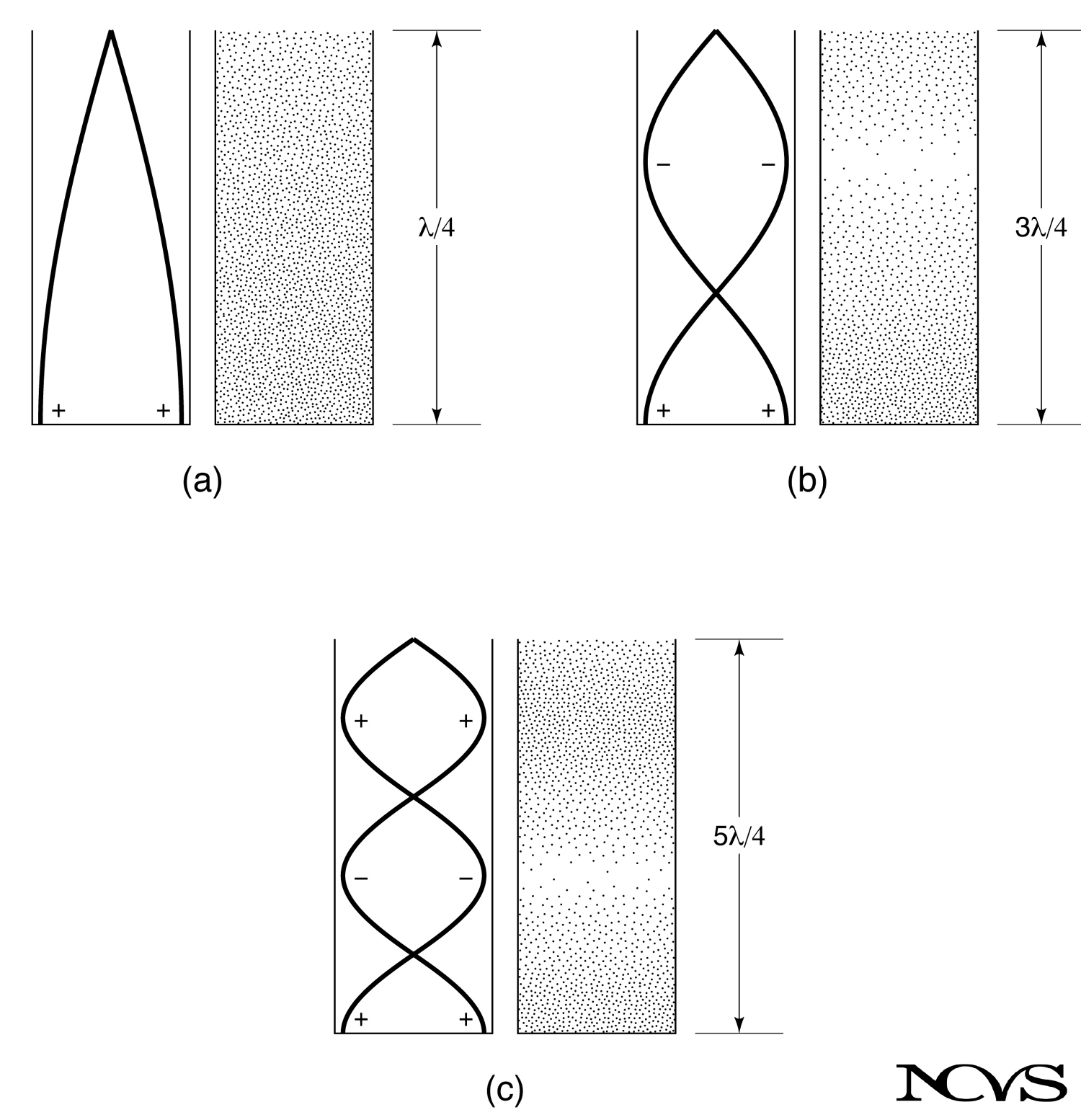 Figure 6.4: Pressure distribution (shown by stipple density and line drawings) in the closed-open resonance tube: (a) the lowest quarter-wave resonance, (b) three-quarter wave resonance, and (c) five-quarter wave resonance.
The pressure patterns for the first three formants show:
- First formant (n = 1): λ/4 pattern - pressure decreases from maximum at closed end to zero at open end
- Second formant (n = 2): 3λ/4 pattern - tube length corresponds to three-quarters of a wavelength
- Third formant (n = 3): 5λ/4 pattern - tube length corresponds to five-quarters of a wavelength
Note that pressure doubling (positive or negative) occurs at several locations along the tube as n increases, but always at the closed end and never at the open end.
These are “snapshots” in time. A half period later, all of the compressions (+) become rarefactions (-), and vice versa. The important feature of a standing wave is that the amplitudes of the acoustic pressures (the maximum positive or negative excursions) anywhere in space remain the same.
Numerical Example
For an average male vocal tract length of 17.5 cm and a sound velocity of 35,000 cm/s, the formant frequencies are:
Fₙ = (2n - 1) × 35,000/(4 × 17.5) = (2n - 1) × 500 HzThe lowest four formant frequencies are:
- F₁ = 500 Hz
- F₂ = 1,500 Hz
- F₃ = 2,500 Hz
- F₄ = 3,500 Hz
These formants are evenly spaced at 1,000 Hz intervals for a uniform tube.
Summary
The quarter-wave resonator is fundamental to understanding vocal tract acoustics. A tube closed at one end (the glottis) and open at the other (the lips) resonates at frequencies given by Fₙ = (2n-1)(c/4L), where only odd multiples of the fundamental are present. These resonances, called formants, are created by constructive interference of waves reflecting between the two ends.
The tube is called “quarter-wave” because at the lowest formant frequency, the tube length equals one-quarter of the wavelength. Standing wave patterns show pressure maxima at the closed end and pressure minima at the open end, with the complexity of the pattern increasing for higher formants.
Key Takeaways
- ✅ Quarter-wave resonators are closed at one end and open at the other, like the vocal tract
- ✅ Formant frequencies are given by Fₙ = (2n-1)(c/4L), containing only odd harmonics
- ✅ Standing waves form through constructive interference of multiply-reflected waves
- ✅ Pressure is always maximum (doubled) at the closed end and minimum (zero) at the open end
- ✅ For a 17.5 cm vocal tract, formants are spaced at approximately 1000 Hz intervals
- ✅ The term “quarter-wave” refers to the tube length being λ/4 at the first formant
Related Topics
Further Reading
- Fant, G. (1960). Acoustic theory of speech production. The Hague: Mouton.
- Titze, I. R. (2000). Principles of voice production (2nd ed.). National Center for Voice and Speech.
- Stevens, K. N. (1998). Acoustic phonetics. MIT Press.