Vowel Shapes
Vowel production involves creating specific configurations of the vocal tract that selectively emphasize certain frequencies while attenuating others. These vowel shapes—the three-dimensional articulatory postures of the tongue, jaw, lips, and pharynx—determine formant frequencies and thus vowel quality. Understanding the articulatory basis of vowel shapes connects physical vocal tract configurations to acoustic outputs, providing essential knowledge for voice pedagogy, clinical intervention, and theoretical models of speech production.
The Articulatory Space for Vowels
Unlike consonants, which involve significant constrictions or closures in the vocal tract, vowels are produced with relatively open configurations that allow unimpeded airflow.
Defining Characteristics of Vowel Articulation
Open Vocal Tract: Vowels require a vocal tract configuration without complete closure or narrow turbulence-producing constrictions. The narrowest constriction in vowel production typically has a cross-sectional area of at least 0.25-0.50 cm², sufficient to maintain laminar (non-turbulent) airflow.
Laryngeal Voicing: In most languages, vowels are typically voiced (produced with vocal fold oscillation), though whispered and voiceless vowels exist. The periodic glottal source provides the acoustic energy that the vocal tract filters to create vowel quality.
Resonant Filtering: The vocal tract acts as an acoustic filter whose resonances (formants) shape the spectrum of the glottal source. Vowel quality derives primarily from these resonances rather than from the sound source itself, exemplifying the source-filter theory of speech production.
Degrees of Freedom
Vowel articulation involves multiple independent or semi-independent articulatory dimensions:
- Tongue height (vertical tongue body position)
- Tongue advancement (horizontal tongue body position)
- Tongue root position (pharyngeal expansion/constriction)
- Jaw opening (mandibular height)
- Lip configuration (rounding, protrusion, spreading)
- Velopharyngeal port (raised for oral vowels, lowered for nasal vowels)
- Larynx height (vertical laryngeal position)
These dimensions do not operate entirely independently—anatomical linkages and motor control strategies couple certain dimensions—but they provide a multi-dimensional space within which vowel shapes are defined.
Tongue Position: The Primary Articulatory Dimension
Tongue configuration, particularly the position of the tongue body, constitutes the primary articulatory variable in vowel production.
Vertical Dimension: Tongue Height
High vowels (/i/, /u/): The tongue body is raised toward the palate, creating a narrow channel between tongue and roof of mouth. This constriction divides the vocal tract into two main cavities: a relatively small oral (front) cavity and a larger pharyngeal (back) cavity.
Mid vowels (/e/, /o/, /ə/): The tongue body occupies an intermediate height position, with moderate constriction. The division between oral and pharyngeal cavities is less extreme than for high vowels.
Low vowels (/a/, /æ/): The tongue body is lowered, typically accompanied by jaw lowering. The vocal tract is relatively undivided, with minimal constriction and maximal overall cross-sectional area.
Horizontal Dimension: Tongue Advancement
Front vowels (/i/, /e/, /ɛ/): The highest point of the tongue body is in the anterior-central oral cavity, near the hard palate. The constriction is relatively forward, creating a large pharyngeal cavity and small oral cavity anterior to the constriction.
Central vowels (/ə/, /ʌ/): The tongue body constriction occurs near the junction of hard and soft palate. The pharyngeal and oral cavities have more balanced proportions.
Back vowels (/u/, /o/, /ɑ/): The highest point of the tongue body is in the posterior oral cavity, near the velum or upper pharynx. This creates a smaller pharyngeal cavity and larger oral cavity anterior to the constriction.
Tongue Root Position
Beyond the tongue body position, the tongue root (base of tongue) can advance or retract:
Advanced Tongue Root (ATR): The tongue root moves forward, expanding the pharyngeal cavity. This configuration is characteristic of tense vowels in many languages and creates distinctive acoustic effects, particularly lowering F1.
Retracted Tongue Root (RTR): The tongue root pulls backward, constricting the pharyngeal cavity. This configuration characterizes lax vowels and certain vowel harmonies in languages like Mongolian and various African languages.
In English, the tense-lax distinction (e.g., /i/ vs. /ɪ/, /u/ vs. /ʊ/) involves not only tongue height but also tongue root position, with tense vowels generally showing more ATR.
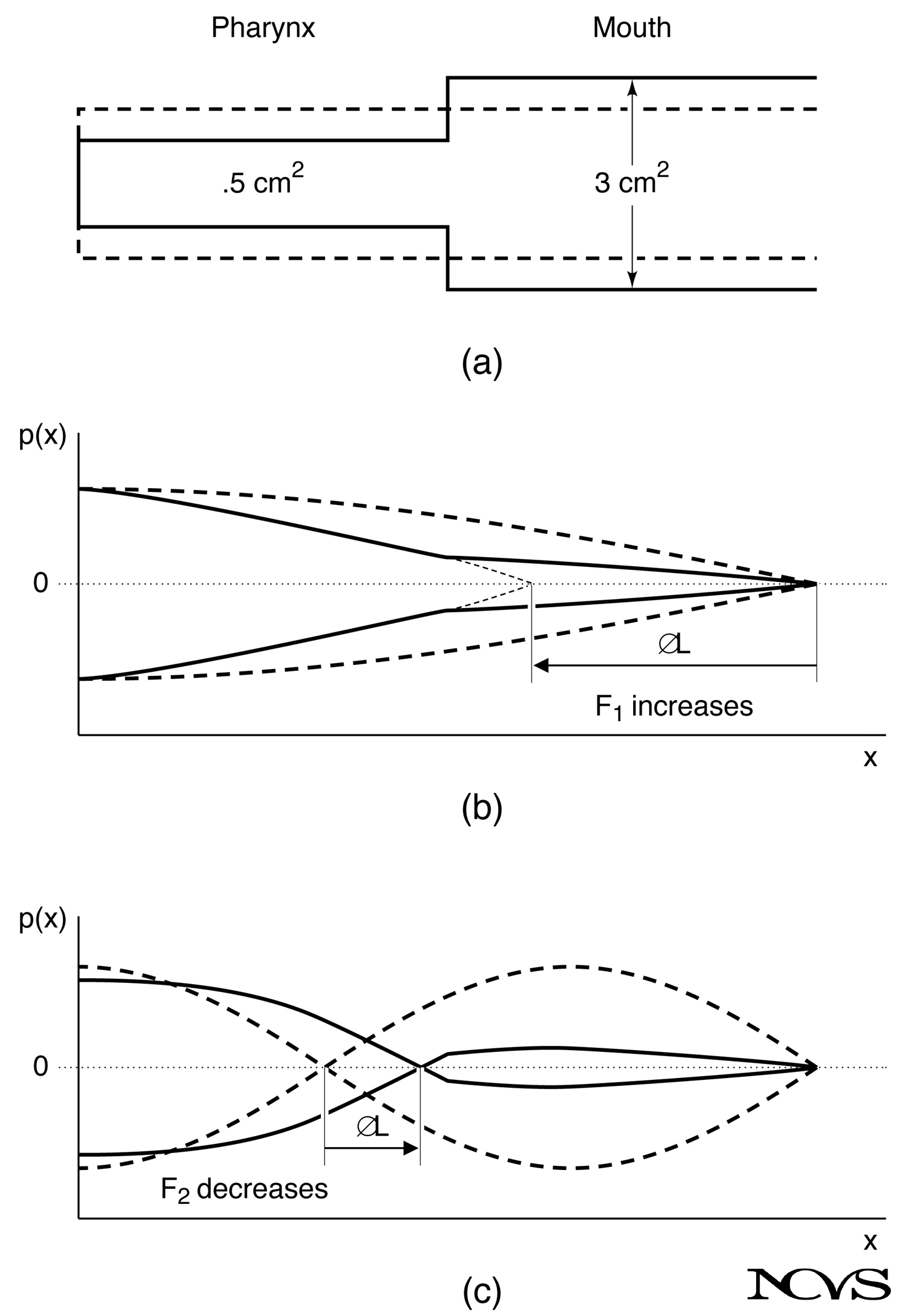 Figure 6.9: Midsagittal view showing tongue positions for different vowel categories, illustrating the two-dimensional articulatory space of tongue height and advancement.
Jaw Position and Opening
Jaw position strongly influences vocal tract shape, though its effects are partially coupled with tongue position.
Jaw Height and Vowel Height
High vowels: Produced with relatively closed jaw (small inter-incisor distance, typically 5-15 mm). The closed jaw constrains tongue position, encouraging high tongue positions.
Mid vowels: Intermediate jaw opening (15-25 mm inter-incisor distance). The moderate opening allows flexible tongue positioning.
Low vowels: Open jaw (25-50 mm or more inter-incisor distance). Maximum jaw opening generally accompanies low tongue positions, though the tongue can maintain various shapes with an open jaw.
Independence of Jaw and Tongue
While jaw and tongue positions typically correlate, they maintain some independence:
Jaw fixation experiments: When speakers produce vowels with jaw held at constant opening (e.g., bite block studies), they can still produce distinguishable vowels by adjusting tongue shape. Formant frequencies shift but vowels remain identifiable, demonstrating that tongue shape is primary and jaw position secondary.
Compensatory articulation: Speakers with restricted jaw mobility (e.g., temporomandibular joint dysfunction) can partially compensate through tongue adjustments, though vowel quality typically suffers compared to normal articulation.
Jaw Position in Singing
Singers often open the jaw more than speakers for comparable vowels:
Acoustic rationale: Greater jaw opening can enhance acoustic coupling between pharyngeal and oral cavities, improving resonance and projection.
F1 consequences: Excessive jaw opening raises F1, which can be desirable for high pitches (where F1 must be raised to align with F0) but may distort vowel quality at lower pitches.
Pedagogical guidance: “Drop your jaw” is common singing instruction, but excessive or inappropriate jaw opening can compromise vowel intelligibility or create excessive tension.
Lip Configuration
Lip shape contributes significantly to vowel quality, particularly through rounding and protrusion.
Lip Rounding
Rounded vowels (/u/, /o/ in English; /y/, /ø/, /œ/ in French): Lips form a circular or oval aperture with reduced area. The lip corners draw together, and lips may protrude forward.
Unrounded vowels (/i/, /e/, /a/): Lips are spread or neutral, with corners retracted. The lip aperture is larger and more slit-like than rounded.
Acoustic Effects of Lip Rounding
Lip rounding has systematic acoustic consequences:
Formant lowering: Rounding lengthens the vocal tract (through protrusion) and increases the cross-sectional area at the lips. Both effects lower all formants, but F3 and higher formants are affected most strongly, with F2 showing substantial lowering.
Quantitative effects: Lip rounding typically lowers F2 by 200-400 Hz and F3 by 300-500 Hz. The effect on F1 is smaller (50-150 Hz) but still perceptually significant.
Rounded vs. unrounded pairs: Languages with phonemic lip rounding contrast show systematic formant differences:
- /i/ (unrounded): F2 ≈ 2300 Hz
- /y/ (rounded front high vowel, as in French “tu”): F2 ≈ 1800 Hz
Degree of Rounding
Lip rounding is not binary but varies in degree:
Close rounding: Lips form a small circular opening with maximum protrusion (as in /u/). Maximum formant lowering effect.
Mid rounding: Moderate lip aperture and protrusion (as in /o/). Intermediate formant lowering.
Open rounding: Lips rounded but with larger aperture and less protrusion (as in /ɔ/). Reduced formant lowering effect.
Lip Spreading
While often described as “neutral,” lip spreading (retraction of lip corners) is an active articulation for some vowels:
Extreme spreading: The vowel /i/ in many languages involves active lip spreading, increasing the lip aperture width. This may contribute to maximizing F2.
Acoustic effects: Spreading may raise formants slightly (opposite of rounding effect), though the effect is smaller than that of rounding.
Pharyngeal Configuration
The pharyngeal cavity plays a crucial but often underappreciated role in vowel shaping.
Pharyngeal Width
The pharynx can expand or constrict through several mechanisms:
Tongue root position: As discussed earlier, advancing the tongue root expands the pharynx while retracting it constricts the pharynx.
Larynx height: Raising the larynx shortens and narrows the pharynx; lowering the larynx lengthens and can expand the pharynx.
Pharyngeal wall tension: The pharyngeal constrictor muscles can actively narrow the pharynx, while relaxation allows expansion.
Acoustic Consequences
Pharyngeal width affects formant frequencies, particularly F1:
Expanded pharynx: Larger pharyngeal cavity generally lowers F1. This explains part of the ATR (advanced tongue root) acoustic signature.
Constricted pharynx: Smaller pharyngeal cavity raises F1. Some voice qualities (e.g., “tight” or “squeezed” voice) involve pharyngeal constriction.
Pharyngeal Vowels
Some languages (e.g., Arabic, some Caucasian languages) distinguish vowels primarily by pharyngeal configuration:
Pharyngealized vowels: Produced with retracted tongue root and constricted pharynx, creating distinctive low formant patterns.
Non-pharyngealized vowels: Produced with neutral or expanded pharynx.
These contrasts demonstrate that pharyngeal shape is an independent articulatory dimension, not merely a consequence of tongue position.
Larynx Height
Vertical laryngeal position varies across vowels and speakers, with significant acoustic consequences.
Natural Larynx Height Variation
In typical speech, larynx height varies somewhat across vowels:
High vowels: Larynx often rises slightly, particularly for high front vowels.
Low vowels: Larynx often lowers, particularly for low back vowels.
This natural variation contributes to formant frequency patterns but is not necessary for vowel distinction.
Controlled Larynx Manipulation
Speakers and singers can consciously control larynx height:
Lowered larynx: Common in classical singing, particularly for male voices. Creates darker, more “covered” tone quality by:
- Lengthening vocal tract (lowering all formants proportionally)
- Expanding pharynx (lowering F1 particularly)
- Increasing distance from source to radiation point
Raised larynx: Sometimes used in certain singing styles (e.g., some country music, belting). Creates brighter, more “forward” tone by:
- Shortening vocal tract (raising all formants)
- Potentially constricting pharynx (raising F1)
Neutral larynx: Speech typically uses near-neutral larynx height, allowing natural variation across vowels and prosodic contexts.
Clinical Considerations
Abnormal larynx height can indicate dysfunction:
Chronically elevated larynx: May indicate hyperfunction, excessive tension, or compensatory strategies. Common in certain voice disorders.
Inability to lower larynx: May indicate reduced flexibility or neurological involvement.
Assessment of larynx height during vowel production can provide diagnostic information about motor control and tension patterns.
Velopharyngeal Configuration
While oral vowels (standard in English and most languages) use a closed velopharyngeal port, nasal vowels involve an additional articulatory dimension.
Nasal vs. Oral Vowels
Oral vowels: Velum raised, closing off nasal cavity. All acoustic energy radiates through mouth. Formant structure reflects only oral and pharyngeal cavities.
Nasal vowels: Velum lowered, opening velopharyngeal port. Acoustic energy radiates through both mouth and nose. Additional acoustic resonances and antiresonances (anti-formants) complicate the spectrum.
Acoustic Effects of Nasalization
Nasalization dramatically alters vowel acoustics:
Additional resonances: Nasal cavity introduces additional formants (nasal formants) at relatively fixed frequencies (around 250 Hz, 1000 Hz, 2000 Hz).
Antiresonances (zeros): Coupling of oral and nasal branches creates antiresonances that cancel energy at certain frequencies, often near oral formant frequencies.
Formant bandwidth increase: Nasalization increases formant bandwidths (reduced Q factor) due to increased damping from nasal cavity surfaces and narrower coupling.
Overall effect: Nasal vowels typically sound “muffled” compared to oral vowels, with reduced overall amplitude and less distinct formant structure.
Nasalization in Languages
Phonemic nasalization: Languages like French, Portuguese, Polish, and Hindi distinguish oral and nasal vowel phonemes (e.g., French /a/ vs. /ã/).
Contextual nasalization: In English and many languages, vowels become partially nasalized adjacent to nasal consonants (/m/, /n/, /ŋ/) through coarticulatory anticipation or carryover.
Hypernasality: Excessive nasalization (e.g., due to velopharyngeal insufficiency) is considered a voice disorder in languages without phonemic nasal vowels.
Articulatory-Acoustic Relationships
Specific articulatory configurations produce predictable acoustic patterns through the physics of acoustic resonance in tubes.
Tongue Height and F1
The inverse relationship between tongue height and F1 stems from cavity size relationships:
High tongue: Creates large pharyngeal cavity and small oral cavity. The large pharynx acts as a Helmholtz resonator coupled to the smaller oral cavity, producing low F1 (typically 250-350 Hz for /i/, /u/).
Low tongue: Creates smaller pharynx and larger oral cavity, raising F1 (typically 700-1000 Hz for /a/, /æ/).
This relationship is remarkably consistent across speakers and languages, making F1 the primary acoustic correlate of vowel height.
Tongue Advancement and F2
The relationship between tongue advancement and F2 reflects the distribution of cavity volumes anterior and posterior to the primary constriction:
Front tongue position: Long pharyngeal cavity (back cavity) and short oral cavity (front cavity). This configuration, approximated as two-tube model, raises F2 (typically 1800-2800 Hz for front vowels).
Back tongue position: Short pharyngeal cavity and long oral cavity, lowering F2 (typically 700-1200 Hz for back vowels).
The F2 pattern systematically distinguishes front, central, and back vowel categories.
Lip Rounding and Multiple Formants
Lip rounding affects all formants but F3 most strongly:
Mechanism: Rounding lengthens the tract (lowering all formants) and increases terminal impedance (affecting higher formants more).
F2 effect: Particularly salient perceptually, explaining why rounded and unrounded vowels with similar tongue positions sound quite different (e.g., /i/ vs. /y/).
F3 effect: Useful for distinguishing rounded vowels, particularly in languages with front rounded vowels.
Three-Tube Model
For more accurate acoustic prediction, vowels can be modeled as three-tube configurations:
- Pharyngeal section: From glottis to tongue constriction
- Oral section: From constriction to lips
- Lip section: Short tube representing lip protrusion
The relative lengths and cross-sectional areas of these three sections determine formant frequencies with considerable accuracy.
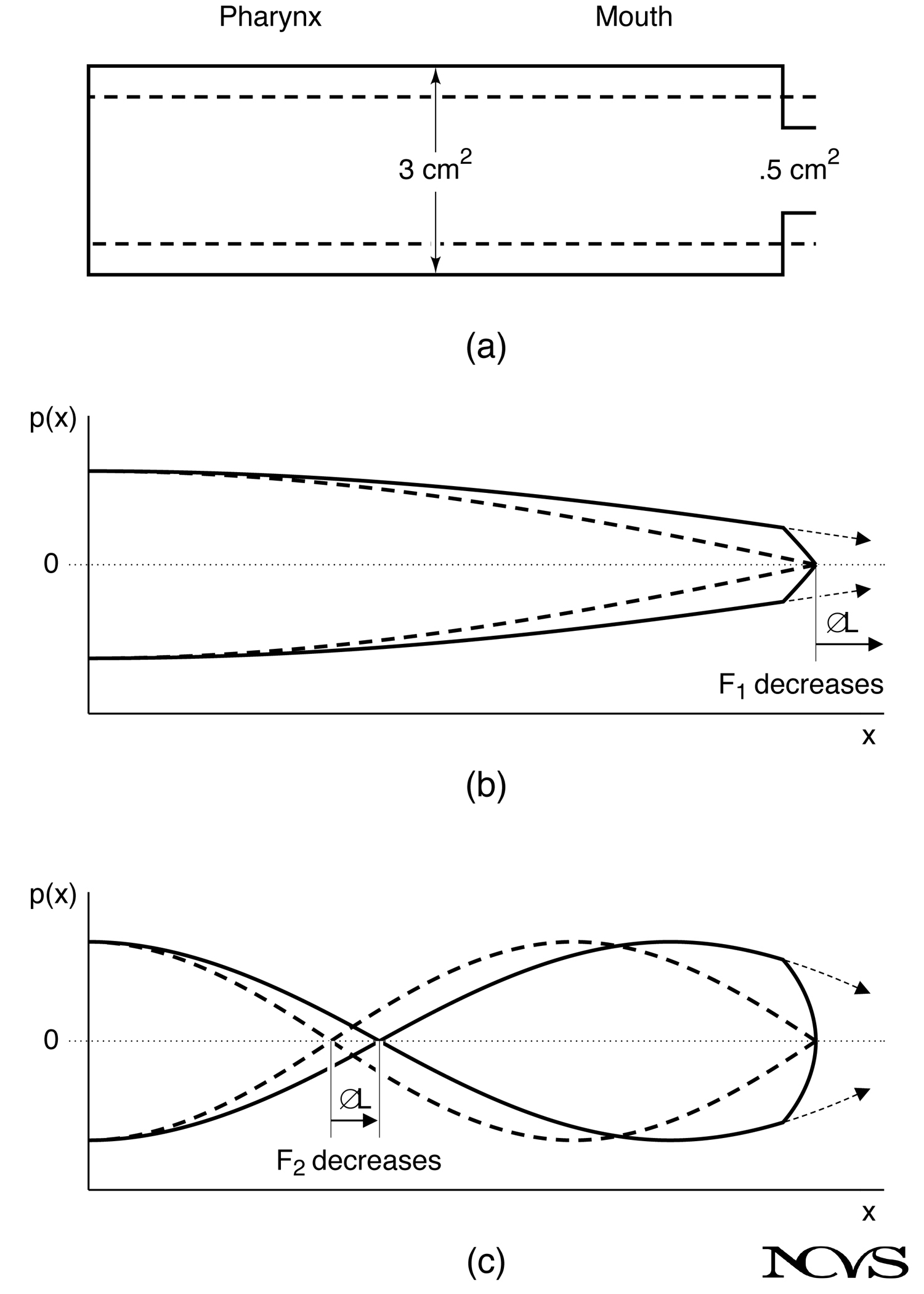 Figure 6.11: Three-tube approximation of vowel shapes showing pharyngeal, oral, and lip sections for different vowel categories.
Vowel Modification Strategies
Understanding articulatory-acoustic relationships enables systematic vowel modification for artistic or clinical purposes.
Formant-Targeted Modifications
Raising F1: Achieved by lowering tongue/jaw or expanding pharynx. Used in singing for high pitches or to enhance power.
Lowering F1: Achieved by raising tongue or constricting pharynx. Creates darker, more covered quality.
Raising F2: Achieved by fronting tongue or reducing lip rounding. Creates brighter, more forward quality.
Lowering F2: Achieved by backing tongue or increasing lip rounding. Creates darker, warmer quality.
Vowel Migration Rules
Singers and speakers modify vowels systematically:
High vowel modification: On ascending pitch, high vowels (/i/, /u/) are modified toward mid vowels (/e/, /o/) to raise F1 and maintain acoustic efficiency.
Extreme high notes: All vowels converge toward /a/ or /ɔ/ on highest pitches where F0 exceeds F1 for all closed vowels.
Maintaining intelligibility: Modifications aim to preserve some acoustic signature of the target vowel while optimizing for pitch and resonance.
Summary
Vowel shapes are three-dimensional articulatory configurations determined primarily by tongue position, jaw opening, lip rounding, pharyngeal width, and larynx height. Tongue height (vertical dimension) inversely affects F1, with high vowels producing low F1 (250-350 Hz) and low vowels producing high F1 (700-1000 Hz). Tongue advancement (horizontal dimension) directly affects F2, with front vowels producing high F2 (1800-2800 Hz) and back vowels producing low F2 (700-1200 Hz).
Lip rounding lowers all formants, particularly F2 and F3, by lengthening the vocal tract through protrusion and altering terminal impedance. Pharyngeal width, controlled by tongue root position, larynx height, and pharyngeal muscle tension, primarily affects F1, with expanded pharynx lowering F1. Larynx height modifies all formants proportionally through vocal tract length changes, with lowered larynx darkening timbre and raised larynx brightening it.
These articulatory dimensions show partial independence, allowing speakers flexibility in achieving target acoustics through different articulatory strategies—a property called “motor equivalence.” Vowel shapes can be modeled as multi-tube configurations, with three-tube approximations (pharyngeal, oral, and lip sections) providing good acoustic predictions. Understanding articulatory-acoustic relationships enables systematic vowel modification for singing, therapeutic intervention, and optimization of voice quality across the pitch range.
Key Takeaways
- ✅ Tongue height is the primary determinant of F1, with high tongue positions producing low F1 and low tongue positions producing high F1
- ✅ Tongue advancement controls F2, with front articulations producing high F2 and back articulations producing low F2
- ✅ Lip rounding lowers all formants, especially F2 and F3, through vocal tract lengthening and impedance changes
- ✅ Pharyngeal width affects F1 primarily, with expanded pharynx lowering F1 and constricted pharynx raising F1
- ✅ Larynx height modifies all formants proportionally, with lowered larynx darkening tone and raised larynx brightening it
- ✅ Jaw opening and tongue height are partially coupled but maintain some independence, allowing compensatory articulation
- ✅ Vowel shapes can be modeled as multi-tube configurations, with three-tube models providing accurate formant predictions
- ✅ Understanding articulatory-acoustic relationships enables systematic vowel modification for singing and clinical applications
Related Topics
- The F1-F2 Vowel Chart
- Three-Tube Approximation
- Two-Tube Approximations
- Quarter-Wave Resonance
- Rules for Modifying Vowels
- Acoustic Impedance of Tubes
Further Reading
- Stevens, K. N. (1998). Acoustic Phonetics. Cambridge, MA: MIT Press.
- Fant, G. (1960). Acoustic Theory of Speech Production. The Hague: Mouton.
- Ladefoged, P., & Johnson, K. (2014). A Course in Phonetics (7th ed.). Boston: Cengage Learning.
- Titze, I. R. (2000). Principles of Voice Production (2nd ed.). Iowa City: National Center for Voice and Speech.
- Story, B. H. (2005). A parametric model of the vocal tract area function for vowel and consonant simulation. Journal of the Acoustical Society of America, 117(5), 3231-3254.
- Wood, S. (1982). X-ray and model studies of vowel articulation. Working Papers in Linguistics (Lund University), 23, 1-192.