Articulatory and Acoustic Descriptions of Vowels
Vowels are perceived and classified on the basis of the two lowest formant frequencies of the vocal tract (Peterson & Barney, 1952). This chapter explores how articulatory configurations relate to acoustic outputs and how the F₁-F₂ chart provides a framework for understanding vowel production.
The Source-Filter Theory of Vowels
A complex tone of many harmonics, generated at the larynx by vocal fold vibration, is acoustically filtered by the vocal tract (the pharynx and mouth as a combined tube) according to formant frequencies. As far as vowel perception is concerned, this filtering process simplifies the code that the auditory processor has to deal with.
Heavy concentration (or bunching up) of acoustic energy in the two formant regions has the effect of eliminating all but the relevant harmonics in the vicinity of the two formant frequencies.
The F₁-F₂ Vowel Chart
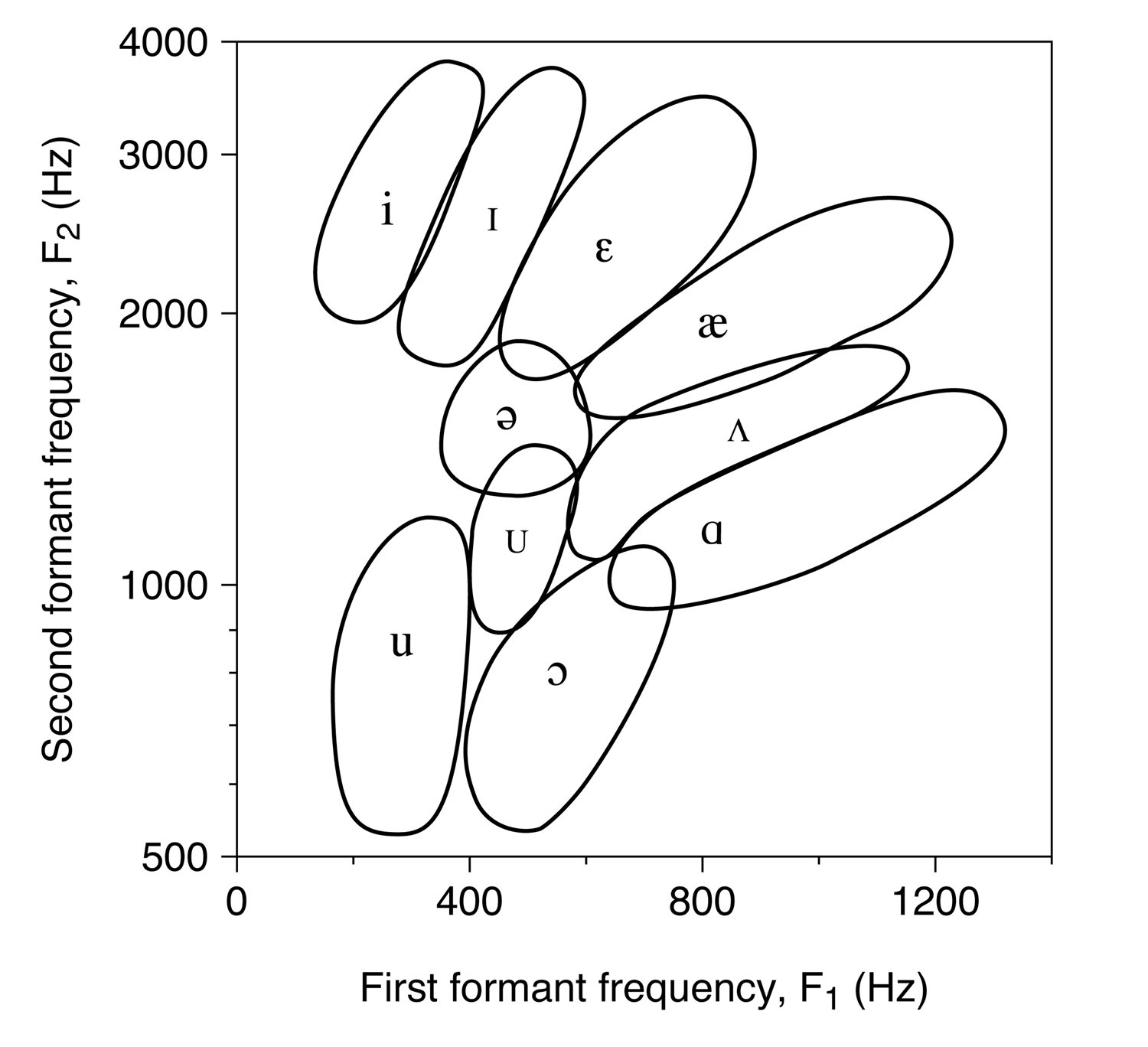 Figure 6.7: Vowel chart showing regions of F₁ and F₂ for 10 English vowels in men, women, and children (after Peterson & Barney, 1952).
Peterson and Barney (1952) demonstrated that the two formant frequencies F₁ and F₂ belonging to a vowel category can occupy an entire range of values if speaker differences, ages, and genders are included in a group of speakers.
Vowel Ranges
Consider the vowel [a] as in father:
- F₁ range: 600 Hz to 1,300 Hz (depending on speaker)
- F₂ range: 800 Hz to 1,700 Hz (depending on speaker)
The vowel [u] shows:
- Larger range in F₂ than in F₁
- Consistently low F₁ across speakers
- F₂ varies more with vocal tract length
The neutral vowel [ə] (schwa):
- Centrally located in vowel space
- Approximately round space in the F₁-F₂ chart
- Represents the uniform tube configuration
Extended Ranges for Singing
If singing vowels were included, the range of formant frequencies for a given vowel would be further expanded (Appelman, 1967; Miller, 1977; Sundberg, 1977). Singers often modify vowels from speech norms to:
- Align formants with harmonics for increased power
- Achieve more consistent tone quality across pitch ranges
- Facilitate smooth transitions between vowels
Traditional Articulatory Description
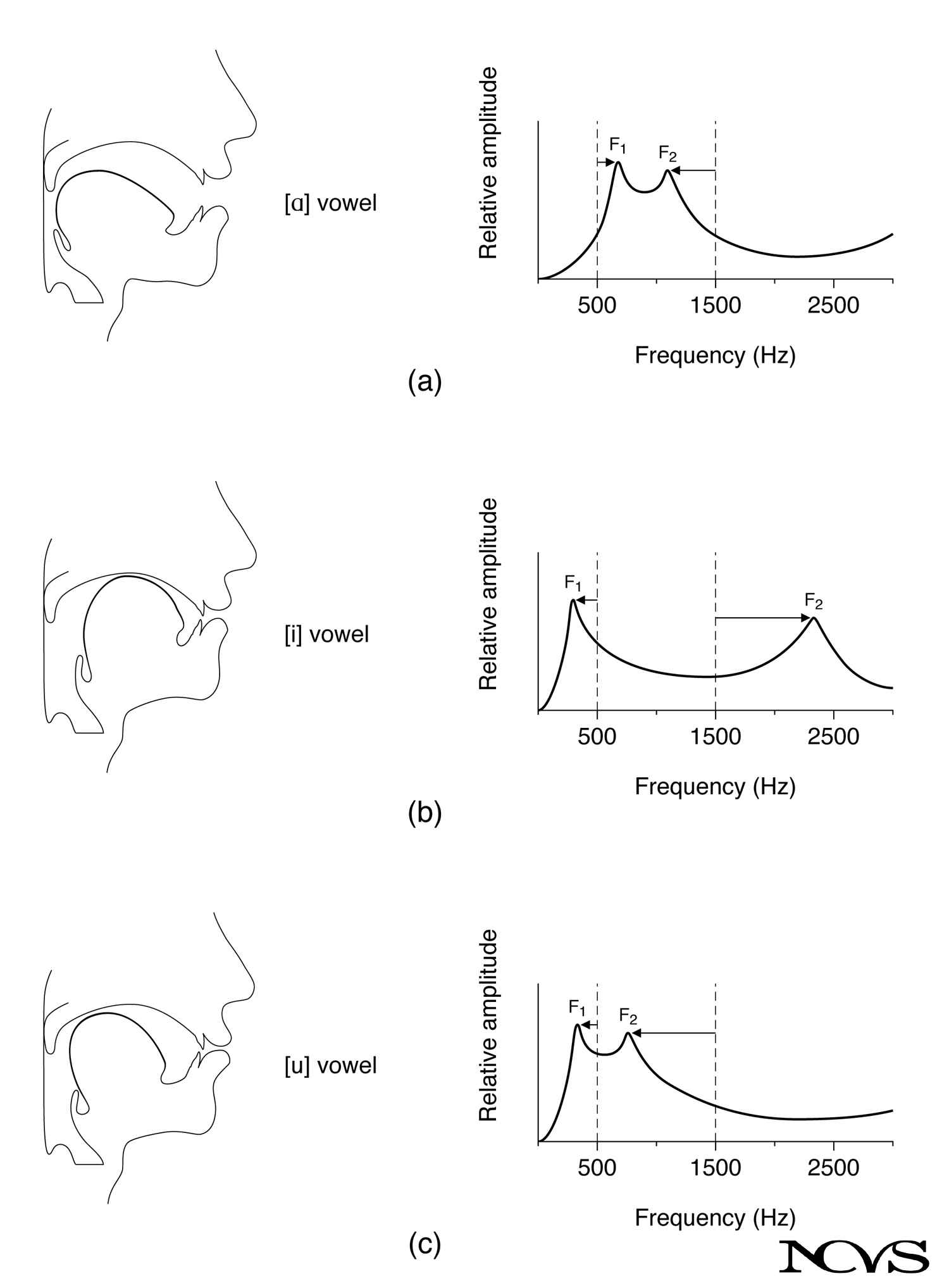 Figure 6.8: Articulatory shapes (left side) and corresponding spectra (right side) for the three corner vowels [a], [i], and [u].
In traditional articulatory phonetics, vowels are described on the basis of:
- High-low placement of the tongue
- Front-back placement of the tongue
The Three Corner Vowels
[a] - Low Back Vowel
- Tongue placement: Low and back
- Jaw: Lowered (open)
- Lips: Neutral to slightly spread
- F₁: High (~700-900 Hz for males)
- F₂: Low (~1000-1300 Hz for males)
[i] - High Front Vowel
- Tongue placement: High and front
- Jaw: Raised (closed)
- Lips: Spread
- F₁: Low (~250-350 Hz for males)
- F₂: High (~2200-2500 Hz for males)
[u] - High Back Vowel
- Tongue placement: High and back
- Jaw: Raised (closed)
- Lips: Rounded
- F₁: Low (~250-350 Hz for males)
- F₂: Low (~700-900 Hz for males)
These three vowels are called corner vowels because they represent extreme placements of the tongue, forming the corners of a triangle in articulatory space. They also display extreme locations in the F₁-F₂ chart, forming a triangle in formant space.
Neutral Vowel Configuration
The vocal tract shape for the neutral vowel [ə] most nearly approximates the closed-open tube with a uniform cross section. The tongue is:
- Neither high nor low
- Neither front nor back
- Creating nearly constant cross-section from glottis to lips
Formant frequencies for this configuration:
- F₁ = 500 Hz
- F₂ = 1,500 Hz
- F₃ = 2,500 Hz
- F₄ = 3,500 Hz
These are evenly spaced at 1,000 Hz intervals, as predicted by the quarter-wave resonator equation for a 17.5 cm tube.
Formant Displacements from Neutral
With reference to the neutral-tube formant frequencies, note how F₁ and F₂ of the three corner vowels are displaced:
[a] vowel:
- F₁ is raised (from 500 Hz to ~800 Hz)
- F₂ is lowered (from 1500 Hz to ~1200 Hz)
- Formants are compacted (moved closer together)
[i] vowel:
- F₁ is lowered (from 500 Hz to ~300 Hz)
- F₂ is raised (from 1500 Hz to ~2300 Hz)
- Formants are diffused (spread apart)
[u] vowel:
- F₁ is lowered (from 500 Hz to ~300 Hz)
- F₂ is lowered (from 1500 Hz to ~850 Hz)
- Both formants shift downward
These changes will be explained in detail with tube models of the vocal tract.
Vowel Space Characteristics
The vowel space forms a triangle (or trapezoid) with:
Vertical Dimension (F₁)
- High F₁: Open vowels (low tongue, open jaw)
- Low F₁: Close vowels (high tongue, closed jaw)
- Primary articulator: Jaw height and tongue height
- Acoustic correlate: Pharynx cavity size
Horizontal Dimension (F₂)
- High F₂: Front vowels (tongue advanced)
- Low F₂: Back vowels (tongue retracted)
- Primary articulator: Tongue front-back position
- Acoustic correlate: Oral cavity size relative to pharyngeal cavity
Cross-Linguistic Variation
Different languages use different portions of the vowel space:
- Three-vowel systems (e.g., Classical Arabic): /i/, /a/, /u/ (the three corners)
- Five-vowel systems (e.g., Spanish, Japanese): Add /e/ and /o/ at intermediate positions
- Complex systems (e.g., English, French): Many intermediate vowels and diphthongs
All languages tend to maintain sufficient acoustic distance between vowel categories to ensure perceptual distinctness.
Summary
Vowels are characterized acoustically by their first two formant frequencies (F₁ and F₂) and articulatorily by tongue height and advancement. The F₁-F₂ chart provides a two-dimensional space in which vowels cluster into categories. The three corner vowels [i], [a], and [u] occupy extreme positions in both articulatory and acoustic space. The neutral vowel [ə] represents a uniform vocal tract and produces evenly spaced formants at 500 Hz intervals.
Understanding the relationship between articulation and acoustics is fundamental for voice pedagogy, as it allows teachers and clinicians to predict how articulatory changes will affect acoustic output.
Key Takeaways
- ✅ Vowels are perceived and classified primarily on the basis of F₁ and F₂
- ✅ The F₁-F₂ chart maps acoustic vowel space and shows considerable overlap between speakers
- ✅ Corner vowels [i], [a], [u] occupy extreme positions in formant space
- ✅ The neutral vowel [ə] has formants at 500, 1500, 2500 Hz for a 17.5 cm tract
- ✅ F₁ correlates inversely with tongue/jaw height (low tongue = high F₁)
- ✅ F₂ correlates with tongue advancement (front tongue = high F₂)
Related Topics
Further Reading
- Peterson, G. E., & Barney, H. L. (1952). Control methods used in a study of vowels. Journal of the Acoustical Society of America, 24, 175-184.
- Fant, G. (1960). Acoustic theory of speech production. The Hague: Mouton.
- Ladefoged, P. (1975). A course in phonetics. New York: Harcourt Brace Jovanovich.