Acoustic Impedance and Reflection
Based on the new definition of acoustic impedance for tubes, reflection coefficients at tube interfaces can be calculated. These reflections are fundamental to understanding how standing waves form in the vocal tract and how formants are created.
Reflection Coefficient Definition
At any two-tube interface, a new reflection coefficient is defined as:
r = (p₂c₂/A₂ - p₁c₁/A₁) / (p₂c₂/A₂ + p₁c₁/A₁)where the subscripts 1 and 2 denote the acoustic properties of the adjacent tubes. This reflection coefficient is similar to the plane wave reflection coefficient discussed in Chapter 5, except that the tube areas A₁ and A₂ are now in the denominators of each of the impedance terms.
Simplified Form for the Vocal Tract
In most speech applications, the air density and the sound velocity are constant throughout the airway. This means that p₂ = p₁ and c₂ = c₁ at any tube interface. The reflection coefficient can then be simplified algebraically to:
r = (A₁ - A₂) / (A₁ + A₂)This is a most important result. The reflection coefficient between adjacent tubes is the ratio of the difference between the areas to the sum of the areas. When using this formula, the convention is established that the wave travels from tube 1 to tube 2.
Wave Reflection at Area Changes
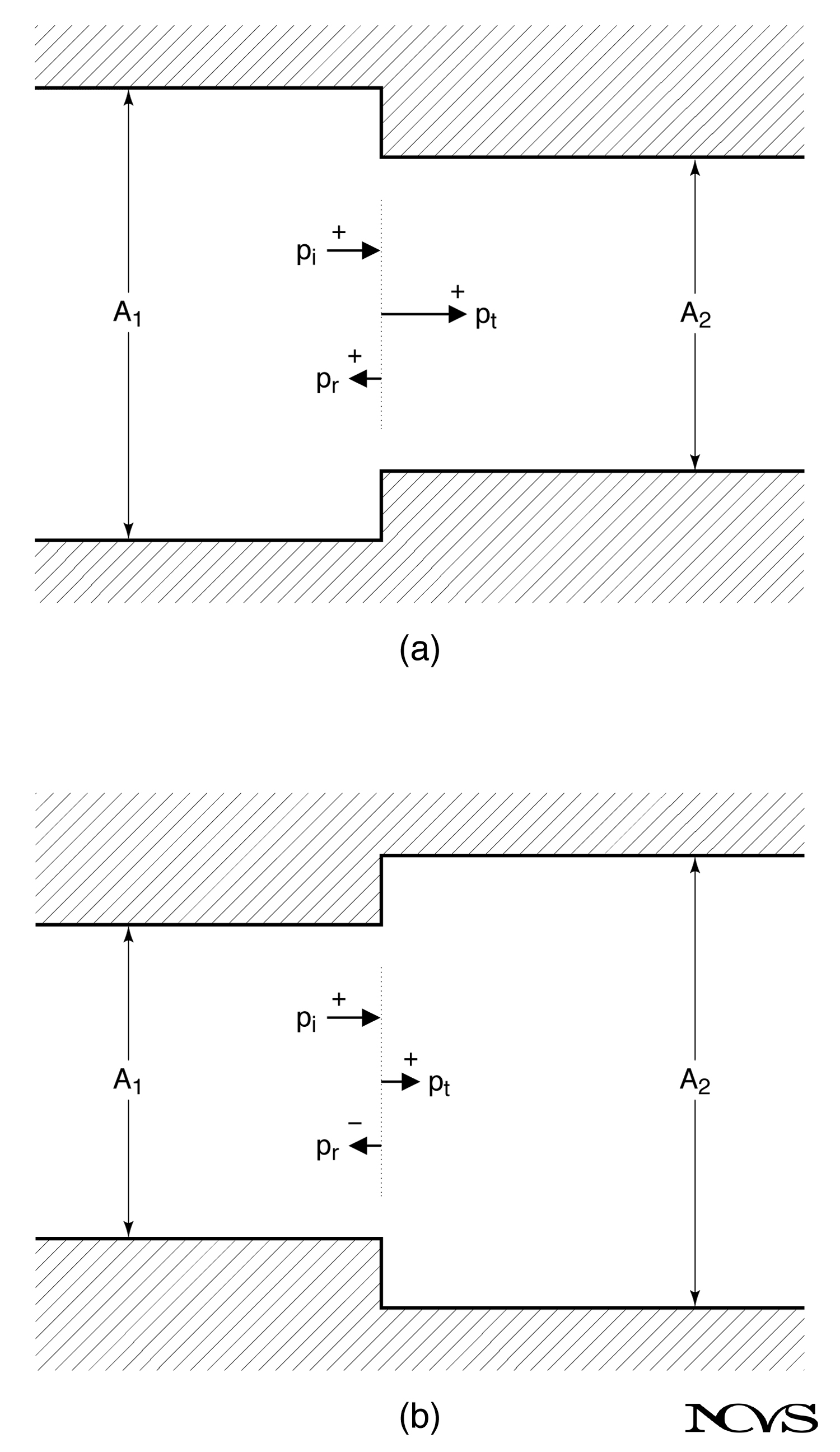 Figure 6.2: Wave reflection and transmission at an interface between two tubes of unequal diameter: (a) an area contraction and (b) an area expansion.
Consider the two-tube interfaces shown in cross section. Assume that an incident wave, a reflected wave, and a transmitted wave can be represented by arrows. The direction of each arrow indicates the direction of wave propagation, the length of the arrow indicates the magnitude of the pressure, and the sign above the arrow indicates whether it is a compression (+) or a rarefaction (-) at the instant of time depicted.
Area Contraction (Pressure Step-Up)
When the tube diameter contracts (A₂ < A₁), the reflection coefficient will be positive according to the equation, and the reflected pressure will have positive polarity (it is a condensation). The transmitted pressure Pₜ = Pᵢ + Pᵣ will be larger than the incident pressure, as shown by the longer arrow in the second tube.
The junction therefore acts as a pressure step-up transformer. Unlike the aerodynamic (Bernoulli) pressure discussed in Chapter 3, which reduces in a constricted region of a pipe, the acoustic pressure increases. It will become more evident in later developments that acoustic pressures are always higher in constricted regions.
Area Expansion (Pressure Step-Down)
In contrast, the area expansion is a pressure step-down transformer. Here, the transmitted pressure Pₜ is less than the incident pressure because the reflected pressure Pᵣ has negative polarity (it is a rarefaction). This is a direct consequence of the fact that A₂ > A₁ and the reflection coefficient is negative.
Acoustic pressures are generally lower in expanded regions of a tube. If we relate these results to wave reflections in unconfined media discussed in Chapter 5, it is interesting to note that a constriction is similar to a density increase, whereas an expansion is similar to a density decrease.
Extreme Cases: Closed and Open Ends
Closed-End Termination
As A₂ approaches zero (completely closed tube), the reflection coefficient approaches +1. This suggests a complete reflection with positive polarity (a new compression). The pressure at the closed end is then twice the pressure of the incident wave.
Open-End Termination
As A₂ approaches infinity (open to free space), the reflection coefficient approaches -1. Again, complete reflection occurs, but the polarity is negative (a rarefaction). The sum of the incident and reflected pressures at the open end is zero, matching the atmospheric pressure outside of the tube.
Practical Implications for Vowels
These reflection principles explain several important phenomena in vowel production:
- Pressure maxima occur at constrictions - This is why vowel “focus” is often sensed at locations of vocal tract narrowing
- Pressure minima occur at expansions - Including the open mouth
- Different vowels have different pressure patterns - Because they have different area functions
- Lip rounding acts as a partial closure - Increasing pressure behind the lips
Summary
The reflection coefficient between two tubes depends only on the ratio of their cross-sectional areas when air density and sound velocity are constant. Area contractions create pressure step-up transformers (positive reflections), while area expansions create pressure step-down transformers (negative reflections). Complete closure gives a reflection coefficient of +1, while opening to free space gives -1.
These reflections are essential for creating standing waves in the vocal tract. The pattern of pressure maxima and minima along the vocal tract depends on where area changes occur, which in turn determines the formant frequencies that characterize different vowels.
Key Takeaways
- ✅ Reflection coefficient between tubes is r = (A₁ - A₂)/(A₁ + A₂) when density and sound velocity are constant
- ✅ Area contractions (A₂ < A₁) produce positive reflections, acting as pressure step-up transformers
- ✅ Area expansions (A₂ > A₁) produce negative reflections, acting as pressure step-down transformers
- ✅ Acoustic pressure increases in constricted regions, opposite to Bernoulli pressure
- ✅ Closed ends have reflection coefficient +1; open ends have reflection coefficient -1
- ✅ The pattern of reflections determines standing wave patterns and formant frequencies
Related Topics
- Sound Propagation in Tubes
- Quarter-Wave Resonance
- Two-Tube Approximations of Vowels
- Bernoulli Pressure
Further Reading
- Fant, G. (1960). Acoustic theory of speech production. The Hague: Mouton.
- Morse, P. (1976). Vibration and sound. New York: American Institute of Physics.
- Stevens, K. N. (1998). Acoustic phonetics. MIT Press.