Filters and Filtering
Filters are devices that transmit (or reject) selectively the frequencies of a complex waveform. The vocal tract acts as an acoustic filter. Understanding filtering is essential for understanding how the same glottal source produces different vowels through different vocal tract configurations.
Four Basic Filter Types
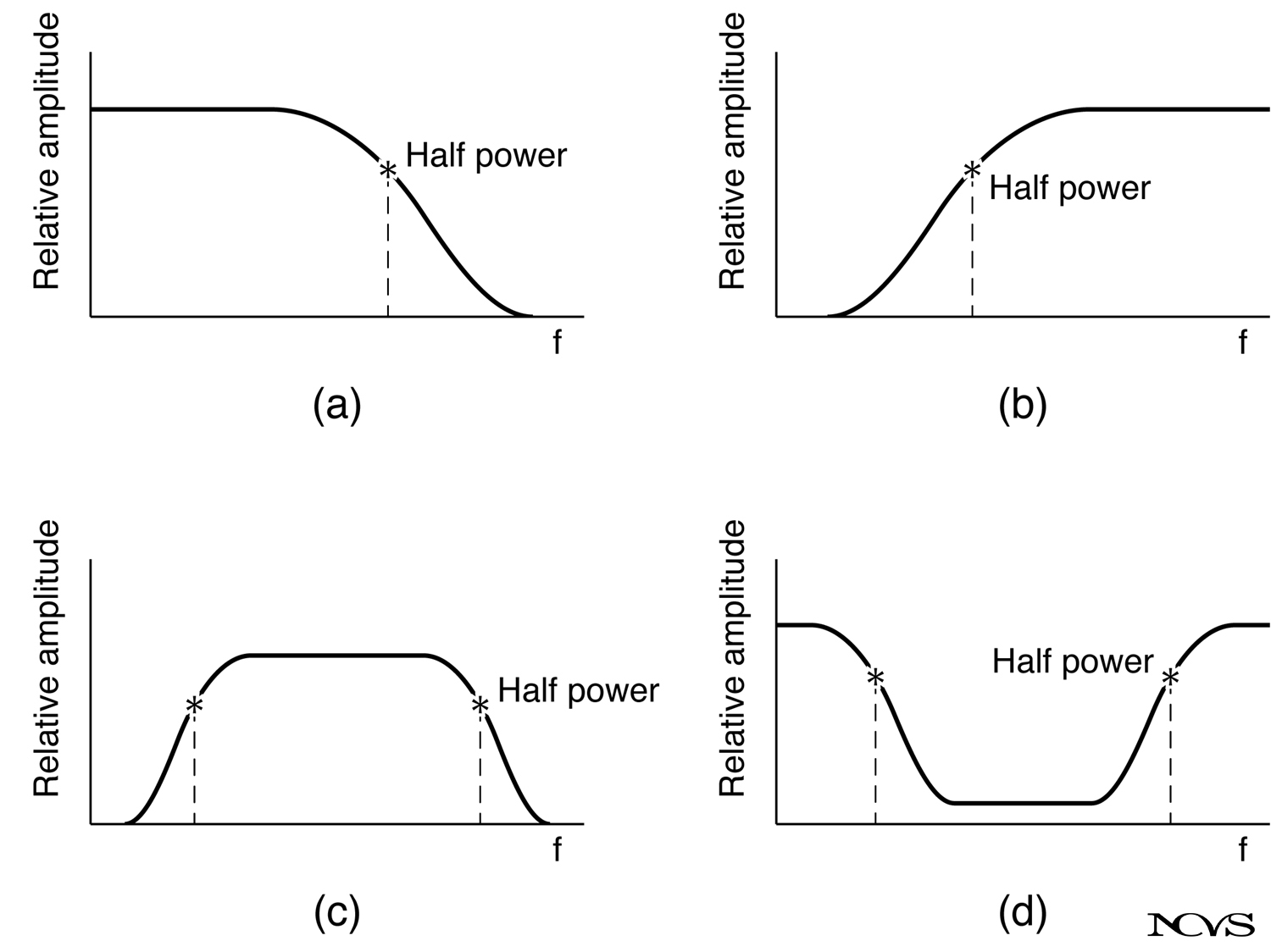
Figure 6.19: Frequency response of filters: (a) low pass, (b) high pass, (c) band pass, and (d) band reject.
There are four fundamental filter types:
1. Low-Pass Filter
-
Pass band: Low frequencies transmitted
-
Stop band: High frequencies attenuated
-
Half-power frequency: Transition point where power drops by 50% (3 dB)
-
Example: Curtains damping high frequencies in a room
2. High-Pass Filter
-
Pass band: High frequencies transmitted
-
Stop band: Low frequencies attenuated
-
Half-power frequency: Transition between pass and stop bands
-
Example: Telephone system cutting off frequencies below 300 Hz
3. Band-Pass Filter
-
Pass band: Frequencies in a specific range transmitted
-
Stop bands: Frequencies below and above the pass band attenuated
-
Two half-power frequencies: Lower and upper cutoff points
-
Bandwidth: Difference between the two half-power frequencies
-
Example: A single formant of the vocal tract
4. Band-Reject Filter
-
Pass bands: Frequencies below and above the reject band transmitted
-
Stop band: Frequencies in a specific range attenuated
-
Two half-power frequencies: Define the reject band
-
Example: Notch filter removing specific unwanted frequencies
The Vocal Tract as a Composite Filter
The vocal tract can be thought of as a composite filter consisting of several band-pass filters, one for each formant.
For each formant:
-
Center frequency: The formant frequency (e.g., F₁, F₂, F₃)
-
Bandwidth: The formant bandwidth
-
Pass band: Range around the formant frequency
-
Stop bands: Frequencies far from the formant
A single formant acts as a band-pass filter, and the complete vocal tract is a series of these band-pass filters.
Source-Filter Theory: Spectral Multiplication
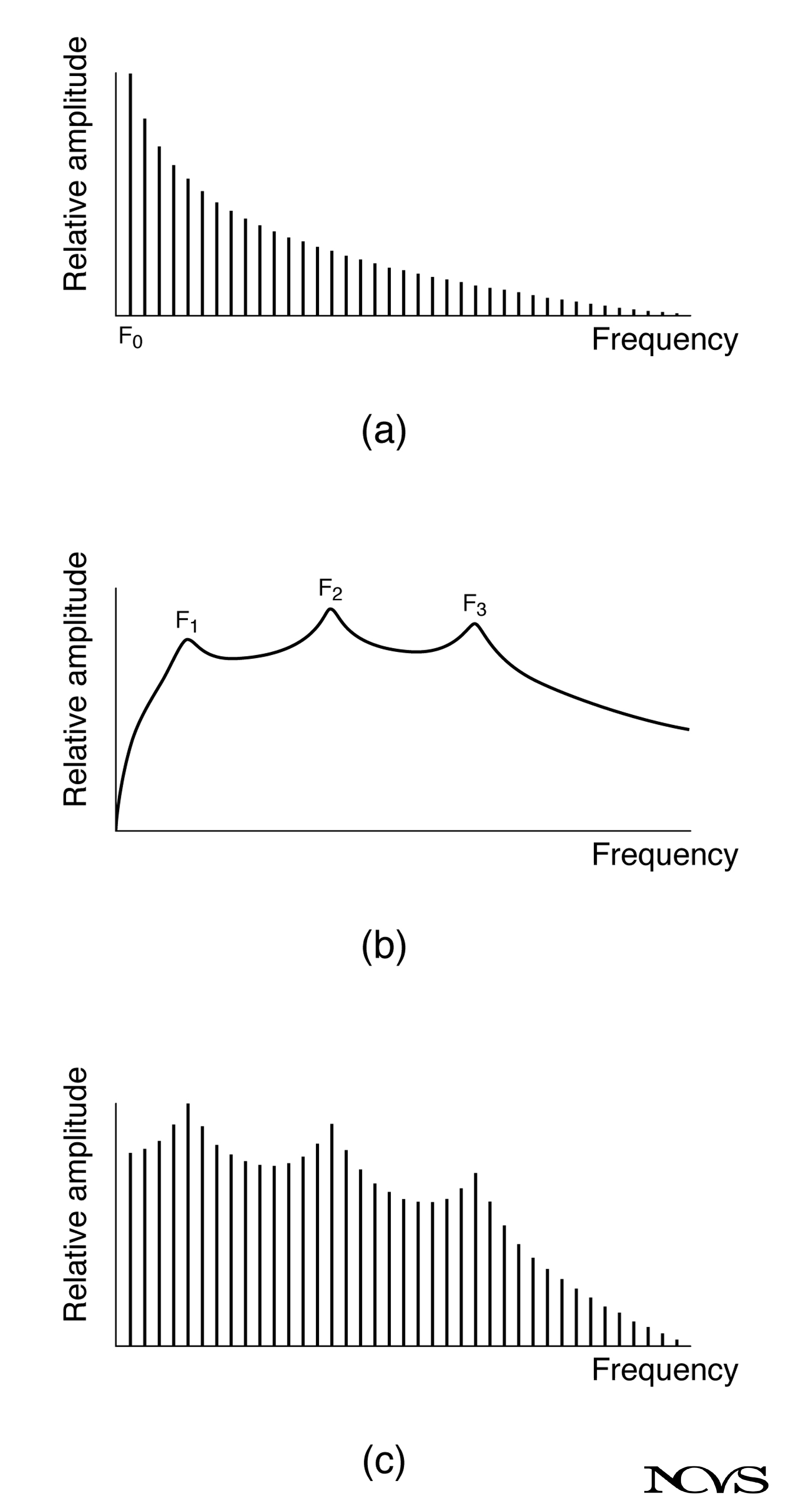
Figure 6.20: Comparing the source spectrum in (a) with the filter spectrum in (b) to obtain the vowel spectrum in (c).
The source-filter theory states: The spectrum of a vowel is the spectrum of the glottal source filtered by the vocal tract.
The Mathematical Process
The process can be illustrated in three steps:
Step 1: Source Spectrum (Figure 6.20a)
-
Line spectrum from glottal source
-
Fundamental frequency F₀
-
Series of harmonics (multiples of F₀)
-
Amplitude decreasing at approximately 12 dB/octave
Step 2: Filter Spectrum (Figure 6.20b)
-
Continuous spectrum with multiple peaks
-
Peaks at formant frequencies (F₁, F₂, F₃, …)
-
Valleys between formants
-
Overall spectral envelope
Step 3: Output Spectrum (Figure 6.20c)
-
Line spectrum (preserves harmonic structure from source)
-
Envelope follows formant structure (from filter)
-
Harmonics near formants are amplified
-
Harmonics in valleys are attenuated
Multiplication vs. Addition
For spectra expressed as amplitudes:
Output Spectrum = Source Spectrum × Filter Spectrum
For spectra expressed in decibels:
Output Spectrum (dB) = Source Spectrum (dB) + Filter Spectrum (dB)
This works because:
log₁₀(a × b) = log₁₀(a) + log₁₀(b)
The multiplication literally becomes superposition (addition) in the dB domain.
Formant Structure Superimposed
The key insight: The formant structure is superimposed onto the source spectrum.
-
The vowel spectrum has the same frequency lines as the source (harmonics of F₀)
-
The vowel spectrum has an envelope that reflects formant structure
-
What changes between vowels: The filter (vocal tract shape), not the source
-
What changes with F₀: The spacing of harmonics, not the formant frequencies
Example
For a male speaker with F₀ = 100 Hz:
Neutral vowel [ə]:
-
Harmonics at: 100, 200, 300, 400, 500, 600… Hz
-
Formants at: 500, 1500, 2500, 3500 Hz
-
Strong harmonics near: 500 Hz (#5), 1500 Hz (#15), 2500 Hz (#25)
[i] vowel (same speaker):
-
Harmonics unchanged: 100, 200, 300, 400… Hz
-
Formants shifted: 300, 2300, 3000 Hz
-
Strong harmonics near: 300 Hz (#3), 2300 Hz (#23), 3000 Hz (#30)
Separating Source from Filter
Speech analysis often involves reversing the superposition—separating the source spectrum from the filter spectrum. This is called inverse filtering or deconvolution.
Why Separate Source and Filter?
-
Voice quality assessment: Isolate laryngeal contribution
-
Vowel identification: Determine formant frequencies independent of F₀
-
Clinical analysis: Separate pathology location (larynx vs. vocal tract)
-
Synthesis: Control source and filter independently
Methods
In the time domain:
-
Inverse filtering: Remove vocal tract effects from the acoustic signal
-
Results in estimate of glottal flow waveform
In the frequency domain:
-
Spectral division: Divide output spectrum by filter spectrum
-
Requires knowledge of filter characteristics
Using cepstral analysis:
-
Convert to cepstrum (inverse Fourier transform of log spectrum)
-
Separate slowly-varying (filter) from rapidly-varying (source) components
Practical Implications
For Voice Production
Understanding filtering explains:
-
Why vowels sound different: Different filter shapes (vocal tract configurations)
-
Why the same vowel sounds similar across pitches: Formants don’t change with F₀
-
Why vowels have characteristic spectra: Formant patterns are recognizable
-
Why source quality matters: Affects input to filter
For Voice Analysis
Filtering concepts guide:
-
Spectrographic interpretation: Identify formants vs. harmonics
-
Measurement strategies: Separate F₀ from formant measurements
-
Clinical assessment: Determine if problem is source or filter
-
Synthesis: Model voices by combining source and filter
Filter Selectivity and Bandwidth
The selectivity of a filter is inversely related to its bandwidth:
Narrow bandwidth:
-
High selectivity
-
Sharp resonance
-
Amplifies narrow frequency range
-
Associated with metallic quality
Broad bandwidth:
-
Low selectivity
-
Broad resonance
-
Amplifies wide frequency range
-
Associated with muffled quality
This relates directly to formant bandwidth discussed earlier—broader formants indicate greater energy loss and less selective filtering.
Summary
Filters selectively transmit or attenuate frequencies. The four basic types are low-pass, high-pass, band-pass, and band-reject. The vocal tract acts as a composite filter with multiple band-pass sections (formants). In the source-filter theory of vowel production, the output spectrum is the product of the source spectrum and the filter spectrum (or their sum in dB). The formant structure is superimposed onto the harmonic line structure from the glottal source. Understanding filtering is essential for interpreting spectral analysis and for separating source contributions from filter contributions in voice production.
Key Takeaways
-
✅ Four basic filter types: low-pass, high-pass, band-pass, and band-reject
-
✅ The vocal tract is a composite filter with multiple band-pass sections (formants)
-
✅ Output spectrum = Source spectrum × Filter spectrum (or sum in dB)
-
✅ Formant structure is superimposed onto the harmonic line structure
-
✅ Vowels differ in filter (vocal tract) shape, not source characteristics
-
✅ Filter bandwidth determines selectivity: narrow = selective, broad = less selective
Related Topics
Further Reading
-
Fant, G. (1960). Acoustic theory of speech production. The Hague: Mouton.
-
Pickett, J. M. (1980). The sounds of speech communication. Baltimore: University Park Press.
-
Titze, I. R. (2000). Principles of voice production (2nd ed.). National Center for Voice and Speech.