The Glottal Source Function
The glottal flow waveform represents the combination of transglottal and displacement flow during vocal fold vibration, creating the primary acoustic input to the vocal tract. Understanding the temporal characteristics of this waveform is essential for relating physiological vocal fold behavior to acoustic outcomes and voice quality.
Temporal Features of Glottal Flow
Two cycles of a typical glottal flow waveform are illustrated below. This waveform represents the pressure disturbance created at the input of the vocal tract, where a burst of air (in the form of a jet) is effectively squirted into the air column at regular time intervals.
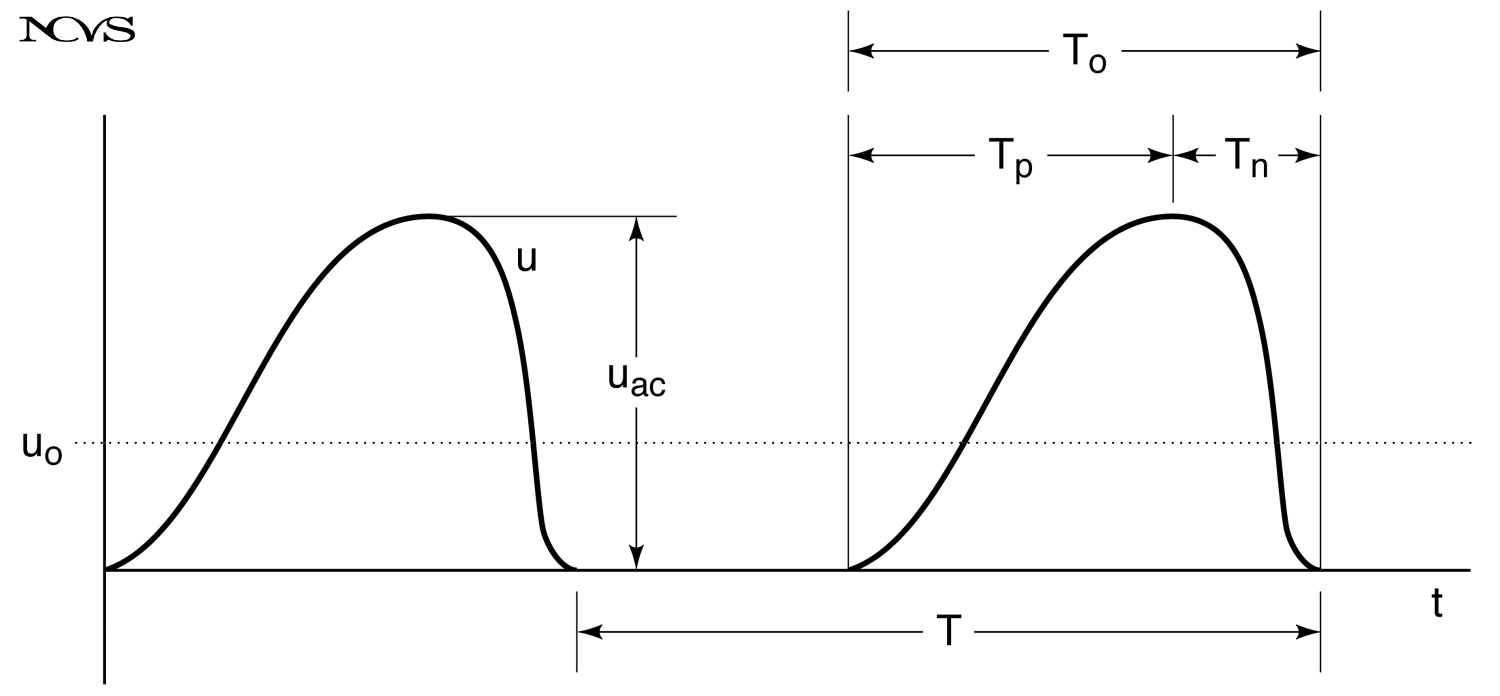 Figure 5.3: Two cycles of a glottal airflow waveform u. Parameters of the flow pulse are described in the text.
Defined Parameters
The following temporal features characterize the glottal flow waveform:
Time Parameters:
- Tp: Time of increasing flow (positive slope)
- Tn: Time of decreasing flow (negative slope)
- To: Duration of flow (open phase)
- T: Period of oscillation (complete cycle)
Amplitude Parameters:
- u₀: Average (steady) flow
- uac: Time-varying (acoustic) flow component
Dimensionless Quotients
From these quantities, two dimensionless parameters are defined that characterize waveform shape independent of amplitude or period:
Open Quotient: $$Q_o = \frac{T_o}{T}$$
The open quotient represents the fraction of the vibratory cycle during which the vocal folds are open and airflow occurs.
Skewing Quotient: $$Q_s = \frac{T_p}{T_n}$$
The skewing quotient characterizes the asymmetry of the flow pulse, indicating whether flow increases more rapidly or decreases more rapidly.
Physiological Control of Quotients
Open Quotient (Q₀)
The open quotient is primarily adjusted by glottal width—the space between the vocal processes of the arytenoid cartilages:
- Increases with abduction of the vocal processes
- Decreases with adduction of the vocal processes
- Typical values: 0.4 to 0.7 in normal phonation
Clinical Significance:
- Values lower than 0.4 are often associated with “pressed” voice quality
- Values above 0.7 tend to produce “breathy” quality, especially at low pitches, because average flow u₀ increases relative to the time-varying component uac
The increased average flow with high Q₀ (caused by spreading of the vocal processes) increases the chance for glottal air turbulence. Therefore, Q₀ and the ratio u₀/uac are useful for acoustic assessment of glottal valving and associated changes in vocal quality.
Skewing Quotient (Qs)
The skewing quotient relates to the abruptness of glottal closure:
- Large Qs (Tp > Tn): Flow increases slowly but decreases rapidly—associated with abrupt closure
- Qs approaching 1.0: More symmetrical pulse shape
- Controlled by vocal fold stiffness, collision forces, and subglottal pressure
Relationship to Voice Quality
The shape of the glottal flow waveform, defined by Q₀ and Qs, helps determine both the amount of acoustic power generated and the quality (timbre) of the sound:
Spectral Consequences
Abrupt changes in flow slope produce high frequencies:
- Large Qs (rapid closure) → More high-frequency energy → “Brassy” quality
- Small Q₀ (short open phase) → Enhanced higher harmonics → “Pressed” quality
Gradual flow changes produce fewer high frequencies:
- Qs and Q₀ both approaching 1.0 → Reduced high frequencies → “Fluty” quality
- Very high Q₀ with turbulence → Noise component → “Breathy” quality
Clinical Voice Types
Pressed Voice:
- Low Q₀ (< 0.4)
- Often large Qs (abrupt closure)
- Enhanced second and third harmonics
- High subglottal pressure
Breathy Voice:
- High Q₀ (> 0.7)
- Elevated u₀/uac ratio
- Turbulent noise component
- Reduced harmonic strength at high frequencies
Normal Voice:
- Q₀ between 0.4 and 0.7
- Moderate Qs
- Balanced harmonic structure
- Appropriate spectral slope
Baseline Flow Variations
Sometimes the minimum (baseline) flow does not reach zero value, as illustrated in the idealized waveform. This may result from:
- Posterior glottal chink: Air leakage through incomplete posterior closure
- Vertical vocal fold movements: Displacement flow from vertical oscillation (like a drumhead or loudspeaker)
The vertical movements create displacement flow even when the glottis is nominally closed, contributing to the baseline flow level.
Time-Frequency Transformations
Understanding the relationship between temporal waveform features and frequency spectrum characteristics provides powerful analytical tools:
- Small Q₀ → Strong second harmonic (produces flatness at bottom of flow pulse)
- Large Qs → Strong third harmonic (produces skewing of waveform)
- Abrupt closure (high maximum flow declination rate) → Enhanced high frequencies
This time-frequency duality allows prediction of spectral features from waveform characteristics and vice versa, providing the foundation for acoustic analysis of voice quality.
Summary
The glottal source function, characterized by temporal parameters and dimensionless quotients, provides the primary acoustic input for speech production. The open quotient Q₀ and skewing quotient Qs define waveform shape independent of amplitude or frequency, relating directly to vocal fold positioning and closure patterns. These parameters correlate strongly with perceived voice quality, with extreme values producing pressed or breathy phonation. Understanding baseline flow variations and the relationship between temporal and spectral characteristics enables sophisticated acoustic assessment of vocal function.
Key Takeaways
- ✅ Open quotient (Q₀ = T₀/T) represents the fraction of the cycle with airflow, controlled by vocal fold abduction
- ✅ Skewing quotient (Qs = Tp/Tn) characterizes pulse asymmetry and relates to closure abruptness
- ✅ Normal Q₀ values range from 0.4 to 0.7; extremes produce pressed or breathy voice quality
- ✅ The ratio u₀/uac (average to time-varying flow) indicates potential for turbulence and breathiness
- ✅ Small Q₀ and large Qs enhance high frequencies, producing brassy or pressed quality
- ✅ Baseline flow above zero may indicate posterior glottal chink or vertical vocal fold motion
- ✅ Time-domain waveform features predict frequency-domain spectral characteristics
Related Topics
Further Reading
- Holmberg, E., Hillman, R., & Perkell, J. (1988). Glottal airflow and transglottal air pressure measurements for male and female speakers in soft, normal and loud voice. Journal of the Acoustical Society of America, 84, 511-529.
- Hertegård, S., Gauffin, J., & Karlsson, I. (1992). Physiological correlates of the inverse filtered flow waveform. Journal of Voice, 6(3), 224-234.
- Titze, I. R. (2000). Principles of Voice Production (2nd ed.). National Center for Voice and Speech.