Sound Generation
Sound production for speech relies fundamentally on creating local disturbances in air pressure and density. Understanding what constitutes sound, both physically and perceptually, provides the foundation for analyzing the complex acoustic phenomena involved in voice production.
Physical Definition of Sound
If a tree falls in the forest and nobody is around, is there sound? This classic riddle has different answers depending on whether we adopt a purely physical or psychophysical definition of sound. If sound is defined only on the basis of perception (psychoacoustics), then the answer is no. If a physical definition is used, then the answer is definitely yes—a disturbance of equilibrium density or pressure clearly occurs when a tree hits the ground.
A practical definition combines both perspectives: if a local pressure disturbance in a continuous medium contains frequencies in the range of 20 to 20,000 Hz (the audible range), sound is produced. Frequencies below 20 Hz are called infrasonic, and frequencies above 20,000 Hz are called ultrasonic.
Condensation and Rarefaction
Pressure disturbances in air manifest as changes in air density:
- Condensation: When pressure disturbance is positive (above average pressure), there is an increase in air density
- Rarefaction: When pressure disturbance is negative, there is a decrease in air density
These local variations in density propagate through the medium as sound waves, carrying acoustic energy away from the source without requiring bulk movement of the medium itself.
Mechanisms of Sound Production
Sound generation requires some form of mechanical disturbance that creates pressure variations in the surrounding medium. In voice production, multiple mechanisms contribute to the overall acoustic output.
Primary Sound Source: Vocal Fold Vibration
The primary source of sound for speech production is the time-varying glottal airflow produced by vocal fold vibration. This mechanism resembles a siren: air is forced through a periodically opening and closing orifice, creating a series of flow pulses. Each pulse generates a pressure disturbance that propagates through the vocal tract.
The analogy between vocal fold vibration and a siren becomes even more interesting when we consider vocal fold motion as a combination of:
- Transglottal flow: Air forced through the glottal orifice (usually the dominant component)
- Displacement flow: Air squeezed out in all directions by the moving vocal fold tissue (significant near glottal closure)
In complex models of vocal fold vibration, these two flows are quantified separately, with the transglottal flow typically dominating but the displacement flow becoming important during the closure phase.
Comparison with Other Sound Sources
Understanding vocal fold phonation benefits from comparing it with simpler sound sources. Three fundamental mechanisms illustrate key principles:
Piston in Cylinder: Air is alternately condensed and rarefied by oscillatory piston movement. Particles in contact with the piston attempt to follow its motion but, not being rigidly connected to the surface or to one another, establish their own characteristic motion through collision. Momentum is imparted to adjacent particles in time-delayed fashion, creating new disturbances at points further from the piston. This “passing along” of pressure disturbances by the medium constitutes sound propagation.
Handclap: Sound is produced by sudden interruption of airflow squeezed out between the hands. This onetime (transient) disturbance can be amplified by cupping the hands slightly, forming a resonance chamber. Some speech sounds—clicks with the tongue or stops with the lips—employ similar mechanisms.
Siren: A jet of air is directed toward a series of holes on the perimeter of a rotating wheel. Periodic interruptions of airflow through the holes create large pressure disturbances and hence very intense sound. The quicker the flow starts and stops, the higher the frequency components will be.
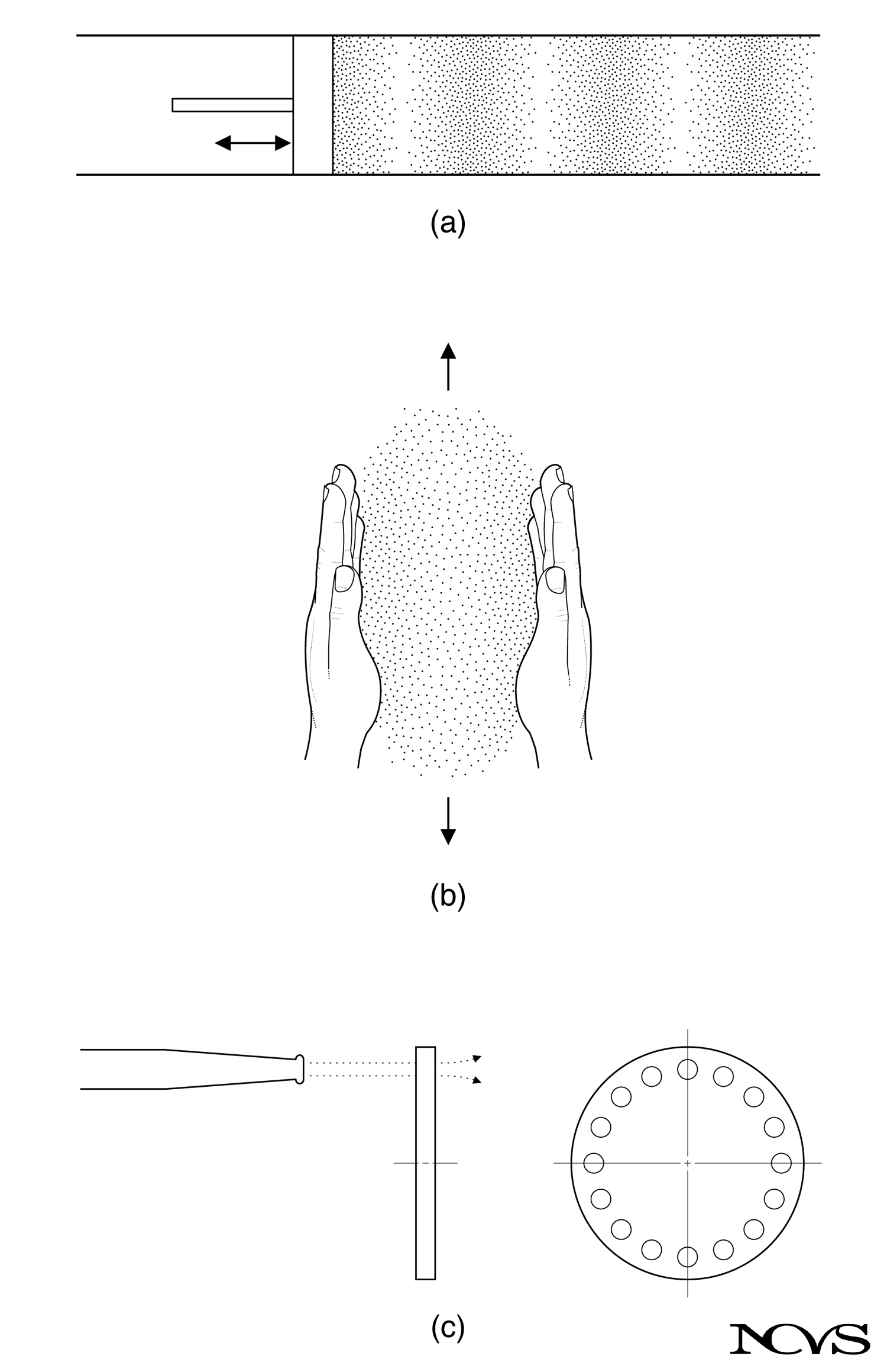 Figure 5.1: Three fundamental sound generation mechanisms. Each illustrates key principles applicable to vocal sound production.
Intensity Despite Small Size
An intriguing aspect of sound production by humans and animals is that small creatures can often make sounds as intense as those made by large creatures. Crickets can be heard over large distances, and the cry of a baby gets immediate attention despite the infant’s small size.
Figure 5.2: The cry of an infant can be very intense. Lack of size is overcome by the higher frequency of the sound source.
As we will learn in Chapter 9, there is a trade-off between the amount of airflow driven by a source and the frequency at which it is driven back and forth. Small sources can be very intense if airflow changes rapidly. This principle explains how infants, despite having much smaller vocal folds than adults, can produce cries of remarkable intensity by oscillating at higher frequencies.
Summary
Sound generation involves creating local disturbances in the pressure and density equilibrium of a medium. For voice production, the primary mechanism is the periodic modulation of airflow through the glottis during vocal fold vibration. This process can be understood by analogy to simpler sound sources like pistons, handclaps, and sirens, each illustrating different aspects of how mechanical motion creates acoustic pressure variations.
The physical definition of sound—disturbances containing frequencies in the audible range—distinguishes sound from other forms of mechanical vibration. Understanding condensation and rarefaction as pressure increases and decreases provides the foundation for analyzing wave propagation. The ability of small sound sources to generate high intensity through rapid flow modulation explains phenomena ranging from cricket chirps to infant cries, and has important implications for understanding voice production efficiency.
Key Takeaways
- ✅ Sound is physically defined as local pressure disturbances in a continuous medium containing frequencies in the audible range (20-20,000 Hz)
- ✅ Condensation (increased density) occurs with positive pressure; rarefaction (decreased density) occurs with negative pressure
- ✅ The primary sound source for speech is time-varying glottal airflow produced by vocal fold vibration
- ✅ Vocal fold vibration combines transglottal flow (through the glottis) and displacement flow (squeezed outward)
- ✅ Small sound sources can produce high intensity by modulating airflow at high frequencies
- ✅ Sound generation mechanisms range from continuous oscillation (piston, vocal folds) to transient events (handclap, stops)
Related Topics
Further Reading
- Titze, I. R. (2000). Principles of Voice Production (2nd ed.). National Center for Voice and Speech.
- Rettinger, M. (1986). Acoustics: Room Design and Noise Control. New York: Chemical Publishing Co.
- Rossing, T. D. (1982). The Science of Sound. Reading, MA: Addison-Wesley.