The Space-Time Concept of a Wave
Wave propagation involves a minimum of two independent variables: space and time. Understanding how these variables interrelate provides fundamental insight into wave mechanics and establishes the mathematical foundation for analyzing acoustic phenomena in the vocal tract.
Independent Variables in Wave Description
A one-dimensional wave propagates along a line, a two-dimensional wave in a plane, and a three-dimensional wave in free space or in an enclosure. Up to four independent variables—x, y, z, and t—may be required to describe a wave mathematically. Since this can become complex, we focus on one-dimensional wave propagation while noting qualitative features of more complex waves.
Simple Laws of Motion Applied to Waves
In Chapter 2, simple laws of motion were reviewed. Objects moving at constant velocity c cover a distance:
$$x = ct$$
in a specified interval of time t. Although a wave is not an “object” in the normal sense, we can treat the wave front (the initial peak compression or rarefaction) as though it were an object.
Critical Point: It is important to remember that particles of the medium (such as the stipples in Figure 5.1a) do not move at constant speed to the right. Their motion remains local and oscillatory. Only the compression or rarefaction continues to move in a straight line as it is passed from one layer of the medium to the next.
The Moving Reference Frame
Consider a pressure disturbance propagating as a wave. An observer moving with the wave at some fixed distance x′ from the peak would observe a constant pressure disturbance.
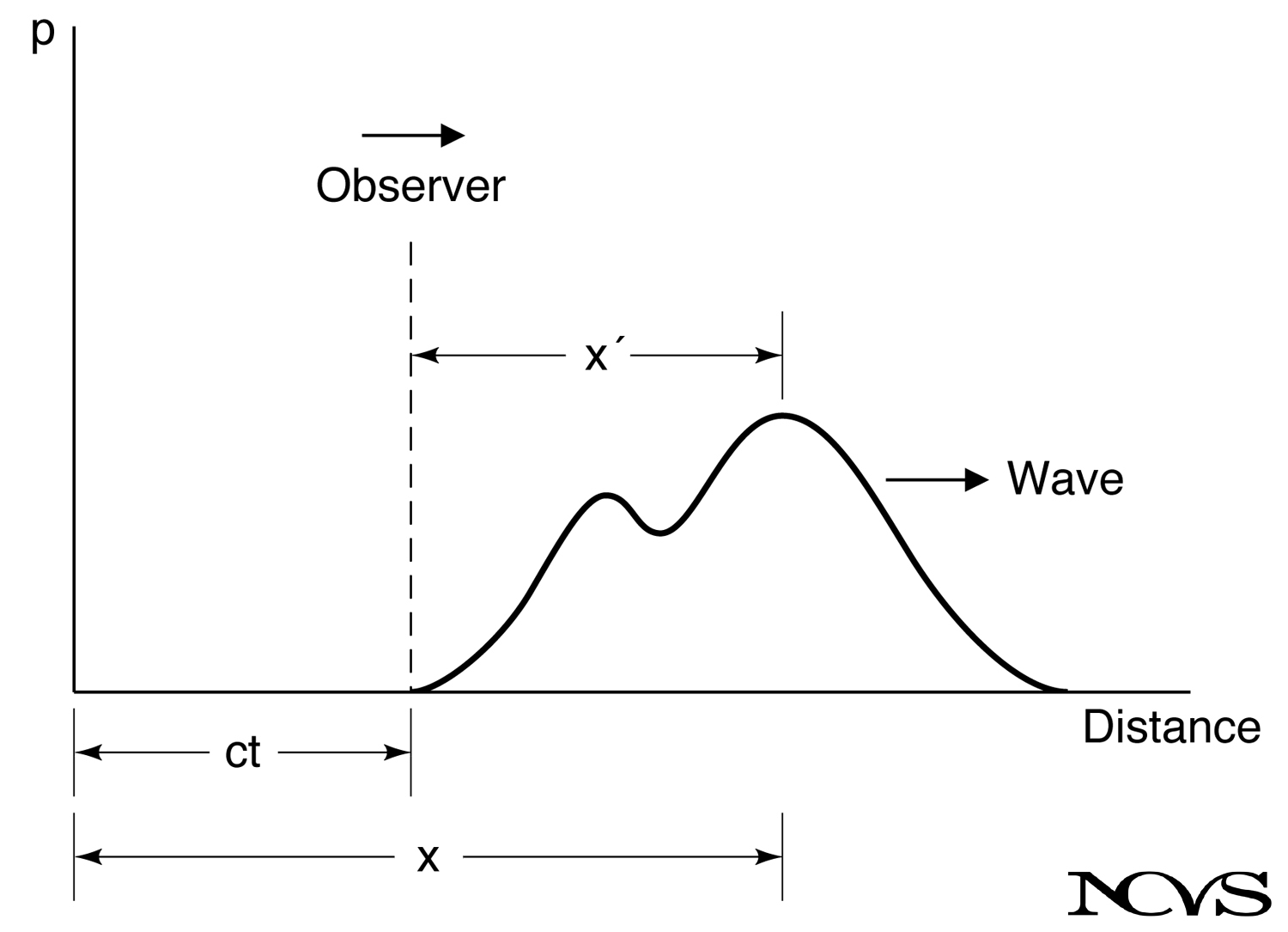 Figure 5.8: Snapshot of a pressure disturbance propagating as a wave toward the right with a velocity c. An observer rides with the wave.
In the Moving Frame
In this moving reference frame, the pressure wave has some arbitrary mathematical function:
$$p = f(x’)$$
This function could be:
- A bell shape
- A sinusoid
- A sharp pulse
- Any other waveshape describing the local air pressure disturbance
In the Stationary Frame
In the stationary reference frame, the peak of the wave is displaced from the origin by:
$$x = ct + x’$$
By direct substitution, the pressure disturbance can be written as:
$$p = f(x - ct)$$
The Fundamental Wave Equation Form
This result—that the pressure disturbance can be formulated by combining the two independent variables x and t into a single compound variable (x - ct)—is one of the most important discoveries of wave mechanics.
Key Implications
- Simplification: However complicated the disturbance, x and t are always combined as this difference
- Symmetry: There is a strong similarity between the space variable x and the time variable t
- Sequence preservation: What is observed spatially is observed in the same (or opposite) sequence temporally
Spatial and Temporal Views
The Snapshot (Space Domain)
Figure 5.8 can be thought of as a snapshot of the moving wave at some instant of time:
- Time is frozen in the picture
- Space extends along the x axis
- Shows the spatial distribution of pressure at one moment
The Slit Observation (Time Domain)
A similar picture is obtained by freezing space and allowing time to progress:
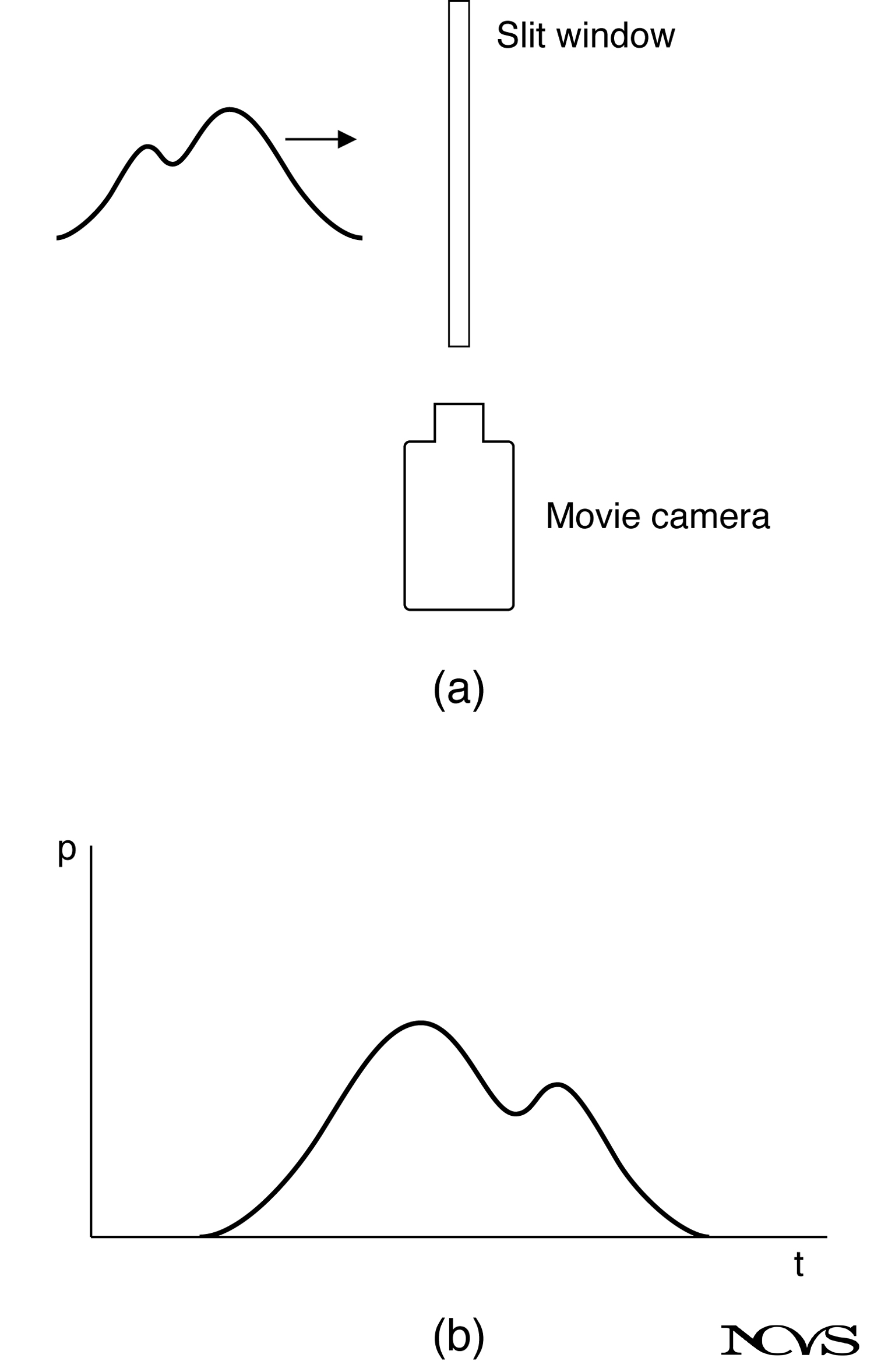 Figure 5.9: Observation of a traveling wave at one point in space: (a) physical arrangement with a slit and a movie camera and (b) display of pressure versus time recorded through the slit.
Setup: A narrow slit is photographed by a movie camera
- Space is restricted to a single value (only the slit is visible)
- Time progresses as the wave passes the slit
- The observed pressure sequence is recorded
Image Reversal
Note that the appearance of the wave in Figure 5.9b is similar to Figure 5.8, but the image is reversed—the larger peak appears first. This reversal is a direct consequence of the wave’s motion to the right.
Thought experiment: If the wave were moving from right to left, Figure 5.9b would be identical to Figure 5.8. This can be visualized by having the wave pass the slit from the right side to the left side in Figure 5.9a.
Mathematical Direction Indication
Forward Wave (Rightward)
$$p = f(x - ct)$$
or equivalently:
$$p = f(t - x/c)$$
Backward Wave (Leftward)
$$p = f(x + ct)$$
or equivalently:
$$p = f(t + x/c)$$
Sign Convention
The sign in the compound variable indicates direction:
- Minus sign (x - ct): Wave traveling in positive x direction (forward/rightward)
- Plus sign (x + ct): Wave traveling in negative x direction (backward/leftward)
Waveform Symmetry and Direction
The waveform shape is preserved (under exchange of x for t as the frozen variable) for propagation in either direction if the pressure disturbance is symmetric—that is, if it rises the same way that it falls.
Examples of Symmetric Waveforms
Sinusoidal waveform:
- Periodically rising and falling pressure
- Completely symmetric
- Direction cannot be determined from snapshot
Bell-shaped pulse:
- Normal distribution shape
- Symmetric rise and fall
- Direction ambiguous from single snapshot
Asymmetric Waveforms
For asymmetric waveforms (like the glottal flow pulse):
- Different rise and fall rates
- Direction can be inferred from shape
- Spatial snapshot differs from temporal recording depending on direction
Summary
Wave propagation requires describing pressure disturbances as functions of both space and time. The fundamental discovery of wave mechanics is that these variables combine in the form (x - ct) for forward waves and (x + ct) for backward waves, where c is the propagation velocity. A spatial “snapshot” freezing time reveals the pressure distribution in space, while a temporal recording at a fixed location reveals the pressure variation in time. For asymmetric waveforms, the spatial and temporal views differ depending on propagation direction, but for symmetric waveforms like sinusoids, the pattern appears identical in both domains. This space-time duality is fundamental to understanding acoustic wave behavior in the vocal tract.
Key Takeaways
- ✅ Wave propagation combines space (x) and time (t) into compound variables: (x - ct) or (x + ct)
- ✅ Forward waves propagate as p = f(x - ct); backward waves as p = f(x + ct)
- ✅ Spatial “snapshots” freeze time and show pressure distribution in space
- ✅ Temporal recordings freeze space and show pressure variation in time
- ✅ For asymmetric waveforms, spatial and temporal patterns differ depending on direction
- ✅ For symmetric waveforms (like sinusoids), spatial and temporal patterns are identical
- ✅ Individual particles oscillate locally; only the disturbance pattern propagates
Related Topics
Further Reading
- Morse, P. M. (1947). Vibration and Sound. New York: McGraw-Hill.
- Kinsler, L., & Frey, A. (1962). Fundamentals of Acoustics (2nd ed.). New York: Wiley.
- French, A. P. (1971). Vibrations and Waves. New York: W. W. Norton.