Sinusoidal Waves
As an example of a more explicit formulation of wave propagation, consider sinusoidal pressure waves—the most fundamental type of acoustic disturbance. Understanding sinusoidal waves provides the foundation for analyzing more complex acoustic phenomena through Fourier decomposition.
Sinusoidal Wave Generation
Consider again the piston in a cylinder shown in Figure 5.1a. Acoustic disturbances (compressions and rarefactions) are produced at regular (periodic) intervals of time as dictated by the sinusoidal back-and-forth motion of the piston.
Pressure at the Source
In Chapter 4, a general expression for sinusoidal displacement was derived. Assuming that pressure disturbances are proportional to the displacement of the piston, the pressure variation at the source is:
$$p = A \sin(\omega t + \theta_0)$$
where:
- A = pressure amplitude
- ω (omega) = radian frequency of vibration (ω = 2πF₀)
- θ₀ = arbitrary phase angle
Phase as Time Delay
The phase angle expresses the time at which the sinusoid reaches its peak value. This time can be advanced or retarded by appropriate choice of θ₀, allowing calculation of pressure disturbances at different distances from the source.
Incorporating Wave Propagation
Knowing that the peak travels to the right at velocity c, the time delay in the arrival of this peak at distance x away from the source is:
$$\text{Time delay} = \frac{x}{c}$$
The corresponding phase delay (in radians) is the angular frequency ω multiplied by the time delay:
$$\text{Phase delay} = \omega \cdot \frac{x}{c} = \frac{\omega x}{c}$$
If the delay is expressed algebraically with a negative sign:
$$\theta_0 = -\frac{\omega x}{c}$$
Substituting this phase angle into the pressure equation yields:
$$p = A \sin\left(\omega t - \frac{\omega x}{c}\right)$$
Factoring out ω:
$$p = A \sin \omega(t - x/c)$$
This is a sinusoidal pressure wave traveling to the right (forward wave). It is an explicit version of the general form p = f(x - ct), with the function f being replaced by the sinusoidal function.
Note: A backward sinusoidal wave would have a positive sign: p = A sin ω(t + x/c)
Wavelength
Definition
The distance between pressure peaks in the spatial representation is called the wavelength. It is usually assigned the symbol λ (lambda) and is measured in meters.
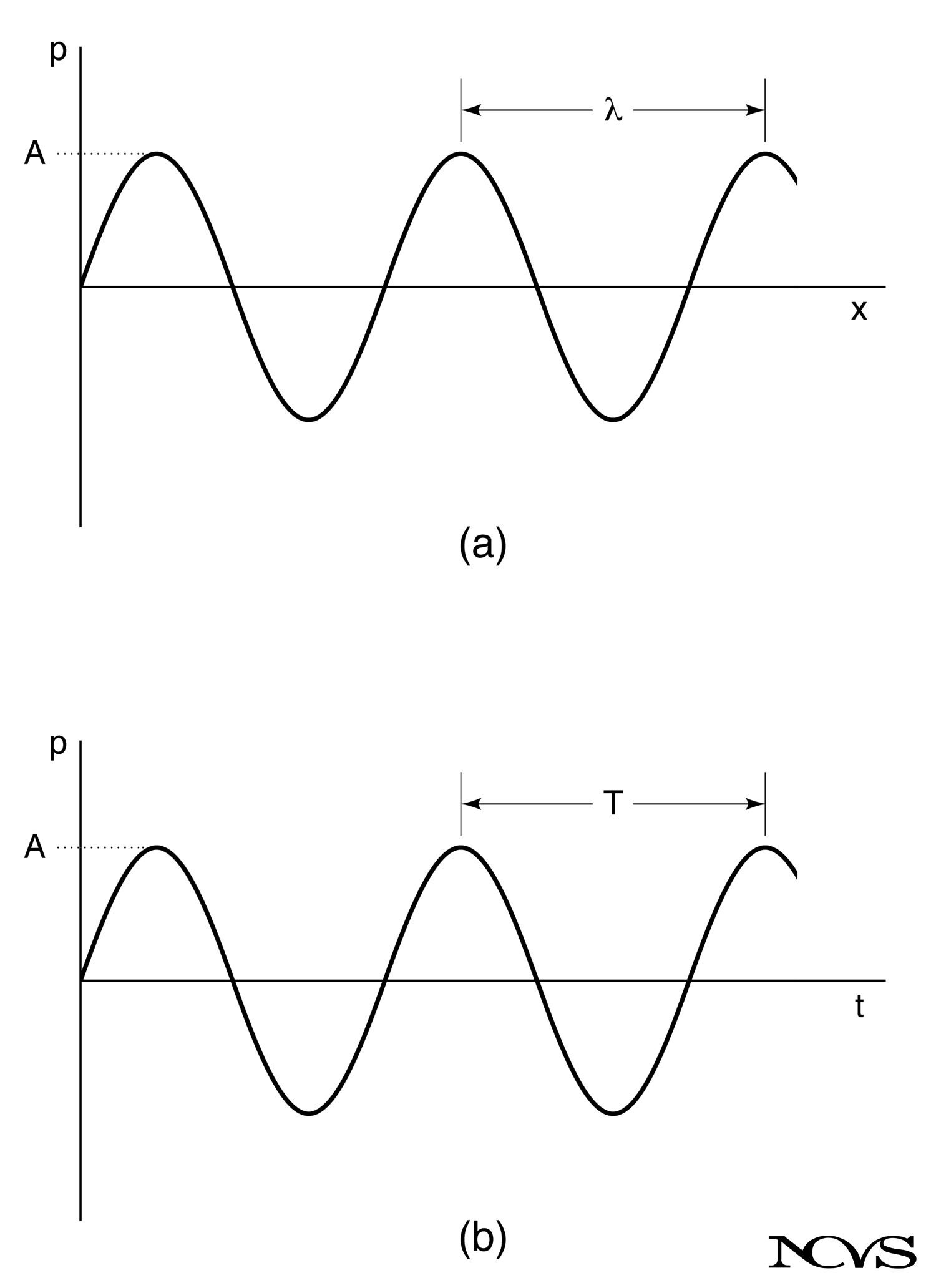 Figure 5.10: Sinusoidal traveling waves: (a) snapshot with time frozen and (b) observation through a slit with space frozen.
Determinants of Wavelength
The wavelength measures how far peaks are separated in space, which depends on both the source and the medium:
Low source frequency:
- Few pressure peaks per second generated
- Propagation velocity is fixed by medium
- Distance between peaks is large
High source frequency:
- Many pressure peaks per second generated
- Distance between peaks is small
This relationship is expressed as:
$$\lambda = \frac{c}{F_0}$$
where:
- λ = wavelength (m)
- c = sound velocity (m/s)
- F₀ = source frequency (Hz)
Example Calculations
For c = 343 m/s (air at standard conditions):
Low pitch (F₀ = 100 Hz):
- λ = 343/100 = 3.43 m (over 11 feet!)
Middle pitch (F₀ = 500 Hz):
- λ = 343/500 = 0.686 m (about 27 inches)
High pitch (F₀ = 5000 Hz):
- λ = 343/5000 = 0.0686 m (about 2.7 inches)
Clinical Insight: The wavelength at typical fundamental frequencies (100-300 Hz) is much larger than vocal tract dimensions (15-20 cm). This means the vocal tract is acoustically “short” compared to the wavelength, which has important implications for resonance theory (Chapter 6).
Period
In the temporal representation (Figure 5.10b), the time between peaks is labeled T (period):
- λ measures distance between peaks in space
- T measures time between peaks at a fixed location
The relationship is:
$$T = \frac{1}{F_0}$$
where:
- T = period (seconds)
- F₀ = frequency (Hz)
Alternative Wave Equation Forms
Using Radian Frequency
Recall that ω = 2πF₀. Then:
$$p = A \sin 2\pi(F_0 t - F_0 x/c)$$
Using Period and Wavelength
Substituting F₀ = 1/T in the first term and F₀ = c/λ in the second term:
$$p = A \sin 2\pi\left(\frac{t}{T} - \frac{x}{\lambda}\right)$$
Space-Time Symmetry
This form makes the symmetry between space and time explicit:
- t/T represents temporal phase (fraction of period)
- x/λ represents spatial phase (fraction of wavelength)
- Both contribute equally to the overall phase
For a backward wave, the minus sign changes to a plus sign:
$$p = A \sin 2\pi\left(\frac{t}{T} + \frac{x}{\lambda}\right)$$
Wavelength Dependence on Medium
Note that wavelength increases with an increase in wave velocity c of the medium. Therefore, λ depends on both the medium and the source:
In air (c ≈ 343 m/s, F₀ = 200 Hz):
- λ = 343/200 = 1.72 m
In water (c ≈ 1480 m/s, F₀ = 200 Hz):
- λ = 1480/200 = 7.40 m (over 4 times longer!)
In helium (c ≈ 965 m/s, F₀ = 200 Hz):
- λ = 965/200 = 4.83 m (about 2.8 times longer)
The wavelength changes with the medium even though the source frequency remains constant.
Summary
Sinusoidal waves represent the simplest case of acoustic wave propagation, with pressure varying as p = A sin ω(t - x/c) for forward waves. The wavelength λ = c/F₀ measures the spatial distance between pressure peaks and depends on both the sound velocity (determined by the medium) and the frequency (determined by the source). The period T = 1/F₀ measures the temporal interval between peaks at a fixed location. Alternative formulations like p = A sin 2π(t/T - x/λ) reveal the fundamental space-time symmetry in wave propagation. Understanding sinusoidal waves is essential because complex sounds can be decomposed into sinusoidal components through Fourier analysis.
Key Takeaways
- ✅ Sinusoidal waves have the form p = A sin ω(t - x/c) for forward propagation
- ✅ Wavelength λ = c/F₀ measures spatial distance between peaks, depending on both medium and source
- ✅ Period T = 1/F₀ measures temporal interval between peaks at a fixed location
- ✅ The alternative form p = A sin 2π(t/T - x/λ) reveals space-time symmetry
- ✅ Wavelength increases with faster propagation velocity for the same frequency
- ✅ At typical voice F₀ (100-300 Hz), wavelength (1-3 m) greatly exceeds vocal tract length (~17 cm)
- ✅ Phase delay increases linearly with distance: phase = ωx/c
Related Topics
Further Reading
- Morse, P. M. (1947). Vibration and Sound. New York: McGraw-Hill.
- Kinsler, L., & Frey, A. (1962). Fundamentals of Acoustics (2nd ed.). New York: Wiley.
- Rossing, T. D. (1982). The Science of Sound. Reading, MA: Addison-Wesley.