Wavelength
Wavelength is the spatial distance over which an acoustic wave completes one full cycle of compression and rarefaction. While frequency describes the temporal repetition rate of sound (cycles per second), wavelength describes the spatial repetition pattern (distance per cycle). Understanding wavelength is essential for analyzing phenomena such as resonance, reflection, diffraction, and the acoustic behavior of the vocal tract, where the relationship between wavelength and cavity dimensions determines resonant properties.
Definition and Conceptual Understanding
Wavelength quantifies the spatial extent of one complete oscillation cycle in a propagating wave.
Spatial Periodicity
Just as temporal periodicity describes repetition over time, spatial periodicity describes repetition over distance:
Period (T): Time between successive peaks passing a fixed observation point.
Wavelength (λ): Distance between successive peaks at a fixed moment in time.
These complementary descriptions reflect the dual nature of waves as phenomena existing in both space and time.
Visual Representation
Imagine taking an instantaneous “snapshot” of a sound wave frozen in time:
Compression Peaks: Regions of maximum positive pressure appear at regular spatial intervals.
Rarefaction Troughs: Regions of maximum negative pressure appear halfway between compression peaks.
Wavelength (λ): Distance from one compression peak to the next, or equivalently, from one rarefaction to the next, or between any two points in the same phase of oscillation.
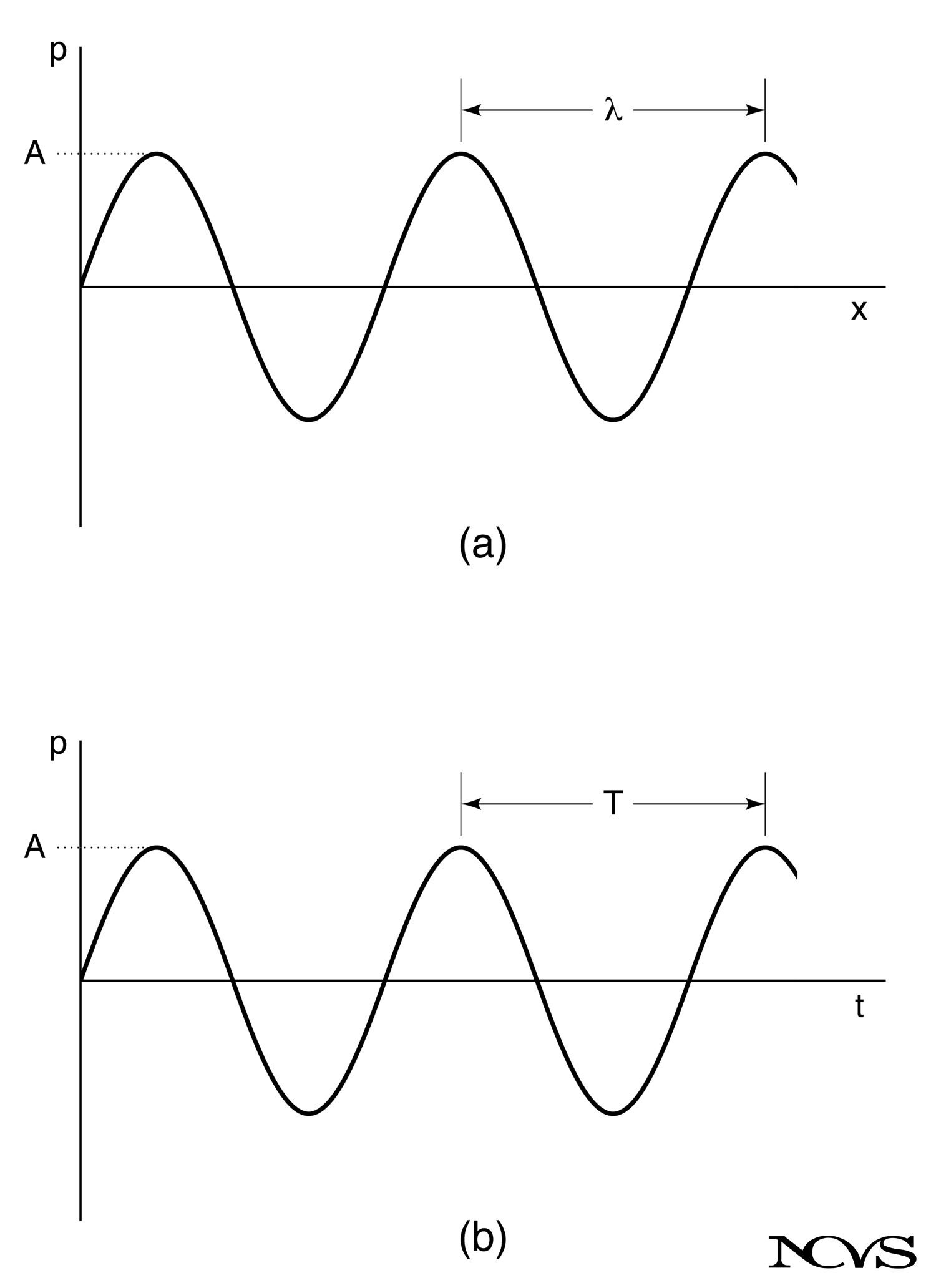 Figure 5.10: Spatial representation of wavelength showing the distance between successive pressure peaks in a sinusoidal traveling wave.
Symbol and Units
Symbol: λ (Greek letter lambda)
Units:
- Meters (m) for most acoustics
- Centimeters (cm) for convenience in voice tract acoustics
- Millimeters (mm) for ultrasound applications
Typical Values in Speech:
- Fundamental frequency (100-300 Hz): λ ≈ 1-3 m
- Formant frequencies (500-3000 Hz): λ ≈ 11-69 cm
- High frequencies (5000 Hz): λ ≈ 7 cm
The Wavelength-Frequency-Velocity Relationship
Wavelength, frequency, and propagation velocity are intrinsically connected through a fundamental relationship.
The Core Equation
The relationship between these three quantities:
c = λfor solving for wavelength:
λ = c/fwhere:
- λ = wavelength (m)
- c = sound velocity (m/s)
- f = frequency (Hz)
Interpretation: Wavelength equals the distance sound travels during one period of oscillation. Since velocity is distance per time (c = distance/time) and frequency is cycles per time (f = cycles/time), wavelength must be distance per cycle (λ = distance/cycle).
Inverse Relationship with Frequency
For a given propagation velocity:
Higher Frequency → Shorter Wavelength:
- More cycles per second means each cycle spans less distance
- f doubles → λ halves
- High-pitched sounds have short wavelengths
Lower Frequency → Longer Wavelength:
- Fewer cycles per second means each cycle spans more distance
- f halves → λ doubles
- Low-pitched sounds have long wavelengths
Example (in air, c = 343 m/s):
- 100 Hz: λ = 343/100 = 3.43 m
- 200 Hz: λ = 343/200 = 1.72 m (half as long)
- 400 Hz: λ = 343/400 = 0.86 m (half again)
- 1000 Hz: λ = 343/1000 = 0.34 m (34 cm)
Direct Relationship with Velocity
For a given frequency:
Higher Velocity → Longer Wavelength:
- Faster propagation means each cycle travels farther before the next begins
- c doubles → λ doubles
- Same frequency produces longer wavelength in faster medium
Example (f = 200 Hz):
- Air (c = 343 m/s): λ = 1.72 m
- Helium (c = 965 m/s): λ = 4.83 m (2.8 times longer)
- Water (c = 1480 m/s): λ = 7.40 m (4.3 times longer)
The frequency remains constant (determined by source), but wavelength adjusts to local propagation velocity.
Wavelength Calculations for Voice Acoustics
Specific calculations relevant to voice production reveal important relationships.
Fundamental Frequency
Adult Male (F₀ ≈ 110 Hz):
λ = 343/110 ≈ 3.1 m (about 10 feet)Adult Female (F₀ ≈ 220 Hz):
λ = 343/220 ≈ 1.56 m (about 5 feet)Child (F₀ ≈ 300 Hz):
λ = 343/300 ≈ 1.14 m (about 3.7 feet)Comparison: All these wavelengths greatly exceed vocal tract length (~14-17 cm), which has important implications for acoustic analysis.
Formant Frequencies
First Formant (F1 ≈ 500 Hz):
λ = 343/500 = 0.686 m ≈ 69 cmSecond Formant (F2 ≈ 1500 Hz):
λ = 343/1500 ≈ 0.23 m ≈ 23 cmThird Formant (F3 ≈ 2500 Hz):
λ = 343/2500 ≈ 0.14 m ≈ 14 cmSignificance: F3 wavelength approaches vocal tract length, while F1 and F2 wavelengths exceed it. This relationship affects how vocal tract behaves as acoustic resonator.
Upper Speech Frequencies
4000 Hz (upper consonant energy):
λ = 343/4000 ≈ 0.086 m ≈ 8.6 cm8000 Hz (fricative energy):
λ = 343/8000 ≈ 0.043 m ≈ 4.3 cmAt these high frequencies, wavelength becomes comparable to oral cavity dimensions, affecting diffraction and radiation patterns.
Wavelength and Vocal Tract Acoustics
The relationship between wavelength and vocal tract dimensions determines acoustic behavior.
Quarter-Wave Resonance
For a tube closed at one end (glottis) and open at the other (lips), resonances occur when the tube length equals an odd multiple of quarter-wavelengths:
L = (2n - 1)λ/4where n = 1, 2, 3, … (resonance number).
Solving for wavelength at resonance:
λ_n = 4L/(2n - 1)First Resonance (n = 1):
λ₁ = 4LFor L = 17 cm (adult male):
λ₁ = 4 × 0.17 = 0.68 m = 68 cmCorresponding frequency:
F₁ = c/λ₁ = 343/0.68 ≈ 504 HzSecond Resonance (n = 2):
λ₂ = 4L/3 = 0.227 m
F₂ = 343/0.227 ≈ 1512 Hz
Third Resonance (n = 3):
λ₃ = 4L/5 = 0.136 m
F₃ = 343/0.136 ≈ 2521 Hz
These are the formant frequencies for a neutral vocal tract configuration.
Long-Wavelength Approximation
When wavelength greatly exceeds cavity dimensions (λ >> L):
Conditions: Low frequencies, small cavities.
Consequence: Pressure essentially uniform throughout cavity at any instant—no significant spatial variation.
Implication: Cavity acts as single lumped compliance rather than distributed resonator; simplified acoustic models apply.
Example: For F₀ = 100 Hz, λ = 3.43 m >> L = 0.17 m. Subglottal pressure can be considered spatially uniform across laryngeal region.
Comparable Wavelength
When wavelength approximates cavity dimensions (λ ≈ L):
Conditions: Formant frequencies in typical vocal tract.
Consequence: Pressure varies significantly along tract length; standing wave patterns form.
Implication: Distributed acoustic model necessary; resonances occur at specific frequencies; cavity shape critically affects response.
Example: At F3 ≈ 2500 Hz, λ ≈ 14 cm ≈ L. Standing wave patterns with nodes and antinodes determine resonance characteristics.
Short-Wavelength Behavior
When wavelength is much smaller than cavity dimensions (λ << L):
Conditions: Very high frequencies (>10 kHz), large cavities.
Consequence: Many wavelengths fit within cavity; complex interference patterns; ray acoustics applicable.
Implication: Diffraction effects; directional radiation; less sensitivity to precise cavity shape.
Typically not dominant in speech acoustics but relevant for some fricatives and for understanding acoustic imaging (ultrasound).
Wavelength and Acoustic Phenomena
Many acoustic behaviors depend critically on wavelength relative to obstacle or opening dimensions.
Reflection
When sound encounters a boundary:
Large Boundary (dimensions >> λ): Specular reflection; sound reflects like light from mirror.
Small Obstacle (dimensions << λ): Scattering; obstacle barely perturbs wavefront.
Intermediate Sizes (dimensions ≈ λ): Complex reflection and scattering patterns.
Voice Application: Vocal tract walls reflect sound effectively across speech frequency range because wall separations (4-8 cm) are comparable to or smaller than wavelengths of interest.
Diffraction
Diffraction is wave bending around obstacles or through openings:
Opening >> λ: Little diffraction; sound propagates in straight beam.
Opening ≈ λ: Significant diffraction; sound spreads into geometric shadow.
Opening << λ: Extreme diffraction; opening radiates equally in all directions (point source).
Lip Radiation: At low frequencies (λ >> lip dimensions), mouth radiates omnidirectionally. At high frequencies (λ << lip dimensions), radiation becomes more directional forward. Transition occurs around 1-2 kHz where λ ≈ lip opening (~2-3 cm diameter).
Standing Waves
Standing waves form when incident and reflected waves interfere:
Nodes: Positions of minimum amplitude, spaced by λ/2.
Antinodes: Positions of maximum amplitude, also spaced by λ/2.
Pattern: Stationary spatial pattern of pressure or particle velocity.
Vocal Tract: Standing wave patterns at formant frequencies determine pressure and velocity distributions, affecting acoustic coupling with vocal folds and radiation efficiency.
Interference
When waves from multiple sources overlap:
Constructive Interference: Waves in phase; amplitudes add.
Destructive Interference: Waves out of phase; amplitudes subtract.
Path Length Difference: Determines phase relationship. Constructive interference when path difference = nλ (n = 0, 1, 2, …); destructive when path difference = (n + 1/2)λ.
Application: Multiple reflection paths in vocal tract create interference patterns contributing to formant structure.
Wavelength in Different Media
Medium properties affect wavelength through propagation velocity.
Air vs. Helium
Same frequency (f = 200 Hz) in different gases:
Air (c = 343 m/s):
λ = 343/200 = 1.72 mHelium (c = 965 m/s):
λ = 965/200 = 4.83 m (2.8 times longer)Helium Speech Effect: Formant frequencies shift upward proportionally to velocity increase because vocal tract dimensions remain constant while wavelengths supporting resonances become longer, requiring higher frequencies to maintain resonance condition L = (2n-1)λ/4.
Air vs. Tissue
Same frequency (f = 5 MHz, medical ultrasound):
Air (c = 343 m/s):
λ = 343/5,000,000 ≈ 0.000069 m ≈ 69 μmSoft Tissue (c = 1540 m/s):
λ = 1540/5,000,000 ≈ 0.000308 m ≈ 308 μmUltrasound Imaging: Wavelength in tissue determines resolution. Shorter wavelengths (higher frequencies) provide better resolution but attenuate more rapidly. Typical clinical frequencies (2-10 MHz) provide millimeter-scale resolution.
Wavelength and Measurement Considerations
Understanding wavelength helps optimize acoustic measurements.
Microphone Spacing
For multi-microphone arrays measuring spatial sound field:
Spacing << λ: Samples adequately represent spatial variations.
Spacing ≈ λ: Marginal sampling; may miss fine details.
Spacing >> λ: Aliasing; spatial patterns undersampled.
Rule of Thumb: Microphone separation should not exceed λ/2 at highest frequency of interest to avoid spatial aliasing.
Acoustic Chamber Dimensions
For anechoic or reverberant chamber design:
Low-Frequency Cutoff: Chamber must be large relative to wavelength of lowest frequency requiring anechoic properties. For 100 Hz (λ = 3.43 m), chamber should be several meters on a side.
Wedge Depth: Anechoic wedges must be several times wavelength depth to effectively absorb sound. Longer wavelengths (lower frequencies) require deeper wedges.
Source-Receiver Distance
Near Field (distance << λ): Complex, distance-dependent acoustic field; not representative of far-field radiation.
Far Field (distance >> λ): Simplified spherical spreading; standard measurement conditions.
Transition Distance: Typically several wavelengths. For voice measurements at F₀ = 200 Hz (λ = 1.72 m), far-field conditions require distance >3-5 m.
Clinical and Research Applications
Wavelength considerations inform various clinical and research protocols.
Acoustic Pharyngometry
Principle: Measures vocal tract cross-sectional area from acoustic reflections.
Wavelength Requirement: Incident pulse wavelength should be comparable to or smaller than smallest dimensions of interest for adequate resolution. Typical frequencies 2-10 kHz (λ = 3.4-17 cm) resolve centimeter-scale structures.
Vocal Tract Imaging
MRI and CT: Not wavelength-dependent (not acoustic).
Ultrasound: Wavelength determines resolution and penetration depth.
- High frequency (7-15 MHz, λ ≈ 0.1-0.2 mm): Excellent resolution, shallow penetration (superficial structures).
- Low frequency (2-5 MHz, λ ≈ 0.3-0.8 mm): Lower resolution, deeper penetration (deeper neck structures).
Room Acoustics for Voice Testing
Recording Environment: Room dimensions and treatment must consider wavelength:
Low Frequencies (F₀, F1): Long wavelengths (>1 m) require large spaces to avoid strong room modes. Small recording booths may have problematic low-frequency resonances.
High Frequencies (F3, F4, consonants): Shorter wavelengths (10-30 cm) are more easily controlled with modest acoustic treatment.
Summary
Wavelength is the spatial distance over which an acoustic wave completes one full cycle, related to frequency and propagation velocity through λ = c/f. This relationship shows that wavelength decreases with increasing frequency (inverse relationship) and increases with increasing propagation velocity (direct relationship). For speech in air, fundamental frequencies (100-300 Hz) produce wavelengths of 1-3 meters, while formant frequencies (500-3000 Hz) produce wavelengths of 11-70 centimeters, and high frequencies (5000 Hz) produce wavelengths of about 7 centimeters.
The relationship between wavelength and vocal tract dimensions critically determines acoustic behavior. At fundamental frequencies, wavelength greatly exceeds tract length (λ >> L), allowing simplified analyses assuming uniform pressure. At formant frequencies, wavelength approximates tract length (λ ≈ L), creating standing wave patterns and resonances at specific frequencies. The quarter-wave resonance condition (L = λ/4 for lowest mode) explains formant frequency distribution in the vocal tract.
Wavelength determines many acoustic phenomena including reflection (effective when boundary dimensions exceed λ), diffraction (significant when opening dimensions approximate λ), and standing wave formation (node spacing = λ/2). In different media, the same frequency produces different wavelengths: helium speech has longer wavelengths than air at the same frequency, shifting formants upward to maintain resonance with fixed tract dimensions. Understanding wavelength is essential for optimizing measurement systems, interpreting acoustic phenomena, and analyzing vocal tract resonance properties.
Key Takeaways
- ✅ Wavelength λ = c/f relates spatial and temporal periodicity through propagation velocity
- ✅ In speech, F₀ wavelengths (1-3 m) greatly exceed vocal tract length (~15-17 cm) while formant wavelengths (10-70 cm) are comparable
- ✅ Quarter-wave resonance (L = λ/4) explains formant frequencies in tube-like vocal tract
- ✅ When λ >> cavity dimensions, pressure is spatially uniform; when λ ≈ dimensions, standing waves and resonances occur
- ✅ Diffraction is significant when opening dimensions approximate wavelength (around 1-2 kHz for lip opening)
- ✅ Helium increases sound velocity, thus wavelength, shifting formants upward to maintain resonance with fixed tract dimensions
- ✅ Clinical applications including acoustic pharyngometry and ultrasound imaging depend on wavelength for resolution and interpretation
Related Topics
- Propagation Velocity
- Sinusoidal Waves
- Reflection of Sound
- Wave Interference and Standing Waves
- Vocal Tract Resonance
Further Reading
- Titze, I. R. (2000). Principles of Voice Production (2nd ed.). Iowa City: National Center for Voice and Speech.
- Fant, G. (1960). Acoustic Theory of Speech Production. The Hague: Mouton.
- Stevens, K. N. (1998). Acoustic Phonetics. Cambridge, MA: MIT Press.
- Kinsler, L. E., Frey, A. R., Coppens, A. B., & Sanders, J. V. (2000). Fundamentals of Acoustics (4th ed.). New York: John Wiley & Sons.
- Beranek, L. L. (1986). Acoustics. New York: American Institute of Physics.