Reflection Coefficients
In most physical situations, medium 2 is not perfectly reflecting—it is neither infinitely stiff (or massive) nor completely yielding. Wave impedances are generally finite and greater than zero, which means that only a fraction of the incident pressure will be reflected while some acoustic energy is transmitted into medium 2.
Partial Reflection
When two media have finite, non-zero impedances, the interface produces:
- Partial reflection: Some energy returns to medium 1
- Partial transmission: Some energy enters medium 2
- The fractions depend on the impedance ratio
This contrasts with the extreme cases (rigid wall or open end) where reflection is complete and transmission is zero.
Definition of Reflection Coefficient
A reflection coefficient is defined as the fraction of the incident wave that is reflected:
$$r = \frac{p_r}{p_i} \quad \text{(at the interface)}$$
where:
- r = reflection coefficient (dimensionless)
- pᵣ = reflected pressure amplitude
- pᵢ = incident pressure amplitude
The reflection coefficient can range from -1 to +1:
- r = +1: Complete reflection, same polarity (rigid wall)
- r = -1: Complete reflection, opposite polarity (open end)
- r = 0: No reflection (perfect impedance match)
- -1 < r < +1: Partial reflection
Calculating Reflection Coefficient
Pressure and particle flow must be continuous across the interface because the interface has zero dimensions—particles are in immediate contact across the boundary. This continuity condition allows the reflection coefficient to be computed from the two wave impedances.
Impedance-Based Formula
$$r = \frac{z_2 - z_1}{z_2 + z_1} = \frac{\rho_2 c_2 - \rho_1 c_1}{\rho_2 c_2 + \rho_1 c_1}$$
where:
- z₁ = ρ₁c₁ = wave impedance of medium 1
- z₂ = ρ₂c₂ = wave impedance of medium 2
Special Cases
Very stiff/dense medium 2 (z₂ >> z₁): $$r \approx \frac{z_2}{z_2} = +1$$ Complete reflection, positive polarity (as with rigid wall)
Vacuum or very soft medium 2 (z₂ ≈ 0): $$r = \frac{0 - z_1}{0 + z_1} = -1$$ Complete reflection, negative polarity (as with open end)
Equal impedances (z₂ = z₁): $$r = \frac{z_1 - z_1}{z_1 + z_1} = 0$$ No reflection, perfect transmission
Wave Diagram Representation
As a shorthand graphical representation, pressure waves can be drawn as arrows with:
- Arrow length: Magnitude of acoustic pressure
- Arrow direction: Forward or backward propagation
- Sign (+/-): Polarity (condensation or rarefaction)
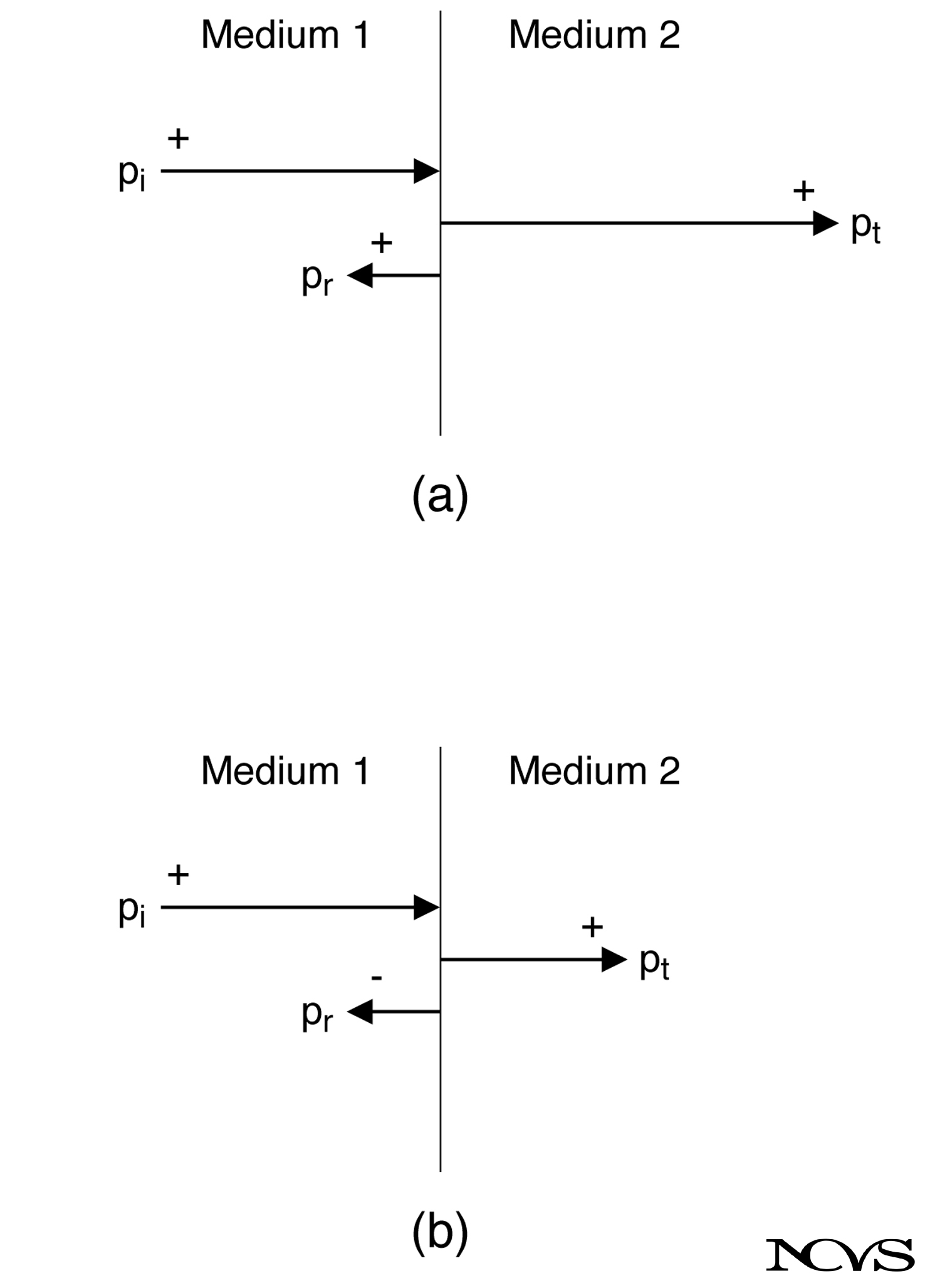 Figure 5.12: Schematic diagram of a wave reflection when medium 2 is (a) denser than medium 1 and (b) less dense than medium 1. The length of each arrow indicates the acoustic pressure magnitude at the interface.
Reading Wave Diagrams
The diagrams show conditions at the boundary only:
- All arrows represent pressure at the interface at a specific moment
- Forward arrows (→) point toward the interface
- Backward arrows (←) point away from the interface
- The total pressure at the interface is the sum of incident and reflected pressures
Transmitted Wave
The reflection coefficient also defines the transmitted wave. At the interface, total pressure is the sum of incident and reflected pressures:
$$p_{\text{total}} = p_i + p_r$$
Because pressure is continuous across the boundary, the transmitted pressure pₜ equals this total:
$$p_t = p_i + p_r = p_i + r \cdot p_i = p_i(1 + r)$$
Therefore: $$\frac{p_t}{p_i} = 1 + r$$
This is called the transmission coefficient (or pressure transmission coefficient).
Example: Medium 2 Denser than Medium 1
Given: z₂ = 2z₁ (medium 2 has twice the impedance)
Reflection coefficient: $$r = \frac{2z_1 - z_1}{2z_1 + z_1} = \frac{z_1}{3z_1} = +\frac{1}{3}$$
Reflected pressure: $$p_r = \frac{1}{3} p_i$$
Total pressure at interface: $$p = p_i + p_r = p_i + \frac{1}{3}p_i = \frac{4}{3}p_i$$
Transmitted pressure: $$p_t = \frac{4}{3}p_i$$
Key Observation: Pressure is transformed up (amplified) by the interface to a denser medium. This is not a violation of energy conservation—as pressure increases, particle velocity decreases correspondingly, keeping total energy constant.
Example: Medium 2 Less Dense than Medium 1
Given: z₂ = z₁/2 (medium 2 has half the impedance)
Reflection coefficient: $$r = \frac{z_1/2 - z_1}{z_1/2 + z_1} = \frac{-z_1/2}{3z_1/2} = -\frac{1}{3}$$
Reflected pressure: $$p_r = -\frac{1}{3} p_i$$ (negative indicates reversed polarity)
Total pressure at interface: $$p = p_i + p_r = p_i - \frac{1}{3}p_i = \frac{2}{3}p_i$$
Transmitted pressure: $$p_t = \frac{2}{3}p_i$$
Key Observation: Pressure is transformed down (reduced) by the interface to a less dense medium. Again, energy is conserved through compensating changes in particle velocity.
Applications to Vocal Tract
The reflection coefficient concept is crucial for understanding vocal tract acoustics.
At the Glottis
Subglottal to supraglottal interface:
- Large area increase (small to large)
- Impedance decreases: z_supraglottal < z_subglottal
- Negative reflection coefficient
- Important for source-tract interaction
At the Lips
Vocal tract to free space:
- Frequency-dependent radiation impedance
- At low frequencies: z_radiation << z_tract → r ≈ -1
- At high frequencies: better impedance match → smaller |r|
- Creates frequency-dependent reflection
At Constrictions
Wide to narrow transition:
- Impedance increases
- Positive reflection coefficient
- Can enhance certain frequencies (anti-resonances)
Narrow to wide transition:
- Impedance decreases
- Negative reflection coefficient
- Typical for most vocal tract expansion regions
Energy Reflection and Transmission
While the pressure reflection coefficient describes pressure ratios, energy transmission depends on both pressure and impedance.
Energy Coefficients
Reflected energy fraction: $$R_E = r^2$$
Transmitted energy fraction: $$T_E = 1 - r^2 = \frac{4z_1 z_2}{(z_1 + z_2)^2}$$
Note that Rₑ + Tₑ = 1, confirming energy conservation.
Maximum Energy Transfer
Energy transmission is maximized when impedances are matched (z₁ = z₂):
- r = 0 (no reflection)
- Tₑ = 1 (complete transmission)
This impedance matching principle is important in:
- Acoustic coupling between systems
- Microphone design
- Hearing aid fitting
- Vocal efficiency considerations
Summary
Partial reflection occurs at interfaces between media with finite, non-zero impedances. The reflection coefficient r = (z₂ - z₁)/(z₂ + z₁) quantifies the fraction of incident pressure that reflects, ranging from -1 to +1. The transmitted pressure equals pᵢ(1 + r), meaning pressure can be transformed up (amplified) at interfaces to denser media or down (reduced) at interfaces to less dense media. Wave diagrams provide graphical representations showing pressure magnitudes, directions, and polarities at interfaces. In the vocal tract, reflection coefficients at the glottis and lips create the boundary conditions essential for formant generation, while energy transmission is maximized when impedances are matched.
Key Takeaways
- ✅ Reflection coefficient r = (z₂ - z₁)/(z₂ + z₁) quantifies fraction of incident pressure reflected
- ✅ Reflection coefficient ranges from -1 (open end) to +1 (rigid wall), with 0 indicating perfect match
- ✅ Transmitted pressure pₜ = pᵢ(1 + r) can be greater or less than incident pressure
- ✅ Pressure amplifies at interfaces to denser media (positive r) and reduces at interfaces to less dense media (negative r)
- ✅ Energy conservation is maintained through compensating changes in particle velocity
- ✅ Wave diagrams use arrow length for magnitude, direction for propagation, and signs for polarity
- ✅ Vocal tract reflections at glottis and lips create boundary conditions for resonance
- ✅ Maximum energy transmission occurs with impedance matching (z₁ = z₂)
Related Topics
Further Reading
- Kinsler, L., & Frey, A. (1962). Fundamentals of Acoustics (2nd ed.). New York: Wiley.
- Morse, P. M. (1947). Vibration and Sound. New York: McGraw-Hill.
- Flanagan, J. L. (1972). Speech Analysis Synthesis and Perception (2nd ed.). New York: Springer-Verlag.