Reflection of Sound
Whenever the acoustic impedance changes in a medium, wave propagation is altered. An abrupt change causes a reflection because a sudden disturbance of the pressure pattern acts like a new source of sound. Understanding reflection is essential for analyzing vocal tract resonance and sound radiation.
Physical Basis of Reflection
Recall that any local disturbance of pressure and density can act as a source of sound. When a propagating wave encounters a change in acoustic impedance, this creates such a disturbance—the wave cannot continue undisturbed when the medium’s acoustic properties change abruptly.
Reflection as a Secondary Source
The reflection process can be understood as:
- Forward wave arrives at interface
- Impedance discontinuity disturbs the pressure pattern
- This disturbance acts as a new source of sound
- New source generates a wave propagating backward from the interface
The amount and polarity of this reflected wave depend on the nature of the impedance change.
Extreme Cases: Complete Reflection
The most dramatic reflections occur when the impedance mismatch is extreme. Two limiting cases illustrate the fundamental principles.
Rigid Wall (Infinite Impedance)
Figure 5.11a illustrates reflection from a very dense solid (medium 2) with wave impedance approaching infinity.
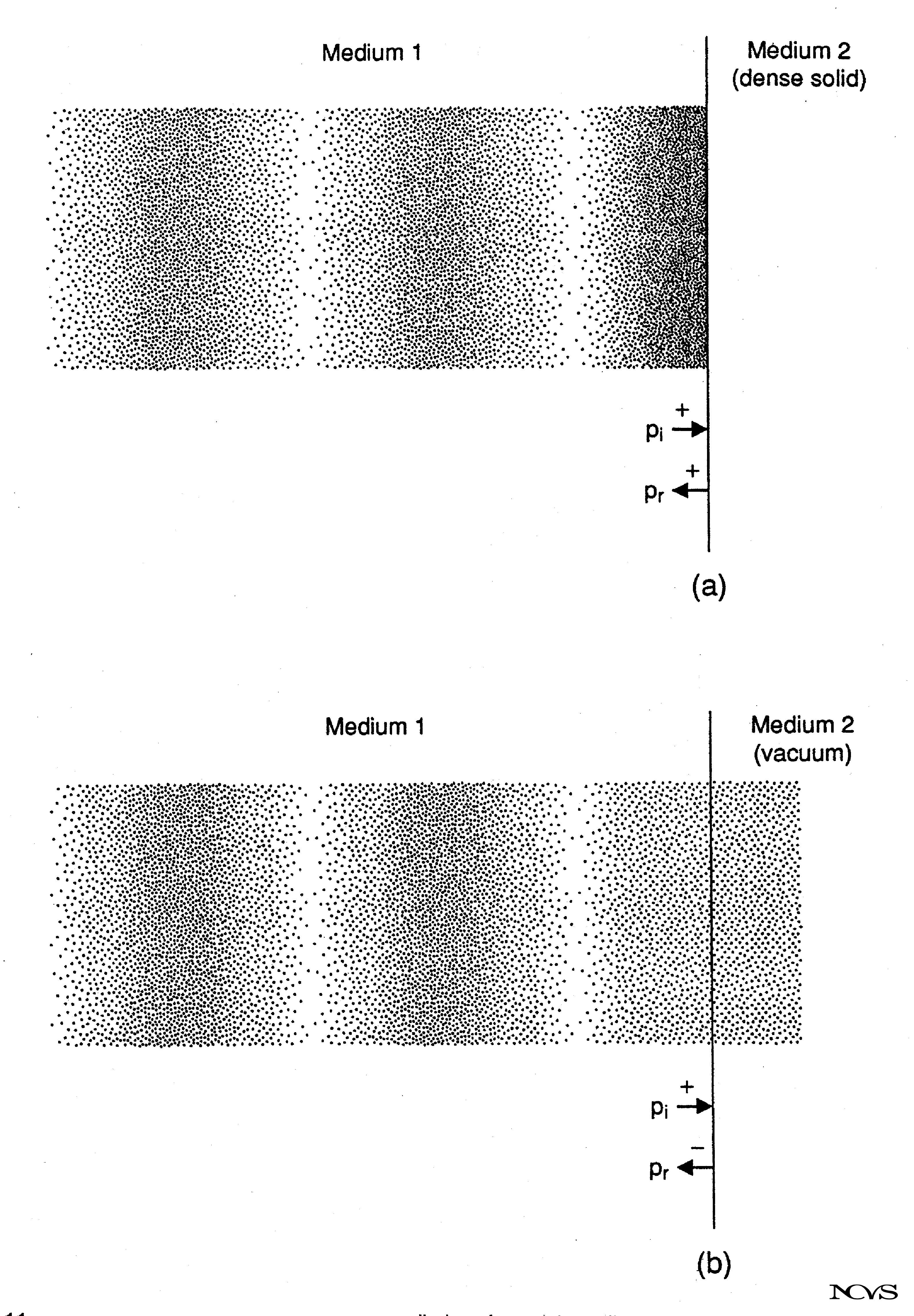 Figure 5.11: Reflection of a plane wave from a media interface: (a) medium 2 as a very dense solid and (b) medium 2 as a vacuum. The density of stipples indicates the magnitude of the acoustic pressure.
At the instant the pressure peak arrives:
- Air particles cannot penetrate the interface
- Particles crowd each other on the left
- Density (and pressure) doubles at the interface
- This additional disturbance generates a backward wave
Pressure relationships:
- Incident pressure: pᵢ
- Reflected pressure: pᵣ = +pᵢ (same magnitude, same polarity)
- Total pressure at interface: p = pᵢ + pᵣ = 2pᵢ
The reflected wave has:
- Same amplitude as incident wave (complete reflection)
- Same polarity (positive → positive)
- Opposite direction (backward propagation)
Key Point: A rigid wall reflects completely with pressure doubling at the interface. The reflected wave has the same polarity as the incident wave.
Open End (Zero Impedance)
Figure 5.11b shows reflection at an interface between air and vacuum (zero impedance).
At the instant the pressure peak arrives:
- Air particles meet no resistance
- Particles quickly spread across the interface
- Excess pressure is immediately depleted
- This creates a sudden rarefaction (negative pressure)
Pressure relationships:
- Incident pressure: pᵢ
- Reflected pressure: pᵣ = -pᵢ (same magnitude, opposite polarity)
- Total pressure at interface: p = pᵢ + pᵣ = 0
The reflected wave has:
- Same amplitude as incident wave (complete reflection)
- Opposite polarity (positive → negative)
- Opposite direction (backward propagation)
Key Point: An open end (zero impedance) reflects completely with pressure nulling at the interface. The reflected wave has opposite polarity to the incident wave. A null medium (vacuum) is as effective in reflecting a wave as a brick wall.
Pressure Continuity
In both extreme cases, the total pressure at the interface (incident plus reflected) equals what the neighboring medium “requires”:
Rigid wall: Requires maximum pressure (particles cannot move)
- Total pressure = 2pᵢ (doubled)
Open end: Requires zero pressure (particles move freely)
- Total pressure = 0 (nulled)
This pressure continuity condition ensures that the interface itself remains continuous—there cannot be a pressure discontinuity at a zero-thickness boundary.
Summary
Acoustic waves reflect at media interfaces due to impedance changes that disturb the propagating pressure pattern. Extreme cases illustrate fundamental principles: rigid walls (infinite impedance) reflect with pressure doubling and preserved polarity, while open ends (zero impedance) reflect with pressure nulling and reversed polarity. In both cases, reflection is complete (no energy transmission), but the phase relationship differs by 180°. The reflected wave combines with the incident wave to satisfy pressure continuity at the interface. Understanding these extreme cases provides the foundation for analyzing partial reflections at finite impedance discontinuities.
Key Takeaways
- ✅ Reflection occurs at impedance discontinuities because they disturb the propagating pressure pattern
- ✅ Rigid walls (infinite impedance) reflect with pressure doubling and same polarity
- ✅ Open ends (zero impedance) reflect with pressure nulling and opposite polarity
- ✅ Both extreme cases produce complete reflection (no energy transmission)
- ✅ Pressure continuity at interfaces determines the relationship between incident and reflected waves
- ✅ A null medium (vacuum) reflects as effectively as a rigid wall, but with opposite phase
- ✅ The reflected wave combines with incident wave to satisfy boundary conditions
Related Topics
Further Reading
- Kinsler, L., & Frey, A. (1962). Fundamentals of Acoustics (2nd ed.). New York: Wiley.
- Morse, P. M. (1947). Vibration and Sound. New York: McGraw-Hill.
- Beranek, L. L. (1954). Acoustics. New York: McGraw-Hill.