Propagation Velocity
The propagation velocity (or speed of sound) is the rate at which acoustic disturbances travel through a medium. This fundamental property depends solely on characteristics of the medium—not on properties of the sound itself such as frequency, amplitude, or waveform shape. Understanding sound velocity is essential for analyzing acoustic wave behavior, including wavelength relationships, reflection phenomena, and timing of acoustic events in the vocal tract.
Definition and Basic Principles
Sound propagation velocity quantifies how rapidly compression and rarefaction patterns travel through a medium.
Conceptual Understanding
When a sound source creates a local pressure disturbance, adjacent particles are displaced, which in turn displace their neighbors, propagating the disturbance outward. The propagation velocity (c) measures how fast this chain reaction proceeds:
Definition: Distance traveled by a wavefront per unit time.
Units: Meters per second (m/s) or centimeters per second (cm/s).
Symbol: Usually denoted as c (from Latin celeritas meaning swiftness) or v.
Typical Value in Air: Approximately 343 m/s (1125 ft/s) at 20°C (68°F) and standard atmospheric pressure.
Independence from Source Characteristics
A critical principle: propagation velocity depends only on the medium, not on the sound itself.
Frequency Independence: High and low frequency sounds travel at the same speed through a given medium (in linear, non-dispersive media like air).
Amplitude Independence: Loud and soft sounds travel at the same speed.
Waveform Independence: Simple and complex waveforms travel at the same speed.
This independence means that once a complex sound is generated, all its frequency components travel together, maintaining temporal relationships and preserving waveform shape during propagation (barring absorption and nonlinear effects).
Clinical Relevance: In acoustic imaging of the vocal folds (ultrasound), sound velocity in tissue determines the relationship between echo timing and tissue depth, enabling measurement of anatomical dimensions.
Physical Determinants of Sound Velocity
Propagation velocity depends on two fundamental properties of the medium: elasticity (resistance to compression) and inertia (mass per unit volume).
The Fundamental Relationship
Sound velocity in a medium is determined by:
c = √(K/ρ)where:
- c = sound velocity (m/s)
- K = bulk modulus (elasticity) (Pa or N/m²)
- ρ = density (mass per unit volume) (kg/m³)
This relationship reveals that:
- Higher elasticity (stiffer medium) → faster sound velocity
- Higher density (more inertia) → slower sound velocity
Elasticity (Bulk Modulus)
The bulk modulus (K) quantifies a material’s resistance to compression:
Definition: Pressure increase required to produce a given fractional volume decrease.
K = -V(ΔP/ΔV)where V is volume, ΔP is pressure change, and ΔV is volume change.
Physical Meaning:
- High K (stiff material): Difficult to compress; small volume change for given pressure
- Low K (compliant material): Easy to compress; large volume change for given pressure
Effect on Sound Velocity: Stiffer media (higher K) transmit pressure disturbances more rapidly because particles are strongly coupled—displacing one particle immediately affects its neighbors.
Examples:
- Solids generally have high bulk modulus → fast sound propagation
- Liquids have moderate bulk modulus → moderate propagation speed
- Gases have low bulk modulus → slower propagation speed
Density (Inertia)
Density (ρ) represents mass per unit volume:
ρ = mass/volume (kg/m³)Physical Meaning:
- High ρ: More mass to accelerate; slower response to forces
- Low ρ: Less mass to accelerate; faster response to forces
Effect on Sound Velocity: Denser media (higher ρ) propagate sound more slowly because greater mass resists acceleration, slowing the transmission of displacement from particle to particle.
Competing Effects: Often, materials with high bulk modulus also have high density. The relative magnitudes determine whether sound travels faster or slower. Generally, the elasticity effect dominates in solids (fast sound despite high density), while density dominates in gases (slow sound despite low elasticity).
Sound Velocity in Different Media
Different physical states and materials exhibit characteristically different sound velocities.
Gases
Air (20°C, standard pressure):
- c ≈ 343 m/s (1125 ft/s)
- Most relevant for speech acoustics
- Relatively slow due to low bulk modulus
Helium:
- c ≈ 965 m/s (2.8 times faster than air)
- Low density despite similar elasticity
- Produces characteristic “squeaky” voice due to shifted formant frequencies
Carbon Dioxide:
- c ≈ 259 m/s (slower than air)
- Higher density and molecular weight
- Lower formant frequencies if inhaled (not recommended)
Oxygen:
- c ≈ 316 m/s (slightly slower than air)
Liquids
Water (20°C):
- c ≈ 1480 m/s (4.3 times faster than air)
- Higher bulk modulus dominates over higher density
- Relevant for studying marine mammal vocalization
Tissue Fluids:
- c ≈ 1500-1600 m/s
- Similar to water (tissues are mostly water)
- Used in ultrasound imaging calculations
Solids
Bone:
- c ≈ 3000-4000 m/s
- High stiffness dominates
- Relevant for bone-conducted hearing
Soft Tissue:
- c ≈ 1540 m/s (average)
- Slightly faster than water
- Critical for ultrasound imaging depth calculations
Steel:
- c ≈ 5000 m/s
- Very high bulk modulus
Rubber:
- c ≈ 50 m/s (quite slow for a solid)
- Low bulk modulus despite solid state
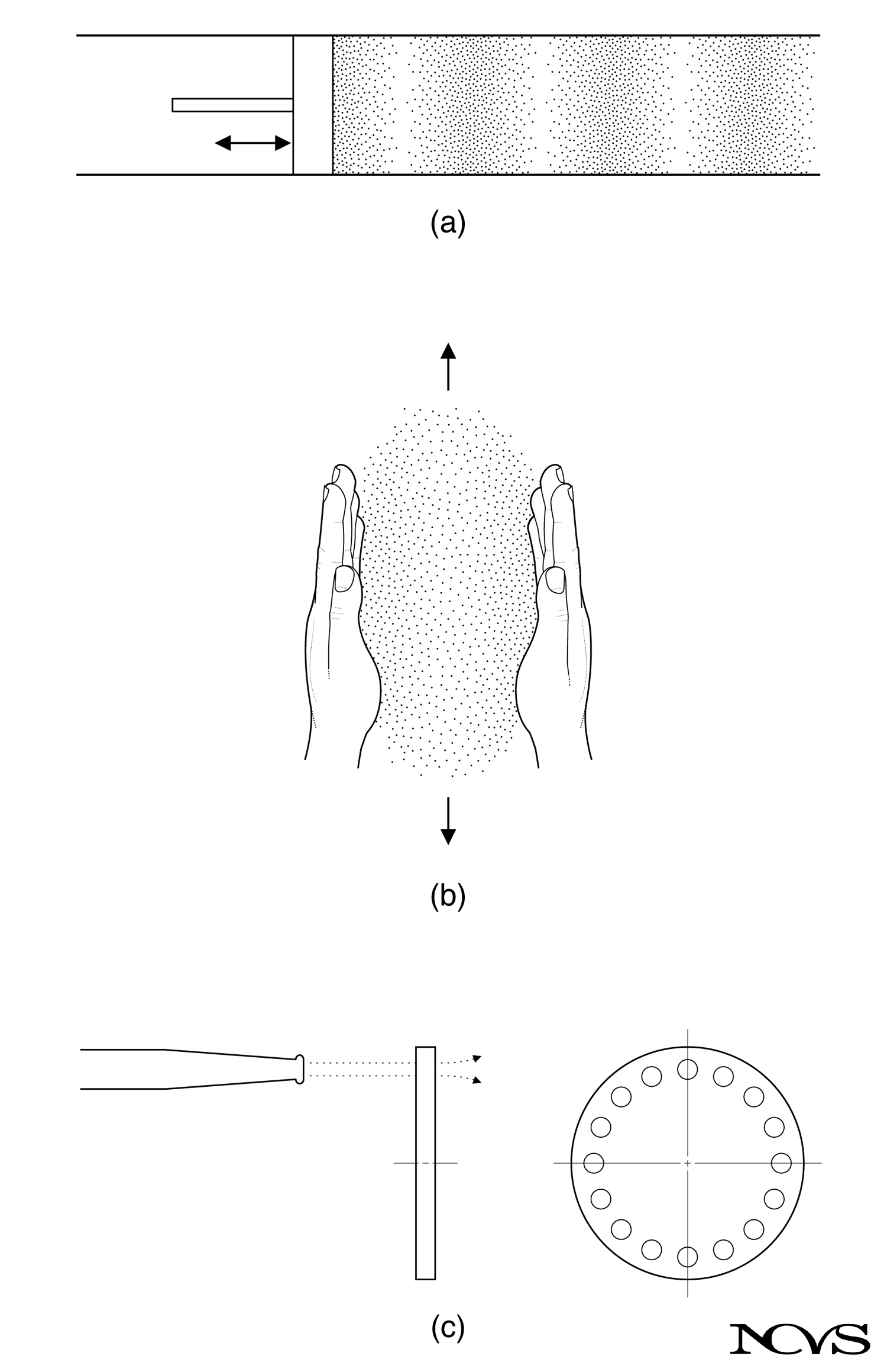 Figure 5.1: Illustration of sound wave propagation showing compression and rarefaction patterns traveling through a medium at velocity c.
Temperature Dependence
In gases, sound velocity depends significantly on temperature.
Temperature Effect in Air
For air, the relationship is approximately:
c = 331.3 + 0.606T m/swhere T is temperature in degrees Celsius.
At 0°C: c ≈ 331 m/s At 20°C: c ≈ 343 m/s (standard reference) At 37°C (body temperature): c ≈ 353 m/s
Rate of Change: Approximately +0.6 m/s per degree Celsius.
Physical Basis
Temperature affects sound velocity through molecular motion:
Higher Temperature:
- Molecules move faster (higher kinetic energy)
- Collisions more frequent and vigorous
- Pressure disturbances propagate more rapidly
- Sound velocity increases
Lower Temperature:
- Reduced molecular motion
- Slower transmission of disturbances
- Sound velocity decreases
Mathematical Relationship: For ideal gases, velocity is proportional to square root of absolute temperature:
c ∝ √T_absolutePractical Implications
Environmental Variation: Outdoor sound propagation speed varies with weather conditions. Summer vs. winter temperature differences can cause ~10% velocity variation.
Refraction Effects: Vertical temperature gradients cause sound rays to curve, affecting long-distance propagation and creating “shadow zones.”
Precision Measurement: Acoustic measurements requiring high accuracy must account for temperature. Laboratory standards specify temperature (typically 20°C or 25°C).
Voice Science: Within the vocal tract (body temperature ~37°C), sound velocity is slightly higher than in room air, affecting resonance frequencies slightly compared to external acoustics.
Implications for Wavelength
Sound velocity directly determines wavelength for a given frequency.
The Velocity-Wavelength-Frequency Relationship
The fundamental relationship connecting these three quantities:
c = λfor equivalently:
λ = c/fwhere:
- c = propagation velocity (m/s)
- λ = wavelength (m)
- f = frequency (Hz)
Interpretation: At higher velocity, the same frequency produces longer wavelength—the spatial distance between pressure peaks increases because peaks travel farther in the time interval between successive peak generations.
Examples in Air (c = 343 m/s)
Low Frequency (f = 100 Hz, typical male F₀):
- λ = 343/100 = 3.43 m (over 11 feet!)
Mid Frequency (f = 500 Hz):
- λ = 343/500 = 0.686 m (about 27 inches)
High Frequency (f = 5000 Hz, upper range of speech):
- λ = 343/5000 = 0.0686 m (about 2.7 inches)
Vocal Tract Length: Adult male ~17 cm, female ~14 cm. At typical F₀ (100-250 Hz), wavelength greatly exceeds vocal tract length, justifying certain acoustic approximations.
Medium Dependence
The same frequency produces different wavelengths in different media:
200 Hz tone:
- In air (c = 343 m/s): λ = 1.72 m
- In water (c = 1480 m/s): λ = 7.40 m (4.3 times longer!)
- In helium (c = 965 m/s): λ = 4.83 m
Frequency remains constant (determined by source), but wavelength adjusts according to local propagation velocity.
Dispersion and Nonlinear Effects
The simple relationship c = √(K/ρ) assumes linear, non-dispersive propagation. Real media may show deviations.
Dispersion
Non-Dispersive Medium: All frequencies travel at same velocity (air, water for normal sound levels).
Dispersive Medium: Different frequencies travel at different velocities, causing waveform distortion during propagation.
Examples of Dispersion:
- Ocean surface waves (gravity waves): longer wavelengths travel faster
- Certain tissue structures at ultrasonic frequencies
- Some viscoelastic materials
Consequence: Complex waveforms containing multiple frequencies gradually change shape as they propagate through dispersive media because components separate temporally.
Air is essentially non-dispersive for audible frequencies, so speech waveforms maintain their shape during propagation (ignoring absorption and reflection effects).
Nonlinear Propagation
At very high intensities, sound propagation becomes nonlinear:
Linear Regime (normal sound levels): c is independent of amplitude and frequency.
Nonlinear Regime (very high intensity):
- Compression phases travel slightly faster than rarefaction phases
- Waveforms progressively distort (steepening)
- Harmonics generated during propagation
- Relevant for intense sound fields (industrial noise, therapeutic ultrasound)
Normal voice production involves linear propagation—sound levels are not high enough to produce nonlinear effects in air.
Clinical and Research Applications
Sound velocity affects various measurement and imaging techniques in voice science.
Acoustic Analysis Timing
Delay Calculations: Time for sound to travel from source to microphone:
delay = distance / cExample: Microphone 1 meter from mouth:
- delay = 1 / 343 ≈ 2.9 ms
For synchronizing audio and video recordings or multiple microphone arrays, propagation delay must be considered.
Ultrasound Imaging
Principle: High-frequency sound pulses (2-20 MHz) reflect from tissue interfaces. Echo delay indicates depth:
depth = (c × time) / 2(Factor of 2 because sound travels to interface and back.)
Standard Assumption: c ≈ 1540 m/s in soft tissue (average).
Accuracy: Velocity varies slightly across tissue types (1450-1650 m/s). Assuming average value introduces small errors (<5%) in depth measurement.
Applications:
- Measuring vocal fold thickness
- Imaging laryngeal cartilages
- Guiding injection procedures
- Assessing tissue properties
Acoustic Pharyngometry and Rhinometry
Acoustic Reflection Technique: Measures cross-sectional area vs. distance along vocal tract or nasal cavity:
Principle: Sound pulses reflect from area discontinuities. Reflection arrival time indicates location:
distance = c × time / 2Requirements: Accurate sound velocity (temperature-corrected) for precise anatomical measurements.
Applications:
- Vocal tract shape during speech
- Airway patency assessment
- Evaluation of surgical outcomes
- Sleep apnea screening
Temperature Correction
All acoustic measurements depending on velocity require temperature correction:
Laboratory Standards: Specify standard temperature (20°C or 25°C).
Field Measurements: Measure ambient temperature and correct velocity:
c_actual = 331.3 + 0.606TPrecision Work: Temperature variations of ±1°C produce velocity variations of ±0.6 m/s (±0.2%), significant for precise measurements.
Propagation Velocity in Voice Production
Within the vocal tract, sound velocity affects resonance and acoustic coupling.
Vocal Tract Resonances (Formants)
Formant Frequencies: Depend on vocal tract shape and sound velocity:
For uniform tube (length L, closed at one end):
F_n = (2n - 1)c / (4L)where n = 1, 2, 3, … (formant number).
Example (L = 17 cm, c = 343 m/s):
- F1 = (1 × 343) / (4 × 0.17) ≈ 504 Hz
- F2 = (3 × 343) / (4 × 0.17) ≈ 1512 Hz
- F3 = (5 × 343) / (4 × 0.17) ≈ 2521 Hz
Temperature Effect: At body temperature (c ≈ 353 m/s), formants are slightly higher (~3%) than calculated using room-temperature velocity.
Helium Speech
Breathing helium mixture increases sound velocity in airways:
Normal Air: c ≈ 343 m/s Heliox (80% He, 20% O₂): c ≈ 850 m/s (2.5× faster)
Effect on Formants: Formant frequencies increase proportionally:
F_helium / F_air = c_helium / c_air ≈ 2.5Perception: Voice sounds “squeaky” or “cartoonish” because formant patterns shift to much higher frequencies, altering vowel quality and overall timbre while F₀ (vocal fold vibration rate) remains unchanged.
Subglottal Tract Coupling
Sound propagation velocity in trachea and bronchi affects subglottal resonances:
Effect on Oscillation: Subglottal resonances can interact with vocal fold oscillation through acoustic-mechanical coupling, potentially affecting F₀ stability and phonation threshold pressure.
Measurement Challenge: Assessing subglottal acoustics requires accounting for propagation velocity in airways with varying cross-sections and wall compliance.
Summary
Propagation velocity is the speed at which acoustic disturbances travel through a medium, determined by the medium’s elasticity (bulk modulus) and density through the relationship c = √(K/ρ). Higher elasticity increases velocity while higher density decreases it. In air at standard conditions (20°C), sound travels at approximately 343 m/s, increasing by about 0.6 m/s per degree Celsius. Sound velocity is independent of frequency, amplitude, and waveform shape in linear, non-dispersive media like air, meaning all components of complex sounds travel together.
Different media exhibit different propagation velocities: gases are slowest (air ~343 m/s, helium ~965 m/s), liquids are intermediate (water ~1480 m/s), and solids are fastest (bone ~3000-4000 m/s, steel ~5000 m/s). The relationship c = λf connects velocity, wavelength, and frequency, determining that higher velocities produce longer wavelengths for the same frequency. In the vocal tract, sound velocity affects formant frequencies and is responsible for the “squeaky” quality of helium speech when elevated velocity shifts formants upward.
Clinical applications requiring accurate sound velocity include ultrasound imaging (using c ≈ 1540 m/s in tissue for depth calculations), acoustic pharyngometry (measuring vocal tract dimensions), and precision acoustic measurements (requiring temperature correction). Understanding propagation velocity is fundamental to analyzing wave phenomena including reflection, wavelength relationships, and resonance in voice production.
Key Takeaways
- ✅ Propagation velocity c = √(K/ρ) depends only on medium properties (elasticity and density), not sound characteristics
- ✅ In air at 20°C, sound travels at approximately 343 m/s, increasing by ~0.6 m/s per degree Celsius
- ✅ All frequencies travel at the same speed in non-dispersive media like air, preserving waveform shape during propagation
- ✅ Different media have different velocities: gases slowest (~343 m/s), liquids intermediate (~1480 m/s), solids fastest (~3000-5000 m/s)
- ✅ The relationship c = λf determines that wavelength is proportional to velocity for constant frequency
- ✅ Helium speech demonstrates velocity effects: higher c shifts formants upward, creating “squeaky” quality
- ✅ Clinical applications require accurate velocity values: ultrasound imaging uses c ≈ 1540 m/s in tissue for depth calculation
Related Topics
Further Reading
- Kinsler, L. E., Frey, A. R., Coppens, A. B., & Sanders, J. V. (2000). Fundamentals of Acoustics (4th ed.). New York: John Wiley & Sons.
- Rossing, T. D., Moore, F. R., & Wheeler, P. A. (2002). The Science of Sound (3rd ed.). San Francisco: Addison Wesley.
- Pierce, A. D. (1989). Acoustics: An Introduction to Its Physical Principles and Applications. New York: Acoustical Society of America.
- Titze, I. R. (2000). Principles of Voice Production (2nd ed.). Iowa City: National Center for Voice and Speech.
- Beranek, L. L. (1986). Acoustics. New York: American Institute of Physics.