Propagation of Sound
It was suggested earlier that local pressure disturbances in a medium are propagated away from the source as waves. This requires local mechanical instability, analogous to the fall of a domino against its nearest neighbor. Understanding wave propagation is essential for analyzing how sound travels through the vocal tract and radiates to listeners.
Wave Propagation Mechanism
Wave propagation is based on local oscillations in an elastic medium. Consider a row of masses and springs representing the elastic and inertial elements of the medium. Each successive snapshot shows the wave at a later time instant.
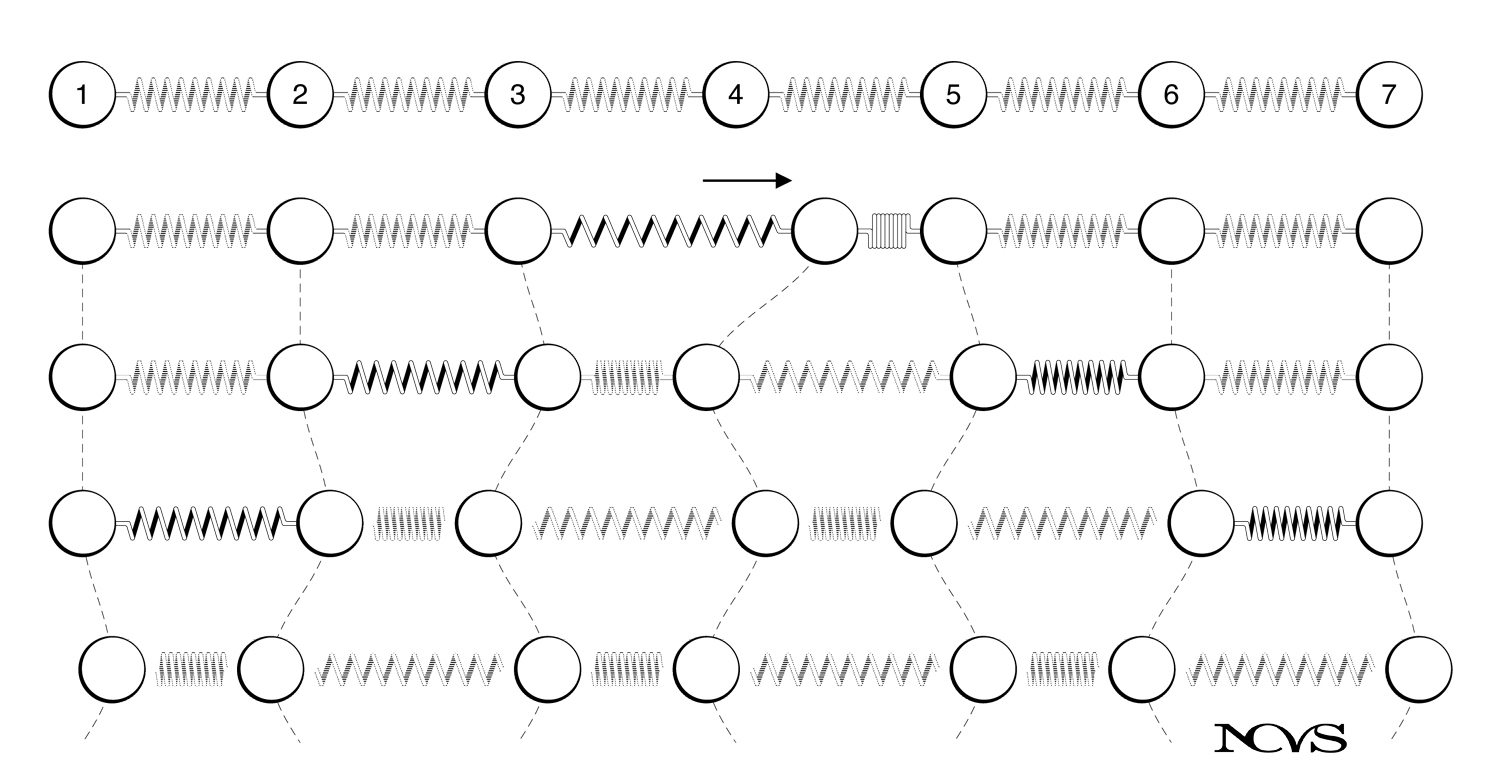 Figure 5.7: Propagation of a longitudinal wave in an elastic medium idealized by a row of masses and springs. Each new row indicates a later value of time.
Step-by-Step Propagation
Initial Disturbance (Row 2):
- Mass 4 is disturbed from equilibrium by an external source
- This initiates propagation of elastic waves in both directions
- Spring between masses 4 and 5 is compressed
- Spring between masses 3 and 4 is expanded
- (In acoustical terms: condensation and rarefaction)
Energy Transfer (Row 3):
- Springs on both sides of mass 4 have absorbed energy
- They now impart this energy to neighboring masses
- Mass 5 is pushed to the right
- Mass 3 is pulled to the right
- Mass 4 receives both push and pull to the left
Overshooting (Row 4):
- Mass 4 overshoots equilibrium position
- After elapsed time, it disturbs neighbors in opposite direction
- Meanwhile, masses 5 and 3 have affected their neighbors
- Compression wave propagates to the right
- Rarefaction wave propagates to the left
Key Principle
The “passing along” of pressure disturbances by the medium is called sound propagation. Note that:
- Individual particles do not travel with the wave
- Only the disturbance (compression or rarefaction) propagates
- Particle motion remains local and oscillatory
- Energy is transmitted through the medium
 Figure 5.6: Wave propagation results from a local disturbance that is transmitted to a neighbor. The dominos do not travel, only the disturbance does.
Propagation Velocity
An obvious question is: what governs the speed of this propagation of elastic (or acoustic) waves? As with simple oscillators discussed in Chapter 4, the speed depends on the inertial and elastic properties of the system.
General Relationship
For all types of media (gases, liquids, solids):
$$c \propto \sqrt{\frac{\text{elastic modulus}}{\text{inertial modulus}}}$$
This means:
- Stiffer medium → Faster propagation
- Denser medium → Slower propagation
The natural frequency of a mass-spring oscillator follows a similar pattern, being proportional to the square root of the stiffness-to-mass ratio.
Sound Velocity in Air
For acoustic waves in air, the stiffness (elasticity) results from the internal pressure in the gas. Imagine squeezing a balloon filled with air:
- Greater internal pressure → More difficult to deform
- Greater internal pressure → Quicker return to undeformed state
Pressure-Density Formulation
The propagation velocity can be written as:
$$c = \sqrt{\frac{\gamma P}{\rho}}$$
where:
- c = speed of sound
- γ (gamma) = adiabatic constant for air (≈ 1.4)
- P = atmospheric pressure
- ρ (rho) = air density
Temperature Dependence
One of the most important relations in kinetic theory of gases is that pressure is directly proportional to temperature but inversely proportional to volume. If volume is conserved locally, the sound propagation velocity becomes:
$$c = \sqrt{\gamma R T}$$
where:
- γ and R = constants
- T = absolute temperature in °K (degrees Kelvin)
Practical Values
At 0°C (273 K):
- c ≈ 331 m/s
At room temperature (20°C, 293 K)—the usual reference value:
- c ≈ 343 m/s
In the warm, humid vocal tract (37°C, 310 K):
- c ≈ 350 m/s (humidity adds a little to the temperature effect)
The differences are modest because c depends on the square root of absolute temperature, and everyday temperatures span only a small fraction of the absolute scale. For example:
- 0°C = 273 K; 37°C = 310 K
- Ratio of absolute temperatures: 310/273 ≈ 1.135
- Ratio of velocities: √1.135 ≈ 1.065, i.e. only about 6.5% faster in the vocal tract than in freezing air
The Helium Demonstration
An interesting experimental verification of the velocity equation involves inhaling helium and attempting to speak normally. Since helium density is much less than air density:
$$\rho_{\text{helium}} \ll \rho_{\text{air}}$$
From the equation $c = \sqrt{\gamma P/\rho}$, decreased density predicts increased sound velocity. This increase raises the resonance frequencies characterizing vowels and consonants in speech, giving rise to the characteristic “Donald Duck-like quacking sound.”
Safety Note: The helium demonstration should only be performed with proper supervision and medical-grade helium. Never use pure helium from party balloons, which can cause asphyxiation. Always ensure adequate oxygen intake.
Medium Property Effects
The dependence of propagation velocity on medium properties has several important implications:
Density Effects
Less dense media → Faster propagation:
- Helium: ~965 m/s (about 2.8 times faster than air)
- Hydrogen: ~1,270 m/s (fastest for gases)
More dense media → Slower propagation (for gases):
- Carbon dioxide: ~259 m/s
- Sulfur hexafluoride: ~133 m/s (produces deep voice effect)
Stiffness (Elasticity) Effects
For liquids and solids, high stiffness dominates:
Water:
- Very high bulk modulus (stiffness)
- c ≈ 1,480 m/s (about 4.3 times faster than air)
Solid tissues:
- Even higher stiffness
- c ≈ 1,500-1,600 m/s in soft tissues
- c ≈ 3,000-4,000 m/s in bone
Clinical Implications
Understanding propagation velocity is important for:
- Ultrasound imaging: Assumes constant velocity in tissue
- Acoustic impedance: Depends on density and velocity (z = ρc)
- Vocal tract length estimation: Must account for warm, humid air
- Time-of-flight measurements: Converting time delays to distances
Summary
Sound propagates through media via transmission of local pressure disturbances from particle to particle without bulk motion of the medium. The propagation velocity depends on the square root of the elastic-to-inertial property ratio, with stiffer media propagating sound faster and denser media propagating it more slowly. For air, velocity depends primarily on temperature, reaching approximately 343 m/s at standard conditions and 350 m/s in the warm vocal tract. The helium demonstration—producing comically high-pitched speech—experimentally confirms the inverse relationship between density and propagation velocity.
Key Takeaways
- ✅ Sound propagation involves transmission of pressure disturbances, not bulk motion of particles
- ✅ Propagation velocity depends on medium elasticity (stiffness) and inertia (density): $c \propto \sqrt{\text{elastic}/\text{inertial}}$
- ✅ In air, sound velocity is approximately 331 m/s at 0°C, 343 m/s at 20°C, and about 350 m/s in the warm vocal tract
- ✅ Sound velocity increases with temperature because pressure increases with temperature
- ✅ Helium’s lower density produces faster sound propagation, raising vocal tract resonances
- ✅ Individual particles oscillate locally; only the disturbance pattern propagates through space
- ✅ Wave impedance (z = ρc) relates pressure to particle velocity in propagating waves
Related Topics
Further Reading
- Kinsler, L., & Frey, A. (1962). Fundamentals of Acoustics (2nd ed.). New York: Wiley.
- Morse, P. M. (1947). Vibration and Sound. New York: McGraw-Hill.
- Rossing, T. D. (1982). The Science of Sound. Reading, MA: Addison-Wesley.