Some Anatomical Terminology
Before exploring the specific structures of the larynx, it is essential to establish a common vocabulary for describing anatomical locations and relationships. Anatomy, the science of structure in plants and animals, requires precise terminology to locate and describe biological components. Unlike geometry, which uses a single origin point and coordinates, vertebrate anatomy uses landmarks and directional terms relative to the body itself.
Directional Terms
In vertebrate anatomy, certain landmarks—such as the head, tail, or spine—serve as reference points. The following directional terms are fundamental for describing laryngeal anatomy:
Primary Directions:
- Caudal: toward the tail
- Rostral: toward the mouth (beak)
- Ventral: toward the belly
- Dorsal: toward the back
Positional Terms in Upright (Erect) Position:
- Anterior: toward the front
- Posterior: toward the back
- Superior: above
- Inferior: below
- Medial (or mesial): toward a center midline or midplane (such as the frontal or sagittal planes)
- Lateral: toward the outside (away from a midline or midplane)
Planes of Reference
Three standard planes divide the body for anatomical description:
Frontal (Coronal) Plane: Divides the body into anterior (front) and posterior (back) portions. This plane is perpendicular to the ground when standing upright.
Transverse Plane: Divides the body into superior (upper) and inferior (lower) portions. This plane is parallel to the ground when standing upright.
Sagittal Plane: Divides the body into left and right portions. The midsagittal plane passes through the midline, creating equal halves.
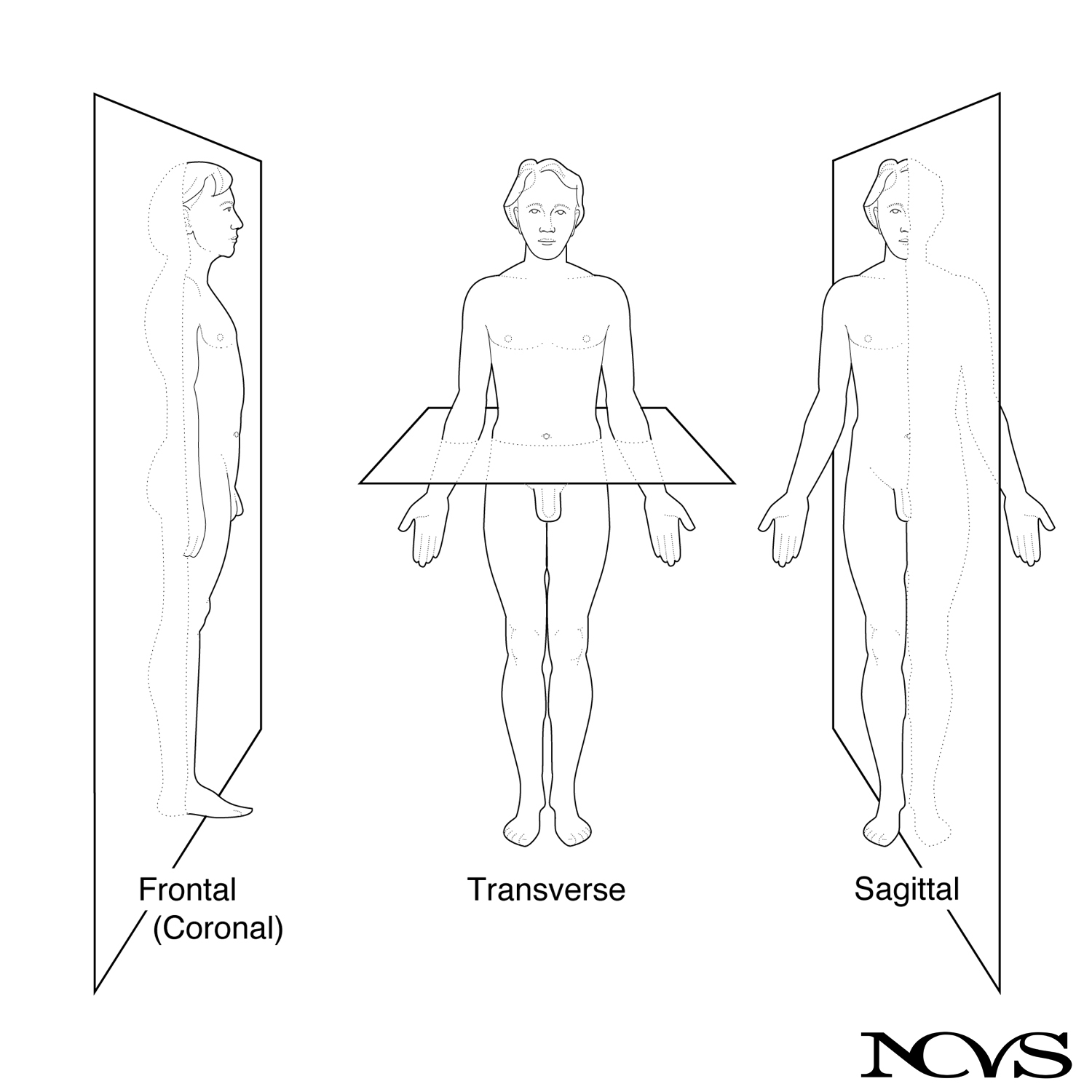 Figure 1.2: Frontal (coronal), transverse, and sagittal planes for identifying anatomical sections of the human body.
These planes provide standardized perspectives for viewing and describing anatomical structures. In laryngeal anatomy, coronal sections are particularly useful for examining the layered structure of the vocal folds, while sagittal sections reveal the airway pathway and cartilage relationships.
Glottal Reference Points
In speech anatomy, an important landmark is the air space between the vocal folds, called the glottis. This reference point defines two critical regions:
- Subglottal: below the glottis (includes the trachea and lungs)
- Supraglottal: above the glottis (includes the pharynx, oral cavity, and nasal cavity)
The distinction between subglottal and supraglottal regions is fundamental to understanding voice production. Subglottal pressure drives vocal fold vibration, while supraglottal structures shape the acoustic output into recognizable speech sounds.
Directional Terms Based on Tissue Orientation
Sometimes directions are established with respect to tissue fiber orientations or fluid flow in airways. Two important terms in this context are:
- Longitudinal: in the direction of the fibers or flow
- Transverse: perpendicular to the fibers or flow
These terms are particularly relevant when discussing vocal fold tissue mechanics and airflow dynamics through the larynx.
Naming Conventions for Muscles and Ligaments
Body tissues are often labeled according to their points of origin and points of insertion. For example, the cricothyroid muscle begins at the cricoid cartilage and ends at the thyroid cartilage. This naming convention immediately conveys which structures are connected and suggests the muscle’s mechanical action.
Understanding these anatomical origins and insertions helps predict muscle function—if a muscle connects two cartilages, its contraction will either bring those structures together or rotate them relative to each other.
Summary
Anatomical terminology provides a precise, universal language for describing the larynx and its components. Directional terms like anterior, posterior, superior, and inferior establish spatial relationships. The three anatomical planes—frontal, transverse, and sagittal—offer standardized perspectives for viewing structures. The glottis serves as a critical reference point dividing subglottal from supraglottal regions.
This nomenclature is not merely academic jargon; it is essential for clinical communication, research documentation, and pedagogical clarity. When a voice clinician describes a “superior cornu of the thyroid cartilage” or a researcher discusses “longitudinal tension in the vocal folds,” these terms convey specific, unambiguous meanings to other professionals.
Key Takeaways
- ✅ Anatomical directions are relative to body landmarks, not absolute coordinates
- ✅ The frontal, transverse, and sagittal planes provide standardized viewing perspectives
- ✅ The glottis divides the vocal tract into subglottal and supraglottal regions
- ✅ Muscles and ligaments are often named for their origin and insertion points
- ✅ Longitudinal and transverse directions describe tissue fiber orientation and airflow
- ✅ Consistent terminology enables precise communication among voice professionals
Related Topics
Further Reading
- Gates, H. A. (1955). Primary anatomy (3rd ed.). Baltimore: Williams & Wilkins.
- Zemlin, W. R. (1964). Speech and hearing science: Anatomy and physiology. Stipes Publishing Co.
- Dickson, D. R., & Maue-Dickson, W. (1982). Anatomical and physiological bases of speech. Boston: Little, Brown.
- Palmer, J. M. (1984). Anatomy for speech and hearing (3rd ed.). Harper & Row.