Hypothesis Two: Maximum Active Thyroarytenoid Stress
The maximum active thyroarytenoid (TA) stress hypothesis proposes that involuntary register transitions occur when the mechanical stress within the contracted thyroarytenoid muscle reaches a physiological limit, typically around 350-500 Hz, beyond which the muscle cannot maintain sufficient activity to support modal register vibration, necessitating transition to falsetto register where TA involvement is minimal. This biomechanical explanation, rooted in muscle physiology and tissue mechanics, complements the subglottal resonance hypothesis by addressing different aspects of register transition phenomena and provides a mechanistic framework for understanding the secondo passaggio and the fundamental distinction between modal and falsetto vibratory modes.
Thyroarytenoid Muscle Biomechanics
Understanding the TA stress hypothesis requires examining the structural and mechanical properties of the thyroarytenoid muscle.
Anatomical Structure
Muscle Configuration
The thyroarytenoid muscle:
- Extends from thyroid cartilage to arytenoid cartilage
- Forms the body of the vocal fold
- Two functional divisions: thyromuscularis and thyrovocalis
- Fibers oriented parallel to vocal fold length
- Embedded within layered tissue structure
- Integral to vocal fold mass and stiffness
Attachments and Force Transmission
Mechanical connections:
- Anterior: thyroid cartilage inner surface
- Posterior: vocal process of arytenoid
- Lateral: continuous with lateral cricoarytenoid
- Medial: vocal ligament and epithelium (cover)
- Length approximately 10-20 mm (varies by individual)
- Cross-sectional area small (~5-10 mm²)
Stress and Strain in Muscle Tissue
Mechanical Definitions
Key biomechanical concepts:
- Stress (σ) = force / cross-sectional area (N/m² or Pa)
- Strain (ε) = change in length / original length (dimensionless)
- Young’s modulus (E) = stress / strain (Pa)
- Active stress: generated by muscle contraction
- Passive stress: from tissue stretch
- Total stress: active + passive components
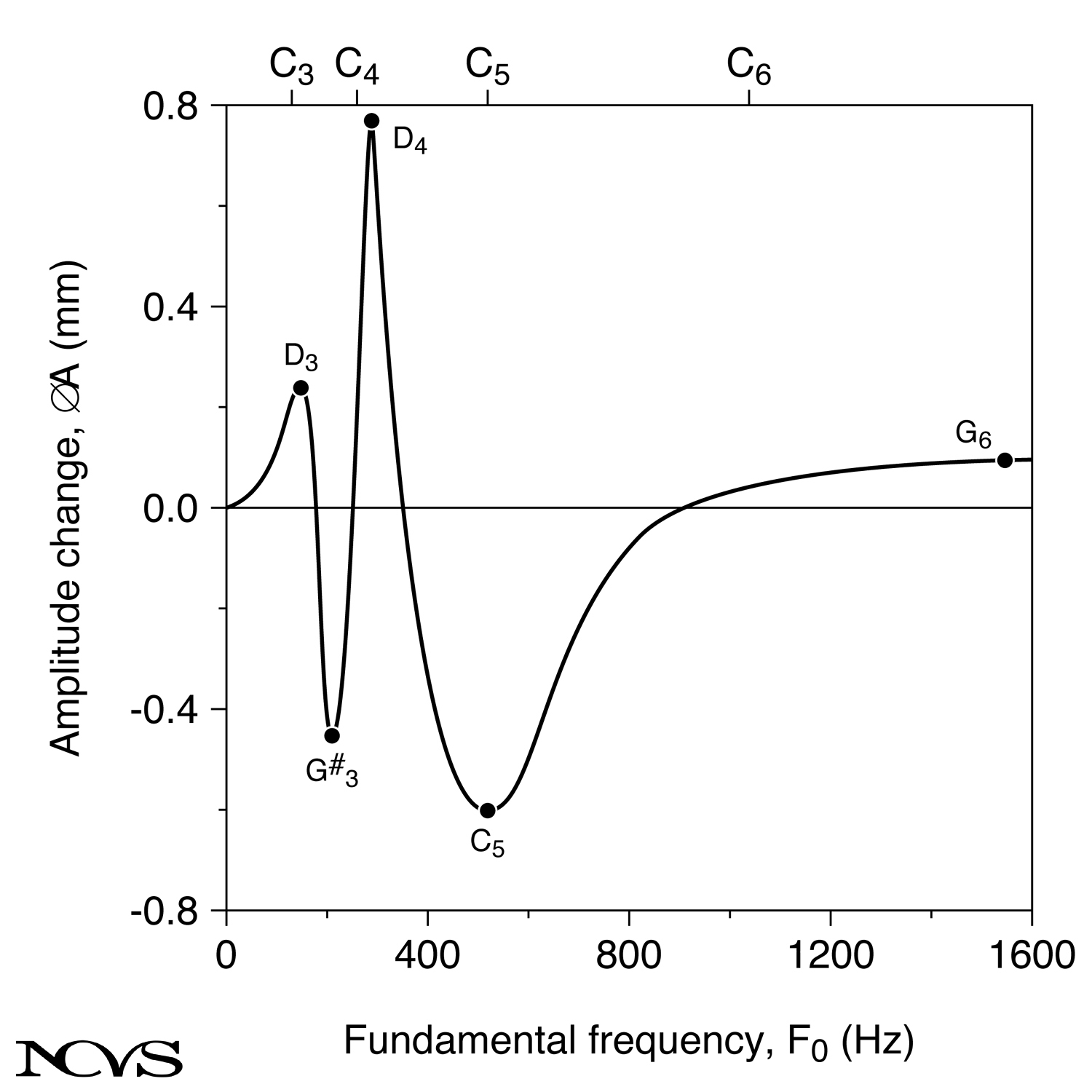 Figure 10.10: Diagram illustrating stress-strain relationships in the thyroarytenoid muscle showing how increasing fundamental frequency requires greater muscle stress to resist cricothyroid elongation, with maximum active stress limiting achievable tension in modal register.
Muscle Activation and Stress
TA muscle mechanics:
- Contraction generates active stress
- Opposes elongation by cricothyroid muscle
- Maximum active stress ~100-300 kPa (varies by muscle)
- Depends on sarcomere length (length-tension relationship)
- Activation level controls stress magnitude
- Individual variation in maximum stress capacity
The Stress Limitation Mechanism
The hypothesis proposes that register transitions occur when TA stress reaches physiological limits.
Cricothyroid-Thyroarytenoid Antagonism
Force Balance
Pitch control involves:
- Cricothyroid (CT) lengthens and tenses vocal folds
- Thyroarytenoid (TA) resists elongation and adds bulk
- Modal register: both muscles highly active
- Force balance determines vocal fold length and tension
- Higher F₀: CT dominates, elongating folds
- TA must generate increasing stress to maintain activation
Modal Register Constraint
In modal register:
- TA body must participate in vibration
- Requires substantial TA activation
- As F₀ increases, CT progressively elongates folds
- TA stretched while contracting (eccentric contraction)
- Stress within TA increases
- Eventually reaches maximum stress capacity
- Further elongation impossible while maintaining activation
Transition Threshold
Critical Frequency
Maximum TA stress predicts:
- Transition frequency where stress limit reached
- Depends on individual muscle strength
- Typical range: 350-500 Hz for trained males
- 400-600 Hz for trained females
- Corresponds to secondo passaggio region
- Individual variation based on muscle properties
Post-Transition Configuration
Beyond stress limit:
- TA cannot maintain high activation
- Muscle relaxes or reduces activity dramatically
- Falsetto register becomes necessary
- CT can further elongate without TA opposition
- Cover-only vibration mode
- Higher F₀ accessible but different quality
Length-Tension Relationship
Muscle Physiology Principles
Sarcomere mechanics:
- Optimal length for maximum force generation
- Too short: actin filament overlap excessive
- Too long: actin-myosin overlap reduced
- Active force decreases at extremes
- TA experiences progressive elongation with F₀
- Eventually reaches unfavorable length
Implications for Register
At extreme elongation:
- TA cannot generate maximum stress
- Even full neural activation insufficient
- Physiological limitation, not voluntary
- Training may extend range slightly
- But fundamental limit exists
- Explains involuntary nature of secondo passaggio
Evidence Supporting the Hypothesis
Multiple lines of evidence support the TA stress limitation mechanism.
Electromyography Studies
Muscle Activation Patterns
EMG research shows:
- TA activity increases with F₀ in modal register
- Peak TA activity occurs just before register transition
- Abrupt decrease in TA activity at transition
- Falsetto shows minimal TA activation
- Pattern consistent across individuals
- Timing correlates with secondo passaggio
Critical Threshold
Observations include:
- Maximum TA activation reached at transition
- Cannot increase further despite effort
- Suggests physiological limit
- Individual variation in threshold frequency
- Training affects threshold to some degree
- But limit consistently observed
High-Speed Imaging
Vibrational Pattern Changes
Videokymography and high-speed video reveal:
- Modal register: full-body vibration
- Thick, short vocal fold configuration
- Substantial vertical phase difference
- Transition point: abrupt change
- Falsetto: cover-only vibration
- Thin, elongated configuration
Body-Cover Decoupling
Imaging demonstrates:
- TA body stops vibrating at transition
- Only epithelium and superficial layer vibrate
- Consistent with TA relaxation
- Cannot be voluntary control alone
- Biomechanical explanation needed
- TA stress hypothesis provides framework
Correlation with Voice Classification
Systematic Variation
Secondo passaggio locations:
- Bass: E4-F4 (~330-350 Hz)
- Baritone: F4-G4 (~350-390 Hz)
- Tenor: G4-A4 (~390-440 Hz)
- Alto: A4-B4 (~440-495 Hz)
- Soprano: B4-C5 (~495-523 Hz)
Anatomical Explanation
Variation correlates with:
- Vocal fold length (longer folds: lower transition)
- TA muscle size (larger muscle: potentially higher limit)
- Individual biomechanical properties
- Systematic with voice type
- Consistent with stress hypothesis predictions
- Individual differences within classifications
Relationship to Body-Cover Theory
The TA stress hypothesis integrates with body-cover model of vocal fold vibration.
Body-Cover Vibration Modes
Modal Register
Body-cover coupling in modal:
- Active TA shortens, thickens vocal fold
- Body (TA) and cover vibrate together
- Strong mechanical coupling
- Requires TA activation
- Limits achievable F₀
- Rich spectral content
Falsetto Register
Body-cover decoupling in falsetto:
- Minimal TA activation allows extreme elongation
- Cover relatively independent
- Only cover vibrates significantly
- CT can lengthen without TA opposition
- Higher F₀ possible
- Reduced spectral content
Transition as Biomechanical Necessity
Forced Shift
Register transition represents:
- Biomechanical solution to conflicting demands
- Cannot maintain modal register beyond stress limit
- Falsetto enables higher frequencies
- Different vibratory mode
- Not merely acoustic choice
- Physiological constraint
Comparison with Subglottal Resonance Hypothesis
The two hypotheses address different aspects of register phenomena.
Complementary Mechanisms
Primo vs. Secondo Passaggio
Possible interpretation:
- Subglottal resonance: primarily affects primo passaggio
- TA stress limit: primarily affects secondo passaggio
- Different frequencies involved
- Both mechanisms may operate
- Explains two transition zones
- Individual factors determine dominance
Different Registers
Alternative view:
- Multiple modal-falsetto boundaries exist
- Primo: first difficulty maintaining modal
- Secondo: absolute limit of modal register
- Both involve TA activation challenges
- Resonance modulates difficulty
- Stress limit imposes absolute ceiling
- Training affects both but cannot eliminate
Integrative Model
Combined Framework
Comprehensive understanding:
- Multiple factors contribute to register transitions
- Subglottal resonance creates instability zones
- TA stress limit imposes upper frequency boundary
- Glottal configuration affects spectral slope
- Acoustic feedback influences stability
- Individual anatomy determines specifics
- Training optimizes all factors
Individual Differences and Training
Both genetic factors and training influence TA stress limits.
Anatomical Variation
Sources of Individual Differences
Factors affecting stress limit:
- TA muscle cross-sectional area
- Fiber type composition (fast vs. slow twitch)
- Muscle length and architecture
- Vocal fold length and mass
- Cartilage dimensions
- Connective tissue properties
Voice Classification Implications
Systematic differences:
- Tenors: may have relatively stronger TA for their size
- Basses: larger overall structures, lower stress limits
- Sopranos: shorter folds, higher stress limits
- Individual variation within classifications
- Explains passaggio variability
- Genetic component significant
Effects of Training
Muscle Conditioning
Voice training may:
- Increase muscle strength (higher stress capacity)
- Improve coordination (more efficient use of stress)
- Extend usable range within register
- Delay transition frequency somewhat
- Develop mixed voice through partial TA activation
- Cannot fundamentally overcome physiological limits
Technical Strategies
Skilled singers:
- Optimize CT-TA balance
- Use minimal necessary TA activation
- Develop efficient vibratory patterns
- Mix registers to span transition zone
- Cannot eliminate secondo passaggio entirely
- Manage rather than eliminate transition
Clinical Implications
Understanding TA stress limitations informs assessment and treatment.
Diagnosis
Identifying TA-Related Register Issues
Clinical evaluation:
- Map secondo passaggio location
- Assess TA activation capacity (if EMG available)
- Test maximum frequency in modal register
- Compare to expected values for voice type
- Identify premature transition (hypofunctional)
- Identify excessive tension (hyperfunctional)
Disorders Affecting TA Function
Muscle Weakness
Hypofunctional conditions:
- Neurological disorders affecting TA
- Aging-related muscle atrophy
- Post-paralysis recovery
- Lower stress capacity
- Premature register transition
- Reduced modal register range
Excessive Tension
Hyperfunctional patterns:
- Excessive TA activation throughout range
- Premature stress limit
- Early secondo passaggio
- Difficulty accessing falsetto
- Vocal fatigue
- Treatment: reducing excess tension
Therapeutic Approaches
Strengthening TA Function
For hypofunctional voice:
- Vocal function exercises
- Emphasizing modal register use
- Progressive range extension
- Resistance training concepts
- Improving neural activation
- Realistic goals based on physiology
Optimizing TA Use
For hyperfunctional voice:
- Reducing excessive activation
- Efficient CT-TA balance
- Appropriate register use across range
- Mixed voice development
- Relaxation strategies
- Preventing premature stress limit
Limitations and Ongoing Research
The TA stress hypothesis, while compelling, has limitations requiring further investigation.
Measurement Challenges
Direct Evidence Difficult
Research obstacles:
- Cannot directly measure muscle stress in vivo
- Biomechanical models require assumptions
- EMG measures activation, not stress
- Imaging shows consequences, not forces
- Individual muscle properties variable
- Validation complex
Alternative Interpretations
Voluntary vs. Involuntary
Questions remain:
- How much is physiological limit vs. learned pattern?
- Role of training in modifying “limits”
- Exceptional singers who seem to transcend limits
- Voluntary falsetto production at any frequency
- Interaction between mechanisms unclear
- Need for refined theoretical framework
Future Directions
Research Needs
Areas for investigation:
- Biomechanical modeling with individual anatomy
- Longitudinal training studies
- Genetic studies of muscle properties
- Advanced imaging techniques
- Integration with acoustic models
- Clinical applications refinement
Summary
The maximum active thyroarytenoid stress hypothesis proposes that involuntary register transitions, particularly the secondo passaggio, occur when mechanical stress within the contracted TA muscle reaches physiological limits (typically 350-500 Hz in males, 400-600 Hz in females), preventing further maintenance of modal register vibration and necessitating transition to falsetto register with minimal TA involvement. The thyroarytenoid muscle experiences increasing stress as cricothyroid-driven elongation progresses with rising fundamental frequency, while TA must remain contracted to maintain body-cover coupling essential for modal register vibration; this antagonistic relationship creates eccentric muscle contraction conditions where active stress eventually reaches maximum capacity determined by cross-sectional area, fiber properties, and length-tension relationships.
Supporting evidence includes electromyography studies showing peak TA activation immediately before register transition followed by abrupt activity decrease in falsetto, high-speed imaging demonstrating body-cover decoupling at transition points, and systematic correlation between secondo passaggio frequencies and voice classifications reflecting underlying anatomical differences in vocal fold length and TA muscle properties. The hypothesis integrates with body-cover theory by explaining why modal register (body-cover coupled vibration) has frequency limits while falsetto (cover-only vibration) enables higher frequencies through minimal TA activation, and complements the subglottal resonance hypothesis by potentially addressing different passaggio zones (secondo vs. primo) through distinct mechanisms.
Individual differences in TA stress limits arise from anatomical variation in muscle cross-sectional area, fiber type composition, vocal fold dimensions, and connective tissue properties, systematically varying with voice classification and contributing to passaggio location variability. Training may increase stress capacity through muscle conditioning, improve coordination efficiency, and develop mixed voice through partial TA activation strategies, but cannot fundamentally overcome physiological stress limitations. Clinical implications include assessment strategies mapping secondo passaggio locations relative to expected values, identification of TA-related dysfunction (hypofunctional premature transition, hyperfunctional excessive tension), and therapeutic approaches emphasizing strengthening for weak TA, tension optimization for hyperfunctional patterns, and realistic goals acknowledging biomechanical constraints.
Key Takeaways
- ✅ TA stress hypothesis proposes register transitions occur when thyroarytenoid muscle stress reaches physiological limit (350-500 Hz typical)
- ✅ CT-TA antagonism creates increasing TA stress with rising F₀; maximum stress capacity limits modal register frequency range
- ✅ EMG evidence shows peak TA activation before transition, abrupt decrease in falsetto; imaging confirms body-cover decoupling
- ✅ Secondo passaggio correlates systematically with voice type, reflecting anatomical differences in vocal fold length and TA properties
- ✅ Hypothesis integrates with body-cover theory: modal requires TA activation for coupling; falsetto enables higher F₀ without TA involvement
- ✅ Complements subglottal resonance hypothesis by potentially addressing different passaggio zones through distinct mechanisms
- ✅ Individual variation based on TA cross-sectional area, fiber composition, and length-tension properties; training extends but doesn’t eliminate limits
- ✅ Clinical applications include mapping passaggi, identifying TA dysfunction, strengthening weak muscles, optimizing tension patterns
Related Topics
- Involuntary Register Transitions: Two Hypotheses
- Hypothesis One: Subglottal Resonances
- The Modal-Falsetto Transition
- Body-Cover Theory
- Vocal Fold Tissue Properties
Further Reading
- Titze, I. R., & Story, B. H. (2002). Rules for controlling low-dimensional vocal fold models with muscle activation. Journal of the Acoustical Society of America, 112(3), 1064-1076.
- Hirano, M. (1988). Vocal mechanisms in singing: Laryngological and phoniatric aspects. Journal of Voice, 2(1), 51-69.
- Kochis-Jennings, K. A., Finnegan, E. M., Hoffman, H. T., & Jaiswal, S. (2012). Laryngeal muscle activity and vocal fold adduction during chest, chestmix, headmix, and head registers in females. Journal of Voice, 26(2), 182-193.
- Roubeau, B., Henrich, N., & Castellengo, M. (2009). Laryngeal vibratory mechanisms: The notion of vocal register revisited. Journal of Voice, 23(4), 425-438.
- Hunter, E. J., & Titze, I. R. (2005). Quantifying vocal fatigue recovery: Dynamic vocal recovery trajectories after a vocal loading exercise. Annals of Otology, Rhinology & Laryngology, 114(12), 909-916.