The Modal-Falsetto Transition
The transition between modal and falsetto registers represents one of the most challenging aspects of vocal technique and a defining characteristic of voice classification. Unlike the pulse-modal transition driven by temporal discontinuity at a relatively invariant frequency, the modal-falsetto transition depends on spectral slope changes resulting from alterations in vocal fold vibratory patterns, typically occurring within passaggio zones that vary systematically with voice type. Understanding this transition requires integrating body-cover theory, acoustic analysis, and perceptual processing mechanisms, with profound implications for vocal pedagogy and the development of mixed voice quality in classical singing.
Characteristics of Modal and Falsetto Registers
The two registers exhibit fundamentally different vibratory patterns and acoustic consequences.
Modal Register Properties
Vibratory Pattern
Modal register, also called chest voice in singing pedagogy:
- Complete glottal closure during each cycle
- Full involvement of vocal fold body (thyroarytenoid muscle)
- Substantial vertical phase difference in mucosal wave
- Rectangular glottal area waveform
- Collision forces at closure
- Strong medial compression
Acoustic Consequences
Modal register produces:
- Rich harmonic content
- Shallow spectral slope (-6 to -12 dB/octave for flow)
- Strong high-frequency energy
- Abrupt glottal closure generates sharp discontinuity
- “Bright” or “brassy” perceptual quality
- High acoustic efficiency
Physiological Control
Modal register requires:
- Significant thyroarytenoid activity
- Moderate to high cricothyroid activity (pitch-dependent)
- Strong adductory forces
- Adequate subglottal pressure
- Relatively short, thick vocal fold configuration
- Body-dominated vibration
Falsetto Register Properties
Vibratory Pattern
Falsetto register, associated with head voice or light mechanism:
- Incomplete glottal closure (persistent gap) or different closure pattern
- Minimal thyroarytenoid body involvement
- Reduced vertical phase difference
- More sinusoidal glottal area waveform
- Reduced collision forces
- Primarily cover vibration
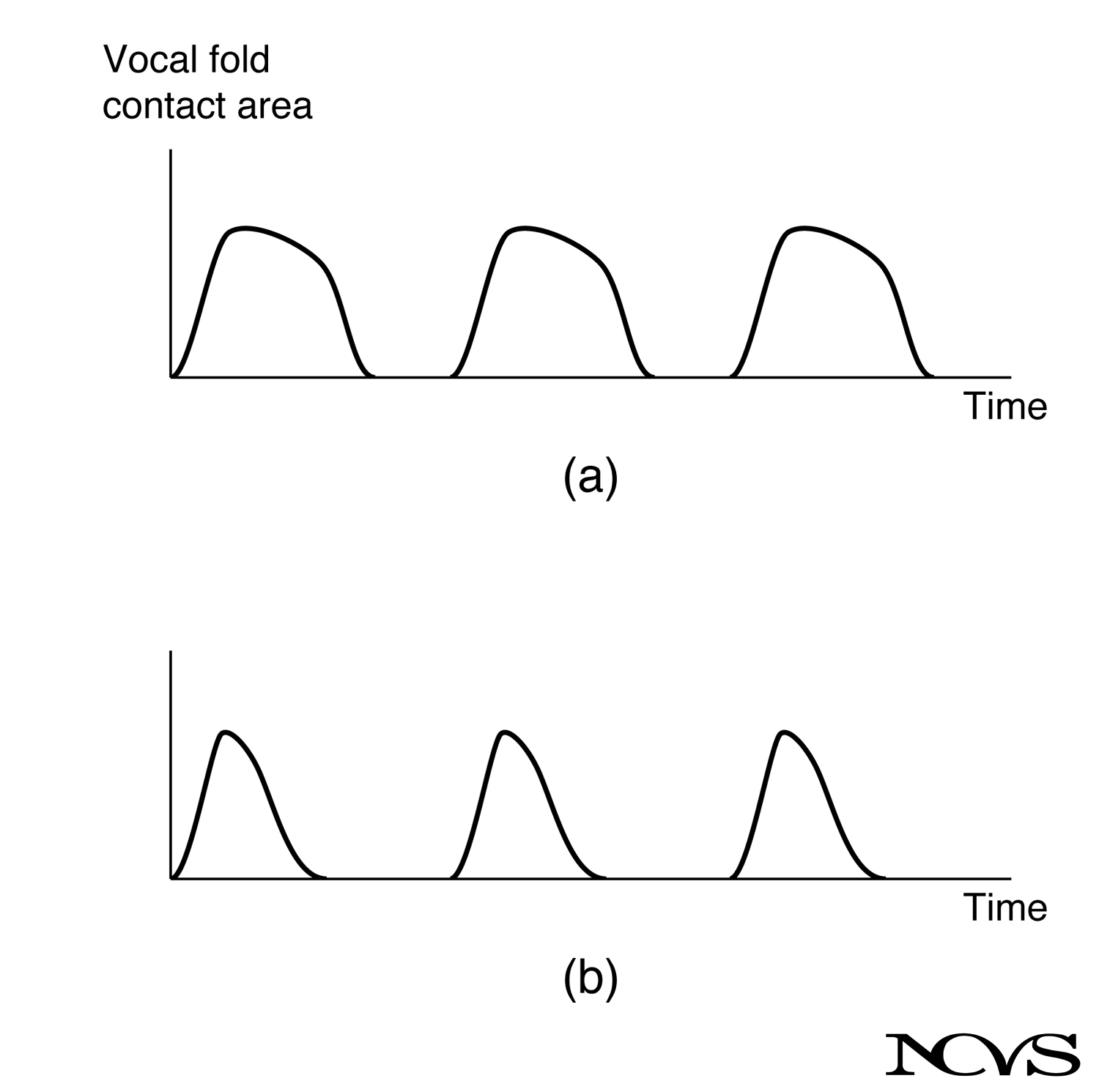 Figure 10.7: Schematic comparison of vocal fold vibratory patterns in modal versus falsetto registers showing differences in closure pattern, vertical phase difference, and body-cover involvement that produce distinct spectral characteristics.
Acoustic Consequences
Falsetto produces:
- Reduced harmonic content
- Steep spectral slope (-12 to -24 dB/octave or steeper)
- Weak high-frequency energy
- Smoother airflow transitions
- “Fluty” or “hooty” perceptual quality
- Lower acoustic efficiency
Physiological Control
Falsetto requires:
- Minimal thyroarytenoid body activation
- High cricothyroid activity (lengthening, tensioning)
- Reduced adductory forces or altered adduction pattern
- Lower subglottal pressure than modal at same F₀
- Elongated, thin vocal fold configuration
- Cover-dominated vibration
Body-Cover Theory and Register Production
The body-cover model provides a physiological framework for understanding register differences.
Vocal Fold Structure
Layered Anatomy
The vocal fold consists of:
- Body: thyroarytenoid muscle (TA)
- Cover: epithelium and superficial lamina propria
- Transition layer: vocal ligament (intermediate and deep lamina propria)
- Differential mechanical properties
- Independent control to some degree
- Interaction determines vibratory mode
Mechanical Coupling
Body-cover interaction:
- Strong body activity pulls cover inward
- Creates thick, short vibrating structure
- Body participates fully in vibration
- Modal register results
Minimal body activity:
- Cover relatively independent
- Creates thin, elongated vibrating structure
- Only cover vibrates significantly
- Falsetto register results
Control Mechanisms
Thyroarytenoid Muscle Role
TA muscle governs register:
- High activation: modal register
- Increases vocal fold bulk
- Shortens and thickens folds
- Enhances medial compression
- Necessary for modal quality
- Limits achievable F₀ range
Low activation: falsetto register
- Reduces vocal fold bulk
- Allows greater elongation by CT
- Reduces medial compression
- Enables higher F₀
- Lighter vocal quality
- Extended upper range
Cricothyroid Muscle Role
CT muscle affects both registers:
- Elongates and tenses vocal folds
- Required for pitch increase in both registers
- Modal: CT works against active TA
- Falsetto: CT works with passive TA
- Different CT activation patterns
- Register transition involves CT-TA balance shift
Abduction Quotient and Register
The abduction quotient predicts register based on glottal configuration.
Definition
Abduction quotient (AQ):
- AQ = (prephonatory glottal width) / (vibrational amplitude)
- Measured at inferior vocal fold margin
- Reflects relative closure completeness
- Predicts spectral slope
- Correlates with register perception
- Can be quantified via imaging
Register Prediction
AQ thresholds:
- AQ < 0.3: modal register likely
- 0.3 < AQ < 0.5: transitional or mixed quality
- AQ > 0.5: falsetto register likely
- Individual variation exists
- Training can modify AQ control
- Provides objective register assessment
Acoustic Markers of the Modal-Falsetto Transition
Multiple acoustic features distinguish the registers and signal transitions.
Spectral Slope Changes
Primary Acoustic Cue
Spectral slope differentiation:
- Modal: -6 to -12 dB/octave (flow spectrum)
- Falsetto: -12 to -24 dB/octave or steeper
- Abrupt change over narrow F₀ range
- Can occur at various fundamental frequencies
- Most salient acoustic difference
- Drives perceptual categorization
Measurement
Quantifying spectral slope:
- Linear regression of harmonic amplitudes
- Typically measured over 1-3 kHz range
- Inverse filtering isolates source spectrum
- Long-term average spectrum (LTAS) useful
- Spectrographic visualization
- Harmonic-to-noise ratio correlates
Harmonic Amplitude Patterns
High-Frequency Energy
Register differences evident in:
- Amplitude of harmonics above 2 kHz
- Modal: substantial energy at high frequencies
- Falsetto: rapid attenuation above 1-2 kHz
- Individual harmonics less informative than overall pattern
- Formant structure overlays source differences
- Trained listeners “hear through” formants
H1-H2 Difference
First two harmonics reveal:
- H1-H2: amplitude difference between first two harmonics
- Modal: H1 often weaker than H2 (H1-H2 negative)
- Falsetto: H1 often stronger than H2 (H1-H2 positive)
- Reflects glottal closure pattern
- Correlates with open quotient
- Useful acoustic measure of register
Fundamental Frequency Discontinuities
Register Breaks
Involuntary transitions show:
- Abrupt F₀ jump (upward or downward)
- Accompanies quality change
- Range: semitone to several semitones
- More common in untrained voices
- Reflects sudden shift in vocal fold configuration
- Pedagogical goal: eliminate or smooth
Voice Range Profile Gaps
Instrumental assessment reveals:
- Regions where one register cannot be sustained
- Overlapping F₀ ranges where both registers possible
- Transition zone width varies with training
- Skilled singers show wide overlap
- Clinical populations may show limited overlap
- Diagnostic and therapeutic implications
Perceptual Processing and Categorization
The auditory system categorizes register based primarily on spectral characteristics.
Spectral Integration
Perceptual Mechanism
Listeners extract:
- Overall spectral envelope shape
- High-frequency energy content
- Brightness versus darkness
- Integrate across critical bands
- Weight mid-to-high frequencies heavily
- Less sensitive to low-frequency changes
Categorical Perception
Modal-falsetto categorization shows:
- Less sharp boundary than pulse-modal
- Wider transition region (several semitones)
- Greater individual variation in boundary
- Training affects categorical boundaries
- Ambiguous region exploited for mixed voice
- Continuous perceptual dimension possible
Perceptual Salience
Identification Accuracy
Listeners categorize register:
- High agreement for clear modal or falsetto
- Reduced agreement for transitional qualities
- Training improves discrimination
- Context affects identification
- Musical style influences expectations
- Individual differences in sensitivity
Aesthetic Preferences
Register perception involves evaluation:
- Cultural and stylistic norms
- Classical singing values seamless transitions
- Some styles embrace abrupt transitions
- Gender expectations differ
- Professional voice users judged strictly
- Changing aesthetic standards over time
Passaggio Zones and Voice Classification
The modal-falsetto transition occurs at characteristic frequencies for different voice types.
Anatomical Basis
Vocal Fold Length and Mass
Voice classification relates to:
- Adult male vocal folds: 17-25 mm length
- Adult female vocal folds: 12-17 mm length
- Longer, heavier folds: lower transition frequency
- Shorter, lighter folds: higher transition frequency
- Systematic variation across bass to soprano
- Individual variation within classifications
Traditional Passaggio Locations
Male Voices
Typical transition zones:
Bass
- Primo passaggio: E3-F3 (165-175 Hz)
- Secondo passaggio: E4-F4 (330-350 Hz)
Baritone
- Primo passaggio: F3-G3 (175-196 Hz)
- Secondo passaggio: F4-G4 (350-392 Hz)
Tenor
- Primo passaggio: G3-A3 (196-220 Hz)
- Secondo passaggio: G4-A4 (392-440 Hz)
Female Voices
Typical transition zones:
Alto/Mezzo-soprano
- Primo passaggio: A3-B3 (220-247 Hz)
- Secondo passaggio: A4-B4 (440-494 Hz)
Soprano
- Primo passaggio: B3-C4 (247-262 Hz)
- Secondo passaggio: B4-C5 (494-523 Hz)
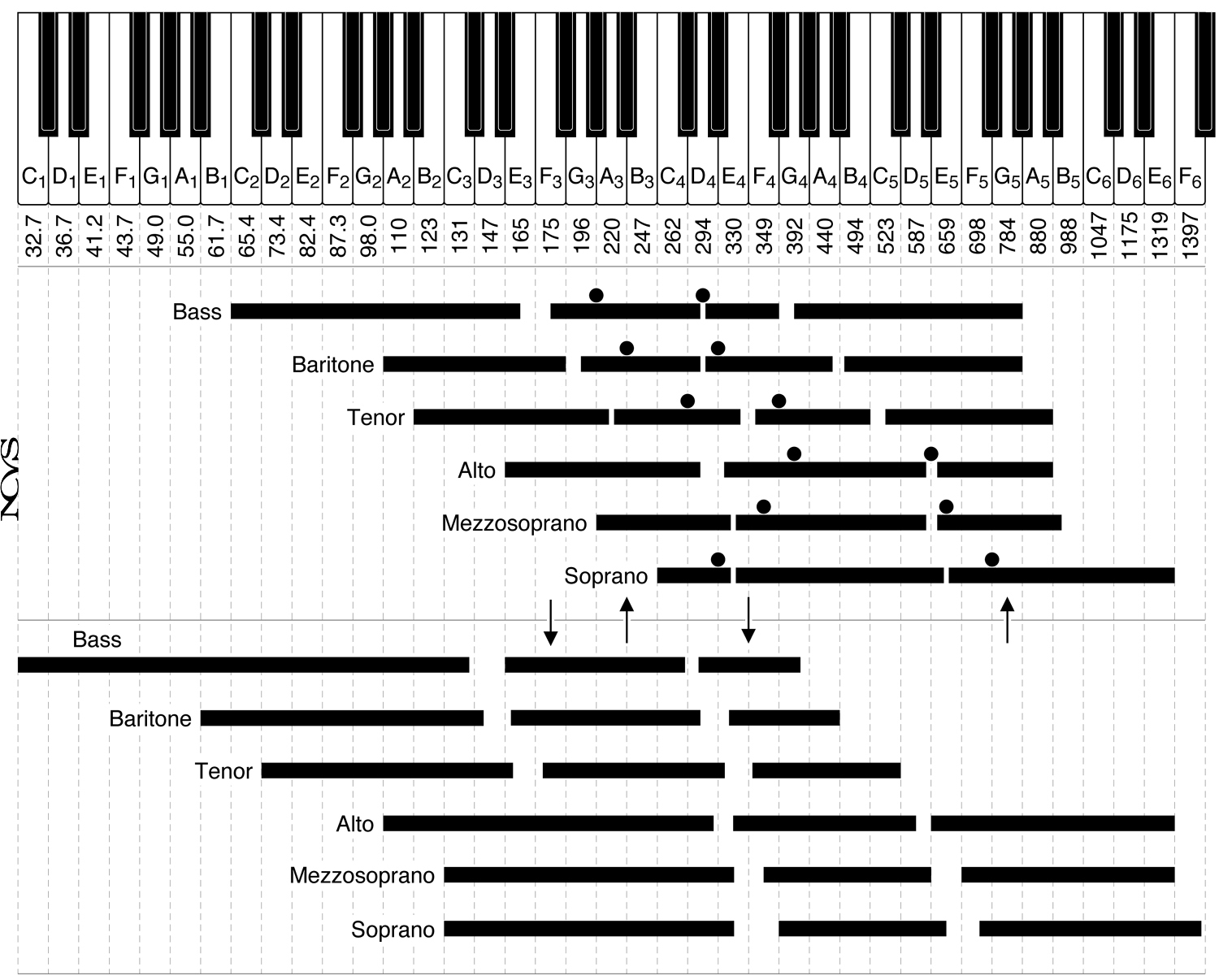 Figure 10.8: Diagram showing typical primo and secondo passaggio frequency ranges for different voice classifications, illustrating systematic relationship between vocal fold length and register transition frequencies.
Primo and Secondo Passaggio
Two Transition Zones
Most voices exhibit:
- Primo passaggio: lower transition zone
- Secondo passaggio: upper transition zone
- Different physiological mechanisms may contribute
- Both involve modal-falsetto interaction
- Pedagogical strategies differ for each
- Individual variation in number and location
Physiological Interpretation
Possible mechanisms:
- Primo: shift from thick to thin vocal fold vibration
- Secondo: further shift or different mode
- Subglottal resonance effects (see hypothesis)
- Maximum TA stress limitations
- Combination of factors
- Active research area
Voluntary Control and Mixed Voice
Skilled singers can navigate transitions smoothly or exploit them stylistically.
Register Blending Strategies
Gradual Transition
Smooth passage through transition:
- Progressive reduction of TA activity
- Gradual shift from body to cover dominance
- Intermediate spectral slopes maintained
- “Mixed voice” in transition region
- Classical singing ideal
- Requires extensive training
Abrupt Transition
Deliberate register shift:
- Sudden change in TA activation
- Clear perceptual discontinuity
- Yodeling exemplifies extreme version
- Stylistically appropriate in some genres
- Less training required
- Natural tendency without instruction
Mixed Voice Development
Acoustic Characteristics
Mixed voice exhibits:
- Intermediate spectral slope
- Partial TA activation
- Complete or near-complete closure
- Blended perceptual quality
- Neither clearly modal nor falsetto
- Stable across F₀ changes
Physiological Basis
Mixed voice requires:
- Partial thyroarytenoid activation
- Sufficient for body-cover coupling
- Insufficient for full modal quality
- Balanced CT-TA activation
- Precise neuromuscular control
- Individual optimal balance
Training Approaches
Developing mixed voice:
- Exercises targeting transitional F₀ region
- Gradual dynamic changes (messa di voce)
- Vowel modification strategies
- Proprioceptive awareness development
- Elimination of excessive tension
- Patient, systematic practice
Gender Differences in Modal-Falsetto Transition
Biological and cultural factors create distinct patterns.
Anatomical Differences
Structural Variation
Sex differences:
- Male vocal folds: longer, thicker, heavier
- Female vocal folds: shorter, thinner, lighter
- Lower transition frequencies in males
- Different typical F₀ ranges
- Overlapping but distinct classifications
- Hormonal influences
Functional Differences
Register Usage Patterns
Typical patterns:
- Males: frequent register transitions in speech range
- Females: modal register often spans speech range
- Males: falsetto for high pitches or special effects
- Females: chest voice for low pitches or emphasis
- Cultural and individual variation
- Training modifies patterns
Transgender Voice Considerations
Register Implications
Voice modification involves:
- Raising or lowering habitual pitch
- May shift relationship to passaggio zones
- Register management strategies differ
- Individual goals and preferences
- Respect for gender identity
- Comprehensive approach needed
Clinical Implications
Register transition difficulties present in voice disorders and require specific interventions.
Assessment
Registral Analysis
Clinical evaluation includes:
- Identifying transition zones
- Testing range in each register
- Assessing smoothness of transitions
- Documenting involuntary breaks
- Perceptual quality judgments
- Acoustic analysis of spectral changes
Voice Range Profile
Instrumental assessment:
- F₀ and intensity capabilities in each register
- Regions of overlap
- Register gaps or breaks
- Comparison to normative data
- Pre/post treatment documentation
- Objective progress monitoring
Disorders Affecting Register Transition
Hyperfunctional Voice
Excessive tension:
- Restricted falsetto access
- Abrupt, uncontrolled transitions
- Limited upper range
- Strain at transitions
- Treatment: tension reduction, register blending
- Often responds well to therapy
Hypofunctional Voice
Insufficient tension:
- Excessive falsetto use
- Difficulty maintaining modal register
- Weak, breathy quality
- Lack of projection
- Treatment: strengthening, adduction training
- May indicate underlying pathology
Mutational Falsetto (Puberphonia)
Persistent adolescent voice:
- Male patient using falsetto habitually
- Avoiding modal register
- Psychological and physical components
- Treatment: facilitating modal register
- Addressing underlying factors
- Often successful with appropriate intervention
Summary
The modal-falsetto register transition depends on spectral slope changes resulting from alterations in vocal fold vibratory patterns, with modal register characterized by complete glottal closure, full thyroarytenoid body involvement, rich harmonic content, and shallow spectral slope (-6 to -12 dB/octave), while falsetto register exhibits incomplete closure or different closure patterns, minimal TA body involvement, reduced harmonics, and steep spectral slope (-12 to -24 dB/octave or steeper). Body-cover theory explains register differences through differential TA activation controlling the degree of body participation in vibration, with high TA activity creating thick, short vibrating structure for modal register and low TA activity allowing thin, elongated cover-dominated vibration for falsetto.
The abduction quotient (prephonatory glottal width divided by vibrational amplitude) predicts register, with values below 0.3 favoring modal register, above 0.5 favoring falsetto, and intermediate values producing transitional or mixed quality amenable to pedagogical development. Spectral slope serves as the primary acoustic cue for register categorization, with listeners integrating high-frequency energy content across critical bands; perceptual categorization shows less sharp boundaries than pulse-modal transition, wider transition regions, and greater individual variation, allowing exploitation of ambiguous region for mixed voice development in classical singing.
Passaggio zones occur at characteristic frequencies varying systematically with voice type (bass primo passaggio E3-F3, soprano B3-C4) due to differences in vocal fold length and mass, with most voices exhibiting both primo and secondo passaggio zones requiring distinct management strategies. Voluntary control ranges from smooth register blending through gradual TA reduction (classical ideal) to abrupt transitions exploited stylistically (yodeling), with mixed voice development requiring partial TA activation, balanced CT-TA coordination, and extensive training. Clinical assessment employs registral analysis, voice range profiling, and acoustic measures; disorders affecting transition include hyperfunctional voice (restricted falsetto access), hypofunctional voice (excessive falsetto use), and mutational falsetto (habitual falsetto avoidance of modal register).
Key Takeaways
- ✅ Modal-falsetto transition depends on spectral slope changes: modal shallow (-6 to -12 dB/oct), falsetto steep (-12 to -24 dB/oct)
- ✅ Body-cover theory explains registers through differential TA activation controlling body participation in vibration
- ✅ Abduction quotient predicts register: <0.3 modal, >0.5 falsetto, intermediate values transitional/mixed
- ✅ Perceptual categorization based on high-frequency energy integration; less sharp boundaries than pulse-modal transition
- ✅ Passaggio zones vary systematically with voice type due to vocal fold length differences (bass ~165 Hz, soprano ~250 Hz primo)
- ✅ Mixed voice achieved through partial TA activation, balanced CT-TA coordination, intermediate spectral characteristics
- ✅ Gender differences in transition patterns due to anatomical variation; males show lower transition frequencies
- ✅ Clinical disorders include hyperfunctional voice (restricted falsetto), hypofunctional voice (excessive falsetto), mutational falsetto
Related Topics
- Temporal Gap and Spectral Slope
- Perception of Vocal Registers
- The Pulse-Modal Transition
- Body-Cover Theory
- Voice Classification
Further Reading
- Titze, I. R. (1988). A framework for the study of vocal registers. Journal of Voice, 2(3), 183-194.
- Roubeau, B., Chevrie-Muller, C., & Arabia-Guidet, C. (1991). Laryngeal vibratory patterns in voice registers. In J. Gauffin & B. Hammarberg (Eds.), Vocal Fold Physiology (pp. 151-158). Singular Publishing Group.
- Miller, D. G., & Schutte, H. K. (1990). Physical definition of the ‘flageolet register.’ Journal of Voice, 4(3), 206-212.
- Sundberg, J., & Högset, C. (2001). Voice source differences between falsetto and modal registers in counter tenors, tenors and baritones. Logopedics Phoniatrics Vocology, 26(1), 26-36.
- Henrich, N. (2006). Mirroring the voice from Garcia to the present day: Some insights into singing voice registers. Logopedics Phoniatrics Vocology, 31(1), 3-14.