Clinical and Pedagogical Issues
Most of us have considerable voluntary control over registers. We can produce vocal fry, often down to a few pulses per second, and we can produce a primitive yodel. But how do we do it, and how do we prevent undesirable registration? The control and blending of vocal registers represents one of the most challenging aspects of voice training and one of the most problematic issues in voice disorders.
Registers as Disorder or Style
In clinical and pedagogical discussions of vocal registers, it is often asked whether frequent registration constitutes a voice disorder. The answer depends largely on context and intent.
Normal Register Use
Some speakers tend to use register variations as part of their natural communication style:
- Use of pulse register (vocal fry) especially at the ends of sentences
- Laughter in falsetto while speaking in modal register
- Multiple register combinations perceived as a swooping vocal style (as in reading nursery rhymes where “big” characters and “little” characters are portrayed by different voice types)
Stylistic Considerations
Register usage varies dramatically across musical styles:
Classical Western Singing (Opera, Art Song, Oratorio)
- Noticeable register changes generally unacceptable
- Emphasis on seamless blending of registers
- Development of “head voice” or “mixed voice” to bridge chest and falsetto
- Perception of smooth transitions as a hallmark of technical mastery
Contemporary and Folk Styles
- Country-western: Deliberate use and exaggeration of register breaks
- Folk music: Natural register transitions embraced
- Soul and Gospel: Strategic use of register changes for emotional effect
- Rock and Blues: Register breaks as expressive devices
- Musical theater: Context-dependent register use
- Jazz: Flexible approach to register management
Electronically Amplified Singing
- Falsetto register becoming more acceptable for high pitches
- Less emphasis on projection, more on timbral variety
- Different technical demands than unamplified singing
Clinical Perspective
Generally, if registration is used with intent and purpose, it can hardly be called a disorder. If it occurs incidentally, however, it can be misinterpreted as:
- Lack of laryngeal control
- Inappropriate message signaling
- Inefficient vocal technique
- Muscular imbalance
- Incomplete coordination between respiratory and laryngeal systems
Excessive use of pulse register (vocal fry) or persistent register instability may indicate vocal hyperfunction or hypofunction. The Voice Range Profile (VRP), when analyzed for register transitions, can reveal limitations in vocal flexibility or control.
Register Equalization with Laryngeal Adjustments and Lung Pressure
Based on the understanding of register mechanisms, several strategies emerge for smoothing abrupt spectral slope transitions.
Coordinating Adduction with Amplitude
The vocal processes can be spread apart to offset increased adduction by TA activity. This must be coordinated with lung pressure, however, according to the amplitude of vibration of the vocal folds.
The Messa di Voce Exercise
A messa di voce exercise (gradual crescendo followed by decrescendo) appears register-free when adduction changes systematically with lung pressure:
Crescendo segment:
- As amplitude of vibration increases
- Vocal folds can be abducted slightly
- Keeps the abduction quotient Qa constant
- Prevents pressed quality
Decrescendo segment:
- As amplitude decreases
- Vocal folds can be adducted slightly
- Maintains consistent Qa
- Prevents breathy quality
If this rule is not followed:
- The messa di voce is likely to sound pressed in the loud segment
- And breathy in the soft segment
Offsetting Subglottal Resonance Effects
Adductory control can also be used to equalize the involuntary register transitions brought about by subglottal resonance:
When driven harder by subglottal formant pressures at specific pitches:
- Vocal processes can be spread apart slightly
- Offsets the increasing amplitude of vibration
- Maintains consistent register quality
When subglottal formant pressures impede vibration:
- Gradual increase in adduction
- Offsets decreasing amplitude of vibration
- Prevents unwanted register shift
Limitations at High Frequencies
Some limitations may be encountered with register equalization techniques, especially at high fundamental frequencies:
The “Strangulation” Effect:
- Increased adduction together with reduced vibrational amplitude
- May cause excessive tension
- Even though spectral slope may be equalized reasonably well
- Output power may dwindle because there is too little airflow
- At this point, the vocalist may need alternative strategies
Gradual Thyroarytenoid Release
The case was made in the discussion of hypotheses that at higher fundamental frequencies, an effective way to eliminate register breaks is to train the thyroarytenoid muscle to deactivate gradually, in coordination with increased cricothyroid (CT) activity.
Electromyographic Evidence
Hirano, Vennard, and Ohala (1970) showed in their electromyographic investigations of laryngeal control that this was indeed the strategy employed by a well-trained singer:
- As pitch was raised, TA activity decreased in relation to CT activity
- There was no abrupt release of TA activity
- Smooth transition accomplished through differential muscle control
Training Challenges
This differential control of two intrinsic laryngeal muscles is one of the most difficult tasks in all of voice training:
- Requires conscious awareness of muscle function
- Demands precise coordination between antagonistic muscles
- Takes considerable time to develop reliably
- Represents a hallmark of advanced vocal technique
- Essential for classical singing in upper range
Register Equalization by Vocal Tract Adjustments
Vocal tract adjustments may also be used to equalize registers. The key insight is that supraglottal resonances can offset the effects of subglottal resonances.
Supraglottal Resonance Effects
Vocal tract adjustments work similarly to subglottal resonances but with opposite polarity:
- The supraglottal pressure is maximally negative at glottal closure
- Whereas the subglottal pressure is maximally positive
- Air rarefaction (rather than compression) takes place above the glottis
- The vocal tract air column maintains forward motion after glottal closure
Formant Tuning Strategy
The F₀ = F₁ case is constructive for supraglottal resonances (rather than destructive as for subglottal resonances). This creates an opportunity for register equalization.
Practical Example
The difficult region between 400 Hz and 800 Hz (which results from F₀ being in the vicinity of the first subglottal formant F₁’) can be equalized by placing the first vocal tract formant F₁ in the same region:
Suitable vowels for this purpose:
- [ɪ] as in “bit”
- [ɛ] as in “bet”
- [æ] as in “bat”
- [ʊ] as in “book”
- [ɔ] as in “bought”
Vowels to avoid in this region:
- [i] as in “beat” (F₁ too low)
- [u] as in “boot” (F₁ too low)
- [ɑ] as in “father” (F₁ may be too low or high depending on formant tuning)
Vowel Chart Analysis
Figure 10.12 shows the Peterson and Barney (1952) vowel chart with subglottal resonance frequencies superimposed:
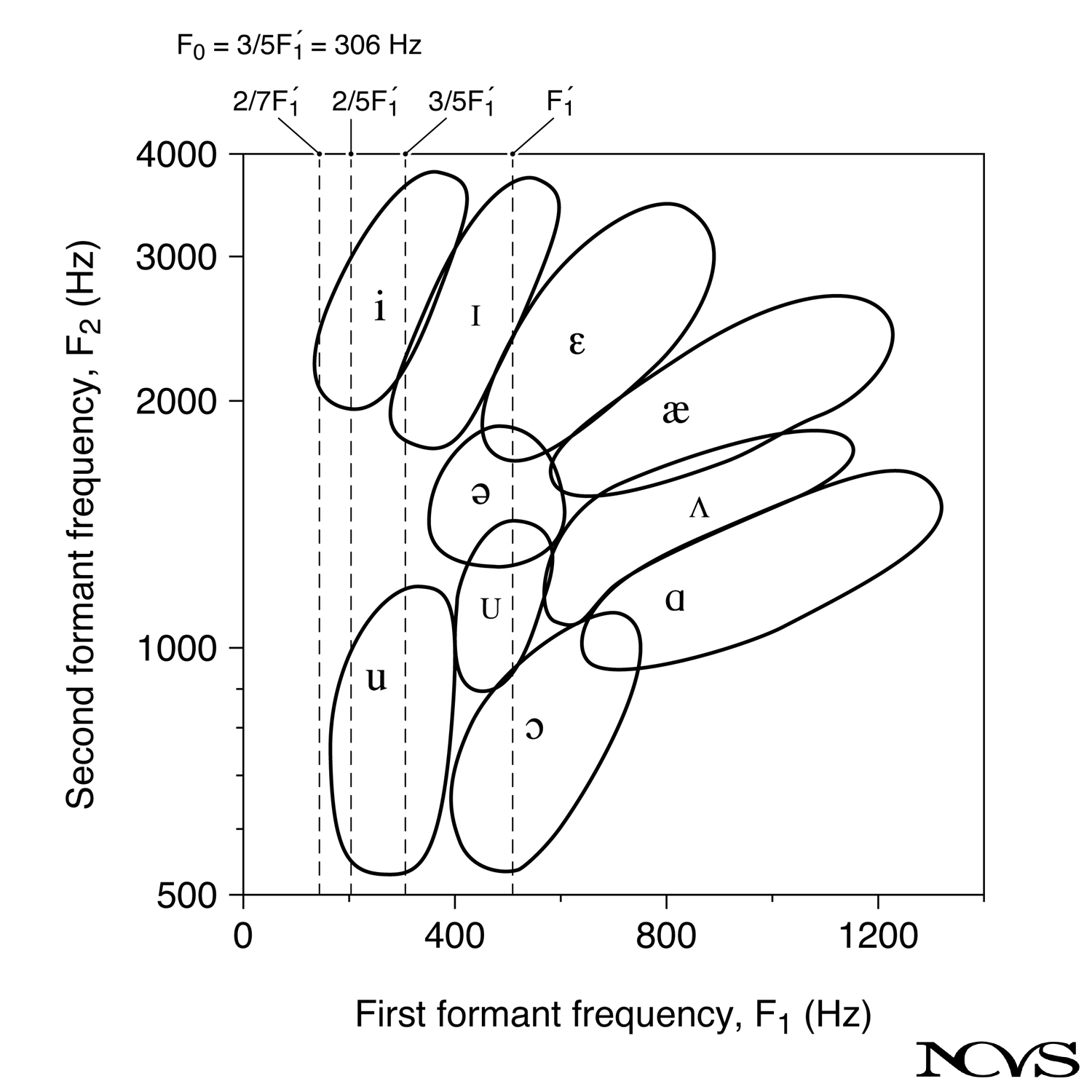 Figure 10.12: Vowel chart with subglottal resonance frequencies superimposed (vertical dashed lines).
The five vowels [ɪ], [ɛ], [æ], [ʊ], and [ɔ] are all intersected by the F₁’ vertical line (at approximately 510 Hz), suggesting that register equalization may be possible with these vowels. The corner vowels [i], [u], and [ɑ], on the other hand, are far removed from the F₁’ line.
Pedagogical Applications
Baritones and tenors know that the mid-range vowels ([ɪ], [ɛ], [æ], [ʊ], [ɔ]), rather than the corner vowels ([i], [ɑ], [u]), are the easiest to produce in the high part of their ranges. This empirical observation aligns with the formant tuning hypothesis.
Lower Register Challenges:
- The (2/5)F₁’ line (representing another inhibitory subglottal resonance at approximately 204 Hz) intersects only the [i] and [u] vowel spaces
- Some equalization could be expected in this 200-Hz region with these vowels
- However, adductory equalization is more likely to be effective here, given the poor vowel selection
Integration with Other Techniques
The general utility of formant tuning for register equalization needs further study. The scheme devised by Coffin (1987) for vowel modification in singing could be modified to include subglottal resonances, creating a more comprehensive approach to register management.
Clinical Applications
Voice Disorders and Registers
From a clinical perspective, register phenomena can both indicate and contribute to voice disorders:
Diagnostic Indicators:
- Excessive pulse register use may indicate hyperfunction
- Inability to access certain registers may suggest excessive tension
- Persistent register instability may signal incomplete coordination
- Sudden register breaks may indicate inadequate training or pathology
Voice Range Profile Analysis:
- VRP analyzed for register transitions
- Reveals limitations in vocal flexibility
- Shows control capabilities across frequency and intensity ranges
- Identifies areas requiring therapeutic intervention
Therapeutic Approaches
Therapeutic approaches for register problems typically focus on achieving optimal balance between:
-
Respiratory support
- Appropriate subglottal pressure for desired register
- Coordination with adductory adjustments
- Breath management for smooth transitions
-
Laryngeal configuration
- Appropriate TA and CT activation
- Balanced adduction for register and intensity
- Gradual muscle coordination changes
-
Resonance strategies
- Formant tuning when appropriate
- Awareness of vowel effects on register stability
- Integration of articulatory and phonatory goals
The Electroglottograph as a Clinical Tool
The electroglottograph (EGG) emerges as a particularly valuable tool for monitoring register transitions through its sensitivity to vocal fold contact area and configuration changes:
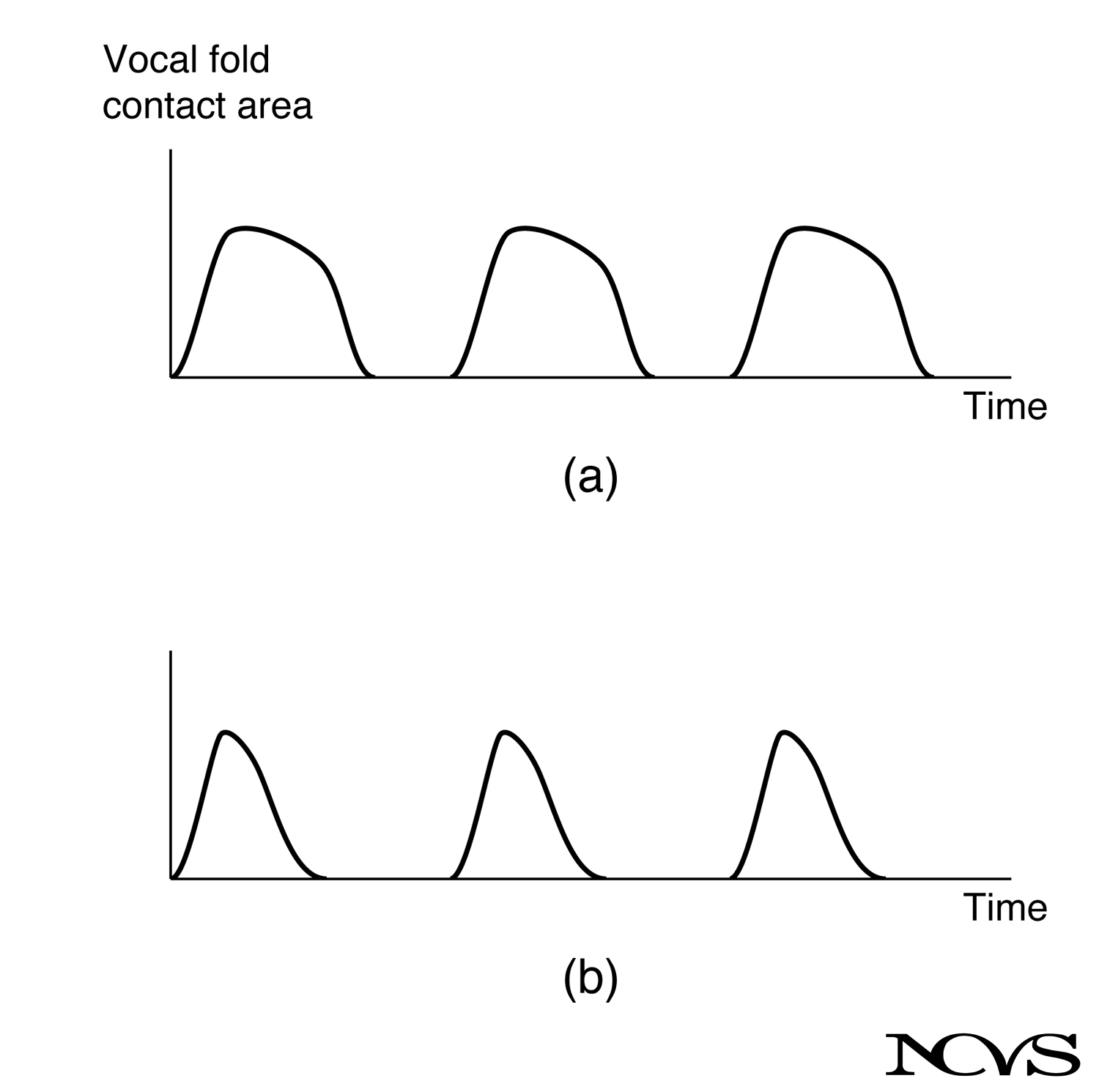 Figure 10.6: Using an electroglottograph to monitor phonation.
The EGG provides:
- Indirect measurement of adduction at the bottom of the vocal fold
- Time-course of vocal fold contact area
- Waveform patterns distinguishing modal from falsetto register
- Biofeedback for voice training and therapy
Figure 10.7: Electroglottograms for (a) modal register and (b) falsetto register. The knee in the waveform on the descending slope for modal register corresponds to bulging of the bottom of the vocal fold.
Summary
The clinical and pedagogical management of vocal registers requires integration of multiple strategies including laryngeal adjustments coordinated with lung pressure, gradual thyroarytenoid muscle release coordinated with cricothyroid activation, and vocal tract adjustments through formant tuning. The messa di voce exercise demonstrates the importance of coordinating adduction with amplitude changes to maintain consistent register quality. Skilled vocalists learn to equalize involuntary register transitions through adductory control that offsets subglottal resonance effects, though this approach may encounter limitations at high frequencies where alternative strategies become necessary. Formant tuning offers another equalization technique, particularly effective in the 400-800 Hz range where mid-range vowels can offset subglottal resonance effects. From a clinical perspective, register phenomena serve as both diagnostic indicators and therapeutic targets, with the electroglottograph providing valuable feedback for monitoring register transitions and guiding intervention strategies.
Key Takeaways
- ✅ Register use can be stylistic or problematic depending on intent and context
- ✅ Classical singing emphasizes seamless register blending, while many contemporary styles embrace register breaks
- ✅ Messa di voce exercises demonstrate the principle of coordinating adduction changes with lung pressure
- ✅ Gradual thyroarytenoid release coordinated with increased cricothyroid activity represents advanced technique
- ✅ Formant tuning can offset subglottal resonance effects, particularly in the 400-800 Hz range
- ✅ Mid-range vowels ([ɪ], [ɛ], [æ], [ʊ], [ɔ]) are more stable than corner vowels in problematic frequency regions
- ✅ The electroglottograph provides valuable biofeedback for register training and clinical assessment
- ✅ Therapeutic approaches must integrate respiratory, laryngeal, and resonance strategies
Related Topics
- Register Equalization with Laryngeal Adjustments and Lung Pressure
- Register Equalization by Vocal Tract Adjustments
- Involuntary Register Transitions: Two Hypotheses
- Perception of Vocal Registers
- Fundamental Frequency Control
- Vocal Tract Resonance
Further Reading
- Hirano, M., Vennard, W., & Ohala, J. (1970). Regulation of register, pitch, and intensity of voice. Folia Phoniatrica, 22, 1-20.
- Coffin, B. (1987). Coffin’s sounds of singing: Principles and applications of vocal techniques with chromatic vowel chart (2nd ed.). Metuchen, NJ: The Scarecrow Press Inc.
- Colton, R., & Conture, E. G. (1990). Problems and pitfalls of electroglottography. Journal of Voice, 4(1), 10-24.
- Rothenberg, M. (1992). A multichannel electroglottograph. Journal of Voice, 6(1), 36-43.
- Miller, R. (1986). The structure of singing. New York: Schirmer.
- Peterson, G., & Barney, H. (1952). Control methods used in a study of the vowels. Journal of the Acoustical Society of America, 24, 175-184.