Hypothesis One: Subglottal Resonances
The subglottal resonance hypothesis proposes that involuntary register transitions occur at specific fundamental frequencies where the tracheal acoustic resonance interacts destabilizingly with vocal fold vibration, creating alternating zones of enhanced and reduced vibrational amplitude that make one register unstable and favor transition to another. This elegant acoustic-aerodynamic mechanism predicts register breaks at musically meaningful intervals corresponding to harmonic relationships with the first tracheal resonance near 500-600 Hz, offering testable predictions about passaggio locations across voice types and explaining why certain frequencies present inherent biomechanical challenges regardless of training level.
Tracheal Acoustics and Resonance
The subglottal airway functions as an acoustic resonator with characteristic frequencies.
Tracheal Resonator Properties
Physical Characteristics
The tracheal system:
- Length: approximately 10-12 cm in adults
- Diameter: approximately 1.5-2.0 cm
- Variable cross-section (slightly tapered)
- Cartilaginous rings provide semi-rigid walls
- Membranous posterior wall more compliant
- Branches into bronchi (complex termination)
Acoustic Modeling
Simplified resonator model:
- Closed at lung end (low compliance)
- Open at larynx (high compliance at glottis)
- Quarter-wave resonator approximation
- First resonance: f₁ ≈ c/(4L)
- For L = 11 cm, c = 35,000 cm/s: f₁ ≈ 795 Hz
- In practice: 500-600 Hz most common
- Damping reduces exact resonance
Individual Variation
Tracheal resonance frequency varies with:
- Tracheal length (gender, height, age)
- Diameter and wall compliance
- Lung volume (affects termination impedance)
- Branching pattern complexity
- Typically 500-650 Hz in adults
- Children show higher frequencies
- Systematic with body size
Higher Resonances
Additional resonance modes exist:
Harmonic Series
Tracheal resonances:
- First resonance (f₁): ~500-600 Hz
- Second resonance (f₂): ~1500-1800 Hz (3f₁)
- Third resonance (f₃): ~2500-3000 Hz (5f₁)
- Odd harmonics only (quarter-wave tube)
- Higher modes progressively more damped
- First resonance most influential
Coupling Mechanism: Pressure Oscillations
The tracheal resonance couples to vocal fold vibration through subglottal pressure modulation.
Aerodynamic-Acoustic Interaction
Pressure Source
Vocal fold vibration creates:
- Pulsatile airflow through glottis
- Pressure perturbations in subglottal space
- Harmonic content at F₀, 2F₀, 3F₀, etc.
- Excites tracheal resonances
- Resonance amplifies pressure oscillations
- Feedback to vocal fold vibration
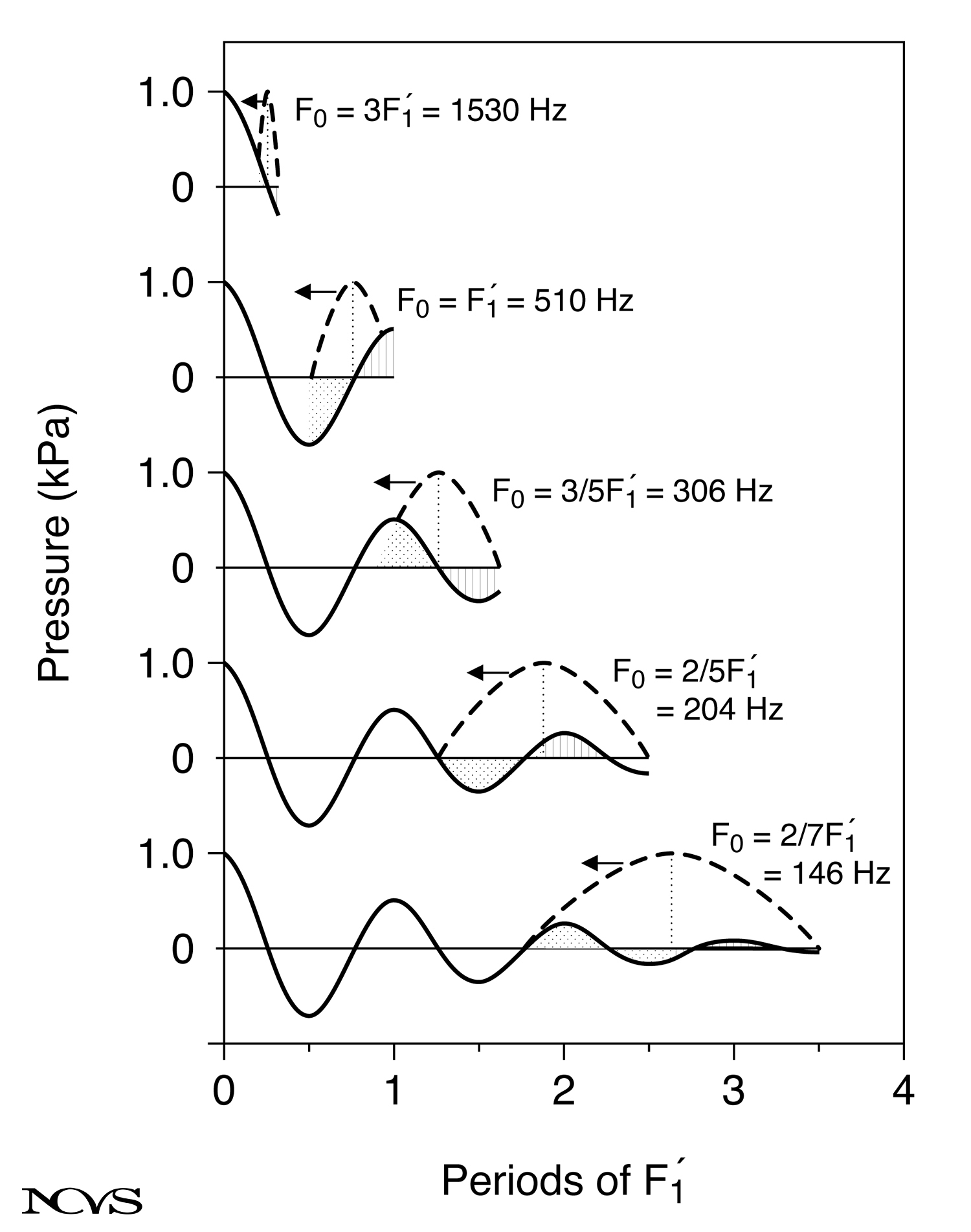 Figure 10.9: Diagram illustrating the subglottal resonance mechanism showing how vocal fold vibration excites tracheal acoustic resonances, creating pressure oscillations that feed back to modulate vocal fold vibrational amplitude, with maximum effect when harmonics align with resonance frequency.
Resonance Amplification
When a harmonic coincides with tracheal resonance:
- Pressure oscillation amplitude increases
- Feedback affects vocal fold motion
- Can enhance or disrupt vibration
- Phase relationship determines effect
- Maximum coupling at resonance
- Bandwidth ~50-100 Hz
Phase-Dependent Effects
The interaction depends critically on phase relationships.
Constructive Coupling
Favorable phase alignment:
- Pressure oscillation aids vocal fold motion
- Enhanced vibrational amplitude
- Easier phonation (reduced threshold pressure)
- Stable, efficient oscillation
- May enhance certain registers
- Subjectively feels “resonant”
Destructive Coupling
Unfavorable phase alignment:
- Pressure oscillation opposes vocal fold motion
- Reduced vibrational amplitude
- Increased threshold pressure
- Unstable oscillation
- Triggers register transition
- Subjectively feels “blocked” or “difficult”
Phase Variability
Phase relationships depend on:
- Exact harmonic frequency
- Tracheal resonance characteristics
- Glottal configuration
- Register (affects glottal impedance)
- Lung volume
- Individual anatomy
Predicted Register Transition Frequencies
The hypothesis predicts specific F₀ values where transitions should occur naturally.
Mathematical Predictions
Harmonic Alignment
Register instability when:
- nF₀ = f₁ (tracheal first resonance)
- For f₁ = 510 Hz (example value)
- n = 1: F₀ = 510 Hz (H1 at resonance)
- n = 2: F₀ = 255 Hz (H2 at resonance)
- n = 3: F₀ = 170 Hz (H3 at resonance)
- n = 4: F₀ = 128 Hz (H4 at resonance)
- Higher harmonics less influential
Musical Note Correspondences
For f₁ = 510 Hz:
- F₀ = 170 Hz: approximately F3 (primo passaggio region for baritone)
- F₀ = 255 Hz: approximately C4 (primo passaggio for soprano)
- F₀ = 340 Hz: approximately F4 (secondo passaggio for tenor)
- F₀ = 510 Hz: approximately B4-C5 (secondo passaggio for soprano)
These predictions align roughly with traditional passaggio locations.
Frequency Ratio Patterns
Harmonic Relationships
Predicted transition intervals:
- Third harmonic coupling: octave + fifth above
- Fourth harmonic coupling: two octaves
- Fifth harmonic coupling: two octaves + major third
- Creates musically meaningful intervals
- Explains multiple passaggio zones
- Voice types differ due to different f₁
Individual Scaling
Tracheal resonance varies systematically:
- Males: typically 500-550 Hz (longer trachea)
- Females: typically 550-650 Hz (shorter trachea)
- Children: 650-750+ Hz (short trachea)
- Predicts lower passaggi in males
- Predicts higher passaggi in females
- Consistent with empirical observations
Evidence Supporting the Hypothesis
Multiple lines of evidence support the subglottal resonance mechanism.
Acoustic Measurements
Spectral Analysis
Research demonstrates:
- Enhanced harmonics near tracheal resonance
- Amplitude modulation at predicted frequencies
- Spectral perturbations in passaggio regions
- Input impedance measurements confirm resonances
- Pressure measurements show oscillations
- Consistent across individuals
Formant-Harmonic Interaction
Observations include:
- Interaction between tracheal resonance and formants
- Complexity in predicting exact effects
- Multiple acoustic factors interact
- First tracheal resonance most prominent
- Measurable in spectrograms
- Contributing but not sole factor
Electroglottography Studies
Vibrational Amplitude Changes
EGG reveals:
- Contact quotient changes at predicted frequencies
- Amplitude modulation in passaggio regions
- Difficulty maintaining stable vibration
- Register transitions at predicted F₀ values
- Individual variation around predictions
- Supporting but not definitive evidence
Vocal Pedagogy Observations
Traditional Passaggio Locations
Correlation with predictions:
- Primo passaggio locations match third-harmonic coupling
- Secondo passaggio locations match higher harmonics
- Systematic variation across voice types
- “Natural break” points long recognized
- Pedagogical strategies address these frequencies
- Centuries of empirical observation
Singer Experiences
Subjective reports:
- Certain pitches feel “unstable”
- Need for technical adjustments at passaggi
- Register transitions easier at predicted frequencies
- Individual variation in exact locations
- Training extends stable range
- Cannot fully eliminate phenomenon
Limitations and Criticisms
The subglottal resonance hypothesis faces several challenges.
Imperfect Predictive Power
Variability in Transition Frequencies
Observations problematic for hypothesis:
- Passaggio locations vary considerably among individuals
- Training substantially modifies transition frequencies
- Some singers avoid register breaks at predicted frequencies
- Voluntary control possible over wide F₀ range
- Individual tracheal resonance only partially explains variation
- Other factors clearly important
Missing Transitions
Not all predicted transitions occur:
- Fundamental at 510 Hz rarely shows register break
- Only some harmonic alignments cause instability
- Mechanism should affect all harmonic coincidences
- Selective occurrence not fully explained
- May depend on register or other factors
- Requires additional theoretical development
Alternative Explanations
Other Mechanisms May Dominate
Competing hypotheses:
- Maximum TA stress may be primary factor
- Body-cover theory explains much variation
- Voluntary control demonstrates other mechanisms
- Subglottal resonance may modulate rather than cause
- Multiple factors likely interact
- Difficult to isolate specific contributions
Methodological Challenges
Measurement Difficulties
Research limitations:
- Subglottal pressure oscillations difficult to measure
- Requires invasive procedures or complex models
- Phase relationships hard to quantify
- Individual tracheal resonance frequency imprecise
- Confounding variables numerous
- Experimental paradigms complex
Theoretical Extensions and Refinements
Recent work extends the basic hypothesis.
Supraglottal-Subglottal Interaction
Combined Resonator System
More complete model includes:
- Vocal tract resonances (formants) above glottis
- Tracheal resonances below glottis
- Glottis couples both systems
- Impedance matching affects efficiency
- Multiple resonances interact
- Complex frequency-dependent effects
Inertance and Compliance
Acoustic impedance considerations:
- Tracheal inertance affects glottal flow
- Lung compliance affects subglottal pressure
- Frequency-dependent impedance
- Can enhance or impede oscillation
- Register may optimize impedance matching
- Contributes to transition mechanisms
Nonlinear Dynamics
Instability Analysis
Dynamical systems perspective:
- Vocal fold oscillation nonlinear system
- Subglottal resonance introduces parametric forcing
- May create bifurcations in solution space
- Register transitions as dynamical instabilities
- Hysteresis possible (different up/down transitions)
- Sophisticated mathematical modeling required
Individual Differences
Anatomical Variation
Sources of individual differences:
- Tracheal length, diameter, compliance
- Lung size and compliance
- Vocal fold dimensions and properties
- Laryngeal height variability
- Breathing patterns
- Explains imperfect population-level predictions
Clinical and Pedagogical Implications
Understanding subglottal resonance informs voice training and therapy.
Assessment
Identifying Resonance-Related Instabilities
Clinical evaluation:
- Map passaggio locations across range
- Correlate with predicted tracheal resonance
- Acoustic analysis for spectral perturbations
- Input impedance measurements (if available)
- Distinguish from other transition causes
- Individual assessment essential
Management Strategies
Compensatory Techniques
Addressing resonance-induced instability:
- Adjust lung volume (changes tracheal impedance)
- Vowel modification (changes supraglottal coupling)
- Intensity adjustment (changes coupling strength)
- Register choice (changes glottal impedance)
- Cannot eliminate resonance but can modify coupling
- Multiple strategies often needed
Register Equalization Approaches
Pedagogical methods:
- Develop awareness of resonance-affected zones
- Practice stabilizing vibration at vulnerable frequencies
- Gradual approach/departure from passaggio
- Mixed voice development spans resonance effects
- Formant tuning strategies
- Integration with other equalization methods
Summary
The subglottal resonance hypothesis proposes that involuntary register transitions occur when harmonics of the fundamental frequency align with the first tracheal resonance (typically 500-600 Hz), creating aerodynamic-acoustic coupling through pressure oscillations that can destabilize vocal fold vibration through phase-dependent enhancement or disruption of oscillation. The tracheal airway functions as a quarter-wave resonator with first resonance f₁ = c/(4L), yielding approximately 500-600 Hz for typical adult tracheal length 10-12 cm, with individual variation based on tracheal dimensions, lung volume, and anatomical factors.
Mathematical predictions suggest register instability when nF₀ = f₁, with third-harmonic coupling (n=3) predicting primo passaggio around 170 Hz for males (F3) and 200 Hz for females (G3), fourth-harmonic coupling predicting secondo passaggio around 255 Hz (C4) for sopranos, and higher harmonics potentially affecting additional transition zones. These predictions correlate moderately well with traditional passaggio locations across voice classifications, with systematic scaling based on gender-related tracheal length differences, and centuries of pedagogical observation supporting existence of natural instability zones at these frequencies.
Supporting evidence includes acoustic measurements showing enhanced harmonics and amplitude modulation near tracheal resonance, electroglottography revealing vibrational amplitude changes and contact quotient modulation at predicted frequencies, and vocal pedagogy observations confirming subjective difficulty and natural break tendencies at passaggio locations. However, limitations include imperfect predictive power with considerable individual variation in actual transition frequencies, strong influence of training on passaggio management, voluntary control possible across predicted instability zones, and alternative mechanisms (maximum TA stress, body-cover dynamics) potentially dominating in many contexts.
Theoretical extensions incorporate supraglottal-subglottal interaction through combined resonator models, nonlinear dynamics perspectives treating transitions as bifurcations in parametric forced oscillator systems, and individual anatomical variation accounting for imperfect population predictions. Clinical and pedagogical implications include assessment strategies mapping passaggio locations relative to predicted tracheal resonances, compensatory techniques involving lung volume adjustment, vowel modification, and register blending to stabilize vibration in resonance-affected zones, and integration with other equalization approaches for comprehensive passaggio management.
Key Takeaways
- ✅ Subglottal resonance hypothesis proposes tracheal acoustic resonance (~500-600 Hz) couples to vocal fold vibration causing instability
- ✅ Tracheal quarter-wave resonator yields f₁ = c/(4L) ≈ 500-600 Hz; individual variation based on tracheal length and lung volume
- ✅ Register transitions predicted when nF₀ = f₁: third harmonic (~170 Hz primo), fourth harmonic (~255 Hz), correlating with passaggi
- ✅ Phase-dependent coupling can enhance or disrupt vibration; unfavorable phase creates instability triggering register transition
- ✅ Evidence includes acoustic measurements, EGG studies, and pedagogical observations; but imperfect predictive power limits hypothesis
- ✅ Voluntary control and training substantially modify transitions, suggesting other mechanisms also important
- ✅ Clinical strategies involve lung volume adjustment, vowel modification, and register blending to manage resonance-affected zones
- ✅ Theoretical extensions include supraglottal-subglottal interaction models and nonlinear dynamics perspectives
Related Topics
- Involuntary Register Transitions: Two Hypotheses
- Hypothesis Two: Maximum Active Thyroarytenoid Stress
- The Modal-Falsetto Transition
- Register Equalization by Vocal Tract Adjustments
- Acoustic Impedance of Tubes
Further Reading
- Titze, I. R. (1988). Regulation of vocal power and efficiency by subglottal pressure and glottal width. In O. Fujimura (Ed.), Vocal Physiology: Voice Production, Mechanisms and Functions (pp. 227-238). Raven Press.
- Rothenberg, M. (1981). Acoustic interaction between the glottal source and the vocal tract. In K. N. Stevens & M. Hirano (Eds.), Vocal Fold Physiology (pp. 305-323). University of Tokyo Press.
- Titze, I. R., & Story, B. H. (1997). Acoustic interactions of the voice source with the lower vocal tract. Journal of the Acoustical Society of America, 101(4), 2234-2243.
- Sundberg, J., Leanderson, R., von Euler, C., & Knutsson, E. (1991). Influence of body posture and lung volume on subglottal pressure control during singing. Journal of Voice, 5(4), 283-291.
- Austin, S. F., & Titze, I. R. (1997). The effect of subglottal resonance upon vocal fold vibration. Journal of Voice, 11(4), 391-402.