Perception of Vocal Registers
The perception of vocal registers represents one of the most intriguing examples of categorical perception in the auditory system. While physiological and acoustic variables change continuously, listeners perceive distinct, qualitatively different register categories. Understanding this perceptual phenomenon requires examining how the brain simplifies complex acoustic information into discrete, identifiable entities.
Definition and Characteristics
The term register describes perceptually distinct regions of vocal quality that can be maintained over some ranges of pitch and loudness. Register changes may occur voluntarily or involuntarily. In some voices, involuntary registers seem to be less apparent than in other voices.
Quantal Perception
If a voice is noticeably registered, a quantal (stair-step) effect in quality is perceived as pitch or loudness is changed. This concept is fundamental to understanding registers:
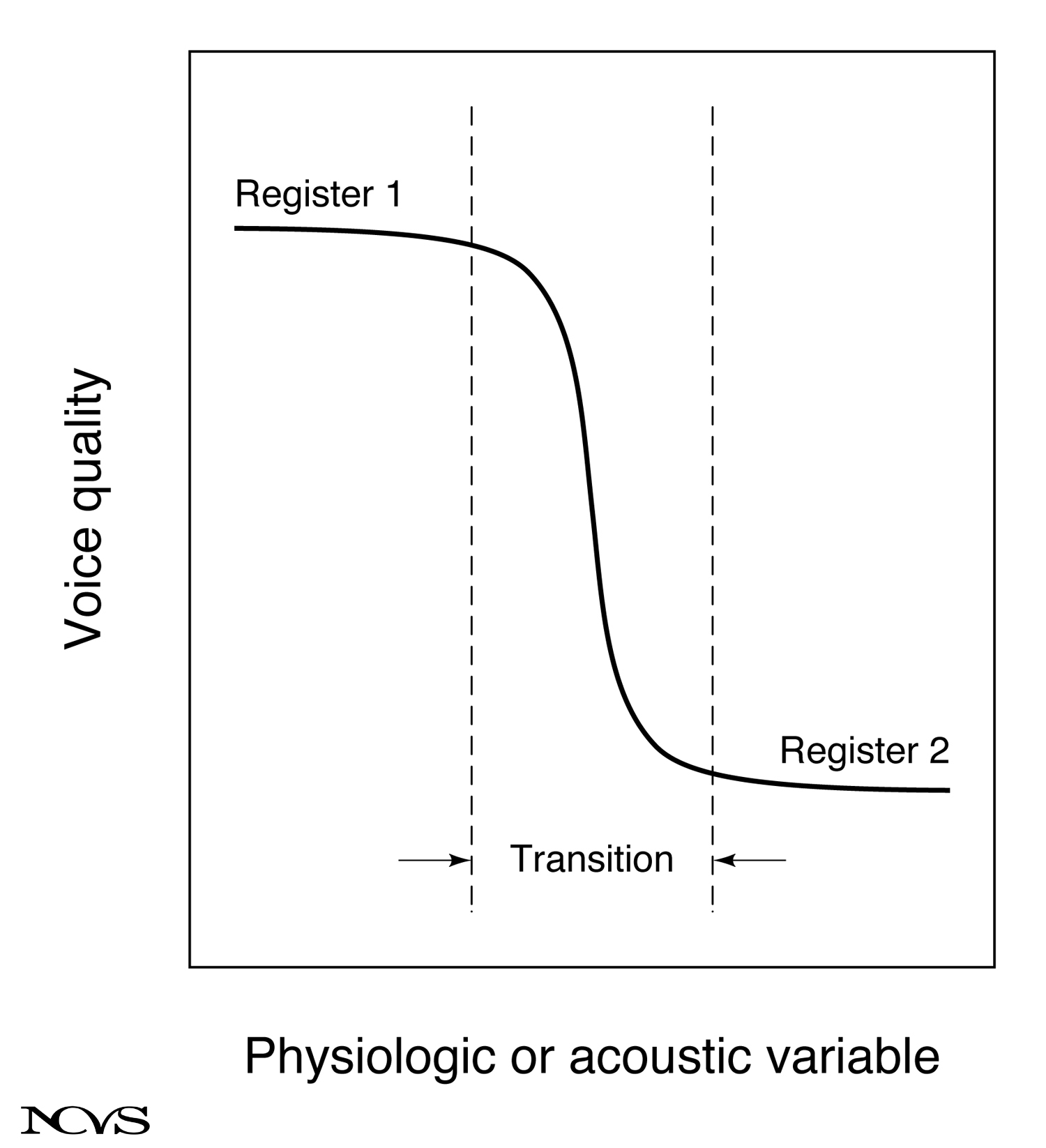 Figure 10.1: General description of a vocal register transition as a quantal (abrupt) change in vocal quality when a physiologic or acoustic variable is changed continuously.
The key characteristics of this quantal phenomenon include:
- Plateaus: Regions where vocal quality remains relatively stable despite changes in control variables
- Abrupt Transitions: Sharp boundaries between registers that are perceptually more relevant than the plateaus themselves
- Continuous Underlying Variables: The physiologic or acoustic parameters change gradually, but perception changes discretely
A one-register voice is effectively a no-register voice because there are no abrupt transitions to draw attention to a quality change.
Categorical Perception in Voice
Registration is at least partially related to categorical perception, the perception of discrete entities in a physical continuum (like perceiving a finite number of colors in a rainbow). This is one way the brain simplifies the number of items it must identify, store, and process.
Speech Perception Parallels
In speech perception, categorical changes have been observed between pairs of voiced-voiceless consonants, such as [b] versus [p] or [g] versus [k], when voice onset time or a formant transition into a following vowel is changed continuously. The acoustic variable (voice onset time or formant transition duration) changes smoothly, but perception switches abruptly from one phoneme to another.
Quantal Acoustic Changes
Quantal acoustic changes can occur as a result of a continuous change of a physiologic variable. This leads more directly to quantal perceptual changes. When the tongue is relatively close to the palate, for example, small changes in tongue height (a physiologic variable) can cause abrupt changes in vowel formants. A quick change in perception from [e] to [i] can then occur.
Two Types of Register Transitions
Research has identified two primary types of register transitions, each based on different acoustic mechanisms:
1. Temporal Gap Transitions
Below some fundamental frequency Fc (about 70 Hz), called the crossover frequency, the auditory system seems to be able to detect localized bursts of acoustic energy, followed by gaps of silence, within each glottal cycle. Above the crossover frequency, the perception is a continuous sound rather than a series of bursts and gaps.
Key acoustic variable: Fundamental frequency (F₀), provided the decay of energy occurs over a constant interval of time.
Primary register: This mechanism explains the transition between pulse register (vocal fry) and modal register.
2. Spectral Slope Transitions
An abrupt change in the spectral slope may result from a small change in the separation between the vocal folds. The spectral slope measures the decrease in amplitude of successive harmonics of the voice source, usually in dB/octave.
Acoustic analogy: The sound changes from “brassy” to “fluty.” A brass instrument has many harmonics (a shallow spectral slope), whereas a flute has fewer harmonics (a steep spectral slope).
Key physiologic variable: The degree of vocal fold adduction, particularly at the inferior portion of the folds.
Primary register: This mechanism explains the transition between modal and falsetto registers.
Demands for Registration
Registration of vocal quality with either a temporal gap or spectral slope is brought about by one of three demands:
Linguistic Demands
Abrupt changes to creaky, falsetto, or fry qualities are sometimes needed for phonetic contrasts in speech, especially in some African and Asian languages. Different languages use register changes as phonologically distinctive features.
Aesthetic Demands
For aesthetic purposes, registration is employed heavily in:
- Yodeling
- Country-western singing
- Hawaiian folk singing
- Musical theater
- Various contemporary music styles
Physiologic Demands
Sometimes involuntary registration occurs as a result of biomechanical and acoustic constraints on the voice. As described by the body-cover theory of pitch control:
- A “lighter” quality (falsetto register) is often a natural consequence of an elongated and stiffened cover (primarily the ligament) at higher pitches
- A “heavier quality” (modal or chest register) is a necessity with a reduced vocal fold length, a lax cover, and full involvement of the vocal fold body in vibration
Theoretical Framework
Any theory of vocal registers must take into account both voluntary and involuntary transition phenomena:
- Pulse register can be produced at will by men, women, and children
- Spectral slope transitions can be induced or inhibited over a large range of fundamental frequencies by skilled vocalists
- These transitions also exhibit certain invariances in F₀ when unattended to
- Vocal pedagogues have charted the location of “natural” register breaks on the keyboard for various voice classifications
Summary
The perception of vocal registers exemplifies the brain’s ability to categorize continuous acoustic phenomena into discrete perceptual categories. Two primary mechanisms underlie register perception: temporal gap transitions (related to fundamental frequency and formant decay) and spectral slope transitions (related to glottal configuration and harmonic content). These transitions occur in response to linguistic, aesthetic, or physiologic demands and can be either voluntary or involuntary. Understanding the perceptual basis of registers provides a foundation for exploring their physiological mechanisms and practical applications in voice training and clinical practice.
Key Takeaways
- ✅ Vocal registers are perceptually distinct regions of vocal quality characterized by quantal (stair-step) transitions between plateaus
- ✅ Register perception is an example of categorical perception, where the auditory system simplifies continuous acoustic changes into discrete categories
- ✅ Two primary transition types exist: temporal gap transitions (pulse-modal) and spectral slope transitions (modal-falsetto)
- ✅ Temporal gap transitions occur around 70 Hz and depend on the relationship between fundamental frequency and formant decay time
- ✅ Spectral slope transitions result from changes in vocal fold adduction affecting the high-frequency harmonic content
- ✅ Registration serves linguistic, aesthetic, and physiologic functions in voice production
- ✅ The transitions are perceptually more relevant than the plateaus themselves in defining register categories
Related Topics
- Temporal Gap and Spectral Slope
- The Pulse-Modal Transition
- The Modal-Falsetto Transition
- Involuntary Register Transitions: Two Hypotheses
- Vocal Fold Body-Cover Theory
Further Reading
- Stevens, K. (1972). The quantal nature of speech: Evidence from articulatory-acoustic data. In E. David and P. Denes (Eds.), Human communication: A unified view. New York: McGraw-Hill.
- Cooper, F., Delattre, P., Liberman, A., Borst, J., & Gerstman, L. (1952). Some experiments on the perception of synthetic speech sounds. Journal of the Acoustical Society of America, 24, 597-606.
- Hollien, H. (1974). On vocal registers. Journal of Phonetics, 2, 125-143.
- Keidar, A., Hurtig, R., & Titze, I. (1987). The perceptual nature of vocal register change. Journal of Voice, 1(3), 223-233.
- Laver, J. (1991). The gift of speech: Papers in the analysis of speech and voice. Edinburgh: Edinburgh University Press.