Register Equalization by Vocal Tract Adjustments
Vocal tract adjustments provide powerful tools for register equalization by modifying the acoustic load on the vocal folds, enhancing or dampening specific harmonics, and compensating for register-related spectral changes. While laryngeal and respiratory strategies address register transitions at their source, vocal tract modifications shape the radiated sound to create perceptual continuity across registers, offset subglottal resonance effects, and optimize acoustic efficiency throughout the range. Strategic formant tuning, vowel modification, pharyngeal space adjustments, and lip-jaw positioning enable skilled vocalists to maintain consistent tone quality across passaggio zones, blend registers seamlessly, and project effectively despite fundamental changes in laryngeal vibratory patterns.
Formant Tuning Across Register Transitions
Aligning formant frequencies with voice source harmonics enhances acoustic output and can stabilize register transitions.
Principles of Formant-Harmonic Interaction
Source-Filter Theory Application
Acoustic foundations:
- Voice source generates harmonics at F₀, 2F₀, 3F₀, etc.
- Vocal tract filters modify harmonic amplitudes
- Formants amplify nearby harmonics
- Radiated spectrum = source × filter × radiation
- Register affects source spectrum
- Formant tuning optimizes filter response
Benefits of Harmonic-Formant Alignment
When harmonic aligns with formant:
- Dramatic amplitude boost (10-30 dB)
- Increased acoustic efficiency
- Reduced phonation threshold pressure
- Enhanced projection
- More stable vocal fold vibration
- Can offset register-related spectral changes
Formant Tuning Strategies
First Formant Tuning (F1)
Vowel modification approach:
- F1 determined primarily by jaw/tongue height
- Low vowels: high F1 (~700-900 Hz)
- High vowels: low F1 (~300-400 Hz)
- Tuning strategy: adjust vowel toward F₀
- Most effective when F₀ > 300 Hz (soprano range)
- Example: tune [a] toward [ɔ] to lower F1
Second Formant Tuning (F2)
Tongue position effects:
- F2 determined by tongue front-back position
- Front vowels: high F2 (~2000-2500 Hz)
- Back vowels: low F2 (~800-1200 Hz)
- Less commonly tuned than F1
- Can enhance specific voice qualities
- Style-dependent application
Singer’s Formant Region (F3-F5 Clustering)
Professional technique:
- Formants F3, F4, F5 cluster around 2500-3500 Hz
- Creates spectral peak in efficient radiation region
- Enhanced projection without increased effort
- Achieved through pharyngeal narrowing
- Compatible with both modal and falsetto
- “Ring” or “squillo” in classical singing
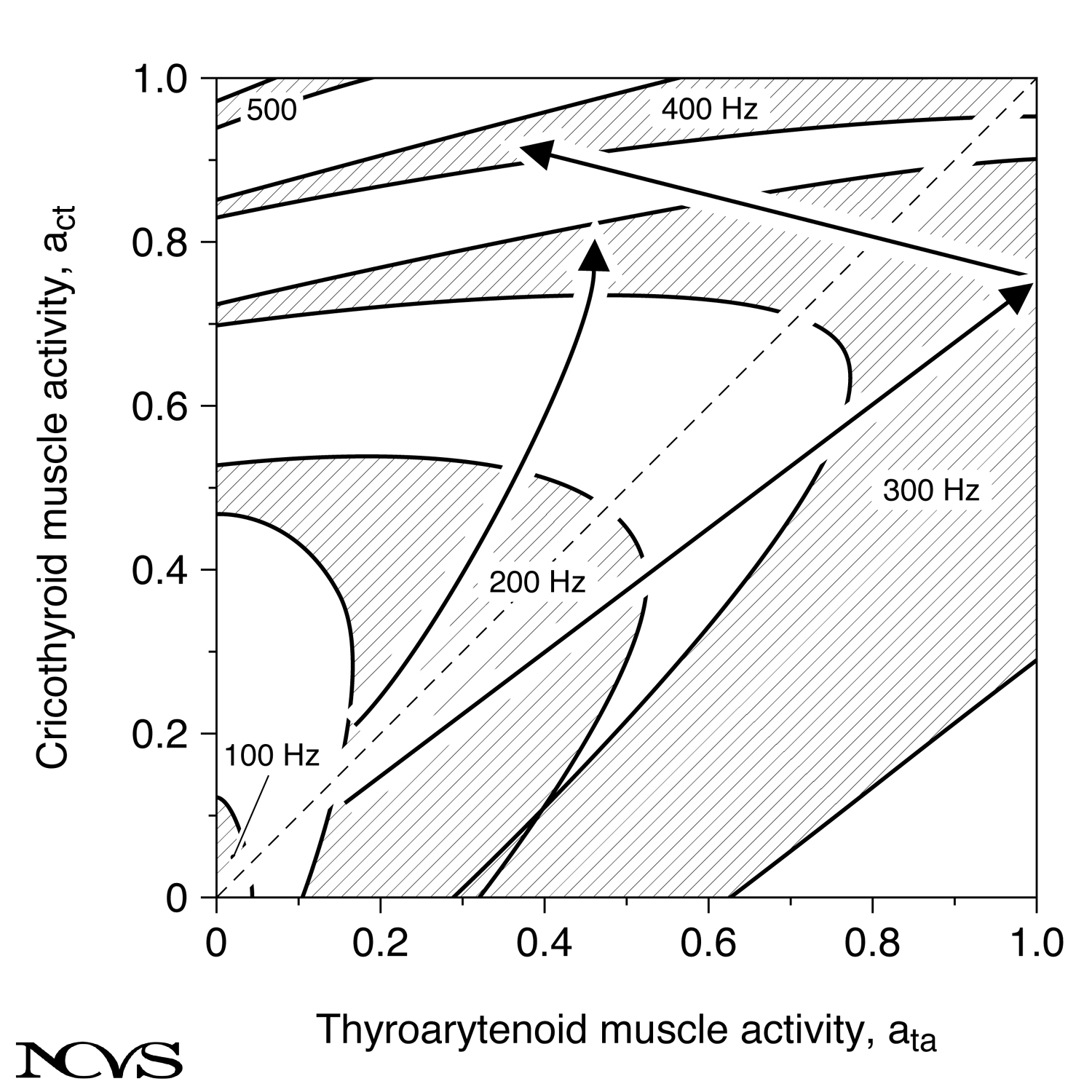 Figure 10.11: Spectrograms showing formant tuning strategies across register transitions with vowel modifications aligning formants to compensate for spectral slope changes, enhancing acoustic output continuity despite source spectrum differences between modal and falsetto registers.
Vowel Modification Techniques
Systematic vowel adjustments enable register equalization and acoustic optimization.
Traditional Vowel Modification
Ascending Through Range
Classical approach:
- Low range: pure, open vowels
- [i], [ɛ], [a], [ɔ], [u] unmodified
- Mid-range (approaching primo passaggio): slight modifications
- [i] → [ɪ], [ɛ] → [e], [a] → [ɑ] or [ɔ]
- Upper range (secondo passaggio and beyond): significant modifications
- All vowels trend toward [ɔ] or schwa-like quality
- Maintains acoustic efficiency
- Reduces laryngeal strain
The “Covering” Concept
Pedagogical tradition:
- “Covering” or “rounding” vowels in upper range
- Acoustically: lowering F1, darkening timbre
- Physiologically: may involve laryngeal lowering
- Prevents excessive brightness/strain
- Facilitates register blending
- Style-specific application (more in opera, less in musical theater)
Vowel-Specific Strategies
[i] (High Front Unrounded)
Challenges and modifications:
- Very low F1 (~300 Hz), very high F2 (~2300 Hz)
- Difficult in upper range (F1-F₀ mismatch)
- Modification: [i] → [ɪ] → [e] → [ø]
- Raises F1 progressively
- Enables higher notes
- Maintains intelligibility
[a] (Low Central)
Tuning approach:
- High F1 (~700-900 Hz)
- Excellent for F1-F₀ matching in soprano range
- Modification: [a] → [ɑ] → [ɔ]
- Slight lowering of F1
- Darker, rounder quality
- Reduces excessive brightness
[u] (High Back Rounded)
Strategic use:
- Low F1 (~300 Hz), low F2 (~800 Hz)
- Dark, covered quality naturally
- Useful for equalizing with other vowels
- Modification often minimal
- Can serve as target for other vowels
- “Dark” vocal production
Resonance Strategies: Covered and Open Sounds
The degree of vocal tract openness and pharyngeal space affects register stability and acoustic characteristics.
Covered (Dark, Round) Production
Acoustic Characteristics
Covered sound features:
- Lowered formant frequencies (especially F1)
- Darker, rounder timbre
- Reduced high-frequency energy
- More similar to falsetto spectral slope
- Can blend registers perceptually
- “Covered” passaggio negotiation
Articulatory Adjustments
Creating covered sound:
- Pharyngeal widening
- Laryngeal lowering (1-2 cm)
- Soft palate raising
- Tongue root retraction
- Lip rounding/protrusion
- “Megaphone” vocal tract shape
Advantages for Register Equalization
Benefits:
- Reduces acoustic contrast between modal and falsetto
- Facilitates smooth spectral transition
- Lowers acoustic load on vocal folds
- Reduces likelihood of pressed phonation
- Enables higher F₀ in modal register
- Traditional approach in classical singing
Open (Bright, Clear) Production
Acoustic Characteristics
Open sound features:
- Higher formant frequencies
- Brighter, more forward timbre
- Enhanced high-frequency energy
- Emphasizes register differences
- “Open” or “clear” production
- More common in contemporary styles
Articulatory Adjustments
Creating open sound:
- Pharyngeal narrowing
- Laryngeal neutral or raised position
- Hard palate focus
- Tongue forward position
- Lip spreading
- Smaller, more compact vocal tract
Style-Dependent Use
Application contexts:
- Musical theater: often open production
- Contemporary commercial music: mixed approaches
- Classical opera: covered in upper range
- Folk/country: open production common
- Aesthetic choice
- Affects register management strategy
Pharyngeal Adjustments
The pharynx plays a critical role in register equalization and acoustic shaping.
Pharyngeal Width and Length
Width Adjustments
Effects of pharyngeal expansion:
- Lowers all formant frequencies
- Creates darker timbre
- Reduces acoustic load
- Facilitates falsetto-like quality
- Can ease passaggio navigation
- Requires active control
Length Adjustments
Laryngeal height effects:
- Lowered larynx: lengthens vocal tract, lowers formants
- Neutral larynx: balanced, natural production
- Raised larynx: shortens vocal tract, raises formants
- Register interactions complex
- Individual optimal positions vary
- Excessive manipulation problematic
Singer’s Formant Development
Pharyngeal Narrowing at Larynx Level
Creating the “ring”:
- Narrowing at lower pharynx (just above larynx)
- Width 6:1 ratio with lip opening (epilarynx tube)
- Clusters F3, F4, F5 around 2500-3500 Hz
- Enhanced projection
- Characteristic of trained opera singers
- Compatible with register equalization
Training the Singer’s Formant
Exercises:
- “Hooty” or “witchy” onset quality
- Pharyngeal narrowing sensation
- Megaphone hand position
- Combine with covered vowels
- Systematic practice
- Individual anatomical variation
Lip and Jaw Positioning
Articulatory gestures at the mouth opening affect formants and acoustic efficiency.
Lip Adjustments
Rounding and Protrusion
Acoustic effects:
- Lip rounding lowers all formants
- Protrusion lengthens vocal tract
- Combined effect enhances darkening
- Useful for covering upper range
- Facilitates [u], [o] production
- Can equalize with unrounded vowels
Spreading and Retraction
Contrasting approach:
- Lip spreading raises formants slightly
- Brightens timbre
- Emphasizes forward placement
- Useful for [i], [e] production
- Style-dependent application
- Less common in classical upper range
Jaw Opening
Degree of Opening
Strategic jaw use:
- Wider opening: higher F1, brighter sound
- Narrower opening: lower F1, darker sound
- Must balance with intelligibility
- Excessive opening: tension, pitch issues
- Insufficient opening: muffled, constricted
- Optimal varies by pitch and vowel
Jaw Stability Through Passaggio
Coordination principle:
- Maintain relatively stable jaw position
- Avoid sudden jaw movements at transitions
- Prevents acoustic discontinuities
- Allows gradual vowel modification
- Reduces visual cues of register change
- Develops with awareness and practice
Integrating Vocal Tract and Laryngeal Strategies
Successful register equalization combines vocal tract and laryngeal adjustments.
Coordinated Approach
Example: Ascending Through Primo Passaggio
Integrated strategy:
- Laryngeal adjustments:
- Gradual CT-TA balance shift
- Maintain optimal adduction
- Coordinate pressure with laryngeal changes
- Vocal tract adjustments:
- Progressive vowel modification toward darker sound
- Maintain pharyngeal space
- Adjust formants for acoustic efficiency
- Result: smooth, seamless transition with consistent tone quality
Balancing Multiple Factors
Avoiding Over-Manipulation
Cautions:
- Excessive darkening: muffled, unclear diction
- Excessive brightening: strained, harsh quality
- Too much focus on mechanics: loss of musicality
- Individual optimal balance
- Style-appropriate choices
- Natural, efficient production ideal
Clinical Applications
Vocal tract adjustments support therapeutic goals in voice disorders.
Assessment of Vocal Tract Function
Evaluation Components
Clinical measures:
- Vowel formant analysis
- Spectral analysis across range
- Visual assessment of articulatory patterns
- Patient awareness of resonance
- Flexibility in modifying vocal tract shape
- Integration with laryngeal function
Therapeutic Vowel Modification
Facilitating Register Access
Clinical strategies:
- Use vowel modification to access difficult registers
- Darker vowels facilitate falsetto
- Brighter vowels may support modal
- Systematic exploration of vowel effects
- Patient education about acoustic principles
- Integration with overall treatment plan
Resonance Therapy
Enhancing Projection and Efficiency
Techniques:
- Forward focus/resonance exercises
- Humming and nasal consonants
- Semi-occluded vocal tract exercises
- Vocal tract shaping awareness
- Optimizing acoustic efficiency
- Reducing phonatory effort
Summary
Vocal tract adjustments enable register equalization by modifying acoustic load on vocal folds, enhancing specific harmonics through formant tuning, and compensating for register-related spectral changes while laryngeal strategies address transitions at source. Formant tuning aligns vocal tract resonances with voice source harmonics providing 10-30 dB amplitude boost, increased efficiency, and enhanced stability; first formant tuning adjusts vowel height (jaw position) particularly effective when F₀ exceeds 300 Hz, while singer’s formant development clusters F3-F5 around 2500-3500 Hz through pharyngeal narrowing creating characteristic “ring” enabling projection without increased effort.
Vowel modification follows systematic patterns ascending through range with pure vowels in low range, slight modifications approaching primo passaggio ([i] → [ɪ], [a] → [ɑ]), and significant darkening in upper range (all vowels trending toward [ɔ]) maintaining acoustic efficiency while reducing laryngeal strain; “covering” concept involves lowering F1 and darkening timbre through laryngeal lowering, pharyngeal widening, and lip rounding, facilitating register blending particularly in classical singing. Covered production (dark, round) lowers formants reducing acoustic contrast between modal and falsetto while open production (bright, clear) raises formants emphasizing register differences, with style-dependent application ranging from classical covered approach to contemporary commercial open strategies.
Pharyngeal adjustments include width expansion lowering formants and creating darker timbre, length modification through laryngeal height changes (lowered lengthens tract, raised shortens), and singer’s formant development through lower pharyngeal narrowing at 6:1 ratio with lip opening. Lip and jaw positioning contribute through rounding/protrusion lowering formants for covering versus spreading/retraction raising formants for brightness, with strategic jaw opening balancing F1 manipulation against intelligibility requirements and stability through passaggio preventing acoustic discontinuities. Integration coordinates vocal tract darkening, pharyngeal space maintenance, and formant tuning with laryngeal CT-TA balance shifts, optimal adduction, and pressure coordination achieving smooth seamless transitions with consistent tone quality; clinical applications include vowel modification facilitating register access, resonance therapy enhancing projection and efficiency, and patient education about acoustic principles optimizing voice function across disorders.
Key Takeaways
- ✅ Formant tuning aligns vocal tract resonances with harmonics providing 10-30 dB boost; F1 tuning through vowel height adjustment most effective above 300 Hz
- ✅ Singer’s formant clusters F3-F5 at 2500-3500 Hz via pharyngeal narrowing enabling projection without increased effort
- ✅ Vowel modification ascends from pure vowels through slight darkening at primo to significant modification in upper range ([ɔ]-like quality)
- ✅ Covering lowers formants through laryngeal lowering, pharyngeal widening, lip rounding; reduces modal-falsetto acoustic contrast
- ✅ Open production raises formants emphasizing brightness; style-dependent choice between covered (classical) and open (contemporary)
- ✅ Pharyngeal width expansion darkens timbre; singer’s formant requires 6:1 lower pharynx:lip width ratio
- ✅ Lip rounding/protrusion lowers formants darkening sound; jaw opening raises F1 balancing brightness with intelligibility
- ✅ Integration coordinates vocal tract adjustments with laryngeal CT-TA shifts achieving seamless transitions and consistent tone quality
Related Topics
- Register Equalization with Laryngeal Adjustments and Lung Pressure
- Clinical and Pedagogical Issues
- Formant Tuning
- Vocal Ring (Singer’s Formant)
- Vowel Shapes
Further Reading
- Sundberg, J. (1987). The Science of the Singing Voice. DeKalb, IL: Northern Illinois University Press.
- Miller, D. G. (2008). Resonance in Singing: Voice Building through Acoustic Feedback. Princeton, NJ: Inside View Press.
- Joliveau, E., Smith, J., & Wolfe, J. (2004). Tuning of vocal tract resonance by sopranos. Nature, 427, 116.
- Titze, I. R., & Story, B. H. (1997). Acoustic interactions of the voice source with the lower vocal tract. Journal of the Acoustical Society of America, 101(4), 2234-2243.
- Sundberg, J., & Skoog, J. (1997). Dependence of jaw opening on pitch and vowel in singers. Journal of Voice, 11(3), 301-306.