Continuity Law of Incompressible Flow
The continuity law is perhaps the most intuitive of the conservation principles. It states that what flows into a pipe must flow out—matter is neither created nor destroyed within the system.
Statement of the Continuity Law
For incompressible flow (constant density) confined to a duct or pipe:
Flow is constant throughout the duct, regardless of cross-sectional area changes.
Mathematically:
v₁A₁ = v₂A₂ = constant = Uwhere:
- v₁ = particle velocity at location 1 (m/s)
- A₁ = cross-sectional area at location 1 (m²)
- v₂ = particle velocity at location 2 (m/s)
- A₂ = cross-sectional area at location 2 (m²)
- U = flow (m³/s)
Physical Interpretation
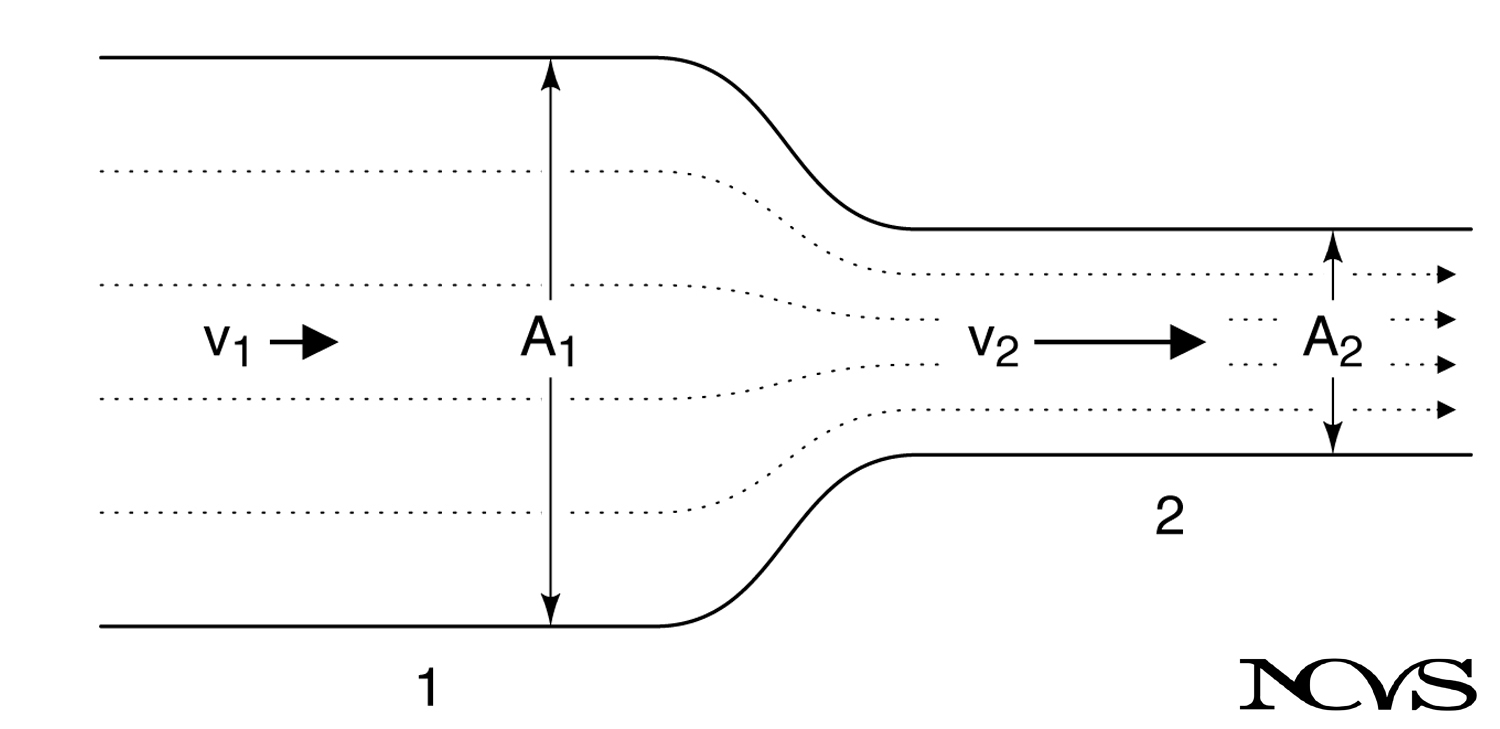 Figure 3.14: Flow lines in a constricted pipe. Locations 1 and 2 refer to different pipe diameters.
The Constriction Effect
Imagine flow through a pipe that narrows from location 1 (wider) to location 2 (narrower):
If fluid is incompressible:
- All fluid particles passing location 1 must also pass location 2
- No leakage through walls
- No accumulation between locations
Since the pipe narrows:
- Particles must speed up
- Maintains same number of particles per unit time
- Velocity increases proportionally to area decrease
The Velocity-Area Relationship
From the continuity equation:
v₂ = v₁(A₁/A₂)This reveals the inverse relationship:
- If area decreases by factor of 2, velocity increases by factor of 2
- If area decreases by factor of 10, velocity increases by factor of 10
- Smaller constrictions produce proportionally higher velocities
Application to the Glottis
The glottis represents the most dramatic constriction in the respiratory tract:
Typical Dimensions
Trachea:
- Diameter: ~2.5 cm
- Area: ~5 cm²
Glottis (during phonation):
- Width: ~0.3-0.5 cm
- Depth: ~1.0-1.5 cm
- Area: ~0.03-0.08 cm²
Area ratio: Approximately 100:1 (trachea to glottis)
Velocity Increase
For typical phonation with flow U = 0.1 L/s:
In trachea:
v₁ = U/A₁ = (0.1 L/s)/(5 cm²)
   = (0.0001 m³/s)/(0.0005 m²)
   = 0.2 m/s
At glottis:
v₂ = U/A₂ = (0.1 L/s)/(0.05 cm²)
   = (0.0001 m³/s)/(0.000005 m²)
   = 20 m/s
The air accelerates from 0.2 m/s to 20 m/s—a 100-fold increase—as it passes through the glottis!
Implications for Voice Production
High Velocities at Glottis
The dramatic velocity increase has several consequences:
- Bernoulli forces: High velocity creates low pressure (discussed in next section)
- Kinetic energy: Fast-moving air carries significant energy
- Turbulence: High velocities can trigger turbulent flow
- Acoustic generation: Rapid velocity changes create sound
Flow Conservation During Vibration
Even as the glottis opens and closes during vocal fold vibration:
Continuity still applies:
- Instantaneous flow equals v×A at any point
- Flow varies with glottal area changes
- Velocity inversely tracks area
Dynamic effects:
- As glottis opens: velocity decreases, flow increases
- As glottis closes: velocity increases, flow decreases
- Flow oscillation creates acoustic pulses
No Air “Storage”
The continuity law means:
- Air cannot accumulate in the vocal tract
- Subglottal pressure drives constant mass flow
- Vocal tract acts as flow-through system
- Supraglottal pressure remains near atmospheric
Traffic Analogy Revisited
Consider a two-lane highway merging to one lane:
Ideal traffic flow (incompressible):
- All cars entering must exit
- No cars created or destroyed
- When lanes merge, cars must travel twice as fast
Real traffic:
- Cars can “compress” (slow down, get closer)
- Creates traffic jams
- Flow becomes compressible
Air in speech:
- Pressures are small enough that air remains essentially incompressible
- Behaves more like ideal traffic than real traffic
- Continuity law applies well
Limitations
The continuity law assumes:
Incompressible Flow
Valid when:
- Pressure changes are small compared to atmospheric
- True for speech (≤3 kPa vs. 101 kPa atmospheric)
- Density remains essentially constant
Breaks down when:
- Pressures approach or exceed atmospheric
- Shock waves form (supersonic flow)
- Not relevant to normal phonation
Rigid Walls
Assumed:
- Duct walls don’t move
- No volume changes from wall compliance
Reality:
- Vocal tract walls can expand slightly
- Effect is generally small for flow calculations
- More important for acoustic resonance
No Leakage
Assumed:
- All flow through main duct
- No side branches
Reality:
- Nasal port can provide leakage path
- Must account for velopharyngeal opening when relevant
Summary
The continuity law states that incompressible flow remains constant throughout a duct system. Velocity and area are inversely related: v₁A₁ = v₂A₂. Application to the glottis reveals dramatic velocity increases (100-fold) as air accelerates through this narrow constriction. This velocity increase has profound implications for pressure forces (Bernoulli effect), energy transfer, and acoustic generation during phonation.
Key Takeaways
- ✅ Continuity law: v₁A₁ = v₂A₂ = U = constant for incompressible flow
- ✅ Velocity is inversely proportional to area: smaller constrictions produce higher velocities
- ✅ Glottal constriction accelerates air from ~0.2 m/s to ~20 m/s (100-fold increase)
- ✅ Flow conservation applies instantaneously, even during dynamic vocal fold vibration
Related Topics
Further Reading
- Titze, I. R. (2000). Principles of voice production (2nd ed.). National Center for Voice and Speech.
- Van den Berg, J., Zantema, J., & Doornenbal, P. (1957). On the air resistance and Bernoulli effect of the human larynx. Journal of the Acoustical Society of America, 29, 626-631.