The Pulmonary System
The pulmonary system consists of the lungs and respiratory airways. Understanding this system’s structure and function is essential for comprehending how aerodynamic power is generated and controlled during phonation.
System Components
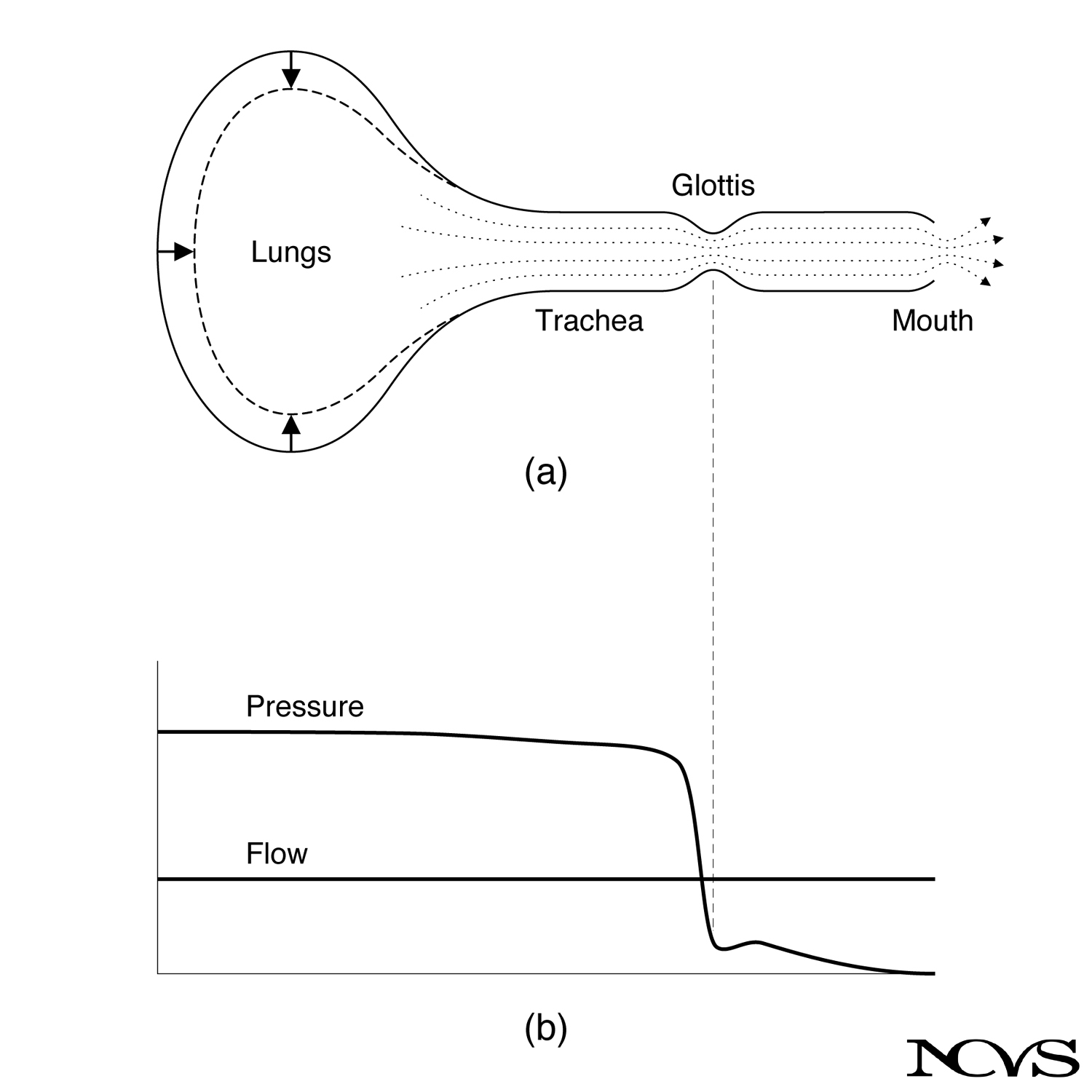 Figure 3.6: (a) Schematic of the pulmonary system. (b) Corresponding pressure and flow pattern for steady flow.
A simple schematic of the pulmonary system reveals major functional components:
The Lungs
The lungs serve as the primary reservoir and power source for phonation. They consist of:
- Millions of alveoli (air sacs)
- Branching bronchioli (airways)
- Elastic tissue and membranes
- Blood vessels for gas exchange
The Trachea
The trachea (windpipe) connects the lungs to the larynx. It’s a tube approximately 12 cm long and 2.5 cm in diameter, reinforced with C-shaped cartilage rings that prevent collapse during pressure changes.
Pressure in the trachea is nearly identical to lung pressure during most conditions because the trachea offers relatively little flow resistance compared to the glottis.
The Glottis
The glottis is the space between the vocal folds. During phonation, it serves as the primary valve regulating airflow. The glottis can:
- Open widely during inspiration
- Close completely for airway protection
- Partially close with rapid oscillation during phonation
- Adjust opening size to regulate airflow
The Upper Respiratory Tract (Vocal Tract)
The upper respiratory tract extends from the glottis to the lips, encompassing:
- Pharynx (throat)
- Oral cavity (mouth)
- Nasal passages (when velum is lowered)
This region is also called the vocal tract because it strongly influences the acoustic characteristics of voice. While not part of the pulmonary system proper, it’s intimately connected to respiratory function during speech.
The Bellows Analogy
The thorax and abdomen, together with the lungs, act as a bellows for producing an airstream:
Bellows Function
- Expansion phase (inspiration): Creates negative pressure, drawing air in
- Compression phase (expiration): Creates positive pressure, pushing air out
- Valve control (glottis): Regulates flow during compression
Differences from Simple Bellows
Unlike simple bellows, the respiratory system:
- Contains elastic elements that store energy
- Operates under neural control with reflexive adjustments
- Coordinates with laryngeal valving
- Maintains gas exchange functions simultaneously
Pressure and Flow Patterns
During Phonation
As shown in Figure 3.6b, during steady phonation:
Pressure:
- High in the lungs
- Nearly the same in the trachea
- Drops sharply across the glottis
- Near zero in the vocal tract
Flow:
- Constant throughout the airway (continuity principle)
- Relatively small during phonation (~0.1-0.2 L/s)
- Much larger during inspiration (~1.0 L/s)
The Glottis as Primary Constriction
The glottis acts as the major flow resistance point. This is evident from the sharp pressure drop across it. Whereas tracheal pressure nearly equals lung pressure, pressure above the glottis is nearly atmospheric (zero relative pressure).
The glottal constriction serves multiple functions:
- Power conversion: Transforms steady aerodynamic flow to oscillatory acoustic flow
- Flow regulation: Controls air expenditure rate
- Airway protection: Prevents foreign matter from entering lungs
- Pressure building: Allows subglottal pressure development
The Larynx as Valve
The larynx serves as a sophisticated valve system with multiple functions beyond phonation:
Emergency Valving
The larynx provides final protection for lung purity. Foreign particles that bypass nasal filtration trigger:
- Epiglottis closure (seals laryngeal entrance)
- Complete glottal adduction (if particles enter)
- Cough reflex (forceful expulsion)
Flow Regulation During Breathing
Less dramatically but equally importantly, the larynx offers gentle resistance to airflow during normal respiration. Lung pressure varies greatly over the respiratory cycle, which would cause major flow fluctuations without regulation.
By varying glottal opening continuously—more closure for higher pressures, less closure for lower pressures—the pulmonary system regulates airflow to be relatively constant. This regulation occurs automatically through nervous system reflexes during both inspiration and expiration.
Integration with Thoracic Action
Laryngeal action and thoracic action are not independent. Reflexes tie them together into a functional unit. This integration means:
- Respiratory muscles and laryngeal muscles coordinate
- Changes in lung pressure trigger laryngeal adjustments
- Laryngeal resistance affects respiratory muscle activation
- Phonation may affect respiration and vice versa
This interconnection is crucial for understanding breath management in speech and singing.
Summary
The pulmonary system—comprising lungs, trachea, larynx, and upper airways—functions as an integrated unit for both respiration and phonation. The thorax and abdomen act as bellows, the glottis serves as a sophisticated valve, and neural control coordinates these elements. Understanding this system’s basic architecture and functional principles provides the foundation for analyzing breathing mechanics, aerodynamic power, and clinical applications.
Key Takeaways
- ✅ The pulmonary system includes lungs, trachea, larynx, and upper respiratory tract
- ✅ The thorax and abdomen function as bellows, with the glottis as the primary valve
- ✅ Pressure drops sharply across the glottis during phonation while flow remains constant
- ✅ Laryngeal and thoracic actions are coordinated through reflexive neural control
Related Topics
Further Reading
- Hixon, T. J. (1987). Respiratory functions in speech. In T. J. Hixon & Collaborators (Eds.), Respiratory function in speech and song (pp. 1-54). Boston: College-Hill Publications.
- Hixon, T. J. (1973). Respiratory function in speech. In F. Minifie, T. Hixon, & F. Williams (Eds.), Normal aspects of speech, hearing, and language (pp. 73-125). Englewood Cliffs, NJ: Prentice Hall.