The Physical Process of Breathing (Boyle’s Law)
Breathing involves complex mechanical interactions between muscles, elastic tissues, and gas physics. Understanding these processes is fundamental to managing breath for voice production.
Boyle’s Law
A physical law useful for conceptualizing the relationship between lung volume and lung pressure is Boyle’s law (named after British scientist Robert Boyle, 1627-1691).
Statement of Boyle’s Law
In a soft-walled enclosure at constant temperature, pressure and volume are inversely related.
Mathematically:
PV = constantwhere P is pressure and V is volume.
This is a special case of the ideal gas law (PV = nRT) with temperature T held constant.
Implications for Breathing
Boyle’s law predicts:
- When lung volume increases → lung pressure decreases
- When lung volume decreases → lung pressure increases
This inverse relationship is the fundamental principle underlying breathing mechanics.
The Inspiratory Process
Muscular Actions
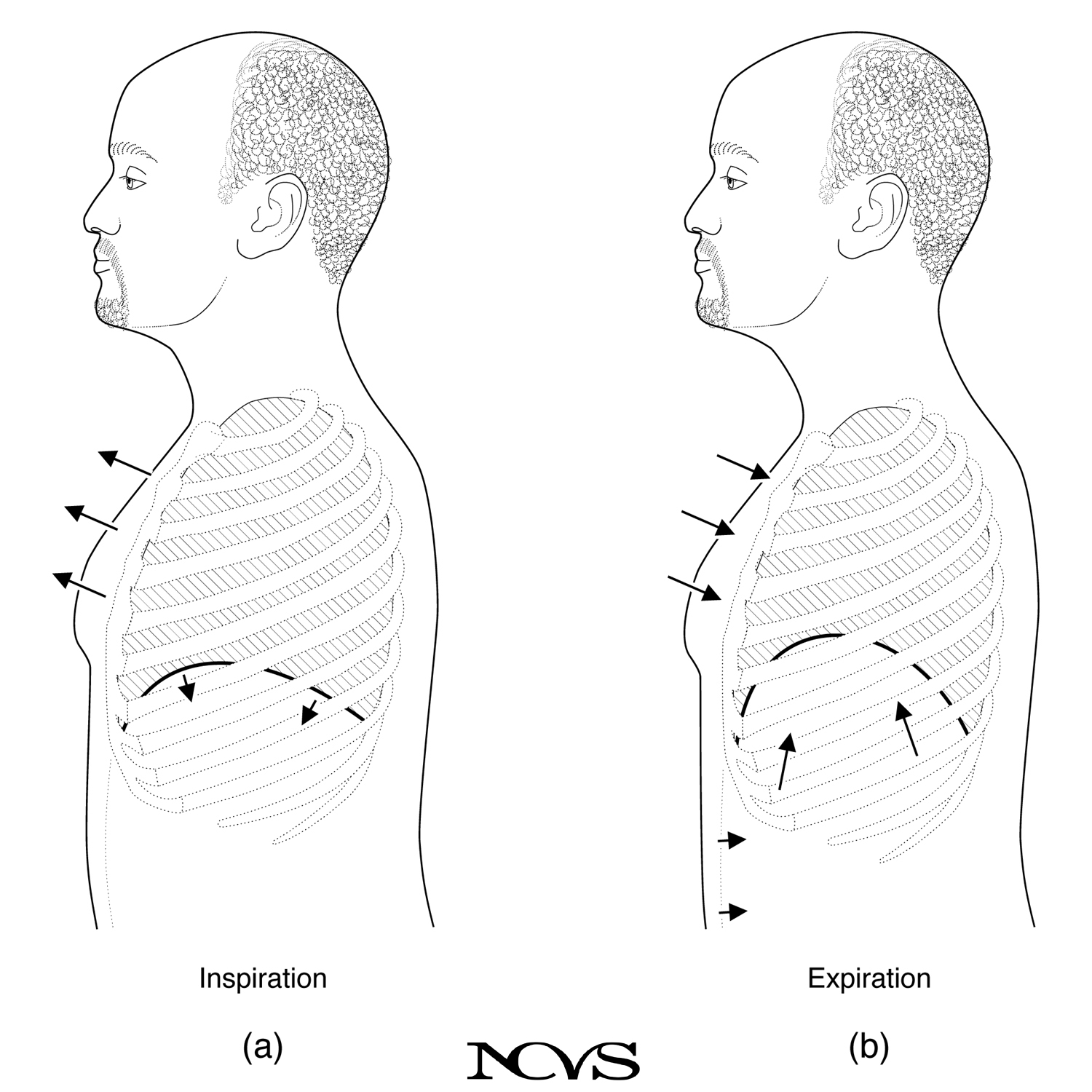 Figure 3.8: Movement of chest wall, diaphragm, and abdomen for (a) inspiration and (b) expiration.
Primary inspiratory muscles:
-
Diaphragm
- Dome-shaped muscle separating thorax from abdomen
- Contracts downward, flattening its curvature
- Increases vertical dimension of thorax
- Pushes abdominal contents downward and outward
-
External Intercostal Muscles
- Run between ribs
- Contract to lift ribs upward and outward
- Movement like lifting a bucket handle
- Increases anteroposterior dimension of thorax
Figure 3.9: Intercostal muscles. (a) External intercostals, lateral view.
The Stepwise Model
Consider inspiration as a series of valving operations:
- Glottis closes
- Diaphragm contracts downward
- Rib cage expands
- Lung volume increases (mechanically forced)
- Lung pressure decreases (Boyle’s law)
- Glottis opens
- Air rushes in until pressure equalizes
- Process can repeat for deeper inspiration
Continuous Inspiration
In actual breathing, the glottis remains open. The stepwise process becomes continuous:
- Slightly negative lung pressure is maintained throughout inspiration
- Inspiratory flow continues until desired volume is reached
- Glottis still serves as a valve, but to regulate rather than start/stop flow
- Flow rate is controlled by glottal opening and rate of thoracic expansion
The Expiratory Process
Muscular and Elastic Forces
Expiration involves multiple force sources:
Phase 1: Elastic Recoil Alone (high lung volumes)
- Lung tissue elasticity provides pressure
- Expanded rib cage provides recoil
- Diaphragm may remain contracted to control release
- No active expiratory muscle needed
Phase 2: Elastic Recoil + Internal Intercostals (mid lung volumes)
- Internal intercostal muscles activate
- Pull ribs together, decreasing thorax volume
- Supplements diminishing elastic recoil
Figure 3.9: (b) Internal intercostals, anterior view.
Phase 3: Active Muscular Compression (low lung volumes)
- Abdominal muscles contract
- Push viscera upward against diaphragm
- Compress lungs from below
- Overcome negative elastic recoil (compressed lungs resist further compression)
Pressure-Volume Relationships for Phonation
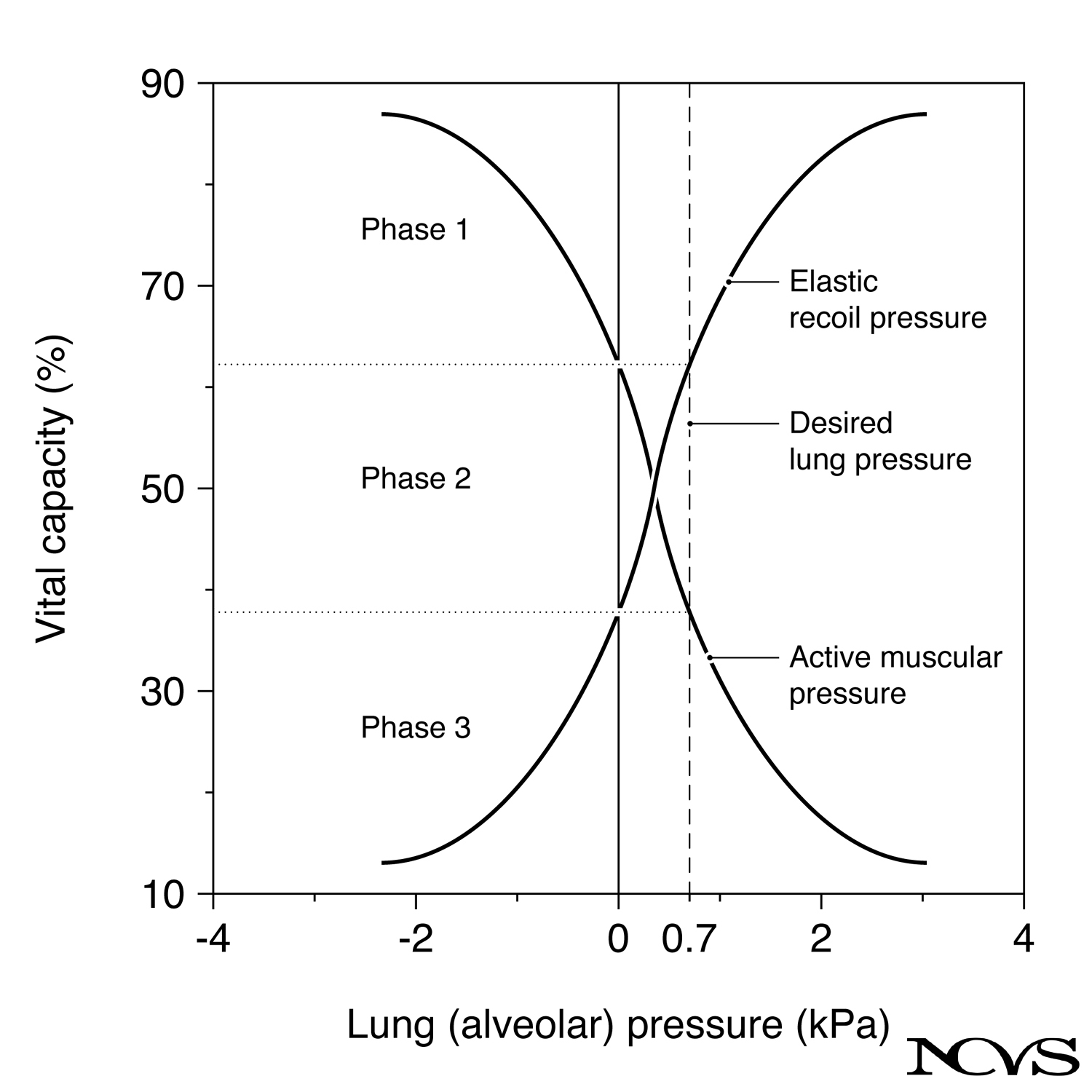 Figure 3.11: Pressure variations during expiration when a constant lung pressure of 0.7 kPa is desired. The three phases relate to muscle contributions.
For sustained phonation requiring constant lung pressure (e.g., 0.7 kPa):
Phase 1:
- Elastic recoil pressure > desired pressure
- Negative muscular pressure needed (diaphragm or external intercostals)
- Must “hold back” excessive recoil force
Phase 2:
- Elastic recoil pressure = desired pressure at beginning
- Increasingly positive muscular pressure needed as recoil diminishes
- Internal intercostals supplement recoil
Phase 3:
- Elastic recoil = zero (or negative)
- Large positive muscular pressure required
- Abdominals and internal intercostals provide force
The Motor Control Challenge
Achieving constant lung pressure (or constant airflow) for phonation is no simple motor task. It requires:
- Continuous monitoring of lung volume
- Graded activation of multiple muscle groups
- Smooth transitions between phases
- Anticipation of upcoming phrase requirements
- Integration with laryngeal control
The complexity increases for:
- Dynamic patterns (crescendo, decrescendo)
- Varying phrase lengths
- Different body postures
- Different pitch requirements
Coordination with the Larynx
The respiratory system and larynx don’t function independently. Neural reflexes coordinate:
Respiratory-Laryngeal Reflexes
- Changes in lung pressure trigger laryngeal adjustments
- Glottal resistance affects respiratory muscle activation
- Inspiration phase involves glottal widening
- Phonation onset requires precise timing
Implications for Training
Breath control training must address:
- Muscle coordination patterns
- Timing of muscle activation/relaxation
- Integration of respiratory and laryngeal control
- Adaptation to varying demands
Summary
Breathing mechanics are governed by Boyle’s law: volume increases cause pressure decreases and vice versa. Inspiration primarily involves diaphragm and external intercostal contraction, while expiration progresses through three phases utilizing elastic recoil, internal intercostals, and abdominal muscles. Maintaining constant lung pressure for phonation requires sophisticated motor coordination across multiple muscle groups. Understanding these mechanical principles is essential for effective breath management in voice production.
Key Takeaways
- ✅ Boyle’s law (PV = constant) governs pressure-volume relationships in the lungs
- ✅ Inspiration uses diaphragm and external intercostals; expiration has three distinct phases
- ✅ Constant lung pressure for phonation requires continuous muscle coordination
- ✅ Respiratory and laryngeal systems are integrated through neural reflexes
Related Topics
Further Reading
- Hixon, T. J. (1973). Respiratory function in speech. In F. Minifie, T. Hixon, & F. Williams (Eds.), Normal aspects of speech, hearing, and language (pp. 73-125). Englewood Cliffs, NJ: Prentice Hall.
- Leanderson, R., Sundberg, J., & von Euler, C. (1987). Effects of diaphragm activity in phonation. Transcripts of the Thirteenth Symposium: Care of the Professional Voice. New York: Voice Foundation.