Lung Volume
The size and capacity of the lungs directly impact respiratory function during speech and singing. Understanding lung volume components and their relationships is essential for analyzing breath management.
Components of Lung Volume
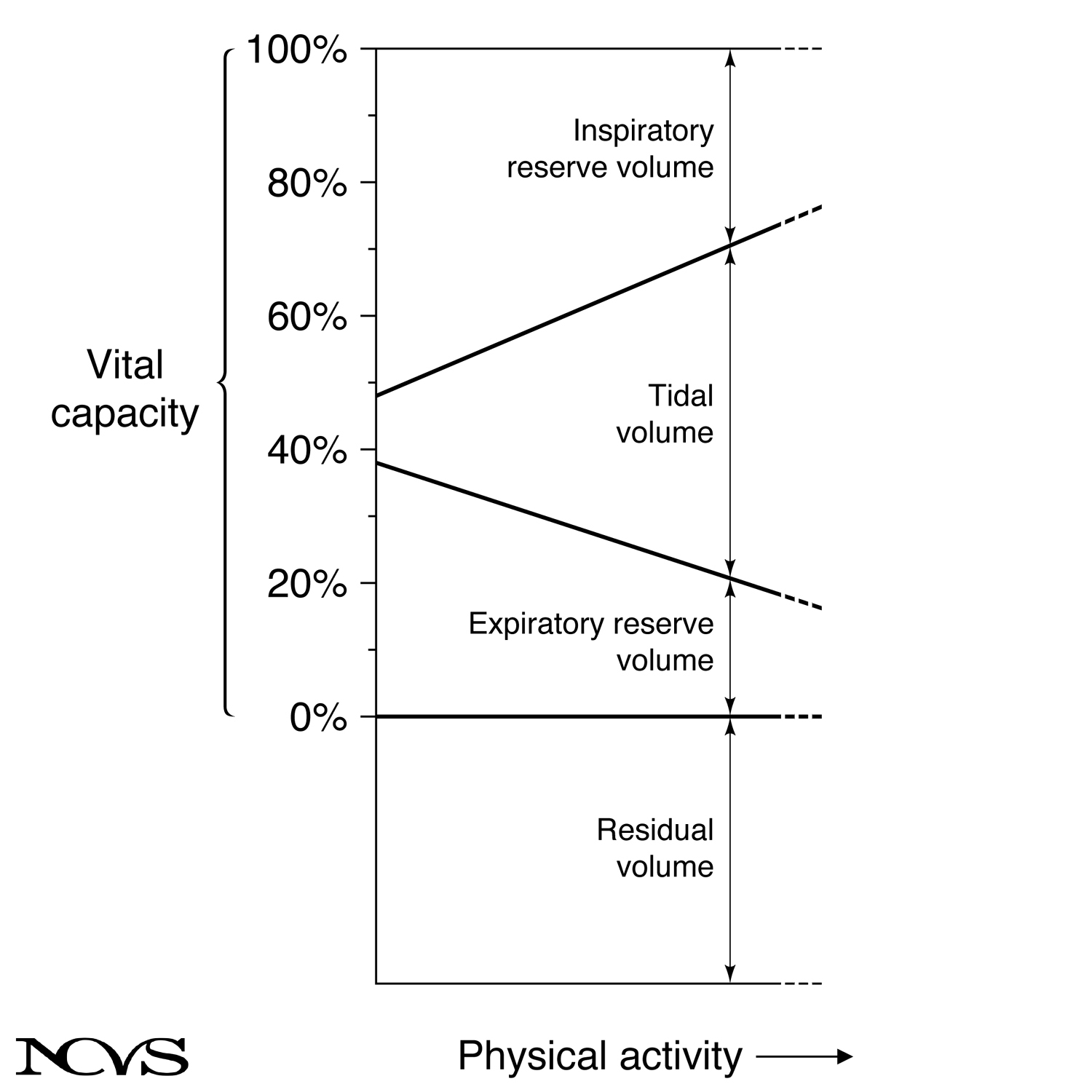 Figure 3.7: Lung volume in relation to vital capacity (100 percent). Physical activity (exertion) changes the tidal volume and reserve volumes.
Total Lung Capacity
Total lung capacity represents the maximum volume of air the lungs can hold. For an average adult, this is approximately 6-7 liters (about 1.5-2 gallons). This total divides into:
- Vital capacity (~4-5 liters)
- Residual volume (~2 liters)
Vital Capacity
Vital capacity is the maximum volume of air that can be voluntarily moved in and out of the lungs. It ranges from approximately 4 to 5 liters in average adults, with variations based on:
- Body size
- Sex (males typically larger than females)
- Age (decreases with aging)
- Physical fitness
- Posture
The vital capacity subdivides into three functional components:
1. Inspiratory Reserve Volume
The inspiratory reserve volume is the additional air that can be inhaled beyond normal tidal inspiration. This represents the “extra” capacity available for deep breaths during:
- Preparation for long phrases
- High-exertion speech or singing
- Physical exercise
2. Tidal Volume
The tidal volume is the amount of air breathed in and out during normal respiration. This varies dramatically with activity level:
- At rest: 10-15% of vital capacity (~0.5 liters)
- Moderate activity: 20-30% of vital capacity
- Vigorous exercise: 50% or more of vital capacity
- Peak competitive exercise: May utilize nearly all reserve capacity
For speech and singing, tidal volume typically falls between resting and moderate exercise levels, though long phrases may approach higher percentages.
3. Expiratory Reserve Volume
The expiratory reserve volume is the additional air that can be forcefully exhaled beyond normal tidal expiration. In singing, long phrases of continuous phonation may require nearly all of this reserve volume.
Residual Volume
The residual volume (~2 liters) can never be voluntarily expelled unless the lungs collapse. This volume:
- Remains constant regardless of activity
- Prevents alveolar collapse
- Maintains some gas exchange even during expiration
- Provides structural support to airways
Lung Volume and Physical Activity
As illustrated in Figure 3.7, physical activity profoundly affects how lung capacity is utilized:
At Rest (Low Activity)
- Tidal volume: Small (10-15% of vital capacity)
- Breathing rate: Slow (12-16 breaths/minute)
- Reserve volumes: Large and unused
- Total ventilation: Adequate for metabolic needs
Moderate Activity (Speaking, Light Exercise)
- Tidal volume: Moderate (20-30% of vital capacity)
- Breathing rate: Moderate (16-25 breaths/minute)
- Reserve volumes: Partially accessed
- Total ventilation: Increased proportionally
Vigorous Activity (Loud Speech, Heavy Exercise)
- Tidal volume: Large (40-60% of vital capacity)
- Breathing rate: High (25-40 breaths/minute)
- Reserve volumes: Substantially used
- Total ventilation: Maximally increased
Peak Output (Shouting, Competitive Exercise)
- Tidal volume: Maximum (approaching 100% of vital capacity)
- Breathing rate: Very high (40+ breaths/minute)
- Reserve volumes: Fully utilized
- Total ventilation: At physiological limits
Implications for Voice Production
Speech
Typical conversational speech uses relatively modest lung volumes:
- Tidal volume: 15-25% of vital capacity
- Phrase length: 1-5 seconds
- Inspiratory reserve: Rarely fully accessed
- Expiratory reserve: Partially used
Singing
Singing places greater demands on lung capacity:
- Tidal volume: 25-50% or more of vital capacity
- Phrase length: Often 5-20 seconds
- Inspiratory reserve: Frequently accessed for long phrases
- Expiratory reserve: May be substantially depleted
Professional singers develop:
- Efficient use of available lung volume
- Rapid inspiratory techniques (“catch-breath”)
- Strategies for managing long phrases within capacity constraints
Clinical Considerations
Measuring Vital Capacity
Vital capacity measurement (spirometry) is useful for:
- Assessing respiratory health
- Detecting lung disease
- Monitoring treatment effectiveness
- Establishing baselines for voice therapy
Factors Affecting Capacity
Vital capacity can be reduced by:
- Pulmonary disease (emphysema, fibrosis)
- Chest wall disorders
- Neuromuscular conditions
- Obesity
- Poor posture
Optimization Strategies
Vital capacity can be improved through:
- Aerobic exercise
- Respiratory muscle training
- Postural alignment
- Weight management
- Smoking cessation
Summary
Lung volume comprises vital capacity (4-5 liters) and residual volume (2 liters). Vital capacity subdivides into inspiratory reserve, tidal volume, and expiratory reserve. Physical activity dramatically affects how these components are utilized, with speech requiring moderate volumes and singing often demanding access to substantial reserve capacity. Understanding these relationships is essential for analyzing breath management in voice production.
Key Takeaways
- ✅ Total lung capacity (~6-7 L) = Vital capacity (~4-5 L) + Residual volume (~2 L)
- ✅ Tidal volume varies from 10-15% at rest to 50%+ during vigorous activity
- ✅ Speech typically uses 15-25% of vital capacity, singing often 25-50% or more
- ✅ Long singing phrases may require nearly all expiratory reserve volume
Related Topics
Further Reading
- Hixon, T. J. (1973). Respiratory function in speech. In F. Minifie, T. Hixon, & F. Williams (Eds.), Normal aspects of speech, hearing, and language (pp. 73-125). Englewood Cliffs, NJ: Prentice Hall.
- West, J. B. (1990). Respiratory physiology: The essentials (4th ed.). Baltimore: Williams & Wilkins.
- Dickson, D. R., & Maue-Dickson, W. (1982). Anatomical and physiological bases of speech. Boston: Little, Brown.