Airflow in Speech and Nonspeech
The respiratory cycle undergoes dramatic transformation when breathing serves phonation rather than purely metabolic needs. Understanding these differences is essential for voice training and clinical assessment.
Normal (Nonspeech) Breathing
Characteristics of Quiet Breathing
During rest, breathing follows a relatively symmetric pattern:
Inspiratory phase:
- Duration: 1-2 seconds
- Flow rate: 0.3-0.5 L/s
- Purpose: Oxygen intake
Expiratory phase:
- Duration: 2-3 seconds
- Flow rate: 0.2-0.3 L/s
- Purpose: Carbon dioxide elimination
Ratio: Inspiration/expiration approximately 1:1 to 1:2
Tidal volume: 10-15% of vital capacity (~0.5 L)
Laryngeal Role in Quiet Breathing
The larynx gently regulates airflow during normal respiration:
- Glottis varies continuously
- More closure for higher lung pressures
- Less closure for lower lung pressures
- Maintains relatively constant flow despite pressure variations
- Functions autonomically (unconscious control)
This regulation applies to both inspiration and expiration, smoothing the flow of air despite varying thoracic pressures.
Speech Breathing
The Asymmetry Problem
Speech introduces dramatic asymmetry to the breathing cycle:
Inspiratory phase:
- Duration: 0.5-1.0 seconds (rapid)
- Flow rate: 1.0-2.0 L/s (high)
- Purpose: Quick air intake between phrases
Expiratory phase:
- Duration: 1-5 seconds (prolonged)
- Flow rate: 0.1-0.2 L/s (reduced)
- Purpose: Sustained phonation
Ratio: Inspiration/expiration approximately 1:5 to 1:10
Why Asymmetry Matters
This asymmetry creates challenges for the respiratory system:
- Rhythmic disruption: Internal pacemakers are interrupted
- Irregular intervals: Linguistic/musical phrasing determines breath timing
- Motor reprogramming: Muscles must coordinate differently
- Dual function conflict: Gas exchange needs vs. phonatory demands
In most strenuous activities (rowing, swimming, running), rhythmic breathing is adjusted for optimal cardiopulmonary performance. Speech and singing, however, require linguistic or musical timing that may conflict with biological optimization.
Laryngeal Involvement in Speech
During phonation, the larynx becomes even more crucial for airflow regulation:
Increased resistance:
- Vocal folds adduct for voicing
- Greater restriction than in quiet breathing
- Higher lung pressure required
Active regulation:
- Glottal resistance adjusts continuously
- Compensates for changing lung pressure
- Maintains desired acoustic output
Refined control:
- Precise timing of onset and offset
- Coordination with articulation
- Integration with prosodic patterns
Singing Breathing
Singing places the most extreme demands on the respiratory system:
Extended Phrases
Duration:
- Typical: 5-10 seconds
- Long: 10-15 seconds
- Extreme: 15-20+ seconds
Implications:
- May require most of expiratory reserve
- Demands exceptional pressure control
- Necessitates efficient laryngeal valve
The “Catch Breath”
Rapid inspiration between long phrases requires:
Technique:
- Duration: 0.3-0.5 seconds
- Flow rate: 2.0-3.0 L/s or higher
- No airway constrictions
Strategy:
- Mouth and nose both open
- Rapid diaphragm and intercostal action
- Immediate readiness for phonation onset
Pressure Management
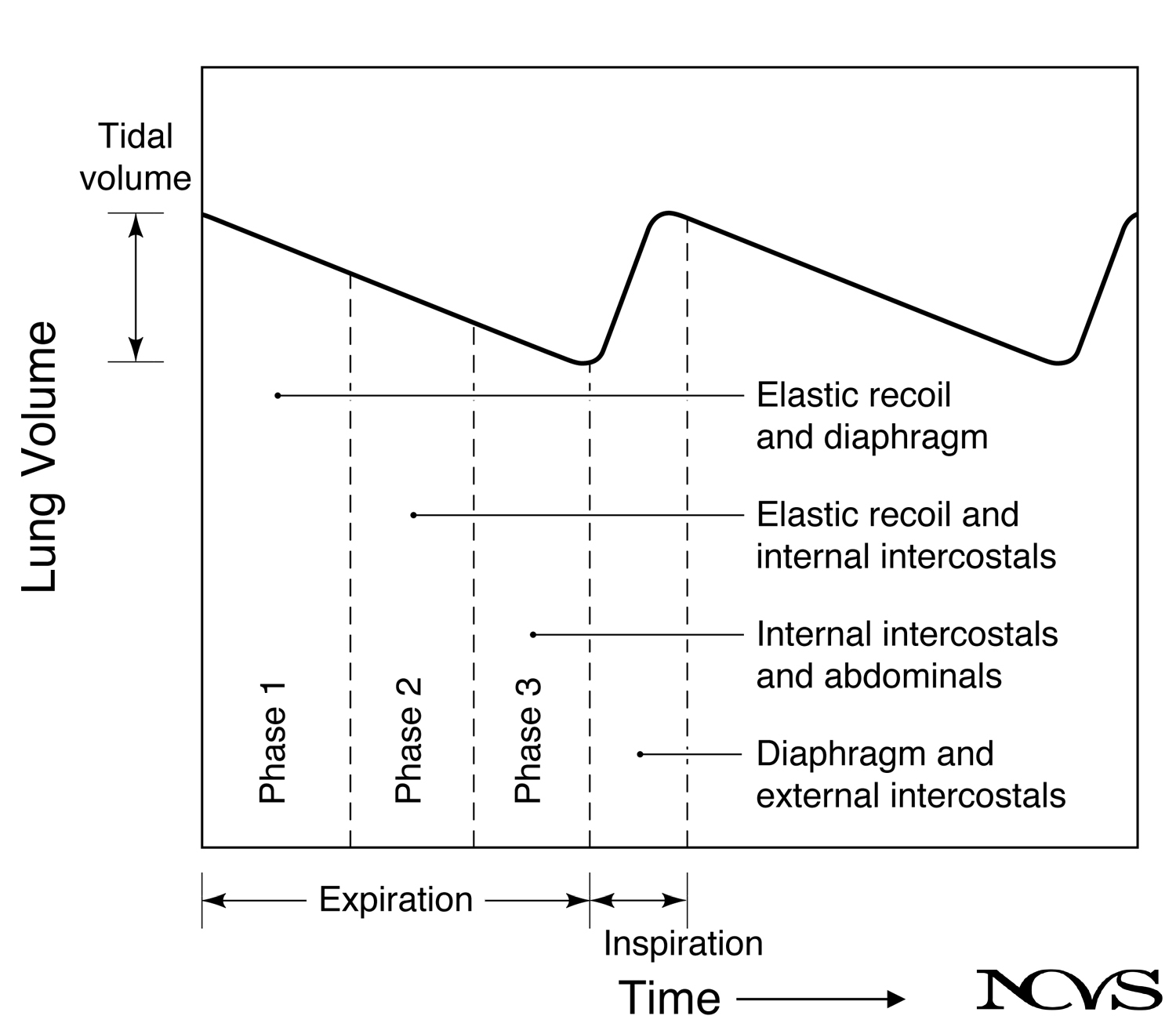 Figure 3.10: Change in lung volume over the breathing cycle for phonation. The expiratory portion is divided into three phases during which different forces contribute to lung pressure.
Singing requires sophisticated pressure control:
High notes:
- Stiffer vocal folds demand higher pressure
- 1.5-3.0 kPa may be required
- Additional muscles recruited (back, chest)
Long phrases:
- Constant pressure maintenance
- Continuous muscle adjustment
- Three-phase strategy (elastic recoil → mixed → active compression)
Dynamic control:
- Crescendo: gradual pressure increase
- Decrescendo: gradual pressure decrease
- Requires fine motor control of bulky respiratory muscles
Respiratory-Laryngeal Coordination
The relationship between respiratory and laryngeal systems is not independent:
Neural Integration
Reflexive connections:
- Lung pressure changes trigger laryngeal adjustments
- Laryngeal resistance affects respiratory muscle activation
- Subglottal pressure monitored continuously
Coordinated patterns:
- Inspiration involves glottal widening
- Expiration involves controlled narrowing
- Phonation onset requires precise timing
Training Implications
Breath management training must address:
- Muscle coordination: Respiratory and laryngeal integration
- Timing accuracy: Phase transitions and onsets
- Adaptive control: Response to varying demands
- Automatization: Reducing conscious effort for routine tasks
Flow Rate Comparisons
Typical mean flow rates during various activities:
| Activity | Flow Rate | Duration | Lung Pressure |
|---|---|---|---|
| Quiet breathing (exp) | 0.2-0.3 L/s | 2-3 s | ~0 kPa |
| Quiet breathing (insp) | 0.3-0.5 L/s | 1-2 s | Negative |
| Speech (exp) | 0.1-0.2 L/s | 1-5 s | 0.3-1.2 kPa |
| Speech (insp) | 1.0-2.0 L/s | 0.5-1.0 s | Negative |
| Singing (exp) | 0.05-0.15 L/s | 5-20 s | 0.5-3.0 kPa |
| Singing (insp) | 2.0-4.0 L/s | 0.3-0.8 s | Negative |
Note the dramatic differences in flow rates and durations across activities.
Summary
Speech and singing transform the breathing cycle from relatively symmetric (quiet breathing) to highly asymmetric patterns. Speech typically shows 1:5 to 1:10 inspiration/expiration ratios, while singing can extend this further. The larynx plays an increasingly active role in regulating airflow during phonation, with neural reflexes integrating respiratory and laryngeal control. Understanding these differences is essential for voice training and clinical intervention.
Key Takeaways
- ✅ Quiet breathing shows ~1:1 to 1:2 inspiration/expiration ratio; speech shows 1:5 to 1:10
- ✅ Speech flows (0.1-0.2 L/s) are much lower than inspiratory flows (1-2 L/s)
- ✅ Singing demands extended phrases (5-20 s) requiring exceptional pressure control
- ✅ Respiratory and laryngeal systems are integrated through neural reflexes
Related Topics
Further Reading
- Hixon, T. J. (1973). Respiratory function in speech. In F. Minifie, T. Hixon, & F. Williams (Eds.), Normal aspects of speech, hearing, and language (pp. 73-125). Englewood Cliffs, NJ: Prentice Hall.
- Leanderson, R., & Sundberg, J. (1988). Breathing for singing. Journal of Voice, 2(1), 2-12.
- Bouhuys, A., Mead, J., Proctor, D. F., & Stevens, K. N. (1968). Pressure-flow events during singing. Annals of the New York Academy of Science, 155, 165-176.