Mechanisms for Self-Sustained Vocal Fold Oscillation
The central challenge in understanding phonation is explaining how oscillation sustains itself against energy losses from tissue viscosity and other damping forces. This section reveals the mechanisms that enable continuous energy transfer from the steady airstream to the vibrating tissue.
The Energy Transfer Problem
As established in the classical description, Bernoulli forces alone cannot explain self-sustained oscillation. The fundamental issue is directional symmetry: the negative pressure in a narrow glottis depends primarily on flow velocity and glottal area, not on whether the folds are moving inward or outward.
For oscillation to sustain, energy must be preferentially added during one phase of the cycle and minimally extracted during the other phase. This requires a force that changes with the direction of tissue velocity—not just with position or speed.
Two mechanisms can provide this velocity-dependent asymmetry:
- Delayed response of the vocal tract air column above the glottis
- Nonuniform movement within the vocal fold tissue creating different glottal shapes during opening versus closing
Both mechanisms can operate simultaneously, and both create the essential phase relationship between driving forces and tissue velocity that enables energy transfer.
Vocal Tract Inertance: The One-Mass Model
The simplest model demonstrating sustained oscillation treats each vocal fold as a single mass-spring-damper system coupled to an air column above the glottis.
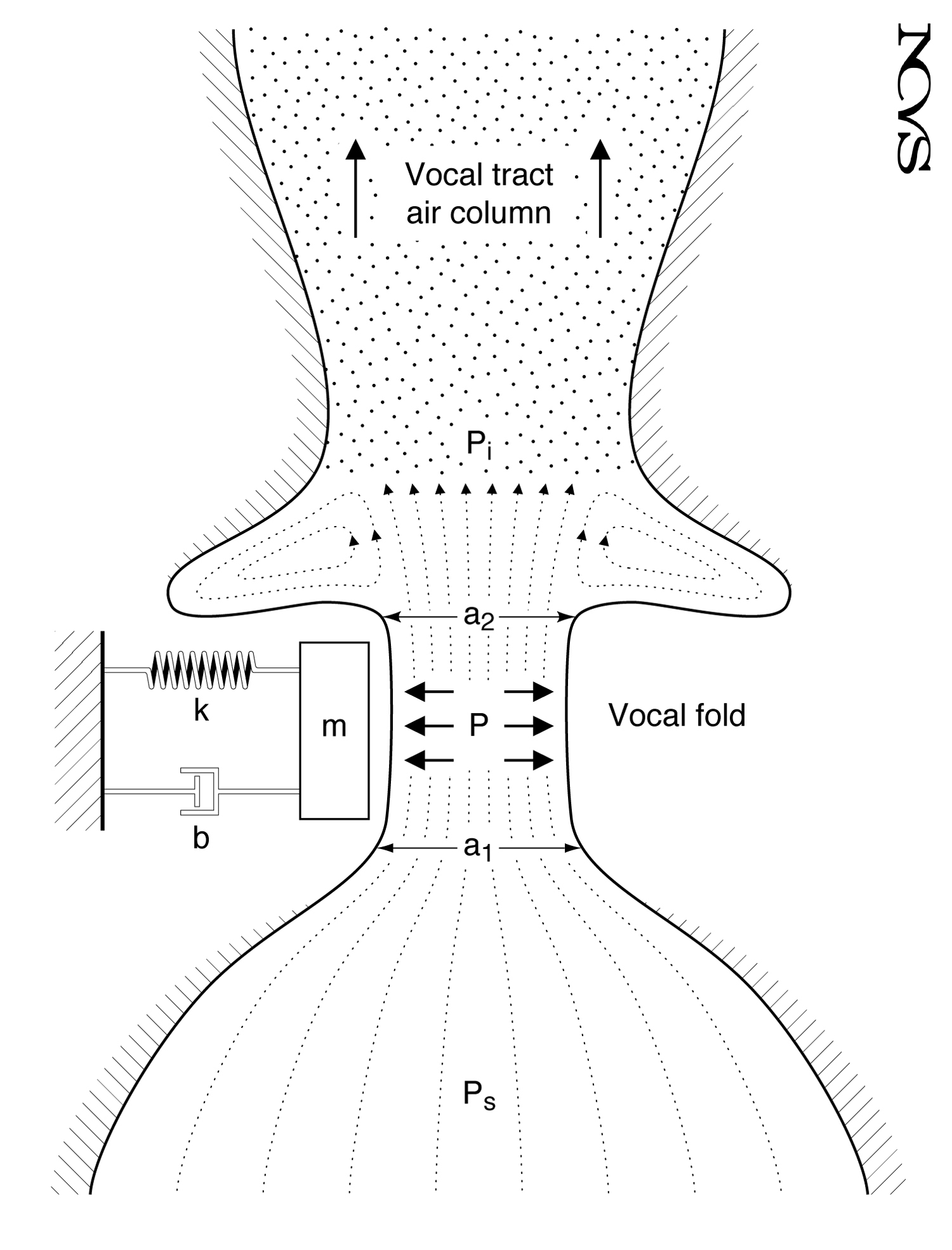 Figure 4.7: One-mass model including airflow through the glottis, pressure against the tissue wall, and the supraglottal air column (vocal tract).
Model Components
Tissue Oscillator:
- Mass m: Effective mass of vocal fold tissue
- Stiffness k: Spring constant representing elastic restoring force
- Damping b: Viscous resistance representing energy loss
Aerodynamic Elements:
- Glottal airflow U: Volume velocity through the glottis
- Subglottal pressure Pₛ: Pressure below the glottis driving airflow
- Supraglottal pressure Pᵢ: Pressure at the vocal tract entrance
Vocal Tract:
- Air column above the glottis with length L and area a
- Inertance I = ρL/a: Sluggishness of air column response
Mean Intraglottal Pressure
The pressure driving the vocal folds can be derived from Bernoulli’s energy law. For the simplified case where both vocal folds move as single masses (creating a rectangular glottal duct with a₁ = a₂), this pressure simplifies to:
P = PᵢThis seemingly trivial result—that the driving pressure equals the supraglottal pressure—actually reveals the key mechanism. Something must happen above the glottis to change Pᵢ during the glottal cycle, creating the asymmetry needed for oscillation.
Inertance of the Air Column
The air column in the vocal tract possesses inertance—analogous to mass in mechanical systems. Just as a mass resists changes in velocity (requiring force to accelerate or decelerate), the air column resists changes in flow rate (requiring pressure to accelerate or decelerate).
The relationship between pressure and flow rate change is:
Pᵢ = I × (dU/dt)where:
- Pᵢ = vocal tract input pressure
- I = inertance of air column = ρL/a
- dU/dt = rate of change of flow (acceleration of air column)
- ρ = air density
- L = length of vocal tract
- a = cross-sectional area
This is Newton’s second law in acoustic form: pressure (analogous to force) equals inertance (analogous to mass) times acceleration of the air column.
The Oscillation Mechanism
The vocal tract inertance creates delayed pressure response that synchronizes with vocal fold movement:
During Glottal Opening:
- Glottal area increases
- Airflow U begins to increase
- Air column accelerates (dU/dt > 0)
- Input pressure Pᵢ becomes positive
- Positive pressure pushes vocal folds apart
- This assists the opening motion
During Glottal Closing:
- Glottal area decreases
- Airflow U begins to decrease
- Air column decelerates (dU/dt < 0)
- Input pressure Pᵢ becomes negative (suction)
- Negative pressure pulls vocal folds together
- This assists the closing motion
The key insight is that the air column’s momentum continues after the glottis begins closing. The flow through the glottis cannot keep up with the air column’s forward motion, creating suction above the glottis that helps pull the folds together.
Energy Transfer
Because Pᵢ is positive during opening and negative during closing, it provides driving force synchronized with tissue velocity. When averaged over a complete cycle, this results in net energy transfer from the steady airstream to the oscillating tissue.
The mechanism operates without any oscillatory lung pressure—only steady subglottal pressure is needed. The vocal tract inertance converts this steady driving pressure into oscillatory forces timed to sustain vibration.
Limitations of the One-Mass Model
While this model successfully predicts oscillation coupled to a vocal tract, it has important limitations:
Requires Vocal Tract: Without the air column above the glottis, this mechanism fails. The model predicts that excised larynges without a vocal tract cannot oscillate—yet experiments show they can.
Overly Simple Tissue: Representing each vocal fold as a single rigid mass ignores the complex layered structure and the wavelike motion observed in the cover.
Collision Dependence: The model works best when the glottis closes completely, though oscillation can actually occur without collision.
These limitations motivated development of more sophisticated models incorporating nonuniform tissue movement.
Historical Significance
The one-mass model with vocal tract coupling, proposed by Flanagan and Landgraf (1968), represented a major advance in understanding phonation. It demonstrated mathematically that:
- Oscillation can be sustained by interaction with an acoustic tube
- The Bernoulli effect contributes but requires coupling to vocal tract inertance
- Similar principles govern both vocal fold oscillation and reed instrument oscillation
This work established the importance of source-tract interaction, showing that the vocal folds and vocal tract cannot be treated as completely independent systems. The coupling has important consequences for voice quality, pitch control, and sound production efficiency.
Comparison with Musical Instruments
The vocal tract inertance mechanism resembles oscillation in reed and brass instruments:
Woodwind Instruments: A reed’s vibration strongly depends on the instrument bore (equivalent to vocal tract). Changing the effective bore length (by opening holes) changes both the pitch and the ease of oscillation.
Brass Instruments: Lip vibration couples to the tube’s acoustic impedance. Players must adjust lip tension to match the instrument’s resonances for efficient sound production.
Human Voice: Unlike these instruments where strong coupling is always present, the voice can operate with varying degrees of source-tract coupling. In speech, relatively weak coupling preserves constancy of phonation across different vowels. In singing at high pitches, stronger coupling may be needed.
This flexibility—the ability to oscillate with or without strong vocal tract coupling—distinguishes the human voice from most musical instruments and reflects the multilayered complexity of vocal fold tissue.
Summary
Self-sustained vocal fold oscillation requires mechanisms that create asymmetry between driving forces during opening versus closing phases. The vocal tract air column provides one such mechanism through its inertance—sluggishness in responding to changing flow.
When the glottis opens and flow increases, positive pressure builds at the vocal tract entrance, assisting opening motion. When the glottis closes and flow decreases, negative pressure (suction) develops, assisting closing motion. This delayed pressure response synchronizes with tissue velocity to transfer energy from steady lung pressure to oscillating tissue.
The one-mass model with vocal tract coupling successfully predicts sustained oscillation and reveals important similarities between voice and musical instruments. However, it fails to explain oscillation without a vocal tract, indicating that additional mechanisms involving nonuniform tissue movement must be considered.
Key Takeaways
- ✅ Self-sustained oscillation requires velocity-dependent forces that differ between opening and closing phases
- ✅ Vocal tract inertance creates delayed pressure response synchronized with glottal area changes
- ✅ Positive pressure during opening and negative pressure during closing transfer energy to tissue
- ✅ Steady lung pressure converts to oscillatory forces through interaction with vocal tract inertance
- ✅ This mechanism resembles reed and brass instrument oscillation but does not explain all vocal fold vibration
Related Topics
- Classical Description
- Nonuniform Tissue Movement
- Glottal Pressure and Flow
- Respiratory Fluid Dynamics
Further Reading
- Flanagan, J. L., & Landgraf, L. (1968). Self-oscillating source for vocal tract synthesizers. IEEE Transactions on Audio and Electroacoustics, AU-16, 57-64.
- Titze, I. R. (1983). Mechanisms of sustained oscillation of the vocal folds. In I. Titze & R. Scherer (Eds.), Vocal Fold Physiology: Biomechanics, Acoustics, and Phonatory Control (pp. 349-357). Denver: Denver Center for the Performing Arts.
- Titze, I. R. (1988). The physics of small amplitude oscillation of the vocal folds. Journal of the Acoustical Society of America, 83(4), 1536-1552.