Time-Varying Glottal Pressure and Flow
Having explored the mechanisms of self-sustained oscillation, we now examine the temporal patterns of airflow and pressure that emerge during sustained phonation. These waveforms reveal how energy transfer occurs throughout the vibratory cycle and connect theoretical mechanisms to observable phenomena.
Recap of Self-Sustained Oscillation
Two mechanisms enable continuous energy transfer from the airstream to vocal fold tissue:
Vocal Tract Inertance: Delayed response of the air column creates pressure that is positive during opening and negative during closing, synchronized with tissue velocity.
Nonuniform Tissue Movement: Convergent glottal shape during opening produces higher mean intraglottal pressure than divergent shape during closing, again synchronized with velocity.
Both mechanisms share a common requirement: asymmetry in driving pressure between opening and closing phases. This asymmetry ensures that net energy flows into the tissue over a complete cycle, overcoming damping losses.
Temporal Events During Oscillation
The relationship between tissue displacement, velocity, airflow, and pressure reveals the detailed physics of energy transfer.
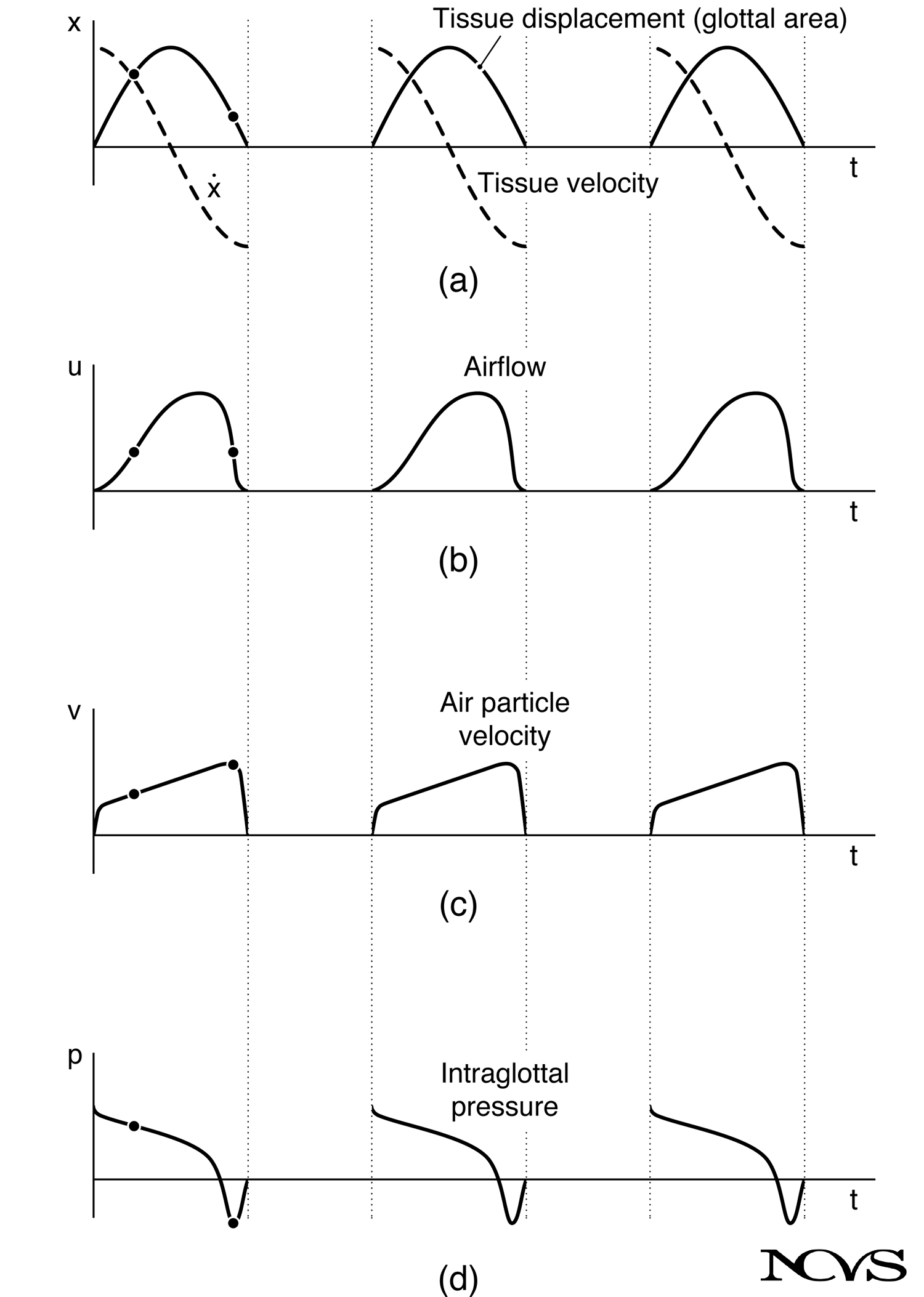 Figure 4.11: (a) Vocal fold displacement and velocity at glottal center, (b) glottal airflow, (c) air particle velocity, and (d) mean intraglottal pressure. Note the phase relationships among these quantities.
Tissue Displacement and Velocity
Displacement Waveform (x):
- Shows lateral position of vocal fold edge over time
- Maximum during peak opening
- Minimum during closure (often zero with collision)
- Roughly sinusoidal but with asymmetries
Velocity Waveform (ẋ):
- Rate of change of displacement
- Positive during outward (opening) movement
- Negative during inward (closing) movement
- Maximum magnitude occurs near equilibrium position
- Zero at peak displacement and at closure
The velocity waveform is critical because energy transfer depends on the product of force and velocity. When driving pressure and velocity have the same sign (both positive or both negative), energy flows into the tissue.
Glottal Airflow
The glottal airflow U represents volume velocity—the volume of air per second passing through the glottis. Its temporal characteristics are distinctive:
Slow Rise: Flow increases gradually during opening as glottal area increases. The rate of rise is limited by:
- Inertia of the air column (takes time to accelerate)
- Gradual increase in glottal conductance
- Buildup of pressure gradient
Abrupt Fall: Flow decreases suddenly during closure as glottal area rapidly decreases to zero. The abrupt termination occurs because:
- Collision creates immediate area reduction
- Air column momentum cannot maintain flow through closed glottis
- Sudden impedance change
Skewing: The combination of slow rise and abrupt fall creates rightward skewing of the flow waveform—the peak occurs later in time than the midpoint between onset and offset. This asymmetry is a crucial feature affecting voice quality and acoustic output.
Peak Delay: The peak in airflow occurs after the peak in vocal fold displacement. This delay reflects the inertia of the air column—flow continues to increase even as the glottis begins to narrow.
Air Particle Velocity
While glottal airflow U measures volume per second, air particle velocity v measures how fast individual air molecules move through the glottis. These quantities relate through the continuity equation:
U = a × vwhere:
- U = volume velocity (flow)
- a = glottal cross-sectional area
- v = air particle velocity
Since glottal area a is proportional to vocal fold displacement x (for both folds moving symmetrically), we can write:
v = U / xThis division operation creates the air particle velocity waveform shown in Figure 4.11c.
Asymmetric Shape: Dividing the flow waveform by the displacement waveform amplifies the asymmetry:
- During the rising portion of flow, displacement is increasing, so v increases less than U
- During the falling portion of flow, displacement is decreasing, so v decreases more rapidly than U
- Result: Air particle velocity is higher during closing than during opening for the same flow value
Increasing Trend: The average air particle velocity shows an upward trend from left to right—velocity is systematically higher in the latter half of the open phase than in the first half. This increasing trend is the key to understanding pressure asymmetry.
Intraglottal Pressure Dynamics
The mean intraglottal pressure P drives the vocal folds laterally. Its temporal variation creates the asymmetry needed for energy transfer.
Bernoulli Relationship
Bernoulli’s energy conservation law states that in a duct at constant flow:
P + ½ρv² ≈ constantwhere:
- P = static pressure against walls
- ρ = air density
- v = air particle velocity
This relationship means that when air particle velocity increases, pressure decreases, and vice versa. The constant represents total pressure (static + dynamic).
Pressure Asymmetry
Comparing two points with identical airflow U (marked by dots in Figure 4.11b):
Point 1 (Early in Cycle):
- Lower air particle velocity v
- Higher static pressure P
- Convergent glottal shape (if nonuniform movement present)
Point 2 (Later in Cycle):
- Higher air particle velocity v
- Lower static pressure P
- Divergent glottal shape (if nonuniform movement present)
Even though the flow is identical at these two points, the pressure is lower at Point 2 than at Point 1. This is shown in Figure 4.11d, where the pressure waveform decreases from left to right despite the flow waveform being symmetric about its peak.
Synchronization with Velocity
The critical feature is how intraglottal pressure P correlates with tissue velocity ẋ (dotted line in Figure 4.11a):
During Opening (ẋ > 0):
- Tissue moving outward
- Early in cycle
- Lower air particle velocity
- Higher intraglottal pressure
- Pressure helps push folds apart
- Energy added to tissue
During Closing (ẋ < 0):
- Tissue moving inward
- Late in cycle
- Higher air particle velocity
- Lower intraglottal pressure (even negative/suction)
- Pressure offers less resistance or actively assists
- Less energy extracted from tissue
The downward trend in pressure matches the downward trend in tissue velocity. This positive correlation between driving force and velocity over the cycle enables net energy transfer.
Small Negative Dip
A small dip below zero pressure often occurs just before closure (visible in Figure 4.11d). This represents:
- Very high air particle velocity as glottis narrows
- Strong Bernoulli suction effect
- Assists final closure
- Brief but not necessary for overall mechanism
Importantly, sustained oscillation does not require pressure to become negative. What matters is that pressure is higher during opening than during closing.
The Role of Asymmetry
The essential feature enabling self-sustained oscillation is asymmetry—the fact that conditions during opening differ from conditions during closing:
Airflow Asymmetry:
- Slow rise vs. abrupt fall
- Created by vocal tract inertance
- Results in flow waveform skewing
Velocity Asymmetry:
- Lower during early opening
- Higher during late closing
- Created by dividing flow by changing area
Pressure Asymmetry:
- Higher during opening
- Lower during closing
- Created by velocity asymmetry via Bernoulli effect
- Enhanced by convergent-divergent shape changes
Energy Transfer:
- Positive pressure during positive velocity → energy in
- Negative pressure during negative velocity → energy in
- Lower pressure magnitude during negative velocity than during positive → net energy in
Without these asymmetries, oscillation would damp out. The Bernoulli effect alone cannot create asymmetry—it requires either vocal tract inertance, nonuniform tissue movement, or both.
Comparison with Classical View
The classical myoelastic-aerodynamic theory emphasized negative Bernoulli pressure “sucking” the vocal folds together. This description captures part of the phenomenon but misses the crucial point:
Classical Emphasis: Negative pressure closes the glottis Complete Mechanism: Pressure is more positive during opening than during closing, regardless of whether it becomes negative
The complete picture recognizes that:
- Pressure need not be negative to assist closing
- What matters is the difference between opening and closing phases
- Multiple mechanisms (vocal tract inertance, tissue wave) create this difference
- Bernoulli effect contributes but does not alone determine oscillation
Clinical Relevance
Understanding these waveforms has practical implications:
Flow Waveform Shape: The degree of skewing (abruptness of closure) affects:
- Spectral content of the voice source
- Voice quality (brightness, breathiness)
- Efficiency of acoustic energy production
Collision Timing: The abrupt flow termination indicates:
- Whether vocal folds contact
- Timing and force of impact
- Potential for impact stress
Pressure Requirements: The mean and peak intraglottal pressure relate to:
- Phonation threshold pressure
- Efficiency of oscillation
- Vocal effort required
These temporal patterns can be estimated from audio recordings (through inverse filtering) or measured directly with specialized instrumentation, providing diagnostic information about vocal fold function.
Summary
During sustained vocal fold oscillation, temporal patterns of displacement, velocity, airflow, and pressure reveal the mechanism of energy transfer. Glottal airflow exhibits characteristic skewing with slow rise and abrupt fall due to vocal tract inertance and collision. Air particle velocity increases throughout the open phase as glottal area decreases while flow remains relatively high.
Mean intraglottal pressure decreases from opening to closing due to increasing air particle velocity (via Bernoulli’s law) and changing glottal shape (from convergent to divergent). This pressure asymmetry synchronizes with tissue velocity—higher pressure during outward movement, lower during inward movement—enabling net energy transfer from the steady airstream to oscillating tissue.
The critical feature is not whether pressure becomes negative, but rather that pressure differs between opening and closing phases in a way that correlates positively with tissue velocity. Multiple mechanisms (vocal tract inertance and nonuniform tissue movement) create this essential asymmetry.
Key Takeaways
- ✅ Glottal airflow exhibits rightward skewing with slow rise and abrupt fall characteristic of vocal source
- ✅ Air particle velocity increases throughout open phase as area decreases while flow remains high
- ✅ Mean intraglottal pressure decreases from opening to closing due to velocity increase via Bernoulli effect
- ✅ Pressure asymmetry synchronized with tissue velocity enables energy transfer regardless of absolute pressure sign
- ✅ Multiple mechanisms create essential asymmetry between opening and closing phases
Related Topics
- Self-Sustained Oscillation Mechanisms
- Nonuniform Tissue Movement
- Respiratory Fluid Dynamics
- Phonation Threshold Pressure
Further Reading
- Rothenberg, M. (1981). Acoustic interaction between the glottal wave source and the vocal tract. In K. N. Stevens & M. Hirano (Eds.), Vocal Fold Physiology (pp. 305-323). Tokyo: University of Tokyo Press.
- Titze, I. R. (1988). The physics of small amplitude oscillation of the vocal folds. Journal of the Acoustical Society of America, 83(4), 1536-1552.
- Scherer, R., & Titze, I. R. (1983). Pressure-flow relationships in a model of the laryngeal airway with a diverging glottis. In D. M. Bless & J. H. Abbs (Eds.), Vocal Fold Physiology: Contemporary Research and Clinical Issues (pp. 179-193). San Diego: College-Hill Press.