Simple Oscillators
Before exploring the complex biomechanics of vocal fold oscillation, we must establish the fundamental principles that govern any oscillating system. Simple mechanical oscillators provide clear examples of these principles and serve as building blocks for understanding more sophisticated models of phonation.
Criteria for Oscillation
Three essential conditions must be satisfied for mechanical oscillation to occur:
1. Stable Equilibrium Position
A stable equilibrium exists when a body at rest experiences forces that return it to that position after any disturbance. Consider three scenarios:
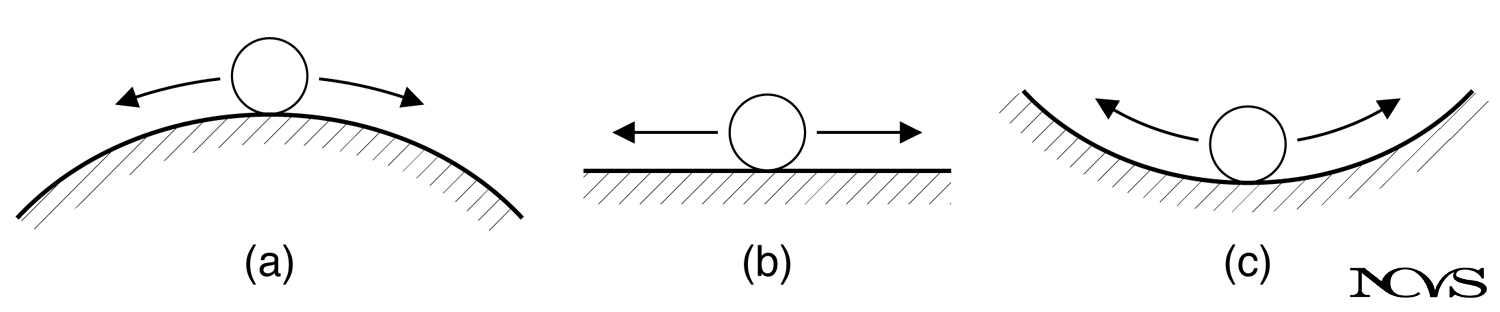 Figure 4.2: (a) Unstable equilibrium—the ball rolls away from the peak. (b) Neutral equilibrium—the ball remains wherever displaced. (c) Stable equilibrium—the ball returns to the bottom of the bowl.
In unstable equilibrium, the slightest disturbance accelerates the body unidirectionally away from the rest position. A ball balanced atop a hill exemplifies this condition—any perturbation causes runaway motion downward.
Neutral equilibrium produces no restoring force. A ball on a flat surface remains wherever displaced, experiencing neither acceleration toward nor away from the original position.
Only stable equilibrium enables oscillation. Here a restoring force always accelerates the body back toward the resting position. Gravity provides this force for a ball in a bowl, with the equilibrium position at the lowest point in the path.
2. Inertia to Overshoot Equilibrium
Even with a restoring force, oscillation requires that the body overshoot equilibrium rather than stopping there immediately. This overshoot occurs because the body acquires momentum during its return path. The restoring force accelerates the body as it approaches equilibrium, giving it maximum velocity exactly at that point.
Since momentum equals mass times velocity, the body must have mass to overshoot equilibrium. Mass represents the inertial property of a mechanical system—its sluggishness or slowness of response. The greater the mass, the greater the tendency to overshoot.
3. Zero Net Energy Loss Per Cycle
For oscillation to be self-sustained rather than damped, the system must replace energy lost to friction and other dissipative forces. This third criterion distinguishes free oscillation (which eventually stops) from self-sustained oscillation (which continues indefinitely).
A system satisfying only the first two criteria will oscillate temporarily but with decreasing amplitude as energy dissipates. Self-sustained oscillation requires an energy source and a mechanism to transfer that energy to the oscillating system at the right times during each cycle.
Types of Oscillation
Oscillatory behavior can be classified based on the energy source and how it interacts with the system:
Natural (Free) Oscillation occurs when a system meeting the basic criteria is disturbed and then left alone. The ball in a bowl, when displaced and released, exhibits natural oscillation. This type is typically damped—energy imparted during the initial disturbance gradually dissipates through friction, and motion eventually ceases.
Forced Oscillation requires an external driving source that is itself an oscillator. This driver dictates much of the vibration pattern. The forcing can be synchronized with the natural oscillation (resonance) to achieve maximum response with minimal stimulus. However, forced oscillation can also occur without regard to natural motion, though this typically requires more energy input.
Self-Sustained Oscillation requires a steady energy source and nonlinear interaction among system components. Unlike forced oscillation with its external oscillatory driver, self-sustained systems use steady energy (like constant airflow or steady muscle contraction) and create their own rhythmic pattern through internal dynamics.
The distinction between forced and self-sustained oscillation can sometimes blur at system boundaries. Is a child being pushed on a swing undergoing forced or self-sustained oscillation? If the pusher is considered external to the system, it is forced. If the pusher is considered part of the system, it is self-sustained. For vocal fold oscillation, the steady airflow from the lungs drives self-sustained oscillation of the laryngeal tissues.
The Swing as a Simple Oscillator
A child on a playground swing provides an excellent example for understanding oscillation principles. The swing system has a stable equilibrium position (hanging straight down), with gravity providing the restoring force. The child’s mass provides inertia to overshoot equilibrium.
Natural Oscillation of the Swing
A child who has not learned to “pump” experiences damped oscillation after an initial push. Wind resistance, friction in the joints, and dragging feet dissipate energy. Without additional energy input, the swing gradually slows and stops.
The frequency of natural oscillation depends on the length of the swing and the gravitational constant. Importantly, this natural frequency is independent of the amplitude (how high the swing rises) for small angles—a property characteristic of simple harmonic motion.
Self-Sustained Oscillation Through Pumping
Children learn to maintain oscillation by lowering their torsos and extending their legs in one part of the cycle, while raising their torsos and curling their legs in another part. This pumping changes the effective restoring force of the swing in a nonlinear way—the force is not directly proportional to displacement over the entire cyclic path.
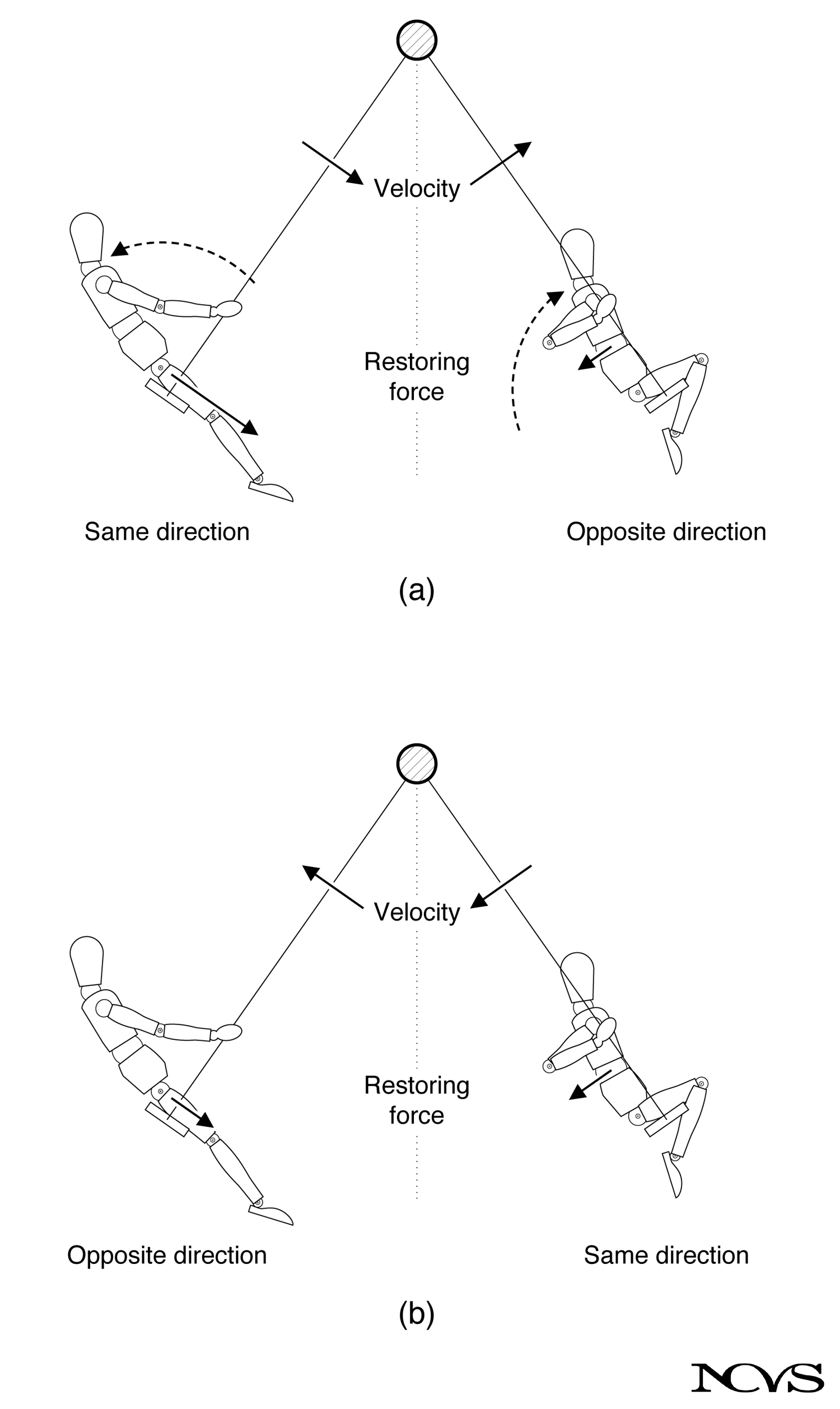 Figure 4.3: (a) A nonlinear restoring force timed with velocity sustains oscillation. (b) The system coasts on the return path with reduced forcing.
The key to sustaining oscillation lies in timing. When motion is to the right, the net restoring force is first increased (torso lowering) then decreased (torso raising). The asymmetry in force timing is illustrated by the unequal arrow lengths. When the average force over the cycle aligns with the direction of velocity, energy transfers to the oscillator.
This energy transfer requires the child’s internal metabolic energy. By reorienting the body at specific points in the cycle, the child creates asymmetric forcing that preferentially adds energy during the desired motion.
Forced Oscillation of the Swing
When an adult pushes the swing, forced oscillation occurs. This works best when pushes synchronize with the swing’s motion—pushing in the direction of movement. The system can coast over part of the return path without continuous forcing.
Energy need not be supplied continuously but can be delivered in synchronized bursts. As with self-oscillation, when the average force over the cycle is in the direction of velocity, energy is imparted to the oscillator. Oscillation sustains if this energy input at least matches frictional losses along the cyclic path.
The Mass-Spring Oscillator
The mass-spring system represents the most fundamental mechanical oscillator and provides a better model for vocal fold vibration than the pendulum.
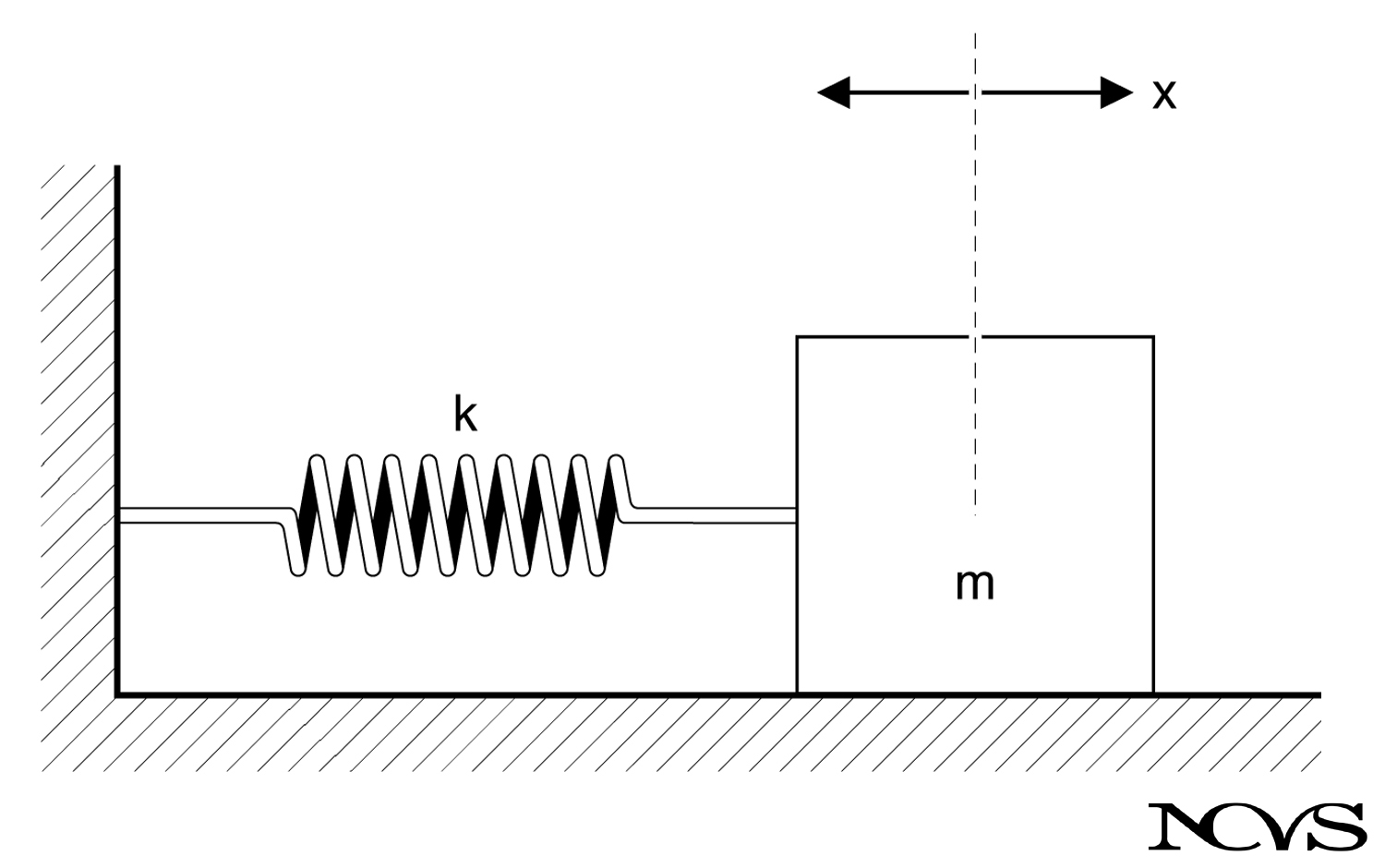 Figure 4.4: A mass attached to a spring. The spring constant k governs the restoring force, and mass m provides inertia.
In this system, the restoring force results from elongation or compression of the spring rather than gravity. The force always opposes displacement from equilibrium: if the mass moves left, the spring pushes right, and vice versa. Inertia causes overshoot, producing oscillation.
Frequency of Oscillation
For natural oscillation of a mass-spring system, the frequency is:
F₀ = (1/2π) × √(k/m)where:
- F₀ = fundamental frequency (Hz)
- k = spring stiffness (N/m)
- m = mass (kg)
This relationship reveals two key principles:
Stiffness Effect: Stiffer springs produce higher oscillation frequencies. Doubling the stiffness increases frequency by a factor of √2 ≈ 1.41.
Mass Effect: Greater mass produces lower oscillation frequencies. Doubling the mass decreases frequency by a factor of √2.
The stiffness-to-mass ratio (k/m) thus determines the natural frequency of oscillation. This principle applies directly to vocal folds, where tissue stiffness relates to elastic properties described in Chapter 2, and mass represents the tissue involved in vibration.
Application to Vocal Folds
The mass-spring model approximates each vocal fold as a simple harmonic oscillator with:
- Mass (m): Effective mass of tissue participating in vibration
- Stiffness (k): Elastic properties of the body and cover layers
- Damping (b): Viscosity and other energy-dissipating mechanisms
While this represents a crude simplification of the complex vocal fold structure, it captures essential dynamics and provides a starting point for more sophisticated models. The frequency equation predicts that:
- Stretching the vocal folds (increasing stiffness) raises pitch
- Thinning the folds (decreasing mass) raises pitch
- Adding mass lesions lowers pitch
These predictions align with clinical observations and voice control strategies.
Oscillators in Nature
Oscillation occurs throughout nature across scales from subatomic particles to astronomical bodies. Molecules exhibit internal oscillatory movement of constituent atoms. Stars pulsate with regular periods. The entire universe may undergo oscillatory expansion and contraction.
Biological systems employ oscillators for rhythmic functions: heartbeat, breathing, circadian rhythms, and locomotion. Walking, for example, may involve oscillatory circuits in the nervous system that generate rhythmic motor patterns.
Even non-physical phenomena sometimes exhibit oscillatory behavior. Political power shifts between opposing viewpoints, stock markets fluctuate, populations of predator and prey species cycle. While mechanical models may oversimplify these complex systems, they can provide useful analogies for understanding cyclic behavior.
Musical Instruments
Oscillation is central to all musical instruments. Strings, air columns, membranes, and plates vibrate in characteristic patterns determined by their geometric and elastic properties. The modes of vibration (discussed later in this chapter) define the acoustic qualities that distinguish one instrument from another.
The guitar plate shown in later figures illustrates how structural vibration patterns—similar in principle to vocal fold tissue vibration—create musical sound when coupled with airflow or mechanical excitation.
Summary
Simple mechanical oscillators illustrate three essential criteria for oscillation: stable equilibrium position, inertia to overshoot equilibrium, and zero net energy loss per cycle for sustained oscillation. Systems can undergo natural (damped) oscillation after disturbance, forced oscillation driven by external oscillators, or self-sustained oscillation using steady energy with nonlinear internal mechanisms.
The playground swing demonstrates both self-sustained oscillation (through pumping) and forced oscillation (through pushing), illustrating how energy transfer depends on timing between applied forces and system velocity. The mass-spring oscillator provides a more direct model for vocal folds, with oscillation frequency determined by the ratio of stiffness to mass.
These principles establish the foundation for understanding vocal fold vibration as a self-sustained oscillation driven by steady lung pressure interacting nonlinearly with tissue biomechanics and vocal tract aerodynamics.
Key Takeaways
- ✅ Oscillation requires stable equilibrium, inertia to overshoot, and energy balance for self-sustaining motion
- ✅ Natural oscillation gradually damps without energy input; self-sustained oscillation maintains amplitude through timed energy transfer
- ✅ Nonlinear interaction creates asymmetry between force and velocity, enabling energy transfer from steady sources
- ✅ Mass-spring oscillators model vocal folds with frequency determined by stiffness-to-mass ratio
- ✅ Timing between applied forces and system velocity determines whether energy is added or extracted
Related Topics
- Classical Description
- Graphical and Mathematical Representations
- Self-Sustained Oscillation Mechanisms
- Biomechanics of Laryngeal Tissue
Further Reading
- Case, W. B., & Swanson, M. A. (1990). The pumping of a swing from the seated position. American Journal of Physics, 58, 463-467.
- Benade, A. H. (1976). Fundamentals of musical acoustics. New York: Oxford University Press.
- Titze, I. R., & Talkin, D. T. (1979). A theoretical study of the effects of various laryngeal configurations on the acoustics of phonation. Journal of the Acoustical Society of America, 66(1), 60-74.