Simple Harmonic Motion
Simple harmonic motion (SHM) represents the most fundamental form of oscillation—periodic motion in which restoring force is directly proportional to displacement from equilibrium. This idealized motion produces perfectly sinusoidal waveforms and serves as the foundation for understanding more complex oscillatory behavior. While real vocal fold vibration is not simple harmonic motion (nonlinear forces, asymmetric waveforms, collision dynamics), SHM principles provide essential conceptual tools for analyzing voice production.
Definition and Characteristics
Simple harmonic motion occurs when a system experiences a restoring force proportional to displacement and directed toward equilibrium.
Mathematical Condition
The defining characteristic of SHM is Hooke’s Law restoring force:
F = -kxwhere:
- F is restoring force
- k is spring constant (stiffness)
- x is displacement from equilibrium
- Negative sign indicates force opposes displacement
This linear relationship between force and displacement produces sinusoidal motion.
Resulting Motion
Applying Newton’s second law (F = ma) yields:
m(d²x/dt²) = -kxRearranging:
d²x/dt² + (k/m)x = 0This differential equation has sinusoidal solutions:
x(t) = A cos(ωt + φ)or equivalently:
x(t) = A sin(ωt + φ)where:
- A is amplitude
- ω = √(k/m) is angular frequency
- φ is phase constant
- t is time
Key Properties
Sinusoidal: Displacement vs. time forms perfect sine or cosine wave.
Periodic: Motion repeats with period T = 2π/ω = 2π√(m/k).
Frequency: f = 1/T = (1/2π)√(k/m), depends only on system parameters (k, m), not on amplitude.
Isochronous: All amplitudes oscillate at same frequency—period is amplitude-independent.
Symmetric: Motion is symmetric about equilibrium—same behavior in positive and negative directions.
Graphical Representation
Understanding SHM graphs builds intuition for oscillatory motion analysis.
Displacement vs. Time
Plotting x(t) = A cos(ωt) reveals sinusoidal oscillation:
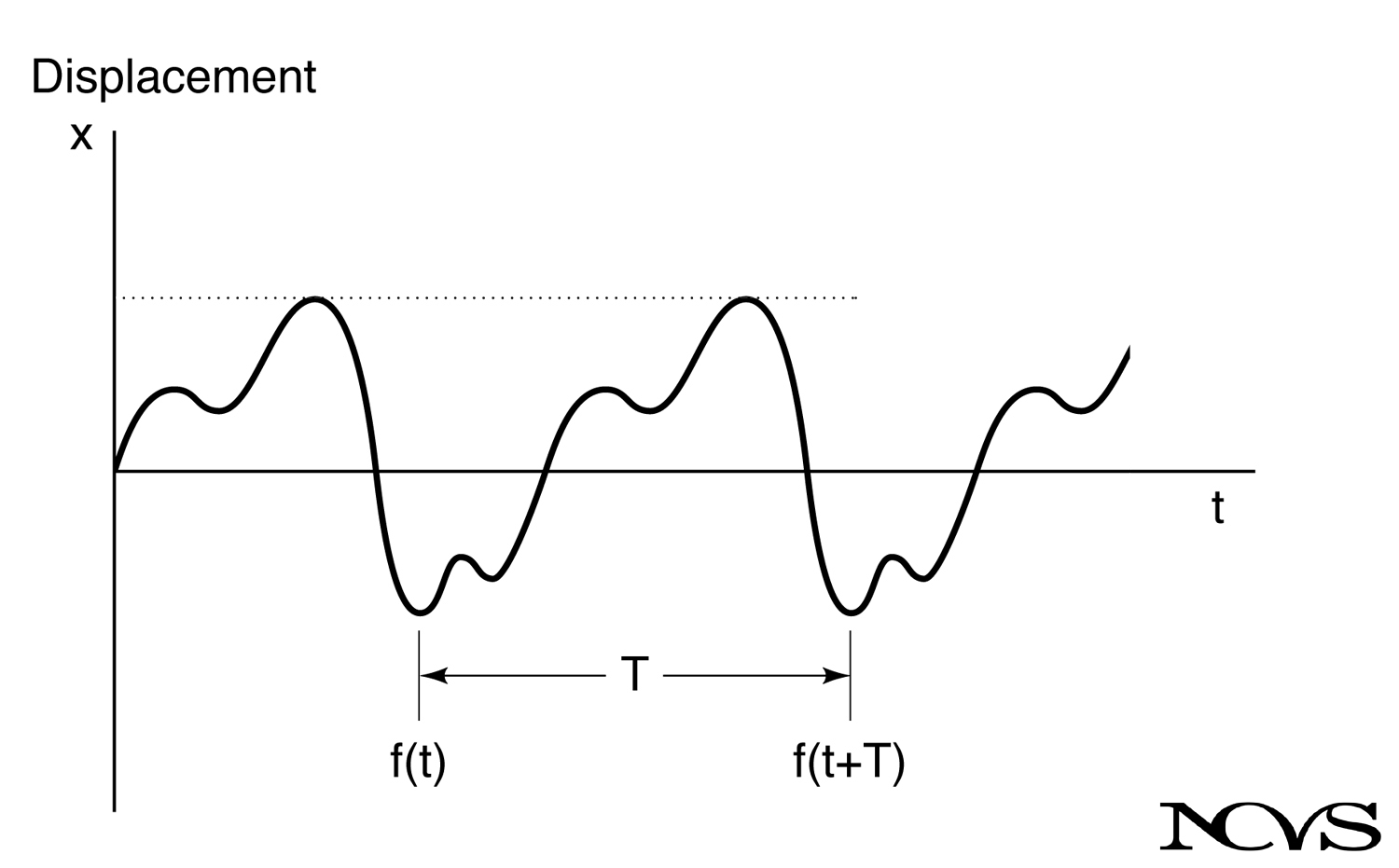 Figure 4.5: Displacement, velocity, and acceleration in simple harmonic motion. Note that velocity leads displacement by 90° (quarter cycle), and acceleration leads displacement by 180° (half cycle).
Features:
- Amplitude (A): Maximum displacement from equilibrium (peak height)
- Period (T): Horizontal distance for one complete cycle
- Equilibrium crossings: Points where x = 0
- Extrema: Points of maximum/minimum displacement (velocity = 0)
Velocity vs. Time
Velocity is the time derivative of displacement:
v(t) = dx/dt = -Aω sin(ωt + φ)For φ = 0:
v(t) = -Aω sin(ωt)Properties:
- Phase: Velocity leads displacement by 90° (quarter cycle)
- Maximum velocity: v_max = Aω occurs at equilibrium (x = 0)
- Zero velocity: Occurs at maximum displacement (turning points)
- Amplitude: v_max proportional to both A and ω
Acceleration vs. Time
Acceleration is the second derivative of displacement:
a(t) = d²x/dt² = -Aω² cos(ωt + φ) = -ω²xProperties:
- Phase: Acceleration leads displacement by 180° (half cycle)
- Proportional to displacement: a = -ω²x (always pointing toward equilibrium)
- Maximum acceleration: a_max = Aω² occurs at maximum displacement
- Zero acceleration: Occurs at equilibrium
Phase Relationships
Phase describes position within the oscillation cycle and relationships between different quantities.
Phase Angle
Definition: Phase angle (ωt + φ) specifies location in cycle, measured in radians or degrees.
Complete Cycle: 2π radians = 360° = one period
Phase Constant (φ): Initial phase—determines position at t = 0
Phase Differences
Displacement and Velocity: Velocity leads displacement by π/2 (90°):
- When displacement is maximum, velocity is zero
- When displacement is zero, velocity is maximum
- They cross zero at different times
Displacement and Acceleration: Acceleration leads displacement by π (180°):
- When displacement is positive, acceleration is negative
- When displacement is zero, acceleration is zero
- Maximum displacement corresponds to maximum acceleration magnitude
Velocity and Acceleration: Acceleration leads velocity by π/2 (90°):
- When velocity is maximum, acceleration is zero
- When velocity is zero, acceleration is maximum
These phase relationships are universal in SHM, independent of specific parameters.
Energy in Simple Harmonic Motion
Energy continuously transforms between potential and kinetic forms while total energy remains constant (no damping).
Potential Energy
Stored in the spring (or equivalent elastic element):
PE(t) = (1/2)kx² = (1/2)kA²cos²(ωt + φ)Properties:
- Maximum at extremes of motion (x = ±A)
- Zero at equilibrium (x = 0)
- Varies as cos² (oscillates at twice the frequency of motion)
Kinetic Energy
Stored in motion of mass:
KE(t) = (1/2)mv² = (1/2)mA²ω²sin²(ωt + φ)Since ω² = k/m:
KE(t) = (1/2)kA²sin²(ωt + φ)Properties:
- Maximum at equilibrium (v = v_max)
- Zero at extremes (v = 0)
- Varies as sin² (oscillates at twice frequency of motion)
Total Energy
E_total = PE + KE = (1/2)kA²[cos²(ωt) + sin²(ωt)] = (1/2)kA²Using the identity cos²θ + sin²θ = 1:
E_total = (1/2)kA² (constant)Key Insights:
- Total energy depends only on amplitude squared and stiffness
- Total energy is constant (energy is conserved in ideal SHM)
- Energy oscillates between potential and kinetic forms
- Transformation occurs twice per cycle (once each direction through equilibrium)
Energy and Frequency
Total energy does not depend on frequency directly, but for given amplitude, higher-frequency systems move faster through equilibrium:
v_max = Aω = A√(k/m)Higher stiffness (k) or lower mass (m) increases both frequency and maximum velocity for given amplitude.
Examples of Simple Harmonic Motion
Mass-Spring System
The archetypal SHM system: mass attached to spring oscillates when displaced.
Natural Frequency: f = (1/2π)√(k/m)
Application to Voice: Vocal fold tissue layers approximate mass-spring system; body-cover model uses this analogy.
Simple Pendulum (Small Angles)
For angles θ < 15°, pendulum motion approximates SHM:
Natural Frequency: f = (1/2π)√(g/L)
Isochrony: Period independent of amplitude (small angles only)
Application: Swing analogy for understanding resonance and energy input.
Torsional Oscillator
Rod or wire twisted about axis experiences restoring torque proportional to angle:
Angular SHM: θ(t) = θ_max cos(ωt)
Application: Some models of vocal fold rotation during oscillation.
Departures from Simple Harmonic Motion
Real systems exhibit deviations from ideal SHM that affect behavior.
Nonlinear Restoring Force
When F ≠ -kx, motion is no longer simple harmonic:
Amplitude-Dependent Frequency: Period changes with amplitude
Asymmetric Motion: Rise and fall times differ
Harmonics: Waveform contains multiple frequency components
Vocal Fold Application: Collision forces, amplitude-dependent stiffness, and nonuniform tissue properties create nonlinear behavior.
Damping
Energy dissipation causes amplitude decay:
x(t) = A₀e^(-γt)cos(ωt + φ)where γ = c/(2m) is decay constant.
Effects:
- Amplitude decreases exponentially
- Frequency slightly reduced
- Total energy decreases over time
Vocal Fold Application: Tissue viscosity creates damping; phonation threshold pressure must overcome this dissipation.
External Driving
Periodic external force at frequency ω_d:
Resonance: Maximum amplitude when ω_d ≈ ω₀ (natural frequency)
Phase Shift: Displacement lags force by amount depending on frequency ratio
Vocal Fold Application: Aerodynamic forces and vocal tract inertance provide driving forces.
Fourier Analysis and SHM
Simple harmonic motion connects deeply to Fourier analysis.
Pure Sinusoid
SHM produces pure tone—single frequency with no harmonics:
Spectrum: Single peak at f = ω/(2π)
Waveform: Perfect sine or cosine
Application: Ideal oscillators, tuning forks (approximately)
Complex Periodic Motion
Non-SHM periodic motion contains multiple sinusoidal components (Fourier series):
x(t) = A₀ + Σ[Aₙcos(nωt + φₙ)]Fundamental: Component at lowest frequency (ω)
Harmonics: Components at integer multiples (2ω, 3ω, …)
Vocal Fold Application: Glottal waveform contains fundamental (F0) plus harmonics; waveform shape determines harmonic amplitudes.
Building Complexity from Simplicity
Complex waveforms result from superposition (sum) of simple harmonic components:
- Square wave: Odd harmonics with amplitudes 1/n
- Sawtooth wave: All harmonics with amplitudes 1/n
- Triangle wave: Odd harmonics with amplitudes 1/n²
This principle underlies speech synthesis and analysis—complex voice signals decompose into simple sinusoidal components.
Reference Circle and Phasor Representation
A powerful visualization represents SHM as projection of uniform circular motion.
The Reference Circle
Imagine a point moving counterclockwise around a circle of radius A at constant angular velocity ω. The projection of this point onto a diameter executes SHM:
Horizontal projection: x(t) = A cos(ωt)
Vertical projection: y(t) = A sin(ωt)
Angular position: θ = ωt + φ
Phasor Diagrams
Phasor: Rotating vector of length A at angular velocity ω
Applications:
- Visualizing phase relationships
- Adding sinusoids graphically
- Analyzing AC circuits (electrical engineering)
- Understanding wave interference
Connection to Voice: Multiple harmonic components can be represented as phasors; their sum creates the complex glottal waveform.
Applications to Vocal Fold Oscillation
While vocal fold vibration is not simple harmonic motion, SHM concepts provide valuable approximations and insights.
When SHM Approximation Works
Small Amplitude: At low vocal intensity, oscillation may approach linearity
Specific Modes: Some normal modes of vocal fold vibration approximate SHM
Component Analysis: Individual Fourier components are sinusoidal (SHM)
Where SHM Fails
Collision: Vocal fold contact during closure is highly nonlinear
Large Amplitude: Amplitude-dependent tissue properties violate linearity
Aerodynamics: Flow-induced forces are nonlinear functions of displacement and velocity
Asymmetry: Opening and closing phases differ due to asymmetric aerodynamic forces
Utility Despite Limitations
SHM remains useful because:
- Conceptual Framework: Establishes basic oscillation principles
- First Approximation: Provides starting point for more complex models
- Limiting Behavior: Real system approaches SHM at small amplitudes
- Component Analysis: Fourier components are sinusoids even if total waveform is not
Summary
Simple harmonic motion represents the idealized case of oscillation with linear restoring force proportional to displacement, producing sinusoidal motion described by x(t) = A cos(ωt + φ). The natural frequency f = (1/2π)√(k/m) depends only on system parameters (mass and stiffness), independent of amplitude. Velocity leads displacement by 90° and acceleration leads displacement by 180°, reflecting the phase relationships inherent in SHM.
Energy continuously transforms between potential energy (maximum at extremes) and kinetic energy (maximum at equilibrium) while total energy E = (1/2)kA² remains constant in the absence of damping. Real oscillators depart from ideal SHM through nonlinear restoring forces, damping, and external driving forces. Vocal fold oscillation is not simple harmonic motion due to collision forces, amplitude-dependent properties, and nonlinear aerodynamics, but SHM concepts provide essential foundation for understanding oscillatory behavior and analyzing complex periodic waveforms through Fourier decomposition.
Key Takeaways
- ✅ Simple harmonic motion requires linear restoring force F = -kx proportional to displacement
- ✅ SHM produces sinusoidal motion x(t) = A cos(ωt + φ) with amplitude-independent frequency
- ✅ Natural frequency f = (1/2π)√(k/m) depends only on stiffness and mass, not amplitude
- ✅ Velocity leads displacement by 90° and acceleration leads displacement by 180° in phase
- ✅ Total energy E = (1/2)kA² remains constant, transforming between potential and kinetic forms
- ✅ Vocal fold oscillation departs from SHM due to nonlinear forces, collision, and asymmetric aerodynamics
- ✅ Despite limitations, SHM provides conceptual foundation and approximation for small-amplitude oscillation
Related Topics
- Mass-Spring Oscillator
- Periodicity
- Types of Oscillation
- Fourier Analysis of Voice
- Normal Modes of Vibration
Further Reading
- French, A. P. (1971). Vibrations and Waves. New York: W. W. Norton & Company.
- Titze, I. R. (2000). Principles of Voice Production (2nd ed.). Iowa City: National Center for Voice and Speech.
- Marion, J. B., & Thornton, S. T. (1995). Classical Dynamics of Particles and Systems (4th ed.). Fort Worth: Saunders College Publishing.
- Crawford, F. S. (1968). Waves (Berkeley Physics Course, Volume 3). New York: McGraw-Hill.
- Kreyszig, E. (2011). Advanced Engineering Mathematics (10th ed.). New York: John Wiley & Sons.