Nonuniform Tissue Movement: Multimass Models
High-speed observation of vocal folds reveals that uniform tissue displacement seldom occurs. Instead, the vocal fold cover exhibits wavelike motion relatively independent of the body, with the bottom of the fold moving ahead of the top. This nonuniform movement provides a second mechanism for self-sustained oscillation.
Evidence from Observation
Repeated examination of vocal folds using high-speed cinematography and videostroboscopy has demonstrated that the vocal folds do not move like solid bars. The cover, being very pliable and loosely connected to deeper tissue layers, can move relatively independently.
A wavelike motion has been observed within the cover, suggesting that a ribbon model better represents this tissue layer than a rigid mass. Like a flag in the wind, the ribbon is fixed at both ends (arytenoid and thyroid cartilages) but can bend and flex freely in the middle despite attachment to the body.
Phase Differences
The key observation is that upper and lower portions of the vocal folds do not move in phase. Specifically:
- The bottom of the fold moves ahead of the top in both opening and closing
- This creates phase lag between superior and inferior margins
- Different glottal shapes result at different points in the cycle
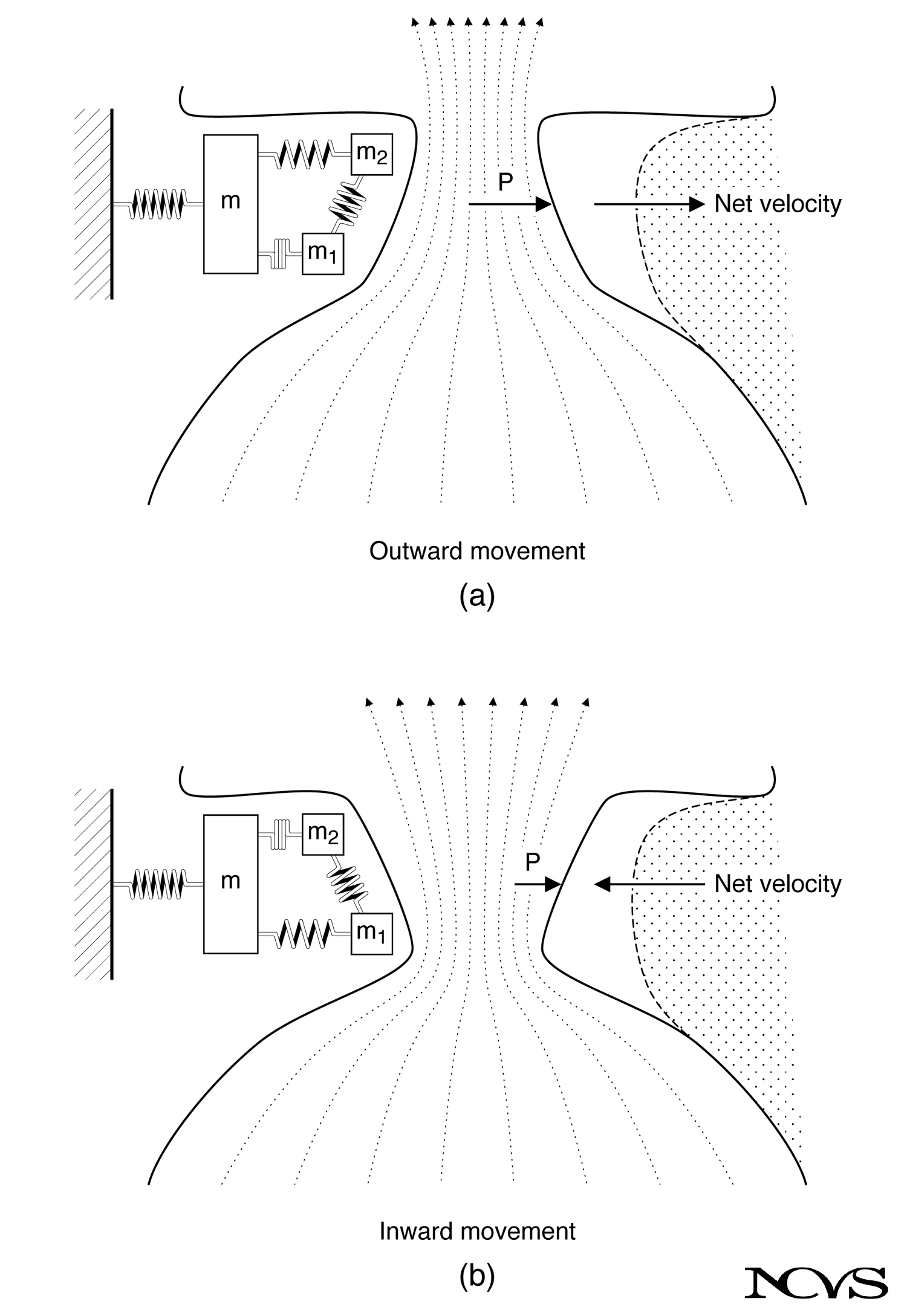 Figure 4.8: Three-mass model showing (a) outward movement with convergent glottis and (b) inward movement with divergent glottis. The bottom leads the top in the direction of net tissue velocity.
Convergent and Divergent Glottal Shapes
The phase difference between upper and lower margins creates alternating glottal configurations:
Convergent Glottis (Opening Phase)
During lateral (outward) movement:
- Lower margin moves outward ahead of upper margin
- Glottal duct narrows from entry to exit
- Cross-sectional area decreases in the direction of airflow
- Results in convergent shape
Divergent Glottis (Closing Phase)
During medial (inward) movement:
- Lower margin moves inward ahead of upper margin
- Glottal duct widens from entry to exit
- Cross-sectional area increases in the direction of airflow
- Results in divergent shape
This alternation between convergent and divergent shapes occurs naturally as a consequence of the wavelike motion in the tissue.
The Two-Mass and Three-Mass Models
To represent nonuniform movement mathematically, the vocal fold can be divided into multiple masses that can move independently while remaining coupled through springs.
Two-Mass Model Structure
The vocal fold cover is represented by two small masses:
- Lower mass (m₁): Represents inferior portion of fold
- Upper mass (m₂): Represents superior portion of fold
Each mass has:
- Its own spring connection to the body
- Spring coupling to the other mass
- Individual damping element
- Separate contact with airflow
The masses can move with different amplitudes and phases, creating the convergent-divergent alternation observed in real vocal folds.
Three-Mass Model Extension
Adding a third mass (representing the body of the fold) provides:
- Better representation of vertical phase differences
- Ability to model more complex vibratory patterns
- Improved prediction of collision dynamics
Pressure Asymmetry Mechanism
The alternating glottal shapes create pressure asymmetry through the Bernoulli effect—but now applied differently during opening versus closing.
Mean Intraglottal Pressure
A simplified expression for the mean pressure acting on the glottal walls is:
P = (1 - a₂/a₁) × (Pₛ - Pᵢ) + Pᵢwhere:
- P = mean intraglottal pressure
- a₁ = glottal area at entry (bottom)
- a₂ = glottal area at exit (top)
- Pₛ = subglottal pressure
- Pᵢ = supraglottal pressure
- (Pₛ - Pᵢ) = transglottal pressure
Convergent Glottis (a₂ < a₁)
When the glottis narrows toward the exit:
- The factor (1 - a₂/a₁) is positive
- P is greater than Pᵢ
- Both transglottal and supraglottal pressure components drive tissue outward
- Higher net driving pressure during opening
Divergent Glottis (a₂ > a₁)
When the glottis widens toward the exit:
- The factor (1 - a₂/a₁) is negative
- P is less than Pᵢ (can even be negative)
- Reduced driving pressure
- Lower net driving pressure during closing
This pressure asymmetry has been confirmed experimentally using physical models of the glottis. Mean intraglottal pressure is consistently larger for convergent shapes than for divergent shapes at the same flow rate.
Jet Formation Caveat
In divergent glottal configurations, the airstream often detaches from the vocal fold surfaces and forms a jet with diameter less than the actual glottal width. This jet keeps the pressure closer to zero (or slightly positive) than Bernoulli’s law would predict for flow filling the entire duct.
Nevertheless, the key principle holds: convergent glottis produces higher driving pressure than divergent glottis. This asymmetry provides the mechanism for energy transfer.
Energy Transfer Without Vocal Tract
The crucial advantage of this mechanism is that it operates independently of the vocal tract. The pressure asymmetry arises from glottal shape alone, not from vocal tract inertance.
This explains experimental observations that:
- Excised larynges without vocal tracts can oscillate
- Vocal folds can vibrate in various acoustic environments
- Speech maintains relatively constant voice quality across different vowels despite changing vocal tract shapes
Synchronization with Tissue Velocity
The convergent-divergent alternation naturally synchronizes with tissue velocity:
Opening Phase:
- Tissue velocity positive (moving outward)
- Convergent glottis
- Higher driving pressure
- Pressure and velocity in same direction → Energy added
Closing Phase:
- Tissue velocity negative (moving inward)
- Divergent glottis
- Lower driving pressure
- Reduced opposing force → Less energy extracted
Over a complete cycle, net energy transfers from airstream to tissue, sustaining oscillation against damping losses.
Mucosal Wave Description
The two/three-mass models capture the essential physics, but an alternative description emphasizes the wave nature of the motion.
An upward-propagating mucosal wave—a wave traveling from the bottom to the top of the fold along its medial surface—produces the same glottal shape alternations as the mass models. This wavelike description emphasizes:
- Continuous rather than discrete tissue elements
- Propagation velocity of the wave
- Similarity to surface waves on water
Recent research has shown that the two-mass model, the mucosal wave model, and continuum mechanics models are mathematically equivalent in their essential features. All represent modes of vibration that change glottal shape during the cycle, enabling self-sustained oscillation.
Historical Development
Ishizaka and Matsudaira (1972) introduced the two-mass model and demonstrated computationally that alternating convergent-divergent shapes enable sustained oscillation. This represented a breakthrough in understanding how the vocal folds can vibrate without vocal tract coupling.
Subsequent work by Titze (1988a, 2000) and McGowan (1991) extended these findings, showing that:
- Mucosal wave propagation produces equivalent results
- Multiple degrees of freedom in the tissue are essential
- The mechanism works with or without collision
- Both this mechanism and vocal tract inertance can operate simultaneously
Comparison of Mechanisms
The two mechanisms for self-sustained oscillation have complementary characteristics:
| Feature | Vocal Tract Inertance | Nonuniform Tissue Movement |
|---|---|---|
| Requires vocal tract | Yes | No |
| Requires tissue flexibility | Minimal | Essential |
| Collision dependent | Somewhat | No |
| Similar to instruments | Yes (reeds, brass) | No |
| Dominant in speech | Variable | Yes |
| Dominant in high singing | Possibly | Variable |
In practice, both mechanisms likely contribute to normal phonation, with their relative importance varying based on:
- Vocal fold tissue properties
- Vocal tract configuration
- Fundamental frequency
- Intensity level
- Register (modal voice, falsetto, etc.)
Summary
Nonuniform tissue movement—specifically the phase difference between upper and lower portions of the vocal folds—creates alternating convergent and divergent glottal shapes during the vibratory cycle. The convergent glottis during opening produces higher mean intraglottal pressure than the divergent glottis during closing.
This pressure asymmetry synchronizes with tissue velocity to transfer energy from the airstream to the tissue, enabling self-sustained oscillation independent of the vocal tract. The mechanism can be modeled using discrete masses (two-mass or three-mass models) or continuous mucosal wave propagation, both capturing the essential physics of shape-dependent pressure.
Together with vocal tract inertance, nonuniform tissue movement provides a complete explanation for self-sustained vocal fold oscillation under diverse conditions. The flexibility of the vocal fold cover—with its loose attachment and multiple tissue layers—proves essential for this mechanism.
Key Takeaways
- ✅ Upper and lower vocal fold margins move out of phase, creating wavelike motion in the cover
- ✅ Convergent glottal shape during opening produces higher driving pressure than divergent shape during closing
- ✅ Pressure asymmetry synchronized with velocity transfers energy to tissue without requiring vocal tract
- ✅ Two-mass and three-mass models mathematically capture essential features of nonuniform movement
- ✅ This mechanism explains oscillation in excised larynges and relatively stable phonation across vowels
Related Topics
- Self-Sustained Oscillation Mechanisms
- Normal Modes of Vibration
- Morphology of Vocal Fold Soft Tissue
- Biomechanics of Laryngeal Tissue
Further Reading
- Ishizaka, K., & Matsudaira, M. (1972). Fluid mechanical considerations of vocal cord vibration. SCRL Monograph 8. Santa Barbara: Speech Communications Research Laboratory.
- Titze, I. R. (1988). The physics of small amplitude oscillation of the vocal folds. Journal of the Acoustical Society of America, 83(4), 1536-1552.
- McGowan, R. (1991). Phonation from a continuum mechanics point of view. In J. Gauffin & B. Hammarberg (Eds.), Vocal Fold Physiology: Acoustic, Perceptual, and Physiological Aspects of Voice Mechanisms (pp. 65-72). San Diego: Singular Publishing Group.