Mass-Spring Oscillator
The mass-spring oscillator represents the simplest and most fundamental oscillating system. Despite its apparent simplicity, this model captures the essential physics underlying countless natural phenomena, from atomic vibrations to vocal fold oscillation. Understanding the mass-spring system provides the conceptual foundation for analyzing more complex oscillators, including the layered tissue structure of the vocal folds.
Basic Configuration
A mass-spring oscillator consists of two essential components: a mass that can move freely and a spring that exerts a restoring force when stretched or compressed.
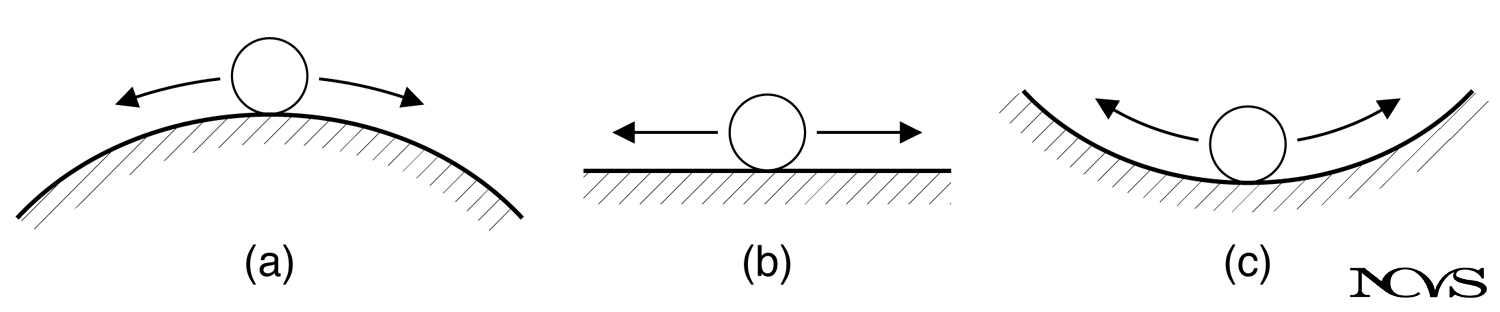 Figure 4.2: A simple mass-spring oscillator showing the mass attached to a spring. When displaced from equilibrium, the spring exerts a restoring force proportional to displacement.
Components and Their Roles
The Mass (m): Provides inertia, the tendency to resist changes in motion. Once set into motion, the mass continues moving even after the restoring force reverses direction, causing it to overshoot equilibrium. The mass stores kinetic energy during motion.
The Spring (k): Provides the restoring force that pulls the mass back toward equilibrium. The spring constant k quantifies stiffness—how much force is required to produce a given displacement. The spring stores elastic potential energy when stretched or compressed.
Equilibrium Position: The resting position where no net force acts on the mass. When displaced from equilibrium, the spring force attempts to restore the mass to this position.
The Restoring Force
The defining characteristic of the spring is its linear restoring force, described by Hooke’s Law:
F = -kxwhere:
- F is the restoring force (Newtons)
- k is the spring constant (N/m)
- x is displacement from equilibrium (meters)
- The negative sign indicates force opposes displacement
This relationship means:
- Doubling the displacement doubles the restoring force
- The force always points toward equilibrium (hence the negative sign)
- Larger k (stiffer spring) produces greater force for same displacement
- The force is directly proportional to displacement (linearity)
Equation of Motion
Applying Newton’s second law (F = ma) to the mass-spring system yields:
m(d²x/dt²) = -kxThis second-order differential equation describes how displacement changes with time. The solution reveals that the mass oscillates sinusoidally:
x(t) = A cos(ωt + φ)where:
- A is amplitude (maximum displacement)
- ω is angular frequency (radians/second)
- φ is phase (initial position in cycle)
- t is time (seconds)
Natural Frequency
One of the most important properties of a mass-spring oscillator is its natural frequency—the rate at which it oscillates when displaced and released.
Frequency Determination
The natural angular frequency depends only on mass and stiffness:
ω = √(k/m)Converting to cycles per second (Hertz):
f = (1/2π)√(k/m)This fundamental relationship reveals several key principles:
Stiffness Effect: Increasing spring stiffness (k) raises frequency. A stiffer spring pulls harder, accelerating the mass more rapidly, shortening the oscillation period. Doubling stiffness increases frequency by √2 ≈ 1.41.
Mass Effect: Increasing mass (m) lowers frequency. Greater mass resists acceleration, slowing the oscillation. Doubling mass reduces frequency by 1/√2 ≈ 0.71.
Independence from Amplitude: In this ideal linear system, frequency does not depend on amplitude. Small and large oscillations occur at the same rate—a property called isochronism.
Application to Vocal Folds
The vocal folds can be approximated as a mass-spring system, particularly for understanding fundamental frequency:
F0 ≈ (1/2L)√(T/ρ)where:
- L is vocal fold length (analogous to string length)
- T is longitudinal tension (analogous to spring stiffness)
- ρ is tissue density (mass per unit length)
This explains why:
- Increasing tension (cricothyroid muscle contraction) raises pitch
- Lengthening the vocal folds (also cricothyroid action) raises pitch
- Greater mass (male vs. female vocal folds) lowers pitch
- Edema or lesions (increasing mass) lower pitch
Energy in the Mass-Spring System
Oscillation involves continuous transformation between two forms of stored energy: potential energy in the spring and kinetic energy in the moving mass.
Potential Energy
When the spring is stretched or compressed, elastic potential energy is stored:
PE = (1/2)kx²Characteristics:
- Maximum at maximum displacement (amplitude)
- Zero at equilibrium position
- Proportional to square of displacement
- Proportional to spring stiffness
At the extremes of oscillation, all energy resides in the spring as potential energy. The mass momentarily stops (zero velocity, zero kinetic energy) before reversing direction.
Kinetic Energy
When the mass moves, kinetic energy is stored in its motion:
KE = (1/2)mv²where v is velocity (dx/dt).
Characteristics:
- Maximum at equilibrium position (maximum velocity)
- Zero at maximum displacement (momentary rest)
- Proportional to square of velocity
- Proportional to mass
As the mass accelerates through equilibrium, all energy resides as kinetic energy. The spring is neither stretched nor compressed (zero potential energy).
Total Energy
In an ideal system without damping, total mechanical energy remains constant:
E_total = PE + KE = (1/2)kA² = constantwhere A is amplitude.
Energy Exchange Cycle:
- At maximum displacement: E = PE_max, KE = 0
- Moving toward equilibrium: PE decreases, KE increases
- At equilibrium: PE = 0, KE = KE_max
- Moving away from equilibrium: KE decreases, PE increases
- At opposite extreme: E = PE_max, KE = 0
- Return journey: Cycle repeats
This exchange occurs twice per oscillation cycle—once in each direction of travel through equilibrium.
Energy and Amplitude
Total energy is proportional to the square of amplitude:
E = (1/2)kA²This means:
- Doubling amplitude quadruples energy
- Reducing amplitude by half reduces energy to one-quarter
- Larger oscillations require substantially more energy
In vocal fold oscillation, amplitude relates to vocal intensity (loudness). Greater amplitude requires more subglottal pressure to supply the increased energy.
Damping in Real Systems
No real oscillator is perfectly ideal. All experience damping—energy dissipation that gradually reduces amplitude over time.
Viscous Damping
The most common damping type involves resistance proportional to velocity:
F_damping = -c(dx/dt)where c is the damping coefficient and dx/dt is velocity.
This force opposes motion, removing energy continuously. The modified equation of motion becomes:
m(d²x/dt²) + c(dx/dt) + kx = 0Damping Regimes
Depending on the relative magnitudes of damping, mass, and stiffness, three behaviors emerge:
Underdamped (c < 2√(km)):
- System oscillates with gradually decreasing amplitude
- Exponential decay envelope modulates sinusoidal oscillation
- Most relevant for phonation and musical instruments
- Amplitude decreases as: A(t) = A₀e^(-γt) where γ = c/(2m)
Critically Damped (c = 2√(km)):
- System returns to equilibrium as quickly as possible without oscillating
- No overshoot beyond equilibrium
- Useful for engineering applications (door closers, shock absorbers)
- Not suitable for sound production
Overdamped (c > 2√(km)):
- System returns to equilibrium slowly without oscillating
- Excess damping prevents energy storage needed for oscillation
- Vocal folds in this regime cannot phonate
Quality Factor
The degree of damping is often expressed as the quality factor (Q):
Q = ω₀m/c = √(km)/cwhere ω₀ is the undamped natural frequency.
Interpretation:
- High Q (low damping): Many oscillations before amplitude decays significantly; sharp resonance
- Low Q (high damping): Rapid amplitude decay; broad resonance
- Vocal folds: Typically Q ≈ 10-30, balancing efficiency with control
Higher Q means the system stores energy more effectively relative to dissipation. Musical instruments typically have high Q for sustained tones. Speech requires moderate Q to allow rapid changes in amplitude and frequency.
Forced Oscillation and Resonance
When an external periodic force drives the mass-spring system, fascinating phenomena emerge.
Driving Force
Consider adding a sinusoidal driving force:
F_drive = F₀cos(ωt)The equation of motion becomes:
m(d²x/dt²) + c(dx/dt) + kx = F₀cos(ωt)Steady-State Response
After transients die away, the system oscillates at the driving frequency (not necessarily the natural frequency), with amplitude determined by how close the driving frequency is to the natural frequency.
Amplitude Response:
A(ω) = F₀/√[(k - mω²)² + (cω)²]Key Features:
- Amplitude depends on driving frequency ω
- Maximum amplitude occurs near natural frequency ω₀
- Damping determines response sharpness
Resonance
Resonance occurs when driving frequency matches natural frequency (ω ≈ ω₀). At resonance:
- Amplitude reaches maximum for given driving force
- Energy transfer from driver to system is most efficient
- Phase relationship optimizes energy input
The amplitude at resonance is:
A_resonance = F₀/(cω₀) = QF₀/kHigher Q produces larger resonant amplitude—the system responds more dramatically to driving at its natural frequency.
Implications for Voice
Resonance principles apply to vocal fold oscillation:
Subglottic Pressure Pulses: Provide driving force through periodic pressure variations.
Vocal Tract Acoustics: At certain pitches, vocal tract resonances can enhance or impede vocal fold oscillation through inertive reactance (see vocal tract inertance mechanism).
Singers’ Formant: Occurs when fundamental or harmonic aligns with vocal tract resonance, enhancing efficiency and projection.
Vibrato: Periodic frequency modulation around mean pitch may exploit resonance effects for timbre variation.
Multi-Mass Systems
Real vocal folds are not single masses but distributed systems with many degrees of freedom. However, understanding single mass-spring behavior provides foundation for more complex models.
Two-Mass Model
The classic two-mass model (Ishizaka & Flanagan, 1972) represents each vocal fold as two masses connected by springs:
- Upper mass (superior portion of fold)
- Lower mass (inferior portion of fold)
- Coupling springs between masses
- Independent spring connections to fixed frame
This model captures:
- Phase difference between upper and lower margins
- Convergent/divergent glottal shapes during oscillation
- More realistic aerodynamic-tissue interaction
- Multiple resonant frequencies
Many-Mass and Continuum Models
More sophisticated models include:
- Multiple masses along fold length and depth
- Continuum models treating tissue as deformable solid
- Finite element models with thousands of elements
Despite complexity, fundamental principles from simple mass-spring system still apply: balance between restoring forces and inertia, energy storage and dissipation, resonance phenomena.
Analogy to Vocal Fold Tissue Layers
The body-cover model of vocal fold structure maps naturally onto mass-spring concepts:
Cover (Superficial Layer): Low stiffness, provides pliable oscillating mass. When loosely coupled to body, acts as relatively independent mass with its own vibrational characteristics.
Body (Muscle): Higher stiffness, provides elastic restoring force. Tension in thyroarytenoid muscle adjusts effective spring constant, controlling frequency.
Ligament (Intermediate/Deep Layers): Moderate stiffness, provides longitudinal tension. Adjustable through cricothyroid muscle action.
The 11 mode of vibration corresponds to the fundamental mode of this layered mass-spring system, where the cover oscillates with particular phase and amplitude relationships that optimize energy transfer from airflow to tissue motion.
Summary
The mass-spring oscillator exemplifies the fundamental physics of oscillation through its two essential components: mass providing inertia and spring providing restoring force. Natural frequency depends on the ratio of stiffness to mass (f = (1/2π)√(k/m)), with stiffer springs and lighter masses producing higher frequencies. Energy continuously transforms between potential energy stored in the stretched spring and kinetic energy of the moving mass, with total energy proportional to amplitude squared.
Real systems experience damping that dissipates energy, characterized by the quality factor Q. Underdamped systems oscillate with gradually decreasing amplitude, while overdamped systems cannot oscillate. When driven by external forces, the system exhibits resonance at its natural frequency, responding with maximum amplitude. These principles directly apply to vocal fold oscillation, where tissue elasticity provides spring-like restoring forces and tissue mass provides inertia, with frequency controlled by adjusting tension and effective mass through laryngeal muscle action.
Key Takeaways
- ✅ The mass-spring oscillator combines two essential components: mass (inertia) and spring (restoring force)
- ✅ Natural frequency is determined by f = (1/2π)√(k/m), increasing with stiffness and decreasing with mass
- ✅ Energy continuously transforms between potential energy (spring) and kinetic energy (mass motion)
- ✅ Total energy is proportional to amplitude squared, meaning doubled amplitude requires four times the energy
- ✅ Damping dissipates energy over time, with quality factor Q quantifying the ratio of stored to dissipated energy
- ✅ Resonance occurs when driving frequency matches natural frequency, producing maximum amplitude response
- ✅ Vocal fold tissue layers function analogously to mass-spring systems, with cover providing mass and deeper layers providing stiffness
Related Topics
- Criteria for Oscillation
- Simple Harmonic Motion
- Types of Oscillation
- Phonation Threshold Pressure
- Body-Cover Model of Vocal Folds
Further Reading
- Titze, I. R. (2000). Principles of Voice Production (2nd ed.). Iowa City: National Center for Voice and Speech.
- Ishizaka, K., & Flanagan, J. L. (1972). Synthesis of voiced sounds from a two-mass model of the vocal cords. Bell System Technical Journal, 51(6), 1233-1268.
- Fletcher, N. H., & Rossing, T. D. (1998). The Physics of Musical Instruments (2nd ed.). New York: Springer-Verlag.
- Story, B. H., & Titze, I. R. (1995). Voice simulation with a body-cover model of the vocal folds. Journal of the Acoustical Society of America, 97(2), 1249-1260.
- French, A. P. (1971). Vibrations and Waves. New York: W. W. Norton & Company.