Graphical and Mathematical Representations of Oscillatory Movement
To fully understand oscillatory behavior, we must be able to quantify it both graphically and mathematically. This section develops the tools needed to describe periodic motion precisely, establishing terminology and relationships essential for analyzing vocal fold vibration.
Periodicity
When oscillatory motion is sustained indefinitely without net loss or gain in energy, the motion is termed cyclic, periodic, or harmonic. These terms are generally interchangeable, though they arose from different scientific traditions.
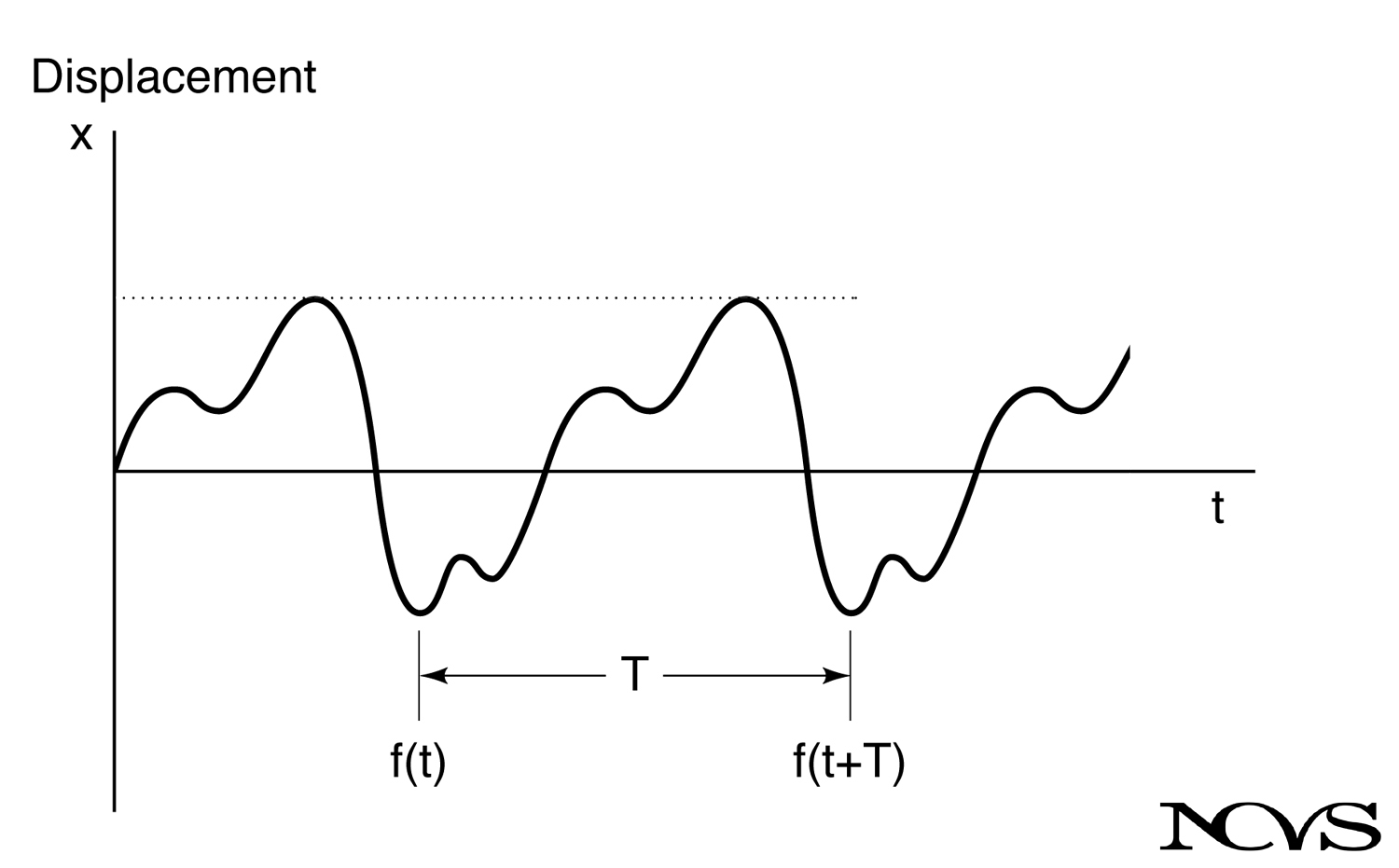 Figure 4.5: A periodic waveform showing displacement as a function of time. The pattern repeats exactly after time interval T.
Mathematical Definition
A waveform representing displacement versus time can be expressed mathematically as x = f(t), where f indicates “a function of” time t. For periodic motion, the defining property is:
f(t + T) = f(t)This equation states that the waveform at any time t must be an exact copy of itself after a specific time interval T has elapsed. The interval T is called the period, measured in seconds.
Complexity and Periodicity
Importantly, periodic motion can have considerable complexity while still satisfying this definition. The waveform need not be a simple smooth curve—it can contain sharp transitions, multiple peaks and valleys, or intricate patterns. The only requirement is exact repetition after each period.
This flexibility explains why many different sounds can all be periodic. A pure tone, a vowel sound, and a musical note from an instrument all exhibit periodicity despite vastly different waveform shapes. The specific shape determines the sound quality (timbre), but the periodicity determines whether the sound has a definite pitch.
Terminology Across Disciplines
The redundancy in terminology reflects the diverse fields that have studied oscillation:
- Mechanical engineers relate oscillatory motion to rotary movement in engines, describing motion in revolutions or cycles per minute (RPM)
- Mathematicians and physicists focus on the time interval of repetition, emphasizing the period T
- Musicians and psychoacousticians recognize that sounds with definite pitch consist of harmonically related frequency components
Despite different emphases, all describe the same fundamental phenomenon: motion that repeats in identical fashion at regular time intervals.
Simple Harmonic Motion
Simple harmonic motion, also called sinusoidal motion, represents the smoothest possible periodic movement. It can be understood as the projection of circular motion at constant speed onto one axis in a plane.
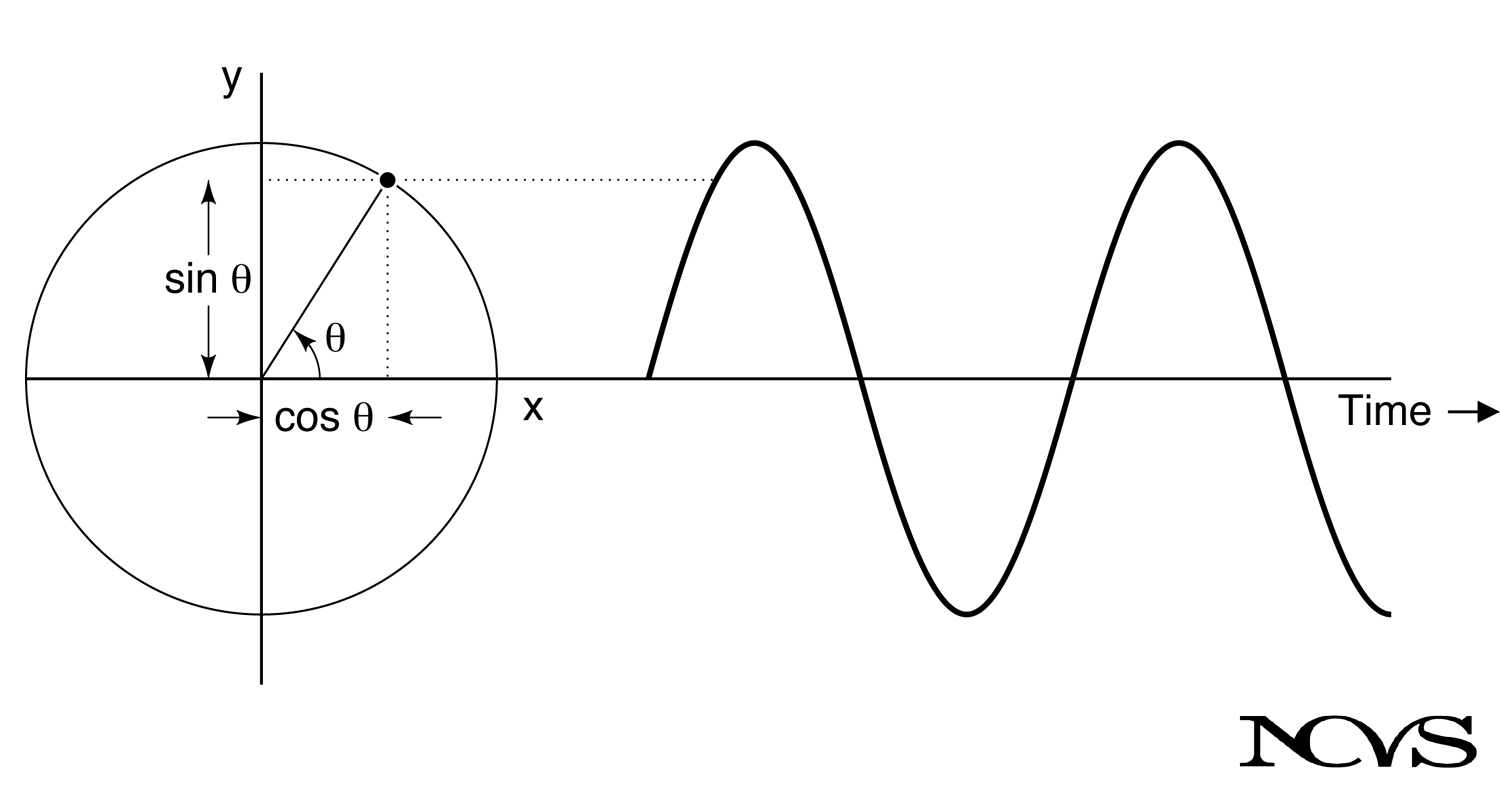 Figure 4.6: Simple harmonic motion shown as circular motion projected onto the y-axis. As a point rotates counterclockwise at constant angular velocity, its vertical position traces a sinusoidal pattern.
Physical Interpretation
Imagine a toy airplane constrained to fly in a circle by an attached string. When viewed from a distance such that the radius appears small compared to the viewing distance, the motion appears to be simple back-and-forth oscillation rather than circular. This back-and-forth movement is simple harmonic motion.
Mathematical Description
Circular motion can be expressed mathematically using trigonometric functions. If a point rotates counterclockwise on a circle of radius A, its position can be described by:
Vertical projection (y-axis):
y = A sin θHorizontal projection (x-axis):
x = A cos θwhere θ is the angle measured from the positive x-axis. The radius A becomes the amplitude—the maximum excursion from equilibrium that the oscillating quantity makes. Amplitude is always a positive number.
Generality of Application
Although derived from displacement, simple harmonic motion can describe any oscillating quantity: pressure, flow, velocity, acceleration, voltage, or current. The amplitude A scales the waveform vertically but does not change its fundamental sinusoidal shape.
Frequency and Angular Relationships
The connection between circular motion and oscillation leads to important definitions relating time and frequency.
Period and Frequency
Since period T measures seconds per cycle, frequency F₀ measures cycles per second. The relationship between them is reciprocal:
F₀ = 1/TThe international standard unit for frequency is the Hertz (Hz), defined as one cycle per second. This relationship means:
- A period of 0.01 seconds corresponds to frequency of 100 Hz
- A period of 0.005 seconds corresponds to frequency of 200 Hz
- A frequency of 125 Hz corresponds to a period of 0.008 seconds
Angular Frequency
For circular motion, we can also measure angular speed—the rate at which the angle θ increases. One complete revolution equals 360° or 2π radians. (A radian is approximately 57°, exactly equal to 180°/π.)
Radian frequency ω (Greek letter omega) measures radians per second:
ω = 2πF₀This gives the relationship:
ω = 2π/TThe angle covered over time is then:
θ = ωt = 2πF₀tThese angular relationships become essential when analyzing acoustic wave propagation and resonance phenomena in later chapters.
Why Multiple Definitions?
The various ways of quantifying oscillation—period, frequency, and angular frequency—serve different purposes:
- Period (T) relates directly to time measurements and is intuitive for slow oscillations
- Frequency (F₀) provides convenient scaling for audio phenomena where periods are very short
- Angular frequency (ω) simplifies mathematical derivations involving derivatives and integrals
In voice science, we most commonly use frequency in Hertz, corresponding to the rate of vocal fold vibration and the perceived pitch of voiced sounds.
The Complete Mathematical Description
Substituting the angular relationship into the sinusoidal expression gives the most general formula for simple harmonic motion:
y = A sin(θ₀ + ωt) = A sin(θ₀ + 2πF₀t)where:
- A = amplitude (maximum displacement)
- θ₀ = phase angle (starting position when t = 0)
- ω = angular frequency in radians per second
- F₀ = frequency in cycles per second (Hz)
- t = time in seconds
Three Governing Metrics
This formula reveals that sinusoidal motion is governed by three independent parameters:
Amplitude (A) scales the waveform vertically. Doubling A doubles the maximum displacement but does not change frequency or timing.
Frequency (F₀) scales the waveform horizontally. Doubling F₀ completes cycles twice as fast, reducing the period by half.
Phase (θ₀) shifts the entire waveform left or right in time. It determines where in the cycle the motion begins when we start our clock (t = 0).
Arbitrary Starting Point
Since sustained oscillation technically has no beginning or end, our choice for time = 0 is arbitrary. We might start our clock when:
- The oscillator passes through equilibrium (θ₀ = 0 or π)
- The oscillator reaches maximum displacement (θ₀ = π/2 or 3π/2)
- Any other convenient reference point
The phase angle θ₀ accounts for this arbitrary choice, ensuring we can describe the motion regardless of when we begin observation.
Practical Applications
These mathematical tools enable precise description of vocal fold motion:
Displacement Waveforms: The lateral position of the vocal fold edge can be graphed versus time, showing amplitude of vibration and fundamental frequency
Velocity Waveforms: The rate of tissue movement (derivative of displacement) provides insight into collision forces and aerodynamic effects
Flow Waveforms: Volume velocity of air through the glottis exhibits periodic modulation with specific shape characteristics related to voice quality
Pressure Waveforms: Acoustic pressure in the vocal tract oscillates at the fundamental frequency and its harmonics
All these quantities can be represented using the mathematical framework of periodic and harmonic motion, enabling quantitative analysis and prediction.
Relationship to Vocal Fold Vibration
While simple harmonic motion represents the ideal smooth oscillation, actual vocal fold vibration exhibits more complex periodic patterns. The displacement waveform may not be a perfect sinusoid due to:
- Nonlinear tissue properties affecting the restoring force
- Asymmetry between opening and closing phases
- Collision impacts creating abrupt transitions
- Coupling to the vocal tract creating additional complexity
However, any periodic waveform—no matter how complex—can be mathematically decomposed into a sum of simple harmonic components (Fourier analysis). This powerful technique, explored in later chapters on acoustics, allows complex vocal fold vibration to be understood through the lens of simple harmonic motion.
Summary
Periodic motion is characterized mathematically by exact repetition after a time interval T (the period). Simple harmonic motion represents the simplest form of periodic movement, corresponding to the projection of uniform circular motion onto a line. This motion can be described by sinusoidal functions involving amplitude A, frequency F₀ (or angular frequency ω), and phase θ₀.
The relationship F₀ = 1/T connects frequency and period, while ω = 2πF₀ relates frequency to angular speed. These mathematical tools provide precise language for describing oscillatory phenomena, applicable to displacement, velocity, pressure, flow, and other quantities relevant to voice production.
Although vocal fold vibration may not follow perfect simple harmonic motion, these concepts establish the foundation for understanding more complex periodic patterns. The ability to quantify oscillation graphically and mathematically enables rigorous analysis of phonation mechanisms.
Key Takeaways
- ✅ Periodicity requires exact waveform repetition after time interval T, allowing considerable complexity in shape
- ✅ Simple harmonic motion represents the smoothest oscillation, mathematically described by sine and cosine functions
- ✅ Frequency F₀ (cycles per second) is the reciprocal of period T (seconds per cycle)
- ✅ Amplitude A, frequency F₀, and phase θ₀ completely specify simple harmonic motion
- ✅ Angular frequency ω = 2πF₀ connects oscillation to circular motion and simplifies mathematical analysis
Related Topics
Further Reading
- Titze, I. R. (2000). Principles of Voice Production (2nd ed.). Iowa City: National Center for Voice and Speech.
- Benade, A. H. (1976). Fundamentals of Musical Acoustics. New York: Oxford University Press.
- Rossing, T. D., Moore, F. R., & Wheeler, P. A. (2002). The Science of Sound (3rd ed.). San Francisco: Addison Wesley.