The Swing as a Simple Oscillator
The playground swing provides one of the most intuitive and experientially familiar examples of oscillation. Nearly everyone has firsthand knowledge of how to make a swing oscillate efficiently, how to increase amplitude, and what happens when pushing at the wrong time. This everyday experience embodies fundamental principles of oscillation that apply directly to vocal fold vibration and other biological oscillators. Understanding the swing deepens comprehension of energy transfer, resonance, and the conditions necessary for self-sustained oscillation.
The Swing as a Pendulum
At its core, a swing operates as a pendulum—a mass suspended from a fixed point that oscillates under the influence of gravity.
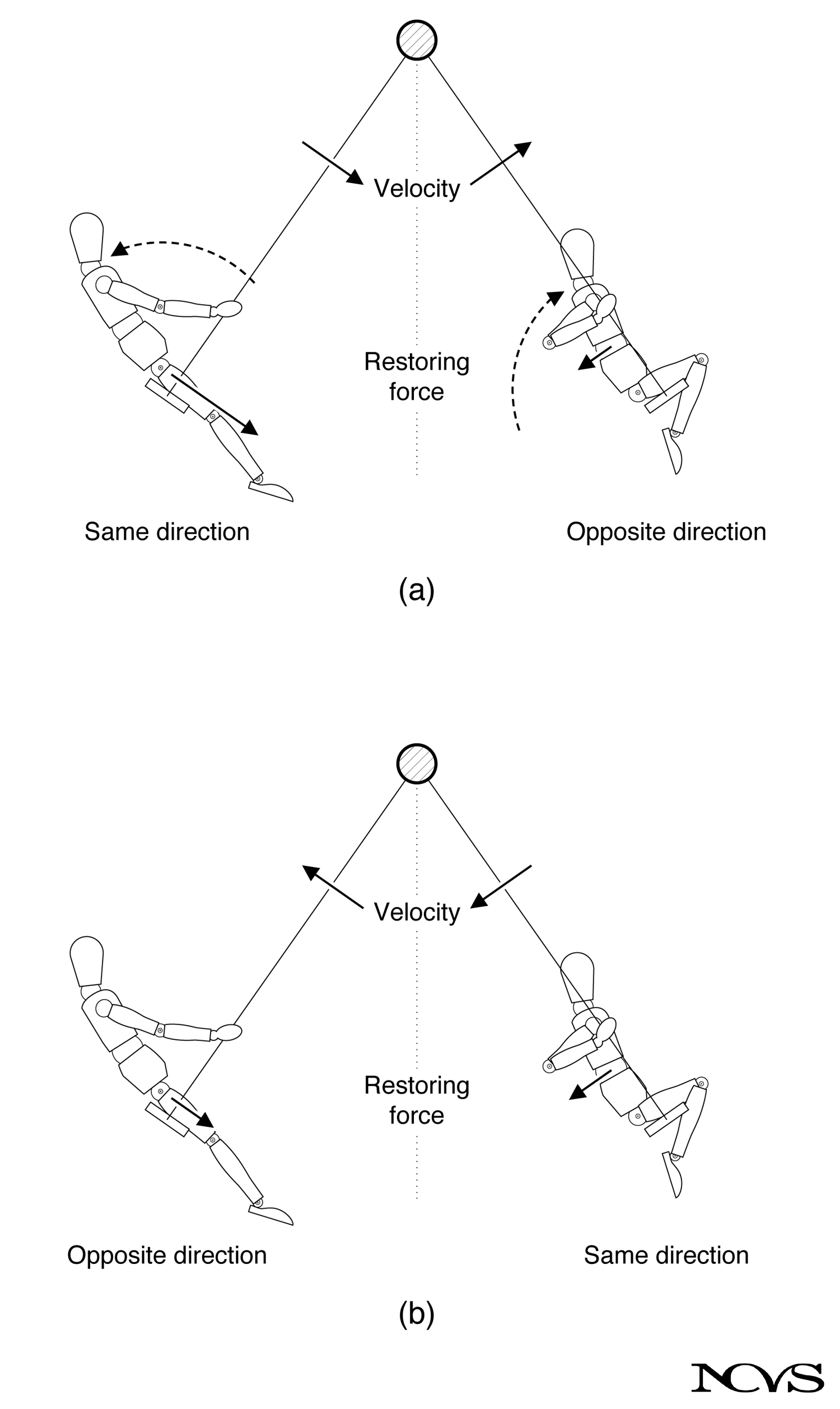 Figure 4.3: A swing functions as a pendulum oscillator. The restoring force comes from gravity acting on the displaced mass, creating a component directed toward equilibrium.
Components of the System
Mass: The combined mass of the seat and person provides inertia. Once set in motion, this mass continues moving due to inertia even after passing through the vertical equilibrium position.
Suspension: The chains or ropes connect the seat to the fixed pivot point overhead. These must be flexible enough to allow free motion but strong enough to support the weight and transmit forces.
Restoring Force: Gravity provides the restoring force. When displaced from vertical, the component of gravitational force tangent to the arc of motion pulls the swing back toward equilibrium.
Equilibrium Position: The vertical position where the swing hangs at rest. At this position, gravitational force acts straight down through the pivot point, creating no torque about the pivot.
How Gravity Creates Restoring Force
When the swing is displaced to angle θ from vertical, gravity creates a restoring torque:
τ = -mgL sin(θ)where:
- m is mass of swing and person
- g is gravitational acceleration (9.8 m/s²)
- L is length from pivot to center of mass
- θ is angle from vertical
- The negative sign indicates torque opposes displacement
For small angles (θ < 15°), sin(θ) ≈ θ, making the restoring force approximately proportional to displacement—the hallmark of simple harmonic motion.
Natural Frequency of the Swing
Like all oscillators, a swing has a natural frequency determined by its physical properties.
Frequency Formula
For small amplitudes, the period (time for one complete oscillation) depends only on length:
T = 2π√(L/g)Converting to frequency:
f = (1/2π)√(g/L)Key Insights:
Length Dependence: Longer swings oscillate more slowly. Doubling length increases period by √2 ≈ 1.41. This is why tall swings in parks move more ponderously than short swings in playgrounds.
Mass Independence: Remarkably, the swing’s natural frequency does not depend on the mass of the person. A child and an adult on the same swing oscillate at the same rate (for small amplitudes). This occurs because heavier mass experiences proportionally greater gravitational force.
Universal Gravity: Since g is constant at a given location, only length matters for frequency. You cannot change the swing’s natural frequency by changing who sits on it.
Typical Values
For a playground swing with L = 2.5 meters:
f = (1/2π)√(9.8/2.5) ≈ 0.31 Hz
T ≈ 3.2 seconds
Each complete back-and-forth cycle takes about 3.2 seconds. The person experiences about 19 complete swings per minute.
Amplitude Effects (Nonlinearity)
The simple formula above assumes small angles. For large amplitudes (typical in actual swinging), the period increases slightly—the swing slows down at larger amplitudes. This nonlinearity makes the swing frequency slightly amplitude-dependent, unlike the idealized linear pendulum.
For large amplitudes, the relationship becomes:
T ≈ 2π√(L/g) × [1 + (θ_max²/16) + ...]This amplitude dependence resembles the nonlinear behavior of vocal folds, where vibratory patterns change with amplitude.
Energy in Swing Oscillation
The swing beautifully illustrates energy transformations fundamental to all oscillators.
Potential and Kinetic Energy
At Maximum Height (extreme positions):
- Maximum gravitational potential energy: PE = mgh
- Zero velocity, zero kinetic energy
- Person momentarily “floats” at the peak before reversing direction
At Lowest Point (equilibrium):
- Minimum potential energy (reference level)
- Maximum velocity, maximum kinetic energy
- Person feels strong centrifugal force pulling outward
In Between:
- Continuous transformation between potential and kinetic energy
- Total energy remains constant (in the absence of damping)
Energy Loss Through Damping
Real swings experience several forms of damping that gradually reduce amplitude:
Air Resistance: Drag force proportional to velocity squared at high speeds. More significant for large amplitudes and lighter masses (children experience more relative drag than adults).
Friction at Pivot: Mechanical friction in the bearing or attachment point dissipates energy as heat. Well-maintained swings minimize this loss.
Chain/Rope Flexing: Internal friction within the suspension material removes small amounts of energy.
Acoustic Radiation: The creaking sound some swings make represents energy converted to sound waves—small but measurable loss.
Without ongoing energy input, these damping mechanisms cause amplitude to decay exponentially until the swing comes to rest.
Pumping the Swing: Self-Sustained Oscillation
The most fascinating aspect of swing behavior is how a person can maintain or increase amplitude through rhythmic body movements—converting the swing into a self-sustained oscillator.
Pumping Technique
To increase amplitude, the person performs coordinated movements timed to the swing’s natural frequency:
At the Back Peak:
- Lean backward, moving center of mass backward and upward
- Extend legs forward
- This raises center of mass, adding potential energy
During Forward Swing:
- Maintain extended position through forward swing
- Energy converts from potential to kinetic
At the Forward Peak:
- Pull legs under body
- Lean forward and crouch
- This lowers center of mass
During Backward Swing:
- Maintain crouched position
- Stand up and lean back just before reaching back peak
- Cycle repeats
Energy Input Mechanism
The pumping action adds energy by changing the effective length of the pendulum at strategic moments:
Lengthening at Peaks: Standing up or leaning back at the peak raises the center of mass against gravity while the swing has little velocity, efficiently adding potential energy.
Shortening at Bottom: Crouching at the bottom reduces the centrifugal force and prepares for the next peak, requiring minimal work against centrifugal force.
The net effect: energy flows into the system, compensating for damping and increasing amplitude. Mathematically, work is done by moving mass against gravitational or centrifugal forces when the timing maximizes energy input.
Resonance and Timing
The critical factor is timing—body movements must synchronize with the swing’s natural frequency. This synchronization is resonance in action.
Correct Timing (at natural frequency):
- Each pump adds energy constructively
- Amplitude grows steadily
- Minimal effort required for large amplitude
Incorrect Timing (off frequency):
- Some pumps add energy, others remove it
- Amplitude remains small or decays
- Effort does not produce desired result
Children learn this timing naturally through trial and error. The swing provides immediate feedback: right timing feels easy and produces big swings; wrong timing feels awkward and ineffective.
External Pushing
Someone can push a swing at its natural frequency from outside:
Optimal Pushing:
- Push at the back peak, just as forward motion begins
- Push frequency matches swing’s natural frequency
- Small, well-timed pushes efficiently increase amplitude
Poor Pushing:
- Pushing at wrong phase (e.g., during forward swing) opposes motion
- Off-frequency pushing creates beating or irregular motion
- Large mistimed pushes may even reduce amplitude
This resembles how aerodynamic forces must be properly timed to sustain vocal fold oscillation. The vocal tract inertance mechanism, discussed elsewhere, acts like properly timed “pushing” that helps maintain oscillation.
Parallels to Vocal Fold Oscillation
The swing analogy illuminates several aspects of voice production.
Natural Frequency
Just as swing frequency depends on physical properties (length), vocal fold frequency depends on length, mass, and tension. Singers and speakers adjust these properties (primarily through laryngeal muscle activation) to change pitch, analogous to changing swing length.
Energy Input Requirements
Just as the person must pump at the right frequency to sustain swinging, subglottal pressure must provide energy input synchronized with vocal fold motion to sustain phonation. The aerodynamic forces act as the “pump” that maintains oscillation against damping.
Resonance Importance
Timing of energy input is critical for both systems. In the swing, pumping at the wrong frequency fails to increase amplitude. In phonation, if aerodynamic forces are improperly timed relative to tissue motion, oscillation may not initiate or sustain efficiently.
Amplitude Control
Larger swing amplitude requires more energy input. Similarly, louder voice (larger vocal fold amplitude) requires greater subglottal pressure. The relationship is nonlinear: doubling amplitude requires approximately quadrupling energy.
Damping Effects
High damping makes swinging difficult—the person must pump harder to maintain amplitude. High vocal fold tissue viscosity (as in dehydration) acts like heavy damping, increasing the phonation threshold pressure needed to maintain oscillation.
Mode of Vibration
A swing primarily oscillates in one plane (back-and-forth), analogous to the dominant 11 mode of vocal fold vibration. However, swings can also twist or move side-to-side (other modes), just as vocal folds can exhibit various vibration patterns beyond the fundamental mode.
Nonlinear Aspects
The swing demonstrates several nonlinear features also present in vocal fold oscillation.
Amplitude-Dependent Frequency
As mentioned earlier, large-amplitude swinging has longer period than small-amplitude swinging. This nonlinearity occurs because the restoring force does not scale linearly with displacement at large angles.
Vocal folds similarly exhibit amplitude-dependent frequency: louder phonation at constant pitch requires subtle adjustments in laryngeal muscle activity to maintain frequency stability.
Asymmetric Motion
The swing motion is symmetric (same behavior forward and backward) only at small amplitudes. At large amplitudes, air resistance and centrifugal effects create asymmetries.
Vocal fold motion is inherently asymmetric: opening and closing phases differ due to asymmetric aerodynamic forces and collision during closure. This asymmetry generates the rich harmonic content of voiced sound.
Threshold for Self-Sustained Oscillation
Below a certain energy input, damping wins and amplitude decays. Above threshold, the person can maintain or increase amplitude. This threshold depends on damping magnitude and pumping effectiveness.
Similarly, phonation threshold pressure represents the minimum subglottal pressure needed to overcome damping and initiate self-sustained vocal fold oscillation. The threshold depends on tissue properties (stiffness, viscosity, mass) and aerodynamic efficiency.
Teaching Oscillation Concepts Through Swinging
The swing serves as an excellent pedagogical tool for several reasons:
Direct Experience: Most people have embodied knowledge of swinging, making abstract concepts concrete.
Immediate Feedback: Correct timing produces obvious results (big swings), while incorrect timing feels awkward.
Adjustable Parameters: Different swing lengths, masses, and pushing techniques demonstrate various oscillation principles.
Observable Energy: The transformation between potential and kinetic energy is physically felt and easily visualized.
Resonance Demonstration: The importance of matching driving frequency to natural frequency becomes intuitively obvious.
When explaining vocal fold oscillation to students or patients, referencing swing experience helps bridge the gap between abstract physics and biological function.
Historical Context
The pendulum’s properties fascinated scientists for centuries. Galileo Galilei (1564-1642) reportedly discovered the period’s independence from amplitude by timing a swinging chandelier in church. Christiaan Huygens (1629-1695) developed the mathematical theory of pendulum motion and invented the pendulum clock, which revolutionized timekeeping.
These early investigations of pendulum mechanics laid groundwork for understanding all oscillatory systems, including biological oscillators discovered centuries later. The vocal fold vibration patterns we now study with high-speed imaging follow the same fundamental principles Galileo observed in that chandelier.
Summary
The playground swing exemplifies fundamental oscillation principles through its pendulum-like behavior. Gravity provides the restoring force when the swing is displaced from vertical, while the combined mass of seat and person provides inertia that carries motion past equilibrium. Natural frequency depends on swing length according to f = (1/2π)√(g/L), independent of mass for small amplitudes but showing slight amplitude dependence for large swings due to nonlinearity.
Energy continuously transforms between gravitational potential energy at the peaks and kinetic energy at the bottom. Damping from air resistance and friction gradually dissipates energy, requiring ongoing input to maintain amplitude. A person can create self-sustained oscillation by pumping—rhythmically shifting body position to add energy at the natural frequency. This resonant energy transfer demonstrates how properly timed small inputs can produce large amplitude responses.
The swing analogy illuminates vocal fold oscillation: both systems require energy input timed to natural frequency, both show amplitude-dependent behavior, and both exhibit a threshold below which sustained oscillation cannot occur. Understanding swing mechanics provides intuitive foundation for comprehending more complex biological oscillators.
Key Takeaways
- ✅ A swing operates as a pendulum oscillator with gravity providing the restoring force toward vertical equilibrium
- ✅ Natural frequency depends on length only: f = (1/2π)√(g/L), independent of mass for small amplitudes
- ✅ Energy continuously transforms between gravitational potential energy (at peaks) and kinetic energy (at bottom)
- ✅ Pumping creates self-sustained oscillation by adding energy timed to the natural frequency (resonance)
- ✅ Optimal pumping requires synchronizing body movements with the swing’s natural frequency
- ✅ Large-amplitude swinging shows nonlinear behavior including amplitude-dependent period
- ✅ The swing analogy helps explain vocal fold oscillation principles including energy input, resonance, and threshold pressure
Related Topics
- Criteria for Oscillation
- Mass-Spring Oscillator
- Types of Oscillation
- Simple Harmonic Motion
- Vocal Tract Inertance
Further Reading
- French, A. P. (1971). Vibrations and Waves. New York: W. W. Norton & Company.
- Fletcher, N. H., & Rossing, T. D. (1998). The Physics of Musical Instruments (2nd ed.). New York: Springer-Verlag.
- Baker, G. L., & Blackburn, J. A. (2005). The Pendulum: A Case Study in Physics. Oxford: Oxford University Press.
- Titze, I. R. (2000). Principles of Voice Production (2nd ed.). Iowa City: National Center for Voice and Speech.
- Goldstein, H., Poole, C., & Safko, J. (2002). Classical Mechanics (3rd ed.). San Francisco: Addison-Wesley.