Perturbations and Fluctuations
The human voice, even during sustained phonation by healthy speakers, is never perfectly periodic. Understanding the nature and sources of these irregularities—whether called perturbations, fluctuations, variations, or modulations—provides essential insight into both normal voice production mechanisms and pathological changes. The terminology used to describe these irregularities, however, requires careful definition to avoid confusion in clinical and research contexts.
Defining the Terms
Perturbations generally refer to small, rapid, cycle-to-cycle variations in the acoustic signal that occur on a time scale comparable to the fundamental period. These irregularities appear as slight differences between successive glottal cycles in parameters such as period duration or amplitude. The term “perturbation” carries a connotation of involuntary, random variation—deviations from an ideal periodic signal that result from inherent biological noise in the voice production system.
In contrast, fluctuations typically describe slower, more regular modulations of voice parameters that occur over multiple cycles. While perturbations represent high-frequency noise relative to the fundamental frequency, fluctuations encompass lower-frequency modulations that may span several glottal cycles or more. The distinction is fundamentally one of time scale: perturbations occur cycle-to-cycle, while fluctuations evolve over longer temporal windows.
The Gray Area Between Terms
The boundary between these categories is not absolute. A 5-Hz tremor, for instance, produces several fundamental frequency cycles within each tremor cycle when phonating at typical speaking frequencies around 100-200 Hz. Should this be called a perturbation or a fluctuation? Conventional usage tends to reserve “perturbation” for the fastest variations (essentially cycle-to-cycle jitter and shimmer) and “fluctuation” for slower modulations including tremor, vibrato, and long-term drift.
This semantic distinction matters less than recognizing the different physical phenomena involved and their measurement requirements. What we choose to call these phenomena is less important than understanding their origins, perceptual consequences, and diagnostic value.
Involuntary versus Controlled Variations
A critical distinction separates involuntary irregularities from intentional modulations. Involuntary perturbations arise from inherent biological noise: neural firing variability, biomechanical asymmetries, aerodynamic turbulence, and other random processes. These perturbations exist in all human voices and increase with vocal pathology, aging, and fatigue.
Controlled fluctuations, in contrast, result from deliberate neuromuscular modulation. Vibrato represents the most familiar example—a trained singer intentionally modulates laryngeal tension, lung pressure, or vocal tract configuration to produce periodic frequency and amplitude variation at rates of approximately 5-7 Hz. Unlike random perturbations, vibrato shows regularity in both rate and extent, with predictable phase relationships between frequency and amplitude modulation.
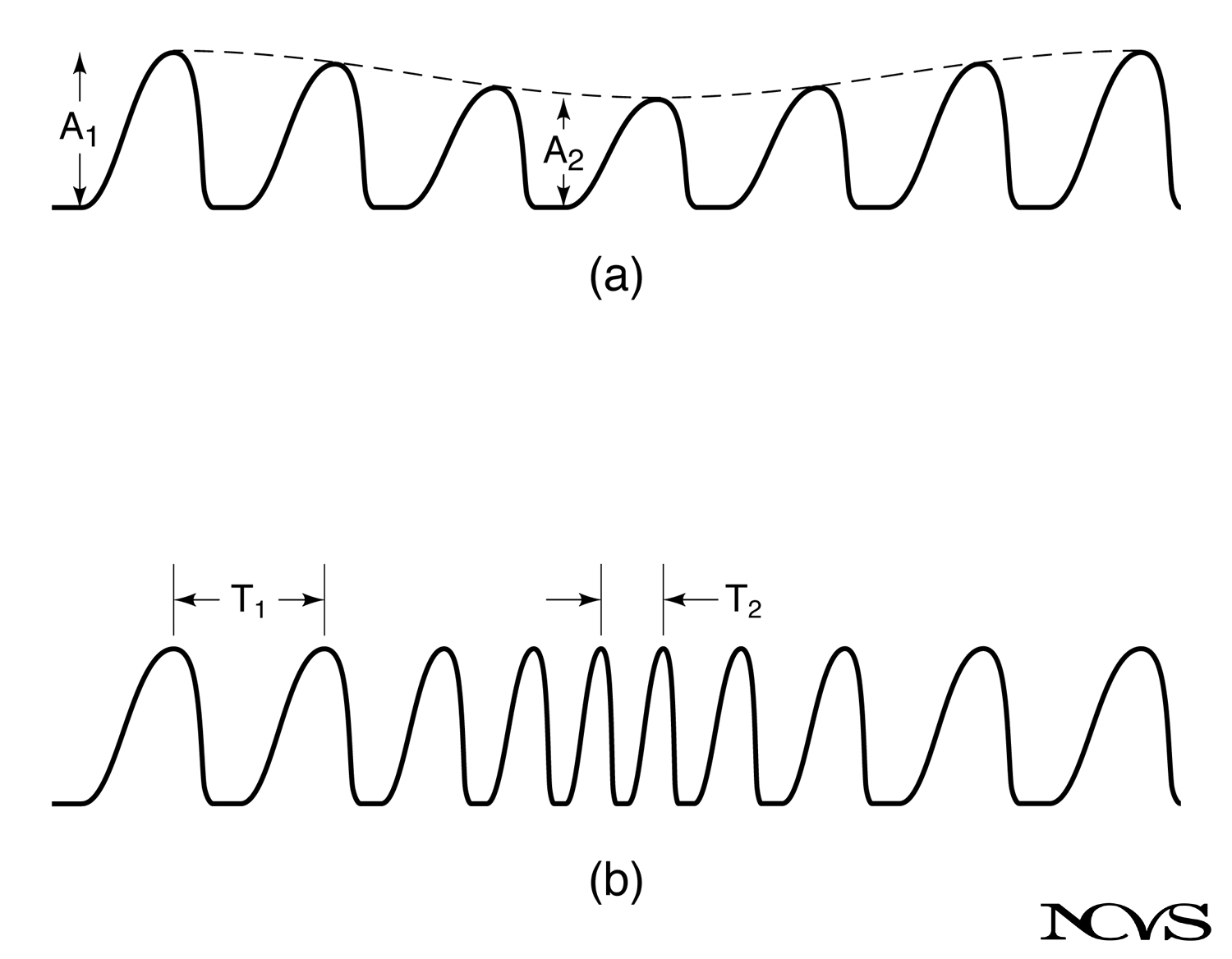 Figure 11.2: Examples of different types of irregularities in voice signals. Type 1 signals show small random perturbations superimposed on nearly periodic oscillation. Type 2 signals exhibit larger modulations or trends. Type 3 signals display more complex aperiodic patterns including subharmonics or chaos.
Pathological versus Artistic Modulations
This controlled-versus-involuntary distinction overlaps with but differs from the pathological-versus-artistic dichotomy. Most perturbations are pathological insofar as they increase with vocal dysfunction and decrease with optimal voice production. However, some degree of perturbation exists even in healthy voices—the question becomes one of magnitude rather than mere presence.
Conversely, while vibrato represents artistic control in Western operatic singing, excessive vibrato rate or extent may signal loss of control due to aging or neurological impairment. The distinction between artistry and pathology sometimes requires subjective aesthetic judgment rather than purely objective measurement.
Temporal Scales and Frequency Content
The temporal scale of irregularities profoundly affects both their perceptual salience and measurement methodology. Consider a speaker phonating at 100 Hz (10 ms fundamental period). Perturbations occurring cycle-to-cycle would have frequency content extending up to the Nyquist frequency of 50 Hz (half the sampling rate in discrete terms, or half the fundamental frequency when considering cycle-to-cycle variations).
In contrast, a 6-Hz tremor produces modulation in the low-frequency region that the ear perceives as distinct from perturbation-induced roughness. The perceptual system processes these different time scales through different mechanisms: fast perturbations contribute to perceived hoarseness or roughness, while slower fluctuations create tremulousness or vibrato quality.
Measurement Window Considerations
Measuring these phenomena requires appropriate analysis windows. Perturbation measures like jitter and shimmer require sufficient cycles to establish statistical reliability (typically 30-100 cycles minimum) while keeping the window short enough that voice parameters remain relatively stationary. Windows of 1-3 seconds often represent reasonable compromises for sustained phonation.
Fluctuation analysis, particularly for phenomena like tremor or long-term average properties, demands longer analysis windows—often 5-10 seconds or more. This creates a fundamental tension: longer windows improve statistical reliability but increase the likelihood of nonstationarity, where voice parameters drift systematically during the analysis period.
Relationship to Voice Quality
The relationship between measurable perturbations and perceived voice quality remains complex and somewhat controversial. Early research assumed a direct monotonic relationship: more perturbation equals worse voice quality. While this holds broadly, exceptions exist at both extremes.
The Low-Perturbation Limit
Near-perfect periodicity, achievable through electronic synthesis or occasionally by exceptional singers during brief intervals, may sound artificial or “dead” rather than ideal. Listeners often prefer voices with small amounts of natural variability, which convey humanness and expression. This suggests an optimal perturbation range rather than a simple “less is better” rule.
The mechanisms underlying this preference remain debated. One hypothesis suggests that small perturbations activate perceptual mechanisms evolved to detect biological signals and extract emotional information from vocal expression. Another view holds that absolute periodicity simply lies outside listeners’ experience and thus sounds unusual.
The High-Perturbation Limit
At the opposite extreme, severe perturbations produce clear voice quality degradation. When cycle-to-cycle period variations exceed roughly 1% (jitter) or amplitude variations exceed about 3% (shimmer), most listeners perceive roughness, hoarseness, or breathiness. These perceptual qualities correlate with clinical diagnoses of dysphonia and vocal pathology.
However, the relationship is not perfectly linear throughout the range. Moderate perturbations (0.5-1.5% jitter) show considerable variability in perceptual correlates depending on phonation type, fundamental frequency, vowel, and individual listener sensitivity. This variability limits the clinical utility of perturbation measures when used in isolation without perceptual assessment.
Types of Parameters Subject to Variation
While much discussion focuses on fundamental frequency and amplitude perturbations, essentially every vocal parameter exhibits both cycle-to-cycle perturbations and longer-term fluctuations:
Temporal Parameters
- Fundamental period (jitter)
- Open quotient (ratio of glottal open time to period)
- Speed quotient (ratio of opening to closing times)
- Glottal closed phase duration
Amplitude Parameters
- Overall amplitude (shimmer)
- Harmonic amplitudes individually
- Spectral tilt (slope of harmonic spectrum)
- Harmonics-to-noise ratio
Spectral Parameters
- Formant frequencies
- Formant bandwidths
- Harmonic frequency alignment with formants
- Spectral energy distribution across frequency bands
Perturbations in these various parameters arise from different physiological sources and contribute differently to perceived voice quality. Period perturbation (jitter) may originate primarily from neural control variability and biomechanical oscillator irregularities, while amplitude perturbation (shimmer) relates more directly to glottal closure patterns and subglottal pressure fluctuations.
Stochastic versus Deterministic Irregularity
A fundamental theoretical question asks whether voice perturbations represent random (stochastic) noise or deterministic chaos—irregular behavior generated by nonlinear dynamics rather than random processes. This distinction matters because it influences both measurement approaches and physiological interpretation.
Stochastic models treat perturbations as additive noise from numerous independent sources: neural firing variability, molecular-level thermal fluctuations, turbulent airflow, and so forth. The central limit theorem suggests that summing many independent random contributions produces Gaussian-distributed variations—a prediction reasonably well-supported for small perturbations in healthy voices.
Deterministic chaos can produce apparently random behavior through entirely deterministic nonlinear interactions. Evidence for chaos in voice signals includes non-integer fractal dimensions, positive Lyapunov exponents, and correlation structures inconsistent with purely stochastic processes. Chaotic dynamics become especially prominent during abnormal phonation including vocal fry, diplophonia, and certain pathological voice types.
Most voice scientists currently view typical perturbations as predominantly stochastic, while acknowledging that deterministic nonlinear dynamics become increasingly important as perturbation magnitudes grow and regular periodic oscillation becomes less stable. The practical implications include recognizing that traditional linear perturbation measures may fail for highly irregular voices requiring nonlinear analysis methods.
Summary
Perturbations and fluctuations describe different aspects of voice irregularity, distinguished primarily by time scale: perturbations represent rapid cycle-to-cycle variations while fluctuations encompass slower modulations over multiple cycles. This distinction correlates imperfectly with other categorizations including involuntary versus controlled, pathological versus artistic, and stochastic versus deterministic irregularities.
Understanding these phenomena requires considering the temporal scale of analysis, the specific parameters being measured, and the relationship between physical measurements and perceptual qualities. While increased perturbations generally indicate reduced voice quality, the relationship is complex, with optimal voice quality potentially requiring small amounts of natural variability rather than perfect periodicity. Both measurement methodology and physiological interpretation must account for the diverse sources and time scales of voice irregularities.
Key Takeaways
- ✅ Perturbations refer to rapid cycle-to-cycle variations, while fluctuations describe slower modulations over multiple cycles
- ✅ Involuntary perturbations arise from biological noise; controlled fluctuations result from intentional neuromuscular modulation
- ✅ Different time scales of irregularity affect perception differently: fast perturbations create roughness, slow fluctuations create tremulousness
- ✅ Optimal voice quality may require small natural variability rather than perfect periodicity
- ✅ Perturbation-quality relationships are complex and non-monotonic, especially at low perturbation levels
- ✅ Multiple vocal parameters exhibit perturbations and fluctuations, each with distinct physiological sources
- ✅ Voice irregularities may be stochastic (random noise) or deterministic (chaotic dynamics), especially in pathological voices
- ✅ Analysis windows must balance statistical reliability against signal stationarity assumptions
Related Topics
Further Reading
- Titze, I. R. (1995). Workshop on acoustic voice analysis: Summary statement. National Center for Voice and Speech.
- Titze, I. R., Horii, Y., & Scherer, R. C. (1987). Some technical considerations in voice perturbation measurements. Journal of Speech and Hearing Research, 30(2), 252-260.
- Herzel, H., Berry, D., Titze, I. R., & Saleh, M. (1994). Analysis of vocal disorders with methods from nonlinear dynamics. Journal of Speech and Hearing Research, 37(5), 1008-1019.
- Kreiman, J., Gerratt, B. R., & Berke, G. S. (1994). The multidimensional nature of pathologic vocal quality. Journal of the Acoustical Society of America, 96(3), 1291-1302.