Cultured (Artistic) Fluctuations
While many vocal perturbations signal pathology or inefficient technique, certain fluctuations represent the pinnacle of artistic vocal expression. Chief among these is vibrato, the periodic modulation of fundamental frequency and amplitude that has become synonymous with accomplished singing in Western classical traditions. Understanding vibrato—its acoustic characteristics, physiological origins, stylistic variations, and pedagogical development—illuminates the boundary between artistry and pathology, between intentional expression and involuntary tremor. This section explores how singers cultivate, control, and employ fluctuations that would constitute problems in other vocal contexts.
Vibrato: Definition and Acoustic Characteristics
Vibrato represents a quasi-periodic modulation of vocal output exhibiting specific acoustic characteristics that distinguish it from tremor and other fluctuations.
Rate of Vibrato
The vibrato rate refers to the number of modulation cycles per second, measured in Hertz (Hz):
Optimal range: 5.5-7.5 Hz, with 6.0-6.5 Hz considered ideal by most vocal pedagogues
Individual variation: Trained singers typically maintain personal vibrato rates within ±0.5 Hz across different pitches and vowels
Developmental trends: Young singers often begin with faster vibratos (7-8 Hz) that slow and stabilize with training
Pathological deviations:
- Too fast (>8 Hz): Often called “tremolo” or “bleat”; perceived as nervous or immature
- Too slow (<5 Hz): Approaches tremor quality; perceived as unsteady or elderly
Research using acoustic analysis of professional opera singers reveals remarkable consistency in vibrato rate both within and across individuals. This suggests that 6-7 Hz represents a perceptually optimal rate for vibrato, possibly relating to temporal integration characteristics of the auditory system or to physiological constraints on laryngeal/respiratory oscillation.
Extent of Vibrato
The vibrato extent (or depth) describes the peak-to-peak variation in fundamental frequency:
Typical range: ±50 to ±100 cents (a cent = 1/100 of a semitone)
- Narrow vibrato: ±25-50 cents
- Medium vibrato: ±50-75 cents
- Wide vibrato: ±75-100 cents
Perceptual thresholds:
- Below ±20-25 cents: Vibrato barely perceptible; may sound straight
- Above ±100-120 cents: Vibrato excessively wide; pitch becomes ambiguous
Context dependence: Vibrato extent varies with:
- Pitch level: Slightly wider at higher pitches (more cents but similar percentage)
- Loudness: Tends to widen with increased intensity
- Emotional expression: Intentionally varied for expressive purposes
- Musical style: Opera allows wider vibrato than art song or chamber music
Waveform Characteristics
The temporal pattern of vibrato modulation exhibits specific waveform properties:
Quasi-sinusoidal shape: Vibrato closely approximates a sine wave in both F0 and amplitude domains
Symmetry: Rise and fall portions of each cycle are approximately equal in duration and shape
Regularity: Successive vibrato cycles maintain consistent rate and extent (low cycle-to-cycle variability)
Phase relationship: F0 and amplitude modulations are approximately in phase, with amplitude peaks coinciding with F0 peaks
These characteristics distinguish vibrato from tremor, which typically shows irregular waveform, asymmetric cycles, and variable rate/extent.
Combined F0 and Amplitude Modulation
Vibrato involves modulation of both fundamental frequency and amplitude:
F0 modulation: Primary perceptual component; typically ±50-100 cents
Amplitude modulation: Secondary but important; typically ±1-3 dB
Ratio: Amplitude modulation extent is generally smaller (in percentage terms) than F0 modulation
Correlation: High correlation between F0 and amplitude cycles suggests common physiological origin
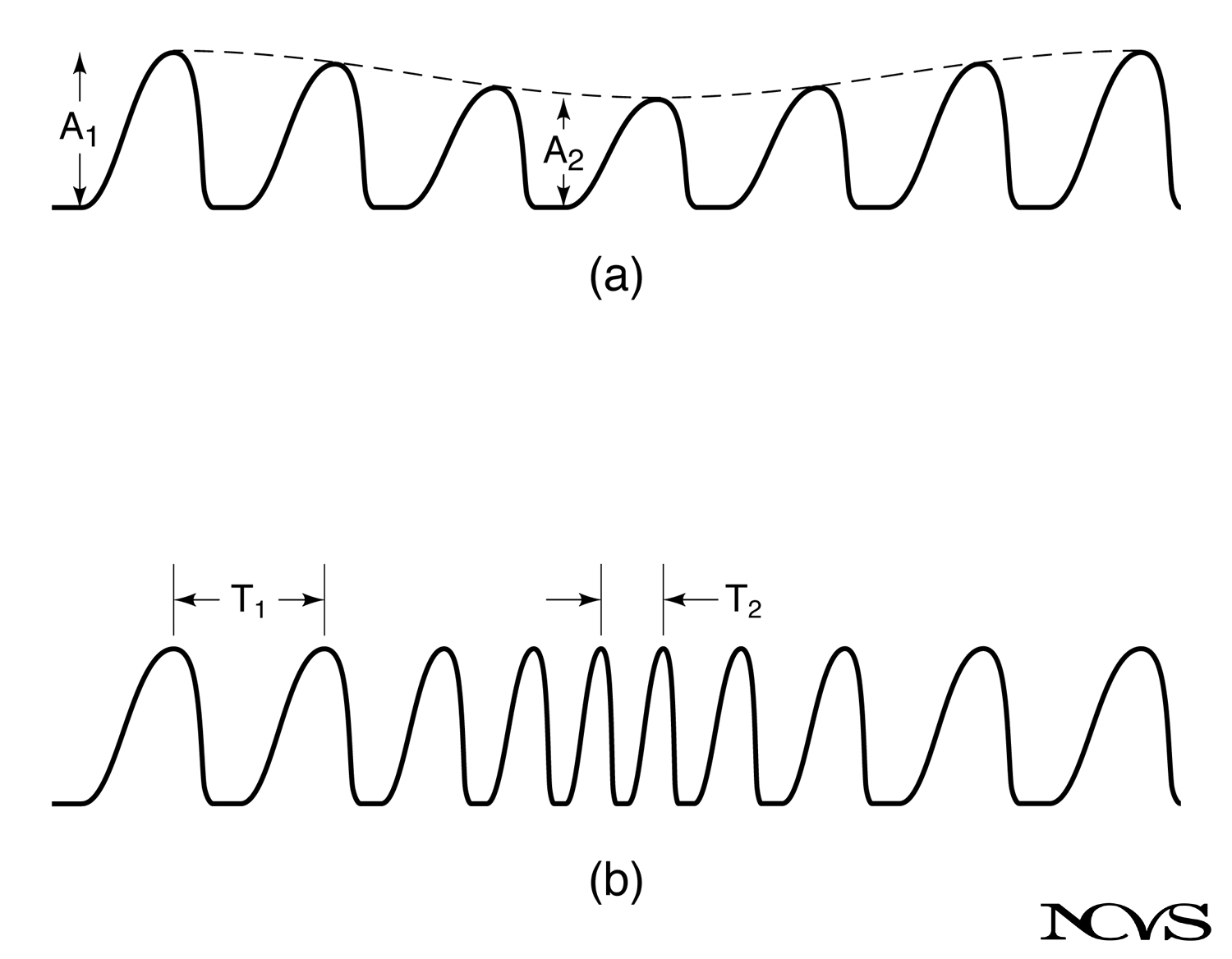 Figure 11.2: Acoustic waveform showing vibrato. Top: F0 contour showing periodic modulation at ~6 Hz. Middle: Amplitude envelope showing correlated amplitude modulation. Bottom: Phase relationship between F0 and amplitude cycles.
The combined modulation creates the characteristic “warmth” and “richness” associated with vibrato. Purely F0 modulation (without amplitude component) sounds artificial; purely amplitude modulation (tremolo) lacks the tonal variety of true vibrato.
Physiological Mechanisms
The physiological origins of vibrato have been debated for over a century. Current evidence suggests multiple mechanisms contribute, with relative contributions varying across individuals.
Laryngeal Mechanisms
The intrinsic laryngeal muscles, particularly the cricothyroid (CT), play a central role in vibrato production:
Cricothyroid Oscillation
Electromyographic (EMG) studies demonstrate rhythmic activity in the cricothyroid muscle at vibrato rate:
Mechanism: Alternating contraction and relaxation of CT muscle creates oscillating vocal fold tension
Rate: CT activity oscillates at 5-7 Hz, matching vibrato rate
Amplitude: Extent of CT activity modulation correlates with vibrato extent
Consistency: CT oscillation pattern is remarkably stable within individuals
The cricothyroid muscle elongates and tenses the vocal folds, primarily affecting fundamental frequency. Rhythmic modulation of CT activity therefore directly produces F0 modulation.
Thyroarytenoid Involvement
The thyroarytenoid (TA) muscle may also participate:
Antagonistic pattern: Some research shows TA activity oscillating out-of-phase with CT
Mechanism: Alternating CT-TA dominance creates oscillating vocal fold configuration
Individual variation: Relative CT vs. TA contribution varies across singers
Other Laryngeal Muscles
The lateral cricoarytenoid (LCA) and interarytenoid muscles show vibrato-rate activity in some singers, potentially contributing to:
- Oscillating glottal resistance
- Varying vocal fold adduction
- Amplitude modulation component
Respiratory Mechanisms
Respiratory muscles contribute to vibrato, particularly the amplitude modulation component:
Subglottal Pressure Modulation
Measurements with subglottal pressure transducers reveal:
Oscillation: Subglottal pressure varies at vibrato rate
Amplitude: Typical variation ±50-200 Pa (0.5-2 cm H₂O)
Correlation: Pressure peaks correlate with F0 peaks and amplitude peaks
Source: Likely reflects oscillating activity in expiratory muscles (internal intercostals, abdominals)
Diaphragmatic Contribution
“Diaphragmatic vibrato” or “belly vibrato” refers to visible abdominal pulsation at vibrato rate:
Mechanism: Rhythmic diaphragm/abdominal muscle activity creates pressure oscillation
Controversy: Some pedagogues advocate training diaphragmatic vibrato; others argue it’s symptomatic rather than causal
Research evidence: Diaphragmatic activity at vibrato rate is documented but its causal role vs. compensatory response remains debated
Laryngeal vs. Diaphragmatic Vibrato Debate
A long-standing controversy in vocal pedagogy concerns the primary source of vibrato:
Laryngeal School
Position: Vibrato originates primarily from oscillating intrinsic laryngeal muscle activity (especially CT)
Evidence:
- EMG shows strong CT oscillation at vibrato rate
- Surgical denervation of CT can eliminate vibrato
- Laryngeal vibrato can occur with relatively steady subglottal pressure
Respiratory School
Position: Vibrato originates primarily from oscillating respiratory activity
Evidence:
- Subglottal pressure oscillates at vibrato rate
- Diaphragm/abdominal activity visible at vibrato rate
- Can produce vibrato-like modulation through pressure variation alone
Integrative View (Current Consensus)
Both mechanisms contribute, with relative contributions varying across:
- Individuals (personal technique and training)
- Pitch levels (different registers may utilize different mechanisms)
- Loudness levels (respiratory contribution may increase at high intensity)
The vibrato likely represents a coordinated neuromuscular pattern involving both laryngeal and respiratory systems, rather than purely one or the other.
Neural Control
Vibrato requires sophisticated neural coordination:
Central pattern generator: A hypothesized neural oscillator (possibly in brainstem) generates the basic vibrato rhythm
Voluntary control: Cortical input allows conscious initiation, modification, and suppression of vibrato
Feedback regulation: Auditory feedback helps maintain consistent rate and extent
Motor learning: Vibrato develops through extensive practice, suggesting cerebellar involvement in motor refinement
The neural control of vibrato represents one of the most sophisticated examples of voluntary rhythmic motor behavior in humans.
Stylistic Variations Across Musical Genres
Vibrato aesthetics vary dramatically across musical styles, cultures, and historical periods.
Western Classical Opera
Characteristics:
- Rate: 6-7 Hz (slightly slower than other styles)
- Extent: ±75-100 cents (widest vibrato)
- Continuity: Nearly continuous vibrato on sustained notes
- Function: Projects over orchestra; adds dramatic intensity
Training emphasis: Developing “free” vibrato that emerges from proper technique rather than manufactured oscillation
Aesthetic value: Wide, regular vibrato signifies vocal maturity and technical mastery
Art Song and Lieder
Characteristics:
- Rate: 6-7 Hz
- Extent: ±50-75 cents (narrower than opera)
- Continuity: More selective use; some straight tone for intimacy
- Function: Textual expression; blends with piano
Stylistic consideration: Over-vibrato can obscure text or sound excessively operatic
Choral Singing
Characteristics:
- Rate: Individual singers maintain personal rates
- Extent: Typically ±40-60 cents (narrower for blend)
- Synchronization: Vibrato rates and phases NOT matched across singers
- Blend: Narrower vibrato facilitates choral blend; excessive vibrato inhibits blend
Pedagogical debate: Some choral traditions emphasize straight tone; others cultivate individual vibrato that blends at ensemble level
Acoustic result: Multiple unsynchronized vibratos create complex amplitude modulation (ensemble vibrato) distinct from individual vibrato
Popular Music and Contemporary Styles
Characteristics:
- Variable use: From continuous vibrato to predominantly straight tone
- Rate: Often faster (7-8 Hz) when used
- Extent: Generally narrower (±30-50 cents)
- Selectivity: Applied to specific notes for expression; not default
Genre variations:
- Broadway/Musical Theater: Moderate vibrato, often delayed (straight onset, vibrato on sustain)
- Pop/Rock: Minimal vibrato; straight tone predominates
- Soul/R&B: Rapid, narrow vibrato as ornament
- Country: Variable; some artists use wide vibrato, others straight tone
- Jazz: Selective use; terminal vibrato common
Non-Western Traditions
Vibrato use varies widely across world music traditions:
Qawwali (South Asian devotional): Rapid, narrow vibrato
Beijing Opera (Chinese): Straight tone predominates; vibrato minimal
Flamenco (Spanish): Straight tone with occasional rapid ornamental vibrato
Bulgarian folk: Straight tone with throat tension; vibrato avoided
These variations demonstrate that vibrato is culturally determined rather than universally “natural” or “correct.”
Historical Changes in Western Classical Music
Vibrato aesthetics have evolved over centuries:
Baroque era (1600-1750): Vibrato used as ornament, not continuous quality
Classical/Romantic era (1750-1900): Gradual shift toward more continuous vibrato
Early 20th century: Wide, continuous vibrato became operatic standard
Historically informed performance (late 20th century onward): Revival of selective vibrato use in baroque/classical repertoire
Historical recordings reveal that vibrato practices among early 20th-century singers differed considerably from modern conventions, with greater variation in extent and more frequent straight tone.
Development and Training
Vibrato development represents a complex pedagogical challenge requiring patience, technique refinement, and individual adaptation.
Natural Emergence vs. Manufactured Vibrato
Pedagogical philosophies differ on how vibrato should be acquired:
Natural Emergence School
Philosophy: Vibrato emerges spontaneously when proper vocal technique is established
Approach:
- Focus on breath support, resonance, and freedom from tension
- Avoid direct vibrato manipulation
- Trust that vibrato will appear when conditions are optimal
Rationale: Manufactured vibrato risks creating artificial, tense, or excessive oscillation
Active Training School
Philosophy: Vibrato can and should be taught through specific exercises
Approach:
- Exercises to develop rhythmic muscle coordination
- Practice varying vibrato rate and extent
- Gradually refine artificially initiated vibrato into natural-feeling pattern
Rationale: Some singers don’t develop vibrato spontaneously; intervention accelerates acquisition
Integrative Approach (Common in Practice)
Most pedagogy combines elements:
- Establish efficient foundational technique (breath, resonance, freedom)
- If vibrato doesn’t emerge naturally, provide guidance
- Refine naturally emerging vibrato through awareness and control
Developmental Timeline
Vibrato acquisition typically follows a progression:
Childhood (pre-adolescence): Little or no vibrato; straight tone predominates
Adolescence: Irregular, fast, or narrow vibrato may begin appearing
Young adult (late teens/early 20s): More regular vibrato develops with training
Maturity (mid-20s onward): Consistent, controlled vibrato characteristic of trained singer
Elderly: May become slower, wider, or more irregular (approaching tremor)
Individual variation is substantial; some singers develop vibrato early, others require years of training.
Pedagogical Exercises
Various exercises aim to develop or refine vibrato:
Messa di Voce
Crescendo-decrescendo on sustained notes:
- Develops coordination of breath pressure and glottal resistance
- Vibrato often emerges during dynamic variation
- Trains control of amplitude component
Pitch Oscillation Exercises
Deliberate alternation between two pitches (e.g., half-step trill):
- Gradually increase speed toward vibrato rate
- Narrow interval until oscillation approaches vibrato extent
- Transition from conscious control to automatic pattern
Tension Release
Exercises targeting specific tension areas:
- Jaw release: Often reduces excessive vibrato rate
- Tongue release: Can facilitate vibrato onset
- Laryngeal positioning: Proper laryngeal height supports stable vibrato
Control and Modification
Advanced singers develop conscious control over vibrato parameters:
Rate control: Ability to slightly accelerate or decelerate vibrato for expression
Extent control: Varying depth from straight tone to wide vibrato
Onset/offset control: Delayed vibrato (straight onset, vibrato on sustain) or terminal vibrato
Suppression: Ability to sing with straight tone when stylistically appropriate
This control requires:
- Kinesthetic awareness of the mechanisms producing vibrato
- Auditory monitoring and feedback
- Years of practice and refinement
Tremolo and Other Variants
Several related phenomena are distinguished from ideal vibrato:
Tremolo
Definition: Amplitude-only modulation without corresponding F0 modulation
Acoustic characteristics:
- Amplitude varies at 5-8 Hz
- F0 remains relatively constant
- Perceived as “wobble” without pitch variation
Origins: May result from respiratory instability or inefficient technique
Distinction from vibrato: Lack of F0 component creates qualitatively different sound
Bleat or Chevroté
Definition: Excessively fast vibrato (>8 Hz)
Characteristics:
- Rate typically 8-10 Hz or faster
- Often narrow extent
- Perceived as nervous, immature, or “goat-like” (chevroté = “goat-like” in French)
Causes: Excessive tension, particularly in external laryngeal muscles
Remediation: Tension reduction, slower rate practice
Wobble
Definition: Excessively slow, wide, or irregular vibrato
Characteristics:
- Rate <5 Hz
- Extent often >100 cents
- May show irregular rate or extent
- Approaches tremor quality
Causes: Lack of proper technique, aging, fatigue, or neurological factors
Remediation: Difficult to correct if well-established; requires fundamental technique reconstruction
Perceptual and Aesthetic Functions
Vibrato serves multiple perceptual and aesthetic functions in singing:
Pitch Perception
Ambiguity reduction: Paradoxically, vibrato can improve pitch accuracy perception by providing a “target zone” rather than precise frequency
Masking: Small pitch inaccuracies are less noticeable with vibrato than with straight tone
Integration: Auditory system integrates over vibrato cycle, perceiving central pitch
Tonal Beauty
Richness: Vibrato adds spectral and temporal richness to sustained tones
Warmth: Associated with emotional warmth and expressivity
Projection: Aids in acoustic projection, making voice more audible over orchestra
Emotional Expression
Dynamic tool: Varying vibrato extent or rate signals emotional changes
Cultural associations: In Western opera, vibrato connotes passion, maturity, seriousness
Absence as expression: Straight tone can signal simplicity, directness, or restraint
Fatigue Masking
Effort reduction: Vibrato may reduce the effort needed to maintain steady tone
Temporal variation: Varying acoustic parameters may reduce listener fatigue compared to absolutely steady tone
Key Takeaways
- ✅ Optimal vibrato exhibits rate of about 5-7 Hz (most often 5.5-6.5 Hz), extent of ±50-100 cents, and quasi-sinusoidal waveform with low cycle-to-cycle variability
- ✅ Vibrato involves combined F0 and amplitude modulation, distinguishing it from purely amplitude-based tremolo
- ✅ Physiological mechanisms include both laryngeal (cricothyroid oscillation) and respiratory (subglottal pressure modulation) components
- ✅ Vibrato aesthetics vary dramatically across musical styles: wide and continuous in opera, narrow and selective in pop/contemporary music
- ✅ Development occurs through either natural emergence from good technique or targeted training exercises, typically stabilizing in young adulthood
- ✅ Pathological variants include tremolo (amplitude-only), bleat (too fast), and wobble (too slow/wide/irregular)
- ✅ Vibrato serves perceptual functions including pitch ambiguity reduction, tonal enrichment, and acoustic projection
- ✅ Advanced singers develop conscious control over vibrato rate, extent, onset, and suppression for expressive purposes
Related Topics
- Some Definitions
- Sources of Fluctuation and Perturbation
- Clinical and Pedagogical Issues
- F0 Control Mechanisms
- Vocal Registers
Further Reading
- Sundberg, J. (1987). The science of the singing voice. DeKalb, IL: Northern Illinois University Press. [Chapter 7: Vibrato]
- Prame, E. (1994). Measurements of the vibrato rate of ten singers. Journal of the Acoustical Society of America, 96(4), 1979-1984.
- Shipp, T., & Izdebski, K. (1981). Current evidence for the existence of laryngeal macrotremor and microtremor. Journal of Forensic Sciences, 26(3), 501-505.
- Titze, I. R., Bergan, C. C., Hunter, E. J., & Story, B. (2003). Source and filter adjustments affecting the perception of the vocal qualities twang and yawn. Logopedics Phoniatrics Vocology, 28(4), 147-155.
- Dejonckere, P. H., Hirano, M., & Sundberg, J. (1995). Vibrato. Singular’s illustrated dictionary of voice and speech disorders. San Diego: Singular Publishing Group.
- Horii, Y. (1989). Frequency modulation characteristics of sustained /a/ sung in vocal vibrato. Journal of Speech and Hearing Research, 32(4), 829-836.