Dependence of Glottal Source Power on Adduction
Vocal fold adduction—the degree of medial compression bringing the vocal folds together at the midline—exerts profound influence on glottal source power and voice intensity. Understanding the mechanisms by which adduction controls acoustic output, the range of adductory configurations, and the interaction between adduction and other control parameters provides essential foundation for clinical voice assessment and pedagogical training strategies.
Mechanisms of Adduction Control
Vocal fold adduction affects glottal source power through multiple interdependent biomechanical and aerodynamic mechanisms.
Medial Compression
Definition and Control
- Medial compression: force pressing vocal folds toward midline
- Generated primarily by lateral cricoarytenoid (LCA) muscles
- Supplemented by interarytenoid muscles
- Opposed by abductory forces (posterior cricoarytenoid)
- Balance determines resting glottal configuration
Effects on Tissue Properties
- Increased compression stiffens vocal fold body
- Raises effective Young’s modulus
- Increases restoring forces during displacement
- Elevates fundamental frequency
- Modifies oscillation amplitude
Range of Compression
- Light adduction: minimal medial compression, breathy voice
- Moderate adduction: balanced compression, modal voice
- Heavy adduction: strong compression, pressed voice
- Extreme adduction: excessive compression, potential for trauma
- Continuous gradient of control
Glottal Flow Resistance
Adduction modulates the resistance to airflow through the glottis:
Resistance Concept
R_g = ΔP / U_gWhere:
- R_g: glottal flow resistance (Pa·s/m³)
- ΔP: transglottal pressure drop (Pa)
- U_g: glottal volume flow rate (m³/s)
Adduction Effects
- Increased adduction raises R_g
- Narrower minimum glottal area during cycle
- Higher resistance to airflow
- Greater pressure drop across glottis
- More negative (subatmospheric) intraglottal pressure
Nonlinear Relationship
- Resistance not constant during cycle
- Varies with instantaneous glottal opening
- Minimum during maximum opening
- Infinite at closure
- Time-varying resistance critical to oscillation
Collision Forces
Strong adduction increases vocal fold collision forces during closure.
Impact Dynamics
- Vocal folds accelerate toward each other during closing
- Collision velocity depends on adduction strength
- Impact force scales with collision velocity squared
- Elastic and viscous components in collision
- Tissue deformation during impact
Acoustic Consequences
- Strong collisions create abrupt flow cessation
- High maximum flow declination rate (MFDR)
- Enhances high-frequency spectral energy
- “Brassy” or “bright” vocal quality
- Increased glottal source power
Clinical Considerations
- Excessive collision forces risk vocal trauma
- Vocal fold lesions (nodules, polyps) associated with hyperadduction
- Balance needed between acoustic output and tissue safety
- Vocal economy strategies minimize collision stress
- Training emphasizes efficient rather than forceful phonation
Open Quotient Modulation
Adduction directly controls the open quotient (Q_o = T_o/T).
Open Quotient Definition
- Fraction of vibratory cycle with open glottis
- Typical range: 0.4 to 0.7 in modal voice
- Below 0.4: pressed voice
- Above 0.7: breathy voice
- Direct indicator of closure completeness
Adduction-Open Quotient Relationship
- Strong adduction decreases Q_o
- Folds close earlier in cycle
- Remain closed longer
- Open less completely
- Shortened open phase
Acoustic Implications
- Lower Q_o enhances even harmonics
- Particularly second harmonic
- Creates richer, more powerful spectrum
- Increases glottal source power
- But may increase vocal effort and strain
Quantitative Relationships
Research has established quantitative relationships between adduction and acoustic output.
Experimental Observations
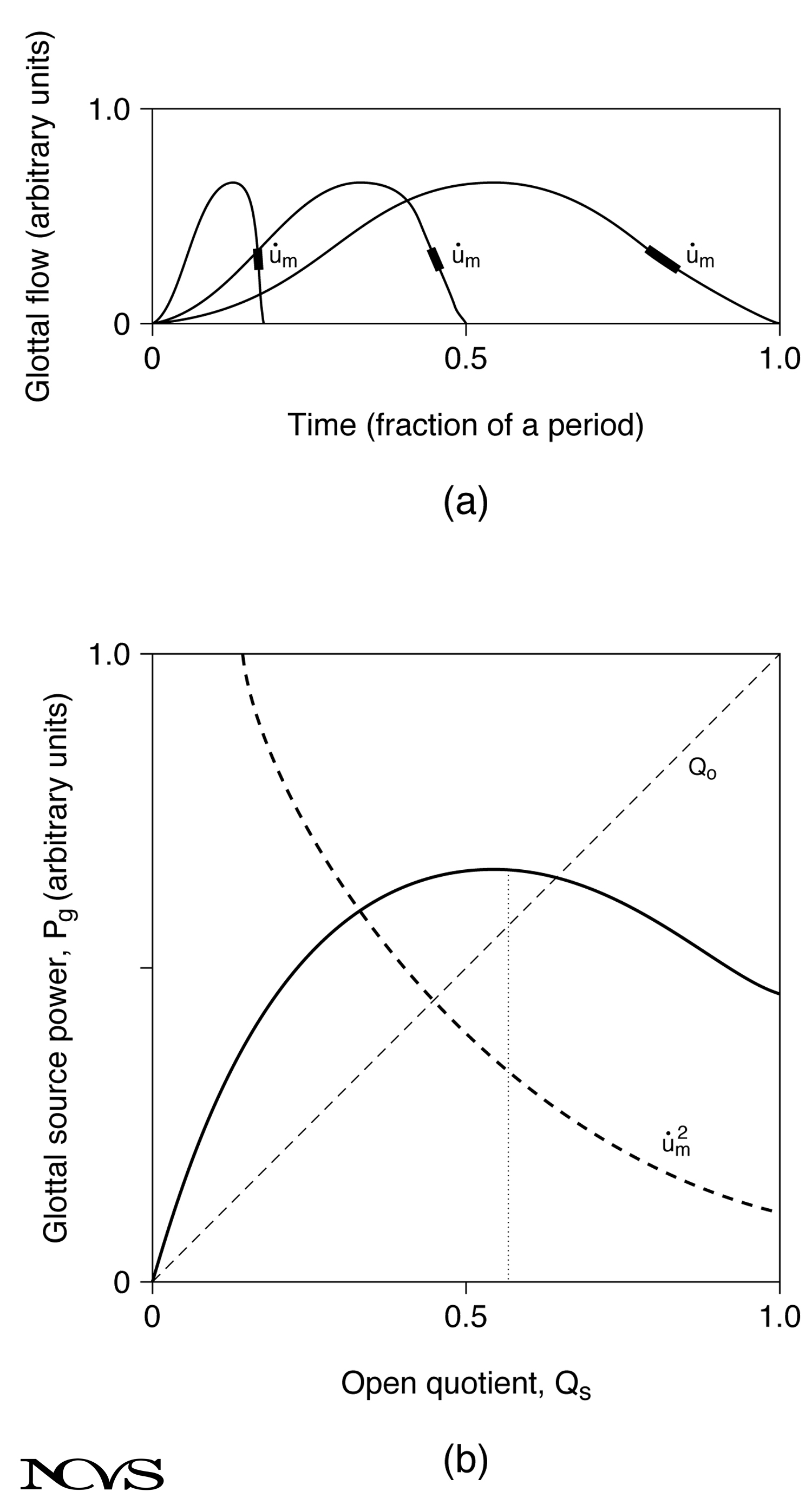 Figure 9.5: Glottal flow waveforms showing progression from breathy (light adduction) through modal to pressed phonation (heavy adduction), with corresponding changes in open quotient, skewing, and amplitude.
Excised Larynx Studies
- Controlled adduction via arytenoid positioning
- Systematic variation of medial compression
- Measurement of flow, pressure, and acoustic output
- Consistent power-adduction relationship observed
- Individual anatomical variation substantial
In Vivo Human Studies
- Surface EMG of laryngeal muscles
- Endoscopic observation of glottal configuration
- Simultaneous acoustic measurement
- Correlation between adduction and intensity
- Complex coordination with other parameters
Power-Adduction Functions
The relationship between adduction level and glottal source power:
General Form
- Glottal power increases monotonically with adduction
- Approximately exponential relationship at low-moderate adduction
- May plateau or decrease at extreme adduction
- Optimal adduction range for efficiency
- Beyond optimal: diminishing returns and increased trauma risk
Typical Magnitude
- Light adduction: 0.5-2 mW glottal source power
- Moderate adduction: 2-10 mW
- Heavy adduction: 10-50 mW
- Very heavy: may exceed 100 mW
- Individual differences substantial (factor of 2-3)
Efficiency Considerations
- Not all adduction levels equally efficient
- Moderate adduction often most efficient
- Heavy adduction increases power but decreases efficiency
- Pressed voice uses excessive power for intensity achieved
- Training seeks optimal adduction for each intensity level
Interaction with Amplitude of Oscillation
Adduction influences the amplitude of vocal fold oscillation during vibration.
Amplitude Determinants
Biomechanical Factors
- Oscillation amplitude: lateral excursion from rest position
- Determined by balance of aerodynamic and tissue forces
- Increased adduction generally increases amplitude
- Up to a point—excessive adduction may limit amplitude
- Complex nonlinear relationship
Energy Storage Mechanism
- During opening: kinetic energy builds
- Maximum at peak opening
- Converted back to potential energy during closing
- Medial compression provides restoring force
- Amplitude reflects energy storage capacity
Amplitude-Power Relationship
Glottal Power Dependence
Approximate relationship:
P_glottal ∝ (amplitude)² × frequencyPhysical Basis
- Power proportional to amplitude squared
- Larger oscillations move more air
- Increased volume velocity amplitude
- Higher acoustic pressure generation
- Quadratic sensitivity to amplitude
Adduction Effect on Amplitude
- Moderate adduction optimizes amplitude
- Too little: insufficient closure, poor coupling
- Too much: restricted motion, reduced amplitude
- Inverted-U shaped relationship
- Individual optimal adduction level
Clinical Patterns
Hypoadduction (Insufficient Closure)
- Reduced oscillation amplitude
- Incomplete glottal closure
- Low glottal source power
- Breathy voice quality
- May compensate with excessive pressure
Hyperadduction (Excessive Closure)
- Initially increases amplitude and power
- Beyond optimal: motion restricted
- Increased collision stress
- Pressed voice quality
- Inefficient power generation
Vocal Registers and Adduction
Adduction patterns differ across vocal registers with distinct power characteristics.
Modal Register
Adduction Characteristics
- Moderate medial compression
- Complete but not excessive closure
- Open quotient 0.4-0.6
- Balanced collision forces
- Efficient power generation
Power Production
- Wide dynamic range possible (30-40 dB)
- Efficient intensity control
- Linear relationship between adduction and intensity
- Sustainable for extended periods
- Typical speech and much singing
Pressed Register
Adduction Characteristics
- Strong medial compression
- Very complete closure
- Open quotient < 0.4
- High collision forces
- Increased tissue stiffness
Power Production
- High glottal source power
- Enhanced high-frequency energy
- Loud voice capability
- But inefficient and potentially traumatic
- Not sustainable for long duration
- Risk factor for voice disorders
Breathy Register
Adduction Characteristics
- Minimal medial compression
- Incomplete closure (persistent glottal gap)
- Open quotient > 0.7
- Low or absent collision forces
- Reduced tissue contact
Power Production
- Low glottal source power
- Reduced high-frequency energy
- Poor intensity capability
- Spectral energy loss through gap
- Increased airflow (higher DC component)
- Inefficient use of respiratory support
Falsetto Register
Adduction Characteristics
- Variable adduction patterns
- Often light to moderate compression
- Thin vocal folds (reduced contact area)
- Open quotient typically 0.5-0.7
- Minimal collision forces
Power Production
- Moderate glottal source power
- Limited dynamic range compared to modal
- Can be efficient at moderate intensities
- High intensities difficult to achieve
- Characteristic of male head voice
Control Strategies and Coordination
Effective voice use requires coordinated control of adduction with other parameters.
Adduction-Pressure Coordination
Independent Control
- Adduction (laryngeal) and pressure (respiratory) relatively independent
- But must be coordinated for optimal results
- Mismatch creates inefficiency
- Training develops coordination
Intensity Production
- Both adduction and pressure increase intensity
- Relative contributions adjustable
- Optimal strategy varies with task
- Speech: more pressure modulation
- Singing: more balanced use of both
Clinical Patterns
- Hyperfunctional: excessive adduction, often with high pressure
- Hypofunctional: insufficient adduction, may use excessive pressure to compensate
- Balanced: appropriate coordination for task demands
Adduction-F0 Coordination
Coupled Effects
- Adduction increases medial compression
- Increased stiffness raises F0
- But also affects intensity
- Must coordinate for independent pitch control
- Training separates adduction and F0 control
Registration Issues
- Register transitions involve adduction changes
- Chest-to-head: reduction in adduction and contact area
- Smooth transitions require skilled coordination
- Abrupt transitions create register breaks
- Professional singers master graduated transitions
Clinical Assessment of Adduction
Evaluating adduction patterns informs diagnosis and treatment.
Endoscopic Assessment
Visualization Techniques
- Rigid endoscopy: excellent image quality
- Flexible endoscopy: functional assessment during speech
- Stroboscopy: mucosal wave and closure patterns
- High-speed video: detailed vibratory analysis
- Ratings of closure completeness
Adduction Patterns
- Complete closure: full medial contact
- Posterior glottal chink: gap at cartilaginous portion
- Anterior gap: incomplete closure anteriorly (rare)
- Spindle-shaped gap: bowing of folds
- Hourglass: hypoadduction with mid-portion closure
Acoustic Correlates
Open Quotient Estimation
- Electroglottography (EGG) indicates contact
- Inverse filtering reveals flow waveform
- Open quotient calculated from waveform
- Correlates with perceptual breathiness
- Objective measure of closure adequacy
Spectral Measures
- Harmonic-to-noise ratio (HNR): reduced with incomplete closure
- Spectral slope: steeper with stronger adduction
- Second harmonic strength: enhanced by low open quotient
- Cepstral peak prominence: reduced in breathy voice
- Quantifies adduction effects acoustically
Aerodynamic Measures
Glottal Resistance Estimation
- Ratio of pressure to flow
- Increased resistance with strong adduction
- Phonation threshold pressure varies with adduction
- Flow-resistant exercises modify adduction patterns
- Objective efficiency indicator
Therapeutic Modulation of Adduction
Voice therapy often targets adduction patterns.
For Hypoadduction (Glottal Insufficiency)
Treatment Goals
- Increase medial compression
- Improve glottal closure
- Enhance adductory muscle strength
- Coordinate respiratory-laryngeal function
- Increase vocal intensity capability
Techniques
- Vocal function exercises
- Pushing/pulling techniques (controversial)
- Pitch glides in firm onset
- Flow-resistant exercises (straws, tubes)
- Semi-occluded vocal tract exercises
Monitoring Progress
- Improved open quotient measures
- Increased maximum intensity
- Enhanced harmonic structure
- Reduced breathiness ratings
- Better endurance
For Hyperadduction (Pressed Voice)
Treatment Goals
- Reduce excessive medial compression
- Achieve efficient closure without forcing
- Decrease collision stress
- Improve vocal efficiency
- Reduce trauma risk
Techniques
- Breathy-to-clear onset glides
- Flow phonation exercises
- Resonant voice therapy
- Semi-occluded vocal tract exercises
- Relaxation and tension-reduction strategies
Monitoring Progress
- Normalized open quotient
- Reduced maximum flow declination rate
- Improved efficiency measures
- Reduced strain ratings
- Better vocal endurance
Summary
Vocal fold adduction profoundly influences glottal source power through modulation of medial compression, glottal flow resistance, collision forces, and open quotient. Increased adduction generally increases glottal source power by enhancing oscillation amplitude, reducing open quotient (particularly enhancing second harmonic energy), and creating stronger vocal fold collisions that generate high-frequency spectral energy. The relationship between adduction and power is approximately exponential at moderate levels but plateaus or decreases at extreme adduction due to restricted motion and inefficiency.
Optimal adduction varies with vocal register, with modal voice using moderate adduction (Q_o = 0.4-0.6), pressed voice using heavy adduction (Q_o < 0.4), and breathy voice using light adduction (Q_o > 0.7). Effective voice use requires coordinated control of adduction with subglottal pressure and fundamental frequency, with imbalances creating hyperfunctional or hypofunctional patterns. Clinical assessment employs endoscopic visualization, acoustic analysis (open quotient, spectral measures), and aerodynamic measures (glottal resistance) to characterize adduction patterns.
Voice therapy targets inappropriate adduction through exercises that increase medial compression for hypoadduction or reduce excessive compression for hyperadduction, monitored objectively through improvements in open quotient, intensity capability, spectral measures, and vocal efficiency. Understanding adduction effects enables more precise diagnosis of voice disorders, more targeted therapeutic interventions, and more effective pedagogical strategies for developing optimal voice production across the intensity and pitch range.
Key Takeaways
- ✅ Adduction increases glottal source power through higher medial compression, increased oscillation amplitude, and enhanced collision forces
- ✅ Open quotient decreases with stronger adduction: Q_o > 0.7 (breathy), 0.4-0.6 (modal), < 0.4 (pressed)
- ✅ Relationship between adduction and power is approximately exponential, plateauing at extreme adduction levels
- ✅ Optimal adduction balances acoustic output with tissue safety and vocal efficiency
- ✅ Registers differ in adduction patterns: modal (moderate), pressed (heavy), breathy (light), falsetto (variable)
- ✅ Effective voice requires coordination of adduction with subglottal pressure and F0 control
- ✅ Clinical assessment uses endoscopy, acoustic measures (open quotient, HNR), and aerodynamics (glottal resistance)
- ✅ Therapy targets hypoadduction (increase compression) or hyperadduction (reduce excessive compression) through specific exercises
Related Topics
- Glottal Source Power and Inverse Filtering
- Phonation Threshold Pressure
- The Glottal Source Function
- Glottal Efficiency
- The Hazards of Pressed Voice
Further Reading
- Titze, I. R. (1988). The physics of small-amplitude oscillation of the vocal folds. Journal of the Acoustical Society of America, 83, 1536-1552.
- Holmberg, E., Hillman, R., & Perkell, J. (1988). Glottal airflow and transglottal air pressure measurements for male and female speakers in soft, normal and loud voice. Journal of the Acoustical Society of America, 84, 511-529.
- Verdolini, K., Druker, D. G., Palmer, P. M., & Samawi, H. (1998). Laryngeal adduction in resonant voice. Journal of Voice, 12(3), 315-327.
- Sundberg, J., Andersson, M., & Hultqvist, C. (1999). Effects of subglottal pressure variation on professional baritone singers’ voice sources. Journal of the Acoustical Society of America, 105, 1965-1971.
- Hillman, R. E., Holmberg, E. B., Perkell, J. S., Walsh, M., & Vaughan, C. (1989). Objective assessment of vocal hyperfunction: An experimental framework and initial results. Journal of Speech and Hearing Research, 32, 373-392.